Address
Nanlang Industrial Zone, Xingtan Town, Shunde District, Foshan, Guangdong, China
Work Hours
Mon–Fri, 9:00 AM – 6:00 PM (CST/UTC+8). We aim to respond to all inquiries within 48 hours.

Address
Nanlang Industrial Zone, Xingtan Town, Shunde District, Foshan, Guangdong, China
Work Hours
Mon–Fri, 9:00 AM – 6:00 PM (CST/UTC+8). We aim to respond to all inquiries within 48 hours.
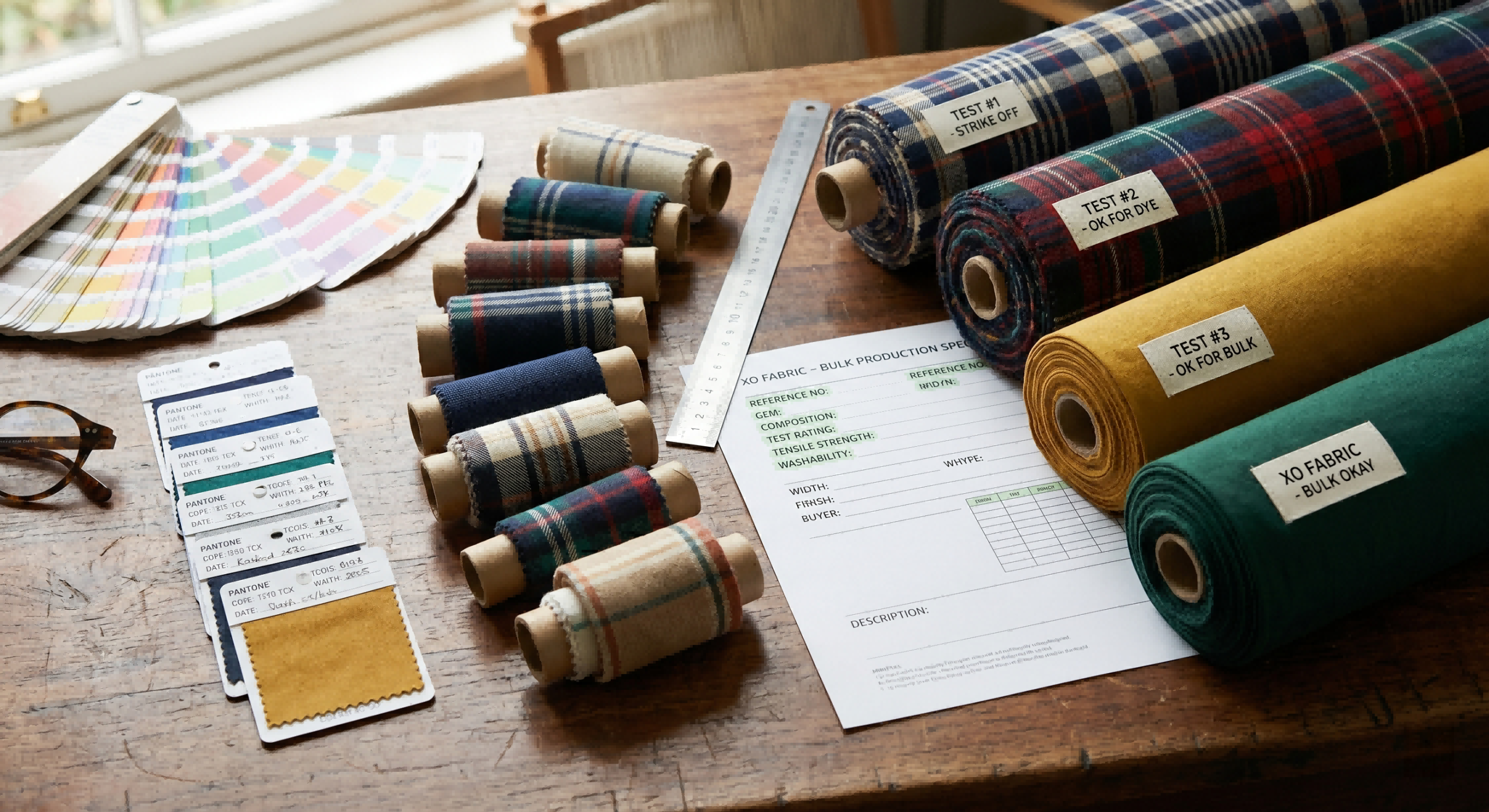
A single week of miscommunication during fabric development can cascade into a three-month delay on your entire product launch. Yet most buyers drastically underestimate how long the sample-to-bulk journey actually takes.
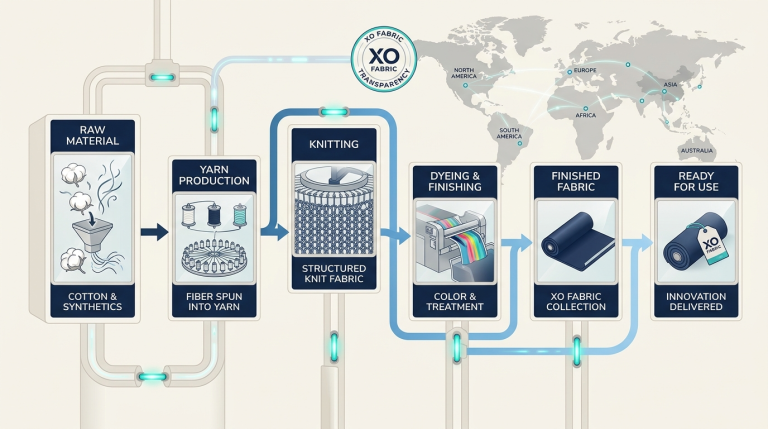
The fabric development process involves multiple interdependent stages. You move through specification, color matching, sampling, testing, approval, and production. Each phase carries its own timeline, dependencies, and potential failure points.
Whether you are launching a technical sportswear line or sourcing upholstery textiles, understanding the development timeline lets you plan realistic launch dates. It also helps you manage your supply chain budget and avoid costly rush orders that compromise quality.
This guide walks you through every stage of the fabric development process. We cover realistic timelines for each phase, common pitfalls to avoid, and practical tips from XO Fabric’s two decades of experience helping brands go from concept to container.
Standard custom fabric development runs between forty-five and ninety days. This window covers everything from initial spec confirmation to final bulk delivery. Complex developments involving new constructions or specialty chemical finishes stretch to ninety or one hundred twenty days.
Here is the phase breakdown at a glance:
Some stages run in parallel. Color matching often overlaps with base fabric weaving. Understanding these overlaps saves weeks. I always tell my designers to map out parallel paths before signing off on a timeline. It changes how you allocate resources and breathe easier during the wait.
This is the foundation everything else builds on. You define fabric construction, fiber composition, weight, width, finish requirements, color targets, performance standards, and order quantities.
The buyer provides a tech pack or reference sample. You also supply a target price per meter, color standards like Pantone or a physical swatch, performance requirements such as shrinkage or pilling ratings, and a hard delivery deadline.
The manufacturer then evaluates feasibility. They check raw material availability and propose a realistic timeline. We typically respond with a full quotation within forty-eight hours of receiving complete specs.
Common delays happen here. Incomplete specs, missing color standards, ambiguous performance requirements, and price negotiations stall momentum instantly. Vague parameters force the mill to guess, and guessing burns days.
Use a standardized fabric spec sheet. Understanding fabric weight (GSM) correctly in your tech pack eliminates back-and-forth. Also, specify Fabric certifications guide requirements upfront. It sets clear expectations from day one.
I once lost three weeks on a jacket order because the shrinkage tolerance was not written down. We assumed standard industry norms. The client wanted sub-two percent. Always write it down.
The mill creates small A4-size swatches in three shade variations around your target color. They use the selected dyeing method to achieve the hue. The first submission usually arrives in five to seven days.
You compare these lab dips to your color standard under D65 standard daylight. If you have access, measure with a spectrophotometer. We use Datacolor systems and provide objective delta-E readings to remove guesswork.
Budget for one or two correction rounds. Each takes three to five days. Rejections usually happen because the shade is too light, the hue direction is off, or metamerism shifts the color under different lighting.
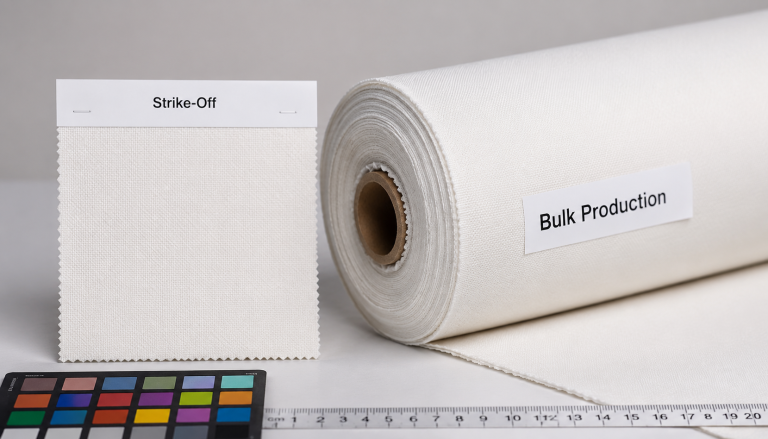
Once approved, this becomes your production color standard. Seal a reference sample immediately. You will compare bulk production against it later.
Never approve lab dips on screen photos only. Color matching in textile production relies on physical light interaction, not pixels. I still cringe when I see clients send over smartphone snapshots with the flash on. It warms up cool tones and kills accuracy. Always request physical swatches.
A strike-off is a sample length, typically one to five meters, produced using the approved lab dip color and target construction. This is your first real look at the actual fabric, not just a tiny swatch.
You evaluate hand feel, drape, visual appearance, color accuracy, width, weight verification, stretch recovery, and surface texture. Physical testing follows immediately.
Send the strike-off to a third-party lab for independent testing. Check pilling via Martindale or Pill Box. Measure shrinkage after wash. Test tensile strength and run color fastness checks.
Approve, reject with comments, or approve with conditions. Rejection means a new strike-off takes seven to ten days. Approval moves you to the PP sample stage. Most mills charge fifty to one hundred fifty dollars for strike-offs. We include strike-off development in the project cost for orders above a thousand kilograms.
How to request fabric samples efficiently saves time. When you get the results, Reading fabric lab reports becomes essential.
Let me share a messy decision moment. We were developing a lightweight cotton blend for a resort wear brand. The strike-off felt perfect, but the lab report showed three percent shrinkage after wash. The brand insisted on sub-two percent.
We could have added a heavy heat-setting finish. That would stiffen the hand and add seven days. We compromised. We adjusted the weave tension slightly, ran a gentle preshrink treatment, and accepted a final shrinkage of 1.8 percent. It took an extra strike-off, but the hand remained soft. Sometimes you trade perfect specs for wearable comfort.
If pilling or seam slippage appears, check the needle size first. Use a 90/14 needle for medium knits. Press seams with steam at 140 degrees Celsius to relax fibers before final inspection.
The PP sample is the final confirmation produced under actual bulk conditions. Same machine, same operators, same dye batch. This is your golden sample.
Strike-off confirms design intent. PP sample confirms production capability. You might see minor variations between the two that need assessment. If ordering large quantities, request PP samples from multiple production batches to verify shade continuity across runs.
Formal written approval via email confirms the PP sample meets requirements. This becomes the quality benchmark for bulk inspection. If the PP fails, the mill identifies the root cause, adjusts the process, and produces a new sample in five to seven days.
Common failures include weight off-spec, color deviation from the approved lab dip, or incorrect finish. Weigh a one-square-meter cut on a digital scale to verify GSM accuracy before approving.
XO Fabric quality control process relies on this gate. Always verify Fabric shrinkage explained metrics on the PP sample before green-lighting the full run. It is the last safe harbor before the machinery rolls out.
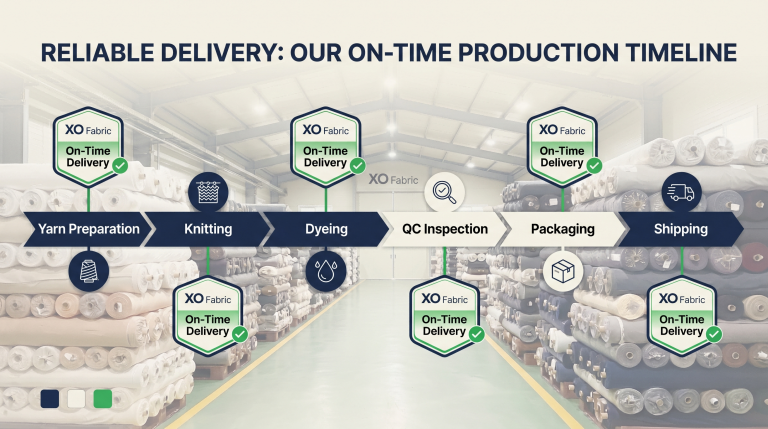
Bulk production kicks off after written PP sample approval. The mill schedules production on confirmed machines and prepares raw materials. In-line quality control happens continuously.
Inspectors check color, weight, width, and surface quality at regular intervals. We perform in-line inspection every five hundred to one thousand meters. Large orders span multiple dye lots.
Each lot is tested for shade consistency against the approved standard. Delta-E tolerance is typically under 1.0 within a lot and under 1.5 between lots. After dyeing, fabric moves through finishing.
Setting, calendering, brushing, or functional treatments each add two to five days. We provide weekly production status updates with photos from the floor. Transparency catches issues early.
A mid-size mill produces three thousand to eight thousand meters per day of standard knits. Specialty fabrics like velvet run slower, at five hundred to two thousand meters daily.
Inside XO Fabric production tour shows how we monitor this pace. Cross-reference your expectations with a Quality control checklist for shipments to stay aligned.
Micro-note: I once watched a whole batch sit for three days because the calendering rollers had not reached optimal temperature. Rushing heat settings destroys hand feel. Patience pays off.
Final inspection uses the four-point system per AATCC or client standards. Typical AQL levels sit at 2.5 for critical defects and 4.0 for major defects. We conduct internal AQL inspection before offering third-party options.
Random bulk samples undergo lab testing for color fastness, shrinkage, weight, and performance claims. Results compile into a final test report. Fabric rolls onto tubes, packs into poly bags, and loads into cartons.
Labeling includes content, width, weight, color code, and lot number. Shipping documentation covers commercial invoices, packing lists, certificates of origin, and required test reports.
Sea freight from Foshan to the US West Coast takes twenty-five to thirty-five days. Air freight takes three to five days at a premium.
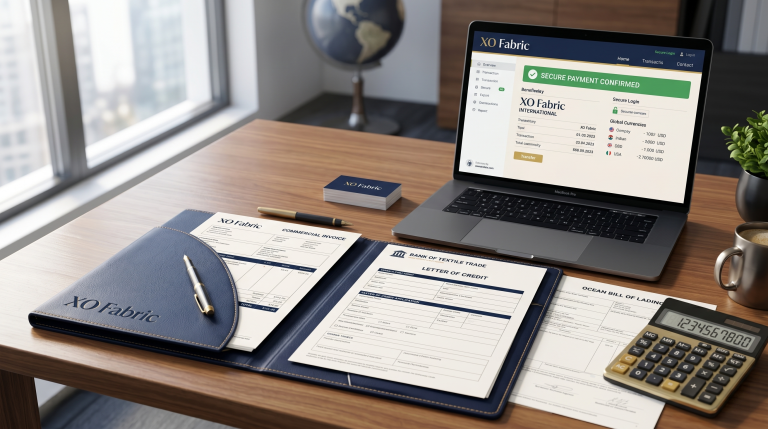
Calculate your total landed cost with Shipping fabric import costs in mind. Review Payment terms explained to ensure cash flow aligns with delivery dates. Never skip the label check. Wrong lot numbers cause warehouse nightmares.
Timelines shift based on complexity. Here are three realistic scenarios mapped out:
| Scenario | Stages & Days | Total |
| Simple solid knit | Spec (3) + Lab dip (8) + Strike-off (10) + PP (7) + Bulk (15) + QC (5) | 48 days |
| Custom yarn-dyed woven | Spec (5) + Lab dip (15) + Strike-off (15) + PP (7) + Bulk (20) + QC (7) | 69 days |
| Digital print polyester | Spec (3) + Test print (3) + Approval (2) + Bulk (5) + QC (3) | 16 days |
Simple piece-dyed solids on stocked greige compress to thirty-five to forty-five days. Complex multi-color yarn-dyed wovens require seventy to ninety days. Plan accordingly.
Silence breeds delays. Structure your communication around these checkpoints:
Stick to these milestones religiously. I have seen projects stall simply because the buyer waited a full week to reply to an email. Speed matters.
Start with clear specs. Vague requirements cause sixty to seventy percent of development delays. Approve decisions quickly. Lab dips sitting on a desk for a week cost you a week. Set internal deadlines.
Forty-eight hours for lab dip review, seventy-two hours for strike-off evaluation. Leverage stocked greige. Our warehouse keeps popular greige fabrics ready. Starting from inventory eliminates weaving time and compresses the timeline by ten to fifteen days.
Run stages in parallel. Start lab dip development while confirming final specs. Begin test sampling while evaluating visual aspects. Good mills will proactively suggest parallel processing. Consolidate testing.
Send all tests to one lab in a single batch. Faster turnaround than piecemeal requests. Explore Managing lead time delays for deeper strategies.
Lab dip rejection loops happen constantly. Poor color standards, metamerism missed during review, or changing target colors mid-process trigger them. Prevention requires providing a Pantone TPX or TCX physical swatch, specifying the light source, and locking your color decision early.
Test failures on strike-offs usually involve shrinkage exceeding spec, low pilling ratings, or insufficient color fastness. Specify realistic performance standards based on your fabric type. Do not demand wool-suiting pilling ratings on a 150 GSM cotton knit.
Raw material shortages add fifteen to thirty days. Polyester staple or specialty yarns often have lead times from yarn suppliers. Confirm availability at the spec confirmation stage. We monitor raw material markets and alert clients proactively.
Holiday impacts matter. Chinese New Year, National Day, and regional holidays add one to three weeks. Plan around them. Avoid placing orders in the two weeks before a holiday period.
Communication gaps cause misinterpretations. Time zone differences and language barriers compound technical confusion. Use written communication to document all decisions. Confirm understanding in writing after calls. Read Negotiating with Chinese textile suppliers to build smoother relationships.
Minimum order quantities shift at each phase. Lab dip stage carries no MOQ. Mills typically develop them free for confirmed orders. We charge a nominal fee of fifty to one hundred dollars per color, refundable against bulk orders.
Strike-off stage requires one to five meters. A small fee applies, usually thirty to eighty dollars per meter depending on complexity. PP sample stage needs ten to fifty meters. This often gets included in bulk pricing for orders above five hundred kilograms.
Bulk production MOQs vary widely. Piece dye runs two hundred to three hundred kilograms per color. Yarn dye requires five hundred to one thousand kilograms. Digital print drops to fifty to one hundred meters.
Order popular base fabrics to gain flexibility. Combine multiple colors into a single production run. Build long-term relationships for progressively lower minimums. Check Understanding MOQ strategies for negotiation tactics.
Inventory changes everything. Our two-thousand-square-meter warehouse stocks over two hundred greige fabric varieties and fifty popular colorways. Ready-stock advantages are massive.
Piece dye from stocked greige takes ten to fifteen days total. Finished stock colors deliver in three to five days. This is ideal for replenishment orders and urgent fills.
We monitor stock levels monthly and replenish based on historical demand. Clients can request stock reservation for upcoming seasons. Explore The XO Fabric advantage for logistics details.
A typical custom fabric development takes forty-five to ninety days. Build your launch calendar around this reality. Clear specs and fast decision-making remain your two biggest controllable speed factors.
Leverage stocked greige and pre-approved colorways for replenishment speed. Establish weekly communication milestones and stick to them. Start your fabric development with XO Fabric by submitting your tech pack or requesting a sample pack.