Address
Nanlang Industrial Zone, Xingtan Town, Shunde District, Foshan, Guangdong, China
Work Hours
Mon–Fri, 9:00 AM – 6:00 PM (CST/UTC+8). We aim to respond to all inquiries within 48 hours.

Address
Nanlang Industrial Zone, Xingtan Town, Shunde District, Foshan, Guangdong, China
Work Hours
Mon–Fri, 9:00 AM – 6:00 PM (CST/UTC+8). We aim to respond to all inquiries within 48 hours.
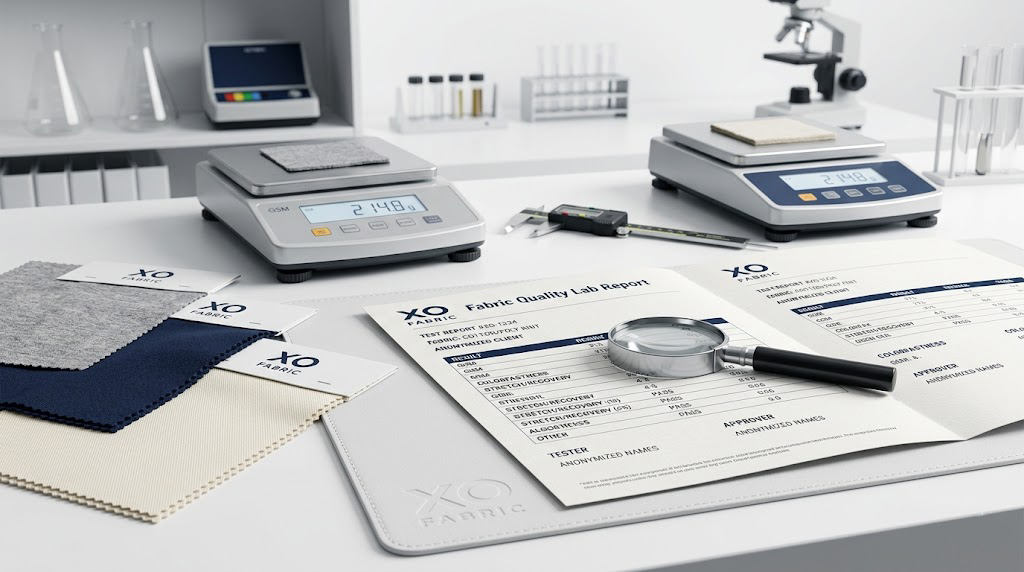
You just received a fabric lab report. The numbers look important, but what do they actually mean for your production run?
If you’ve ever stared at a page of abbreviations and test values wondering whether that 4.2 pH rating is safe for babywear, you’re not alone. This guide breaks down every section in plain English, with real examples from the sourcing floor.
A fabric lab report is an official document from an accredited testing laboratory. It details quantitative and qualitative results for fabric performance, safety, and regulatory compliance.
Think of it as a fabric’s medical chart. It doesn’t just say “this is good.” It shows exactly how the material behaves under stress, after washing, or when exposed to chemicals.
Reports typically come from two sources:
Why does this matter? You’ll use these reports to verify supplier claims, meet regional regulations like REACH or CPSIA, and resolve quality disputes before bulk production starts.
One thing I’ve learned the hard way: a report from an ISO 17025 accredited lab saves weeks of back-and-forth when a compliance question arises. Always ask for that accreditation number upfront.
Most lab reports follow a similar structure. Knowing what to look for in each section helps you spot red flags fast.
Header: This includes the supplier name, lab accreditation details, unique report ID, issue date, and contact information. If the report ID is missing or the date is older than 12 months, request an updated version.
Fabric Description: Lists fiber composition, construction (knit or woven), weight in GSM, width, dyeing method, and batch number. This is where you confirm the material matches your purchase order.
Test Methodology: Details which standards were used (ASTM, ISO, AATCC) and the type of testing equipment. Different methods can yield different results, so consistency matters.
Test Results Table: The core of the report. You’ll see numeric values for each test, pass/fail status against required standards, and margin of error. Look for the “Result” column first, then check the “Requirement” column to see if it meets your target.
Sign-off: Lab accreditation seal, authorized signature, and statement of compliance. No signature? The report isn’t valid for compliance purposes.
Here’s a quick checklist I keep handy:
I once accepted a report where the GSM was listed as “approx. 220.” The actual bulk fabric came in at 195 GSM. That 25-gram difference changed the drape completely. Always insist on exact values, not estimates.
Test results fall into three main categories. Let’s break down what the numbers actually mean for your product.
These measure how the fabric holds up under stress.
| Test | Typical Unit | What to Watch For |
| Tensile Strength | Newtons (N) | Lower than 300N for heavy-duty use may indicate weak yarns |
| Tear Strength | Newtons (N) | Values below 20N often lead to seam failures in activewear |
| Pilling Resistance | 1-5 rating | Anything below 3.5 will show visible pills after 10 washes |
| Shrinkage | Percentage (%) | >5% shrinkage requires pre-washing or pattern adjustments |
| Abrasion Resistance | Martindale cycles | <15,000 cycles may not survive daily wear for upholstery |
Real example: A client sourced a 280 GSM fleece for hoodies. The lab report showed 4.2/5 pilling resistance. Great on paper. But after three wash cycles in our lab, pills formed at the underarm seams. Why? The test used a flat sample, not a sewn seam. Always request seam-specific testing for high-friction areas.
These ensure the fabric is safe for skin contact and meets regulatory limits.
pH level should sit between 4.5-7.5 for direct skin contact. I’ve seen reports with pH 8.2 cause skin irritation in sensitive users. If the value is outside range, ask the mill to neutralize the fabric before shipping.
Formaldehyde content must be ≤75ppm for infant wear. A report showing 82ppm isn’t “close enough.” It fails CPSIA. Reject the batch or request reprocessing.
For AZO dyes and heavy metals, the result should simply state “Not Detected.” Any numeric value here warrants investigation.
These validate special finishes like water resistance or UV protection.
A water resistance rating of 5000mm hydrostatic head means the fabric can withstand light to moderate rain. That’s suitable for casual outdoor jackets, but not for mountaineering gear which typically requires 10,000mm+.
When testing water-resistant finishes, the lab should specify whether the test was done before or after washing. A fabric might start at 8000mm but drop to 2000mm after five washes. Always request “after wash” data for performance claims.
If you’re developing water-resistant coatings, ask the lab to test both hydrostatic head and spray rating. One measures pressure resistance, the other measures surface wetting. You need both for a complete picture.
Micro-note: I once approved a UV-protective fabric based solely on UPF 50+ rating. Forgot to check colorfastness. The navy version faded after two sun exposures, dropping UPF to 30. Now I always bundle UV testing with lightfastness checks.
Lab reports love acronyms. Here are the most frequent ones you’ll encounter, decoded.
Pro tip: If a report uses an abbreviation you don’t recognize, ask the supplier for a glossary. Don’t guess. I once mistook “Crocking” (color transfer test) for a typo and almost skipped a critical colorfastness check.
Another quick reference:
| Term | Plain English |
| Hydrostatic Head | Water pressure the fabric can block before leaking |
| Martindale | Rubbing cycles to test abrasion resistance |
| Colorfastness to Washing | How much color bleeds or fades after laundering |
| Dimensional Stability | How much the fabric shrinks or stretches after washing |
Not every project needs every test. But knowing when to request extras saves costly mistakes later.
Request additional chemical safety tests when sourcing for children’s wear. CPSIA in the US and EN 71 in Europe have strict limits on phthalates, lead, and formaldehyde. A standard report might not include these by default.
For outdoor gear, enhance water and UV testing. Ask for hydrostatic head testing both before and after abrasion. A coating might pass initially but fail after the fabric is scuffed during use.
Medical textiles often require antimicrobial testing per ISO 20743. This isn’t a standard inclusion. Specify it upfront.
Here’s my step-by-step process for requesting tests:
When in doubt about which tests apply to your project, reach out for testing inquiries. A quick consultation can prevent a batch rejection later.
Case study: We developed a compression legging for a fitness brand. Initial lab reports showed excellent stretch recovery. But after wear-testing, the waistband rolled. Why? The report tested fabric recovery on a flat sample, not on a curved, sewn waistband. We re-requested testing with a seam-included protocol. The second report revealed the issue. We adjusted the elastic specification before bulk production. That extra step saved a $40k reorder.
When sourcing functional fabrics, testing isn’t an afterthought. It’s built into the development process.
Partnerships with ISO 17025 accredited third-party labs ensure all test results carry compliance weight. This matters when you’re submitting documentation to retailers or regulatory bodies.
Available test packages cover common scenarios:
For compression fabrics, we test both fabric-level recovery and garment-level performance. The difference matters. A fabric might recover 95% on its own, but only 80% when sewn into a high-stress seam.
Need a sample report to review before placing an order? Request one for in-stock fabrics. Developing something new? Custom testing packages can be scoped for your specific use case.
One note from experience: Don’t wait until production to request testing. Build it into your development timeline. A two-week lab turnaround can delay a whole season if not planned for.
Reading a fabric lab report isn’t about memorizing every standard. It’s about asking the right questions before the fabric leaves the mill.
Start with your end use. What does this garment need to survive? Rain? Repeated washing? High-stress movement? Then work backward to select the tests that validate those requirements.
Keep a running checklist of your non-negotiables: pH range, shrinkage tolerance, minimum abrasion cycles. Share it with your supplier upfront. It turns the lab report from a reactive document into a proactive quality tool.
And when in doubt, ask for clarification. A good supplier will welcome the question. A hesitant one? That’s useful information too.
The best sourcing decisions happen when data meets judgment. The report gives you the data. Your experience provides the judgment. Together, they reduce risk and build better products.