Address
Nanlang Industrial Zone, Xingtan Town, Shunde District, Foshan, Guangdong, China
Work Hours
Mon–Fri, 9:00 AM – 6:00 PM (CST/UTC+8). We aim to respond to all inquiries within 48 hours.

Address
Nanlang Industrial Zone, Xingtan Town, Shunde District, Foshan, Guangdong, China
Work Hours
Mon–Fri, 9:00 AM – 6:00 PM (CST/UTC+8). We aim to respond to all inquiries within 48 hours.
Tencel (Lyocell) Knit Fabric: Sustainable Softness for Apparel. This guide covers key properties, real-world applications, and a practical sourcing checklist for B2B buyers.
A European athleisure brand’s first Tencel knit order arrived with 6% shrinkage across 3,000 pieces — not because the fiber failed, but because the mill skipped a pre-shrink finishing step the fiber technically demands. The real risk? Tencel’s sustainability claims attract buyers, but its moisture-regenerated cellulose chemistry behaves differently from cotton or polyester knits in production, and ignoring those differences costs money.
Let’s clear up the naming confusion first, because it trips up even experienced buyers. When someone asks “What is Tencel knit?” the answer has two layers. Tencel is Lenzing AG’s branded lyocell fiber — it’s a trademark, not a fiber type. The underlying fiber is lyocell, a regenerated cellulose material produced through a closed-loop solvent-spinning process.
Here’s why the distinction matters for procurement. Generic lyocell from non-Lenzing sources may use different solvent systems, have inconsistent batch quality, and lack the traceability chain that comes with Tencel-branded fiber. When you specify “Tencel” in your tech pack, you’re buying into Lenzing’s quality control infrastructure — their fiber certificates, batch tracking, and technical support. When you specify generic “lyocell,” you’re accepting whatever the mill sources.
The production process uses N-methylmorpholine N-oxide (NMMO) as a direct solvent to dissolve wood pulp. Over 99% of the solvent gets recovered and recycled in a closed loop — this is the environmental claim that makes lyocell stand out from conventional viscose rayon, which uses carbon disulfide and generates significant chemical waste.
In knit fabric applications, lyocell gets spun into several yarn types. Ring-spun yarns produce the smoothest surface and highest strength. Open-end yarns are cheaper but yield a slightly rougher hand feel. Most premium Tencel lyocell knit fabric for sale today uses ring-spun construction, often blended with 3–5% spandex for stretch recovery in fitted garments.
I’ve noticed that some buyers confuse Tencel lyocell with cupro Tencel fabric — they’re entirely different. Cupro is derived from cotton linter and processed differently. Lyocell comes from wood pulp (typically eucalyptus or beech). The hand feel overlaps in the “silky” territory, but the chemistry, cost structure, and finishing requirements diverge significantly.
Lyocell works across a surprisingly wide range of knit structures. The fiber’s high wet-tenacity — roughly 85% dry tenacity retention when wet — makes it suitable for constructions that undergo aggressive wet processing. Compare this with viscose rayon knits, which can lose 40–55% of their dry strength in water, making them fragile during dyeing and finishing.
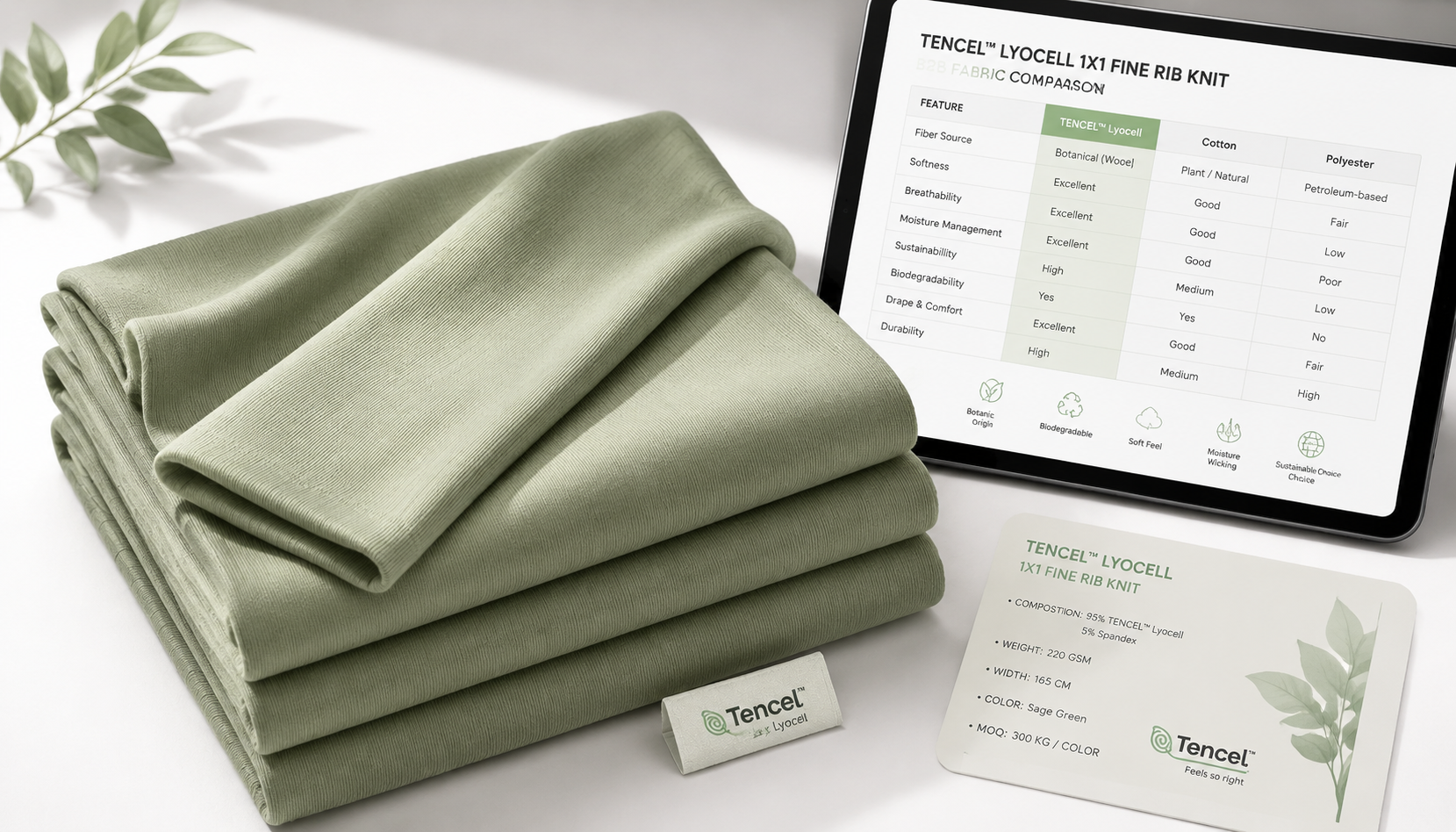
The 1×1 fine rib knit deserves special attention here. It’s one of the most demanding structures for dimensional stability because the rib configuration contracts significantly in width after relaxation. When you’re sourcing a Tencel lyocell 1×1 rib, the finishing specifications matter even more than with jersey.
Forget the marketing language for a moment. What actually matters when you’re writing a purchase order for 10,000 meters of Tencel lyocell knit? Three things: moisture performance, dimensional stability, and hand feel consistency across the order. Everything else is secondary.
Tencel lyocell absorbs approximately 50% more moisture than cotton, according to Lenzing’s technical data. The moisture regain rate sits around 11.5% compared to cotton’s 8.5%. For vertical wicking tests, lyocell knits typically outperform cotton by 15–20% in standardized testing conditions.
What does this mean at the garment level? Brands selling activewear and underwear can make legitimate “moisture-wicking” and “breathable” claims. The fiber’s cross-section is naturally smooth with micro-channels that transport moisture away from skin. Unlike polyester’s moisture-wicking mechanism (which relies on surface treatments that degrade over wash cycles), lyocell’s moisture management is inherent to the fiber structure.
| Property | Tencel Lyocell | Cotton | Viscose Rayon |
|---|---|---|---|
| Moisture Regain | ~11.5% | ~8.5% | ~13% |
| Vertical Wicking (8 hr) | 120–140 mm | 95–110 mm | 110–130 mm |
| Dry Time (relative) | Medium | Slow | Slow |
| Wet Tenacity Retention | ~85% | ~110% | ~45% |
Silk cupro fabric shows similar moisture absorption to lyocell but with significantly lower wet strength and higher production cost. For most apparel applications where both comfort and durability matter, lyocell hits a better balance point.
This is where procurement gets risky. Lyocell knits can exhibit residual shrinkage of 3–8% if the mill doesn’t apply proper finishing. The fiber swells significantly when wet — up to 40% cross-sectional increase — and if the fabric isn’t mechanically relaxed before delivery, it will shrink in the customer’s first wash.
Proper finishing requires either compressive shrinkage processing (the knit equivalent of Sanforizing) or relaxation drying on equipment that allows the fabric to contract freely without tension. Stenter-only finishing, which stretches fabric to a set width, actually locks in tension and increases shrinkage risk.
Key risk checklist for dimensional stability:
Tencel lyocell knits deliver a distinctive peach-skin hand feel with fluid drape and a subtle, almost pearlescent luster. It sits in a unique tactile space — softer than combed cotton, more structured than silk cupro fabric, and more durable than viscose rayon.
Enzyme washes and peach-skin finishing can further modify the hand feel without degrading fiber integrity. Some mills offer a “washed silk” finish that combines mechanical softening with light enzyme treatment. The result feels closer to cupro fabric clothing but at a lower price point and with better pilling resistance.
Tencel lyocell isn’t a universal solution. Its sweet spots are specific, and understanding where it excels — and where it doesn’t — saves procurement headaches.
This is lyocell’s strongest market segment. Single jersey and interlock knits in Tencel dominate premium underwear, loungewear, and sleepwear lines across European markets. The fiber’s smooth surface reduces micro-irritation against skin, and its moisture management keeps the wearer comfortable through the night.
For skin-contact garments, OEKO-TEX Standard 100 Class I certification is increasingly non-negotiable, especially for brands selling into the EU market. Tencel lyocell fibers typically pass these requirements without additional chemical treatment, which simplifies the certification chain.
A mid-size German underwear brand sourced Tencel lyocell jersey for a 12-piece capsule collection targeting eco-conscious consumers aged 25–40. They demanded 180 Fabric GSM Calculator (5.3 oz/yd²) lightweight fabric with ≤3% shrinkage. The initial mill sample at 180 gsm showed 5.2% shrinkage after 5 washes — failing the QA spec.
The mill first tried increasing density to 200 gsm (5.9 oz/yd²), which reduced shrinkage to 3.8% but destroyed the lightweight drape the brand wanted. A second attempt used a resin-finish chemical treatment that hit shrinkage targets but stiffened the fabric and killed the softness after just 3 washes.
The final production used mechanical compressive shrinkage — stenter-free relaxation drying plus calendering at 140°C (284°F) — on 190 gsm (5.6 oz/yd²) fabric. Result: 2.9% shrinkage with 92% of original hand-feel retained in panel testing. The trade-off was a 10 gsm weight increase and 7% higher unit cost. The brand accepted both.
Lyocell’s moisture-wicking properties make it viable for yoga wear and athleisure base layers, though it’s rarely used as a standalone fiber in this segment. Common blend ratios include 67% Tencel / 28% organic cotton / 5% spandex, which balances moisture management with stretch recovery.
Pilling resistance in these blends typically scores ≥3–4 on the Martindale test at 5,000 cycles, which is acceptable but not exceptional. For high-friction applications like cycling shorts or running tights, polyester-lyocell blends may outperform pure lyocell constructions.
Here’s an emerging trend worth watching. Structured knit blazers, knit suiting, and technical shirting are increasingly using lyocell for its drape and wrinkle resistance. These “woven-adjacent” knits exploit lyocell’s fluid hand feel in constructions that mimic tailored garments.
The challenge is fibrillation — lyocell’s natural tendency to develop surface fibers that create a fuzzy appearance. For structured applications, crosslinking finishes (typically DMDHEU-based) can control fibrillation without significantly affecting hand feel. The key is specifying this in your tech pack; not every mill applies crosslinking by default.
| Segment | Typical Construction | Weight Range | Key Spec Priority |
|---|---|---|---|
| Intimate/Lounge | Single jersey, interlock | 150–200 gsm (4.4–5.9 oz/yd²) | Hand feel, shrinkage ≤3% |
| Active/Athleisure | Single jersey, pique | 180–240 gsm (5.3–7.1 oz/yd²) | Moisture wicking, stretch recovery |
| Structured Knits | Rib, interlock | 220–300 gsm (6.5–8.9 oz/yd²) | Wrinkle resistance, fibrillation control |
Most procurement failures with Tencel lyocell come from treating it like cotton or generic viscose. It’s neither. Here’s what your sourcing checklist should cover.
Request Lenzing fiber certificates for every order. Check for Tencel hang-tag licensing, which confirms the fiber source. If you’re specifying recycled-content lyocell, verify GRS (Global Recycled Standard) certification from the mill.
Generic “lyocell” that doesn’t originate from Lenzing’s closed-loop process may have different environmental credentials and inconsistent quality. This is where supplier vetting becomes critical. When evaluating mill capability, look for manufacturers with established track records and integrated production — a supplier with 20 years of manufacturing history and comprehensive certification provides the kind of credibility anchor that reduces sourcing risk.
Ask mills directly about their pre-shrink finishing equipment. Do they have relaxation dryers, or are they stenter-only? This single question separates mills that can deliver stable Tencel knits from those that can’t.
Dyeing method matters too. Reactive dyes are the standard recommendation for lyocell — they bond chemically with the cellulose fiber and deliver wash fastness ≥4 on the grey scale. Some mills attempt cheaper direct dyes, which yield poor wash fastness and color bleeding.
Minimum specifications to include in your tech pack:
For buyers ready to submit detailed quality requirements, the technical inquiry process with specification sheet upload allows you to share your tech pack and receive a feasibility assessment before committing to sampling.
Typical MOQ ranges for Tencel lyocell knit orders vary significantly between stock and custom programs:
Sampling timelines: lab dips typically require 7–14 days, strike-offs 14–21 days. Production lead time for custom orders runs 30–45 days from order confirmation. Mills with in-house dyeing and finishing reduce lead time risk because they don’t depend on third-party processors.
No fiber wins every comparison. The right choice depends on your price point, performance requirements, and brand positioning. Here’s an honest breakdown.
| Dimension | Tencel Lyocell | Combed Cotton | Viscose Rayon |
|---|---|---|---|
| Sustainability | Closed-loop process, ~80% less water than cotton | High water/pesticide use (conventional); better if organic | Open-loop chemical process, significant waste |
| Moisture Management | Excellent (11.5% regain) | Good (8.5% regain) | Very good (13% regain) |
| Hand Feel | Peach-skin, fluid drape | Crisp, structured | Silky, less durable |
| Cost (approx.) | $4.50–7.00/m | $3.00–5.50/m | $2.50–4.00/m |
Now let’s compare against the “premium alternatives” — cupro and modal.
| Dimension | Tencel Lyocell | Cupro | Modal |
|---|---|---|---|
| Sustainability | Closed-loop, wood pulp | Cotton linter byproduct, closed-loop | Beechwood pulp, semi-closed-loop |
| Moisture Management | Excellent | Excellent | Very good |
| Hand Feel | Peach-skin | Silky, near-silk | Soft, cotton-like |
| Cost (approx.) | $4.50–7.00/m | $6.00–10.00/m | $3.50–5.50/m |
Cupro offers the closest hand feel to silk but at a higher price point and with lower abrasion resistance. Modal is softer than cotton and cheaper than lyocell but lacks the same moisture performance and environmental credentials. Stonewashed cupro fabric has a niche following in luxury denim-adjacent markets, but for mainstream apparel production, lyocell provides better value.
Honest guidance builds trust, so here it is. Lyocell is suboptimal for high-abrasion workwear — nylon and polyester outperform it significantly. It’s also a poor fit for extreme low-cost fast fashion, where the 15–30% price premium over viscose rayon erodes margins. And if your application requires high elastic recovery without spandex blends, lyocell alone won’t deliver.
I’d also argue that for brands where consumer recognition of “organic cotton” drives purchasing decisions more than “Tencel” — particularly in certain North American markets — the marketing advantage may not justify the cost premium. Know your customer.
After watching dozens of Tencel lyocell orders go sideways, I can pinpoint three recurring mistakes that cost brands time and money.
Copying cotton knit specifications onto a lyocell order is the single most common source of dimensional-stability failures. Lyocell requires different shrinkage tolerances, different wash-test parameters, and different finishing steps. A spec sheet that reads “cotton jersey, 5% shrinkage tolerance” will produce fabric that shrinks 6–8% in lyocell unless the mill applies specific pre-shrink finishing.
Write your lyocell specs from scratch. Don’t recycle cotton templates.
Lyocell’s surface fibrillation is a natural characteristic, not a defect — but it looks like one if you’re not expecting it. On dark-dyed fabrics, fibrillation creates visible white streaks. On light colors, it produces a peach-skin texture that may or may not be desirable.
A US-based fast-fashion buyer ordered 15,000 m of Tencel lyocell single jersey in black for a fall basics program. The fabric passed initial QC but developed visible white fibrillation streaks after the first industrial wash — a defect the QC team had never encountered with cotton or polyester knits.
The mill first tried heavy silicone softener, which masked the fibrillation temporarily but caused the fabric to fail colorfastness-to-rubbing tests (rated 2 on the grey scale). A second attempt used cellulase enzyme treatment that reduced fibrillation but weakened tear strength by 18%, pushing it below the buyer’s minimum spec.
The final solution combined a light cellulase treatment (0.5 g/L concentration, 45 minutes at 55°C / 131°F) with a crosslinking finish using low-formaldehyde DMDHEU. This reduced fibrillation to acceptable visual levels while maintaining tear strength within 5% of the original spec. The buyer accepted a 3-day delay and $0.12/m cost increase. The order was re-labeled with care instructions specifying “wash inside out, gentle cycle.”
Reactive dyes are standard for lyocell, but some mills attempt cheaper direct dyes that yield poor wash fastness and color bleeding. Always specify the dye class in your tech pack and request wash-fastness test reports before approving bulk production. A dye that looks perfect on a lab dip can fail catastrophically after 10 wash cycles.
Tencel knit is a knitted fabric made from Lenzing’s branded lyocell fiber, produced via closed-loop solvent spinning using NMMO. “Tencel” is a brand name, not a fiber type — the underlying fiber is lyocell, a cellulose-based regenerated fiber. Tencel knits are available in single jersey, rib, interlock, pique, and other constructions, with the fiber’s high wet-tenacity making it well-suited for structures that undergo wet processing.
Tencel lyocell cloth refers to any fabric — knit or woven — made from Tencel-branded lyocell fiber. The key distinction from generic lyocell cloth is traceability: Tencel fiber comes with Lenzing’s certification chain, batch tracking, and technical support. In B2B procurement, specifying “Tencel” rather than generic “lyocell” ensures fiber provenance and access to Lenzing’s quality infrastructure.
On water usage, lyocell uses approximately 80% less water in fiber production than conventional cotton. The chemical process is closed-loop versus cotton’s pesticide and irrigation intensity. Both fibers are fully biodegradable at end of life. However, organic cotton still leads in consumer recognition in some markets — particularly North America — where the “organic cotton” label carries more purchasing power than “Tencel lyocell.”
For brands building a sustainability-first positioning, the Lenzing Tencel technical data provides detailed environmental metrics that support marketing claims with verifiable numbers.
Tencel lyocell knit fabric occupies a genuinely useful position in the sustainable apparel supply chain — better moisture performance than cotton, better durability than viscose, lower environmental impact than both. But it’s not a drop-in replacement for any of them. The chemistry is different, the finishing requirements are different, and the procurement risks are different.
Buyers who invest time in understanding these differences — who write lyocell-specific specs, verify mill finishing capabilities, and test before committing to bulk — consistently get better results than those who treat it as “just another knit.” The fiber rewards careful sourcing.
For teams looking to deepen their technical understanding of knit fabric selection and performance testing, the educational resource library offers additional guides on fiber properties, finishing processes, and quality benchmarking that complement the decision framework outlined here.