Address
Nanlang Industrial Zone, Xingtan Town, Shunde District, Foshan, Guangdong, China
Work Hours
Mon–Fri, 9:00 AM – 6:00 PM (CST/UTC+8). We aim to respond to all inquiries within 48 hours.

Address
Nanlang Industrial Zone, Xingtan Town, Shunde District, Foshan, Guangdong, China
Work Hours
Mon–Fri, 9:00 AM – 6:00 PM (CST/UTC+8). We aim to respond to all inquiries within 48 hours.

You’ve been there. The swatch arrived perfect, the contract was signed, and then the production roll showed up with a slight shade break. It’s the quiet killer of margins. At our mill, we don’t treat quality control like a final checkpoint. It’s woven into every single stage.
We run an integrated shop where knitting, dyeing, and flocking happen under one roof. This means we catch problems before they cascade downstream. Here’s exactly how we keep every meter consistent.
We’ll walk you through the multi-stage inspections, the lab testing against international standards, and the documentation that ties it all together. By the end, you’ll know precisely how we protect your specifications. Trust takes a lot more than a promise on paper.
Most suppliers inspect only before shipping. That single checkpoint approach is fundamentally flawed. Defects created during knitting or dyeing sit hidden until the final roll is packed. You end up paying for air freight replacements.
You face production delays. You watch your brand reputation take a hit when consumers spot inconsistent stitching. By the time a flaw surfaces at the end of the line, the root cause is buried somewhere in week one.
We build quality in, rather than inspecting it in. Every department holds its own dedicated protocols. Defects get caught exactly where they happen. This allows immediate correction before a minor tension shift turns into a full dye lot disaster.
This only works because we own the entire chain. We don’t rely on external vendors who hide behind delayed reports. When tension varies on a knitting machine, we adjust it. When a dye bath pH drifts, we correct it. No waiting.
Inside XO Fabric: Production Tour shows you where each stage happens.
We back this up with hard numbers. We employ over fifty technical staff trained specifically in textile management. We run mandatory checkpoints at five distinct stages across the flow. Our target defect rate sits well below the industry average. We focus on prevention instead of panic.
I learned this the hard way years ago. A trading partner shipped us a batch of interlock with a 4% shrinkage variance. The final inspection passed because they only measured width. We caught the weave density drift in house, adjusted the take-down rollers, and saved the lot.
Here is how the stages actually stack up against reactive methods:
| Single-Checkpoint Model | Our Multi-Stage Approach |
| Defects found too late | Issues caught at source |
| High rework costs | Minimal waste generation |
| Reactive corrections | Preventive machine tuning |
The difference isn’t just paperwork. It’s operational rhythm. You can’t fix a knitting tension error after the fabric has already been dyed and finished. You have to stop the line early. Real quality management requires that discipline.
Raw yarn inspection dictates everything downstream. We test every batch before it ever touches a knitting machine. Tensile strength gets measured first. We check evenness using CV% metrics. Moisture content and twist levels get verified against the mill specification.
If you order a 30s/1 cotton, we confirm the count. Dyed yarns undergo strict color consistency checks. We measure delta E against the approved standard. Anything outside tolerance gets quarantined. Procurement gets notified immediately. We don’t gamble on marginal materials.
Chemicals and auxiliaries follow the same rigor. Dyes undergo purity testing. We verify batch-to-batch consistency. Certifications like OEKO-TEX and REACH compliance get cross-checked. Adhesives for flocking require viscosity testing and bond strength sampling. Shelf life matters.
Finishing chemicals need concentration verification. We test compatibility with the base fabric before bulk application. Every chemical comes from certified suppliers. We keep the COA on file.
How to Read Fabric Lab Report shows you how material specs translate to final output.
Documentation starts here. Each incoming lot gets a unique traceability code. That code follows the material through knitting, dyeing, and finishing. It prints on the final roll tag. This enables precise root cause analysis if anything shifts later. We retain full material records for three years minimum.
All Products begin with rigorously tested materials.
When yarn tension varies by even half a percent, stitch density drifts. I’ve seen designers struggle with uneven garment hang because the base yarn was inconsistent. We catch that before the cone hits the machine.
Moisture regain directly affects GSM calculations. If the yarn arrives at 12% humidity instead of the standard 8%, your finished weight will be off. We condition samples in a controlled room before weighing. It’s a small step that saves major discrepancies later.
This upfront work prevents downstream headaches. You don’t want to discover a weak yarn batch after it’s already been cut into panels.
This stage separates serious mills from trading desks. We monitor the line continuously. Knitting machines run tension sensors. Operators spot-check stitch density every thirty minutes. We use pick counters and GSM scales. Width measurements happen right at the machine exit. We allow a strict tolerance of ±2%.
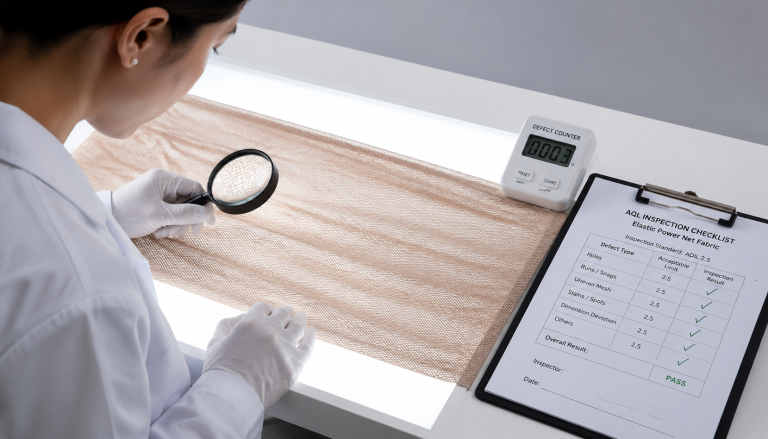
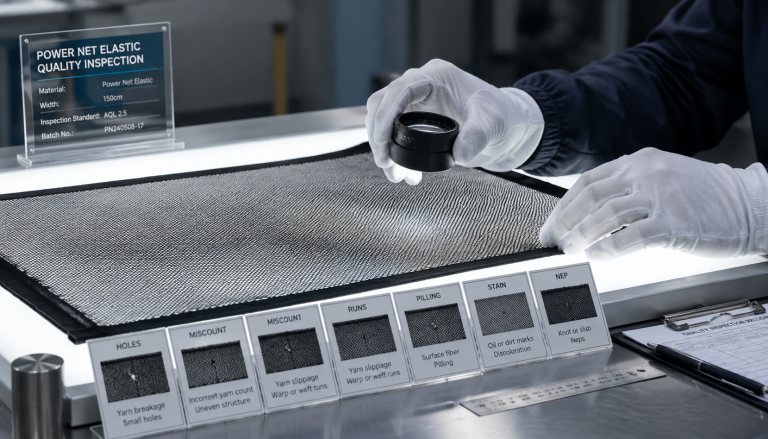
Visual scans catch dropped stitches, runs, holes, and oil contamination. Every roll gets tagged with the machine ID, operator name, and timestamp. Preliminary grading happens on the floor.
Dyeing requires constant attention. We check pre-dyeing scouring effectiveness with absorbency tests. Mid-process color sampling uses a spectrophotometer. We compare readings to the approved lab dip. The dye bath pH and temperature get logged throughout the cycle. Post-dyeing, we run a quick wash fastness test. Shade continuity between batches gets verified under a D65 light box.
Spectrophotometer readings aren’t just about matching a card. They measure spectral reflectance across wavelengths. If the delta E sits above 1.5, the shade break will show up on a garment panel. We reject it internally before it ever leaves the dye house.
Finishing checks focus on width, weight, and hand feel. We verify GSM within ±3% tolerance. Softness, stiffness, and surface smoothness get rated by tactile assessment. Functional finishes like moisture-wicking or antibacterial treatments undergo efficacy testing. Dimensional stability gets pre-checked after twenty-four hours of conditioning.
Flocking adds another layer. We verify adhesive coat weight in grams per square meter. Electrostatic field strength gets monitored during application. Curing temperature and time logs are reviewed. Bond strength depends entirely on those numbers. We run immediate pile adhesion tape tests. Pile density and direction uniformity get visually confirmed.
Fabric Shrinkage Explained shows how dimensional stability starts right here.
I remember a tricky order for a heavy sweatshirt fleece. The client wanted extreme softness but demanded minimal shrinkage. We tried a standard enzyme wash first. The hand feel was perfect, but the lab dip showed a 3.5% warp shrinkage. Too high. We adjusted the relaxation steaming cycle and reduced the mechanical action time.
It compromised the softness slightly, so we added a silicone post-treatment. The compromise worked. We hit 2% shrinkage and maintained the drape they needed. Trade-offs are unavoidable. You usually have to sacrifice a degree of softness to lock down the weave. Knowing where to push and where to hold back matters.
Our on-site lab handles routine testing in-house. We don’t wait for third-party results. Calibration happens quarterly. Certified technicians maintain every instrument. The equipment list includes a GSM balance, shrinkage oven, spectrophotometer, and Martindale pilling tester. We also run light fastness xenon arc tests, tensile strength measurements, and crockmeter rub fastness checks.
Shrinkage testing follows AATCC 135 or ISO 6330 standards. We condition specimens at twenty degrees Celsius and 65% relative humidity for twenty-four hours. Measurements happen in both warp and weft directions. We typically accept shrinkage under 3%. Premium orders demand tighter tolerances. Results get recorded per roll and averaged per dye lot.
Color fastness testing runs a full battery. Wash fastness follows AATCC 61. We require a grade of 3-4 minimum. Rub fastness uses AATCC 8. Dry rubs must hit grade 4. Wet rubs need grade 3. Light fastness testing runs under ISO 105-B02. Outdoor applications demand higher ratings. Perspiration fastness checks both acidic and alkaline resistance. We use standardized gray scales for evaluation.
Pilling resistance and physical durability get equal attention. Martindale pilling tests follow ISO 12945-2. We look for a rating of 3-4 depending on the end use. Tensile and tear strength measurements align with ASTM D5034 and D5587. Abrasion resistance matters for upholstery and high-wear apparel. Flocked products undergo pull tests using the tape method. Some clients request optional peel force testing for extra assurance.
When pilling becomes an issue, it usually traces back to fiber length or twist level. Short fibers migrate to the surface during wear. Friction knots them into pills. You can’t eliminate it entirely, but you can manage it. We adjust the mechanical brushing intensity during finishing. We also recommend tighter weaves for high-friction zones.
| Test Standard | Minimum Acceptance | Premium Threshold |
| Wash Fastness (AATCC 61) | Grade 3-4 | Grade 4-5 |
| Shrinkage (AATCC 135) | ≤3% | ≤2% |
| Pilling (ISO 12945-2) | Rating 3 | Rating 4 |
Lab data prevents guesswork. You can feel a difference in hand, but numbers tell you if it will survive twenty wash cycles. We run these checks before the fabric leaves the lab bench. If a test result sits right on the border, we rerun it twice. Consistency matters more than pushing for a single lucky pass.
Each production batch receives a complete QC dossier. It contains raw material lot numbers. It holds incoming inspection records. In-process logs from every stage get attached. We timestamp them and attach technician signatures. Physical test results cover GSM, shrinkage, color fastness, and pilling. Roll-level reports note any defects, their type, size, and exact location. Final grades get assigned per roll. We digitize every paper record for backup.
Pre-shipment inspection follows a strict protocol. We run a 100% visual check of every roll before packing. AQL-based sampling handles physical re-testing. We typically use Level II with AQL 2.5 for major defects. Roll-by-roll defect mapping catches non-perfect rolls. Packaging gets verified for correct labeling and core quality. The PSI report attaches to the shipment documents.
Request Sample QC Report to see exactly how we format our documentation.
Clients receive a packing list with roll-by-roll details. Length, weight, grade, and dye lot appear clearly. A summary QC report covers test results. Full lab certificates arrive upon request. Certificates of Origin and compliance declarations get included.
This paperwork enables continuous improvement. We review defect trends monthly. Recurring issues trigger root cause investigations. Corrective action plans get implemented immediately. Client feedback directly adjusts our QC parameters. It’s a closed-loop system.
I’ve seen brands rely on verbal guarantees. It never holds up when a shade break hits production. Paper trails protect both sides. They clarify expectations and speed up resolutions.
Documentation isn’t bureaucracy. It’s accountability. You deserve to know exactly what you’re cutting.
Internal defects trigger an immediate pause. We diagnose the issue before production continues. Non-conforming rolls get segregated. They are clearly marked and never mixed with approved stock. Root causes get documented for prevention tracking. For significant deviations, we notify the client proactively. We offer clear options. You can wait for correction, accept a partial shipment, or explore an alternative solution.
Client-reported issues follow a strict timeline. You can report problems within seven days of receipt. Photo documentation speeds up the assessment. Our team responds within twenty-four hours. If the issue falls on us, replacement fabric gets produced at priority. Credits or refunds get issued per mutual agreement. Every case gets logged. It feeds back into our improvement system.
Payment Terms Explained shows how our structure includes built-in quality safeguards.
We stand behind every meter we ship. Fair resolution policies matter. T/T 30/70 payment terms give you leverage. You retain control until satisfaction is confirmed. Long-term partnerships rely on trust. They aren’t built on contracts alone.
When a seam slippage issue popped up last quarter, we didn’t argue. We pulled the raw material data, recalibrated the tension settings, and offered expedited air freight for the replacement batch. Speed and transparency win more loyalty than defensive emails.
Our four-stage framework covers the entire lifecycle. Incoming inspection catches raw material flaws. In-process monitoring stops defects from compounding. Scientific testing validates performance against international standards. Complete documentation ensures full traceability. This level of control is only possible because we own the production chain. There are no outsourced blind spots.
We’ve operated since 2005. Our team includes over fifty technical specialists. We manage a 2,000 square meter facility in Nanlang Industrial Zone. Quality control isn’t just about catching errors. It’s about protecting your brand’s reputation. You depend on consistent fabric. We make it our priority.
Standard lead times run ten to twenty days. We accommodate MOQs starting at three hundred meters. The process stays the same regardless of order size.
Contact XO Fabric to discuss your specific requirements.
Ready to see these standards in action? Request a sample order. We’ll include full QC documentation. You’ll see exactly how we protect your specifications before you commit to a bulk run.
Fabric quality isn’t a magic trick. It’s a series of deliberate choices made long before the roll gets packed. You can feel the difference in the hand, but the real proof sits in the lab data and the inspection logs. When you know exactly where a defect could happen, you stop guessing. You start designing with confidence.
I’ve spent years watching mills chase perfection and others chase deadlines. The ones that survive do both. They build systems that catch errors early, document everything, and own the mistakes. That’s the foundation of a reliable partnership. Your next garment deserves that level of care.