Address
Nanlang Industrial Zone, Xingtan Town, Shunde District, Foshan, Guangdong, China
Work Hours
Mon–Fri, 9:00 AM – 6:00 PM (CST/UTC+8). We aim to respond to all inquiries within 48 hours.

Address
Nanlang Industrial Zone, Xingtan Town, Shunde District, Foshan, Guangdong, China
Work Hours
Mon–Fri, 9:00 AM – 6:00 PM (CST/UTC+8). We aim to respond to all inquiries within 48 hours.
Custom Printed Knit Fabric: Design, MOQ & Production Workflow. This guide covers key properties, real-world applications, and a practical sourcing checklist for B2B buyers.
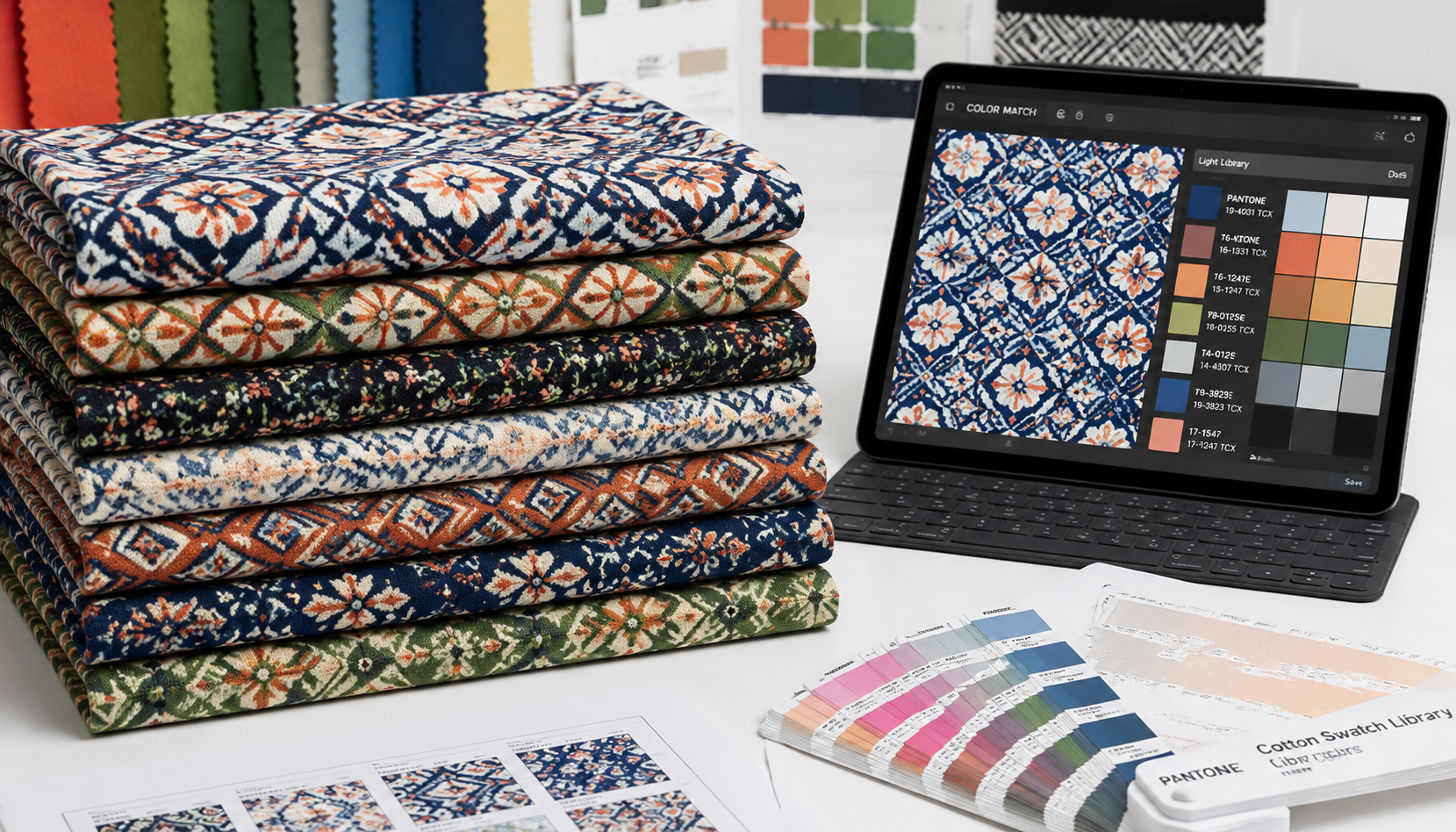
Imagine this: your design team has spent months perfecting a vibrant, all-over print for a new activewear line. You send the final files to a factory, approve a stunning digital proof, and wait for samples. When they arrive, the colors are dull, the fabric feels stiff as cardboard, and the pattern bleeds at the edges. The culprit? A mismatch between your design vision and the factory’s technical capabilities for printed knit fabric custom design. This scenario, where a procurement process derails due to overlooked technical specifics, costs brands thousands in delays and rework. This guide is built to prevent that. We’ll walk through the entire journey—from understanding the core technology to final inspection—so you can source with confidence.
Before diving into mills and MOQs, let’s clarify what we’re dealing with. The term “custom printed knit fabric” isn’t just about putting a pattern on cloth. It’s a specific technical product where the base material’s structure, the printing method, and the final finish are all interdependent variables. Get one wrong, and the entire product fails. For B2B buyers, understanding these fundamentals isn’t academic—it’s the first line of defense against costly mistakes.
The most critical distinction starts at the yarn level. Knit fabrics are constructed from a single, continuous yarn looped together, creating inherent stretch and a softer, more textured surface. Woven fabrics are made by interlacing two sets of yarns at right angles, resulting in a stable, less elastic material. This structural difference directly impacts how inks behave. On a knit, the loops create valleys and peaks. Ink can pool in the valleys or sit atop the peaks, affecting color saturation and edge sharpness. A custom print fabric on a knit requires careful ink viscosity control to prevent bleeding into those loops, something that’s far less of a concern on a tight, flat weave.
When reviewing a tech pack or a quote, you’ll encounter a trio of critical parameters. Understanding them is non-negotiable for effective communication with your supplier.
| Knit Construction | Surface Character | Digital Print Compatibility | Screen Print Compatibility |
|---|---|---|---|
| Single Jersey | Smooth face, textured back, good stretch | Excellent for detailed, photographic prints | Good, but fine lines can blur slightly |
| Interlock | Double-knit, smooth on both sides, stable | Excellent, provides a very flat canvas | Excellent, ideal for bold, opaque colors |
| Rib (1×1, 2×2) | Vertical ridges, high elasticity | Good, but ridges can cause minor color variation | Good, ink sits well on the raised ribs |
| Mesh | Open, porous structure | Poor, ink bleeds through the holes | Not recommended |
The journey from a digital file to a finished roll of custom fabric printing involves several distinct pathways. Choosing the right one depends entirely on your design, order size, and performance requirements. It’s a decision tree, not a one-size-fits-all solution.
Digital printing is the modern workhorse for customization. It works like a giant inkjet printer, spraying dye directly onto the fabric. There are two main flavors. Direct-to-Film (DTF) prints the design onto a special film first, which is then heat-pressed onto the fabric. It’s versatile, working on cotton, polyester, and blends. Sublimation printing uses heat to turn dye into a gas that permeates polyester fibers, becoming part of the fabric itself. The result is incredibly vibrant, wash-fast colors with a zero hand feel—you can’t feel the print at all. The magic for buyers? No screens, no plates. This means you can print a single meter with a complex, multi-color design cost-effectively. MOQs can start as low as 100 m (109 yd), making it perfect for sampling, small-batch production, and designs with unlimited colors.
Screen printing is the old guard, and for good reason. A mesh screen is created for each color in your design. Ink is pushed through the screen onto the fabric. The initial setup—making those screens—is expensive. But once they’re made, the cost per meter drops dramatically as volume increases. For a simple one- or two-color design, the crossover point where screen printing becomes cheaper than digital is often around 500 m (547 yd). For a design with six or more colors, that crossover might be at 1,000 m (1,094 yd) or more. It produces incredibly opaque, vibrant colors and is the standard for high-volume basics. However, it’s less ideal for photographic gradients or designs that change frequently.
Beyond the two main methods lies a world of specialty techniques that add texture, dimension, and luxury. Transfer printing involves printing the design onto paper first, then transferring it to fabric using heat and pressure—great for all-over prints on difficult substrates. Then there’s flocking, a process where fine fiber particles are electrostatically applied to an adhesive-printed area, creating a raised, velvet-like texture. This is where a product like printed flocked fabric comes into play, combining the visual impact of a print with a unique tactile dimension. Foil printing applies a metallic film for a high-shine effect. These techniques add cost and complexity but can create truly standout products for fashion and accessories.
The fabric is the canvas. Choose the wrong one, and even the best print will fail. This decision hinges on fiber content, weight, and knit structure, all tailored to your end product’s use case. Making the best printed knit fabric custom design choice means balancing aesthetics, performance, and cost from the very beginning.
Each fiber brings a distinct set of properties to the table.
Weight dictates function. A 130-150 Fabric GSM Calculator (3.8-4.4 oz/yd²) single jersey is perfect for a breathable t-shirt. A 200-220 gsm (5.9-6.5 oz/yd²) interlock is ideal for a structured polo shirt or a lightweight hoodie. For heavy-duty applications like upholstery or bag lining, you’d look at 250-300 gsm (7.4-8.9 oz/yd²) or higher. Always sample at the intended GSM; a print that looks perfect on a 150 gsm sample may crack or feel heavy on a 280 gsm production fabric.
| Fiber | Recommended GSM Range | Best Print Method | Typical Application |
|---|---|---|---|
| Polyester | 130-220 gsm (3.8-6.5 oz/yd²) | Sublimation | Activewear, sportswear, flags |
| Cotton | 150-280 gsm (4.4-8.3 oz/yd²) | DTF / Reactive Digital | T-shirts, casual wear, home textiles |
| Nylon | 140-200 gsm (4.1-5.9 oz/yd²) | DTF / Specialty Inks | Swimwear, hosiery, lingerie |
| Cotton-Poly Blend | 160-250 gsm (4.7-7.4 oz/yd²) | DTF | Athleisure, uniforms, promotional wear |
For a broader look at available options, browsing a printed series fabrics category page can help visualize the range of base materials and their printed outcomes.
A beautiful sample means nothing if the fabric fails in the real world. B2B procurement is driven by performance data, not just aesthetics. Here are the key metrics your quality team will—and should—be testing.
Color fastness is the fabric’s resistance to color loss. It’s tested under three main stresses, each with its own ISO standard. Wash fastness (ISO 105-C06) measures fading after repeated laundering. Light fastness (ISO 105-B02) measures fading from exposure to light, crucial for curtains and automotive textiles. Rub fastness (ISO 105-X12) measures color transfer from rubbing, critical for dark denim or upholstery. For most apparel, a rating of 4 on a 1-5 scale is the minimum acceptable standard. Anything below 3 is considered a failure. Always request test reports from your supplier’s lab.
For knit fabrics, stretch is a given, but recovery is what matters. How well does the fabric snap back to its original shape after being stretched? Poor recovery leads to baggy knees and elbows. Pilling resistance (ISO 12945) measures the formation of little fabric balls on the surface from abrasion. A rating of 3-4 is generally acceptable for apparel. Dimensional stability is simply the shrinkage rate after washing. For most knits, a shrinkage of less than 5% in both length and width is the industry benchmark. These are the unglamorous tests that separate a professional product from a disappointing one.
This is a tactile, subjective test, but it’s critical. Digital sublimation, where the dye becomes part of the fiber, leaves the fabric’s hand feel virtually unchanged. The fabric remains soft and drapey. Screen printing, however, lays down a layer of ink on top of the fabric. For large, solid areas, this can create a “plasticky” feel and reduce the fabric’s natural drape. Specialty finishes like flocking add a completely new dimension—literally. The flocked area will feel plush and raised, altering the drape and weight. Always handle production-weight samples, not just strike-offs, to evaluate the final hand.
The versatility of printed knits allows them to penetrate diverse markets, each with its own set of non-negotiable requirements.
In this high-performance sector, the fabric must work as hard as the athlete. The primary demands are moisture-wicking properties, four-way stretch for mobility, and extreme colorfastness to withstand sweat, frequent washing, and sunlight. Sublimation printing on polyester or polyester-spandex blends is the dominant choice here. It delivers vibrant, permanent graphics that won’t crack or peel, and it doesn’t compromise the fabric’s technical performance. The design possibilities are endless, from team uniforms to fashion-forward leggings.
For cushion covers, throws, and light upholstery, durability is king. The fabric must withstand dozens of industrial wash cycles without fading or pilling. Light fastness is equally important for items near windows. Heavier GSM interlocks or ponte knits (200-300 gsm / 5.9-8.9 oz/yd²) are common bases. Screen printing or high-quality DTF with pigment inks are often used for their opacity and durability on these heavier substrates. The aesthetic must be maintained through years of use.
This is where digital printing truly shines. Think custom-printed bag linings, hat fabrics, scarves, and neckties. Brands and event organizers need small quantities (sometimes just 50-100 m / 55-109 yd per design) with fast turnaround and the ability to change designs seasonally or per campaign. The low setup cost of digital printing makes this economically viable. The focus is on visual impact, brand consistency, and speed-to-market rather than extreme technical performance.
Knowing the technology is half the battle. Executing a flawless procurement process is the other half. Here’s a streamlined, seven-step workflow to minimize risk.
It starts with your files. Artwork must be in vector format (AI, PDF) or high-resolution raster (300 DPI+, CMYK color mode). Your tech pack should include: exact Pantone color codes, print placement dimensions, fabric composition, GSM, width, and any special finishes. Submit this to your supplier. They will create a “strike-off”—a small printed sample on the actual production fabric. This is your most critical approval point. Check color accuracy against your Pantone chips, assess hand feel, and test a small piece for wash fastness yourself. Do not approve bulk production based on a digital proof alone.
Once bulk starts, request in-line quality control reports. Key checks include color consistency (measured with a spectrophotometer; ΔE ≤ 1.5 is the gold standard), pattern alignment at seams, and consistent width across the roll. A good factory will provide photos and data at this stage. If you have the resources, a third-party QC inspection during production can catch issues before they multiply.
Before shipment, conduct a final inspection using the AQL (Acceptable Quality Level) system, typically at level 2.5 for major defects. This involves random sampling of the finished rolls. Verify final GSM, width, color against the approved sample, and check for defects like holes, stains, or print smudges. Packing should protect the fabric—usually rolled on sturdy cardboard tubes to prevent creasing, wrapped in polyethylene, and packed in export-grade cartons. Choose your shipping method based on cost and urgency: sea freight for bulk (4-6 weeks), air freight for samples or rush orders (5-7 days).
Consider the journey of a North American DTC activewear brand launching a new yoga pant line. They needed a custom-printed, high-stretch knit with a MOQ of just 200 m (219 yd) and a 15-day sample turnaround. Their first three supplier inquiries were rejected due to low volume. The fourth accepted, but used cheap inks, resulting in samples with a wash fastness rating of only 2-3 (industry standard is 4+). After this trial-and-error, they compromised: they raised their MOQ to 500 m (547 yd) and extended the sample lead time to 20 days. In return, they partnered with an integrated mill that had its own digital printing line, achieving consistent 4+ wash fastness and OEKO-TEX Standard 100 certification. The lesson? Realistic MOQs and lead times are often the price of quality and reliability. For a complete overview of how a manufacturer manages this end-to-end process, exploring a custom fabric solutions page can provide valuable insight into integrated service models.
Let’s talk numbers. Unrealistic expectations here are the source of most friction in sourcing. Understanding the “why” behind the numbers leads to better partnerships.
| Print Method | Typical MOQ (Polyester Base) | Typical MOQ (Cotton/Blend Base) | Reason for MOQ |
|---|---|---|---|
| Digital Sublimation | 100 m (109 yd) | N/A (requires poly coating) | Low setup, but ink batch stability |
| DTF (Direct-to-Film) | 100 m (109 yd) | 100 m (109 yd) | Low setup, film and adhesive costs |
| Screen Printing (1-2 colors) | 500 m (547 yd) | 500 m (547 yd) | High initial screen-making cost |
| Screen Printing (4+ colors) | 1,000 m (1,094 yd) | 1,000 m (1,094 yd) | Multiple screens, higher setup cost |
Your final quote is a sum of parts. The biggest drivers are: 1) Number of colors (more colors = more screens or more complex digital file processing), 2) Base fabric cost (nylon is more expensive than polyester), 3) Special finishes (adding water-repellent, anti-microbial, or UV-resistance treatments), 4) Order volume (economies of scale kick in above 1,000 m / 1,094 yd), and 5) Lead time (rush orders often incur a 15-30% premium). A simple one-color print on a stock polyester jersey will be at the low end. A six-color, custom-dyed, water-repellent nylon with a 15-day rush delivery will be at the high end. Always get a breakdown.
Standard timelines are a function of complexity and queue position. Plan accordingly.
It varies significantly by print method. For digital printing (sublimation or DTF), MOQs can be as low as 100 m (109 yd). For screen printing, due to the high setup cost of making screens, the MOQ typically starts at 500 m (547 yd) for simple designs and can go up to 1,000 m (1,094 yd) or more for complex, multi-color prints.
Technically, yes, but it’s challenging and expensive. It requires printing one side, curing it, flipping the fabric, and printing the other side with precise alignment. The main issues are ink bleed-through (especially on lighter fabrics), a significant change in hand feel (the fabric becomes stiffer), and a near-doubling of the cost. It’s rarely done for apparel but can be found in some technical or decorative applications.
The process is called color management. First, specify your colors using Pantone TPG or TCX codes, not just visual references. Second, always request and approve a physical “strike-off” or “lab dip” sample on the actual production fabric under standardized light conditions (D65 lightbox). Third, establish a color tolerance with your supplier—typically a ΔE (Delta E) value of ≤ 1.5 is considered a very close match. This measured approach removes subjectivity.
For global markets, especially in the EU and North America, key certifications include: OEKO-TEX Standard 100 (ensures the fabric is free from harmful substances), GRS (Global Recycled Standard) if using recycled content, and compliance with EU REACH regulations. For specific performance claims, request test reports from accredited labs for colorfastness, pilling, and shrinkage. A supplier’s ability to provide these documents is a strong indicator of their professionalism and quality control systems. You can verify a manufacturer’s commitment to these standards by reviewing their company credentials and production certifications.
Sourcing printed knit fabric custom design is a complex dance between art and science, design and engineering. The most successful projects I’ve seen treat the supplier not as a vendor, but as a technical partner. The goal isn’t just to get the lowest price per meter; it’s to achieve the best value—a product that meets your aesthetic vision, performs flawlessly in its intended use, arrives on time, and passes every lab test your brand requires. Invest the time upfront in understanding the technology, defining your specifications clearly, and building a relationship with a transparent, capable manufacturer. That foundation is what turns a risky procurement process into a reliable, repeatable source of competitive advantage.