Address
Nanlang Industrial Zone, Xingtan Town, Shunde District, Foshan, Guangdong, China
Work Hours
Mon–Fri, 9:00 AM – 6:00 PM (CST/UTC+8). We aim to respond to all inquiries within 48 hours.

Address
Nanlang Industrial Zone, Xingtan Town, Shunde District, Foshan, Guangdong, China
Work Hours
Mon–Fri, 9:00 AM – 6:00 PM (CST/UTC+8). We aim to respond to all inquiries within 48 hours.
Fabric Inspection & AQL Standards: A Practical Buyer's Guide. This guide covers key properties, real-world applications, and a practical sourcing checklist for B2B buyers.
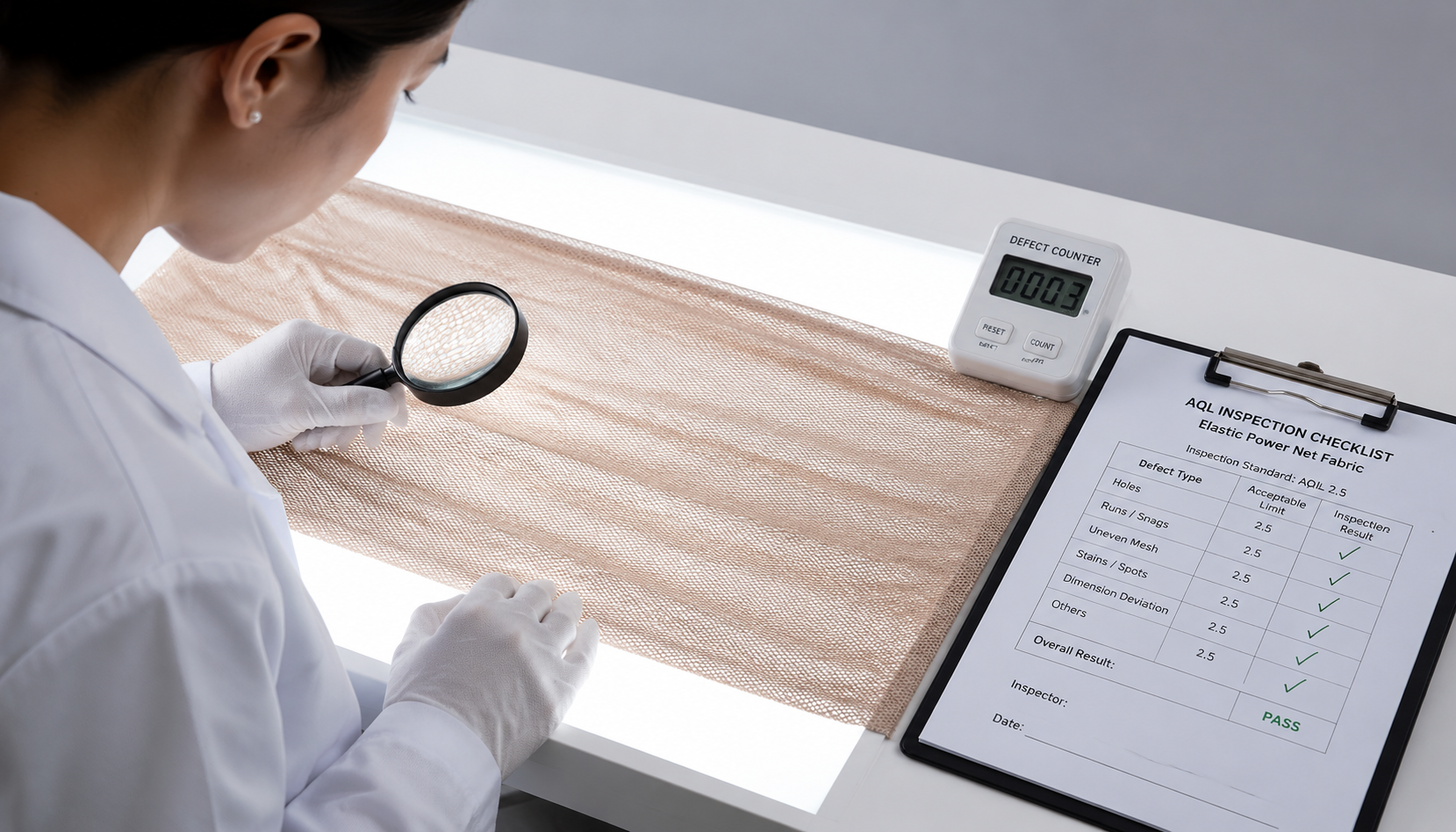
A European activewear brand once received a 12,000 m (13,123 yd) shipment of power-net elastic fabric, only to discover that 8% of the rolls had uneven mesh density. The factory’s internal “visual check” passed them, but any third-party AQL 2.5 audit would have flagged the issue. The buyer ended up absorbing a $4,600 rework bill, all because nobody agreed on a clear inspection protocol before the purchase order was signed. This scenario isn’t rare—it’s a costly lesson in why understanding fabric inspection and AQL standards isn’t just technical jargon; it’s a direct line to protecting your profit margin.
Let’s start with the foundation. AQL stands for Acceptable Quality Limit, and it’s defined in standards like ISO 2859-1 and ANSI ASQ Z1.4. It’s not a guarantee of perfection. Instead, AQL is a statistical threshold—the worst tolerable defect rate in a production lot that a buyer is willing to accept. Think of it as a probability game: if you set an AQL of 2.5, you’re saying you’ll accept a lot if the sample inspection shows no more than 2.5 defective items per hundred units inspected. It doesn’t mean every single piece is flawless.
The core idea is sampling. You don’t inspect every meter of a 5,000 m (5,468 yd) order—that would be impractical and expensive. Instead, you pull a statistically significant sample based on the lot size and a pre-agreed inspection level. The AQL number itself (like 1.0 or 2.5) tells the inspector how many defects are allowed in that sample before the whole lot is rejected. An AQL calculator can help determine the exact sample size and accept/reject numbers, but the principle is simple: it’s about managing risk, not eliminating it. If someone promises “zero defects,” they’re either not using AQL or they’re not being honest about production realities.
Different products and defect types call for different AQL levels. AQL 0.65 is extremely strict, typically reserved for critical safety defects—think needle contamination in children’s wear or chemical residues above OEKO-TEX Standard 100 limits. AQL 1.0 is common for high-value export orders where brand reputation is on the line. AQL 1.5 is the textile industry’s go-to for major defects in woven and knit fabrics—you’ll often see it referenced in an AQL 1.5 chart for major and minor defect classifications. AQL 2.5 is widely used for general consumer goods minor defects, and AQL 4.0 is for bulk commodity items where cosmetic flaws are more tolerated. The key trade-off: a lower AQL number means a stricter standard, which requires a larger sample size and drives up inspection costs.
| AQL Level | Typical Use Case | Sample Size (Lot 2,001–3,200) | Accept / Reject |
|---|---|---|---|
| 0.65 | Critical safety defects | 200 | 3 / 4 |
| 1.0 | High-value export orders | 200 | 5 / 6 |
| 1.5 | Standard textile major defects | 125 | 5 / 6 |
| 2.5 | General consumer goods minor | 80 | 5 / 6 |
| 4.0 | Bulk commodity minor defects | 50 | 5 / 6 |
Before you even think about pulling samples, you need to agree on what counts as a defect. This is where most deals fall apart. A factory’s internal QC list and a buyer’s expectations are often worlds apart, and if that gap isn’t closed before production, you’re headed for disputes.
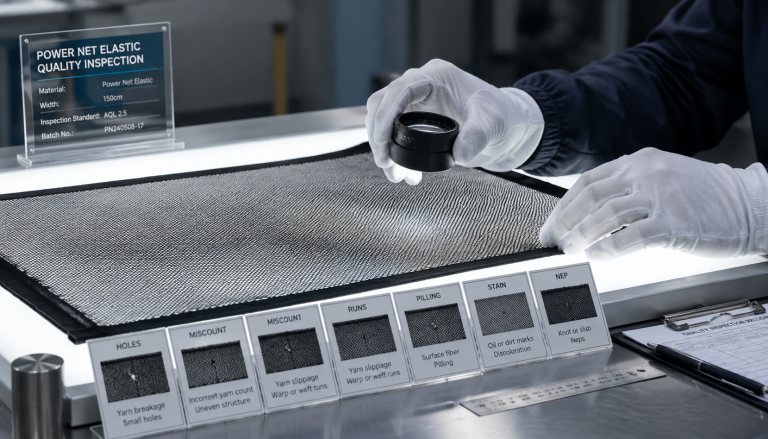
Defects generally fall into three tiers. Critical defects are safety or compliance failures—things like a needle fragment embedded in the fabric or chemical residue exceeding EU REACH limits. These are zero-tolerance; a single critical defect can trigger a full lot rejection. Major defects affect functionality or appearance significantly. For a power-net elastic fabric, that might be a tear strength below the specified 200 N (45 lbf) or a width deviation greater than 2% (about 3 cm / 1.2 in on a 150 cm / 59 in roll). Minor defects are cosmetic—slight shade variation within a 4-grade gray card tolerance, or minor pilling after 3,000 abrasion cycles. The classification you choose directly impacts your AQL level; critical defects might use AQL 0.65, while minor defects could use AQL 2.5 or 4.0.
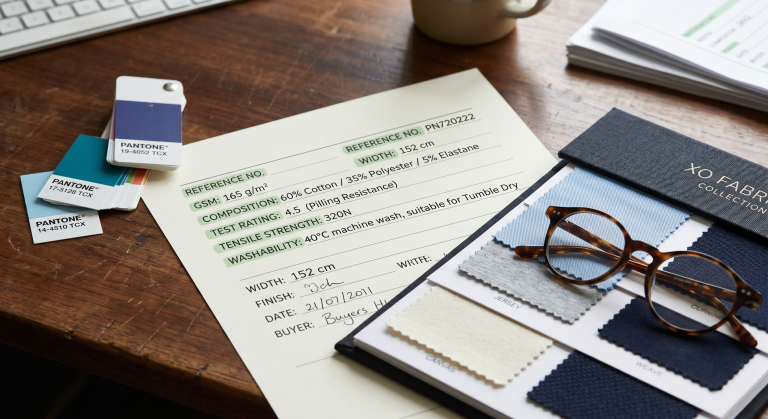
Here’s a reality check: most Chinese mills classify shade variation within a 4–5 grade on the gray card as acceptable. But if you’re a European brand ordering Pantone-adjacent colors for a capsule collection, you might require a delta of ≤ 0.5 grade. That’s a massive gap. I’ve seen buyers assume the factory’s standards are aligned with theirs, only to discover the mismatch after 6,000 m (6,562 yd) of fabric is already dyed. The fix is simple but often skipped: attach a written defect classification annex to every purchase order, complete with photo references and measurement tolerances in both metric and imperial.
Start by creating a defect photo library—actual images of acceptable vs. rejected samples from a pre-production run. Specify tolerances explicitly: width tolerance ± 1 cm (± 0.4 in), weight tolerance ± 5% of the target Fabric GSM Calculator. Require the factory to sign off on this classification before production begins. If they push back, that’s a red flag. A supplier confident in their process will welcome clarity because it protects them too. This kind of detailed agreement is what separates a smooth inspection from a contentious one.
A structured inspection process turns subjective judgment into a repeatable workflow. Here’s a four-gate SOP that covers everything from carton sampling to the final accept/reject decision.
First, define your lot. AQL sampling is based on total linear meters (or yards), not carton count. For a 5,000 m (5,468 yd) order, using General Inspection Level II per ISO 2859-1, you’d need to randomly select at least 8 cartons. Use an AQL calculator to determine the exact code letter and sample size based on your lot quantity. The key here is randomness—don’t let the factory pre-select “good” cartons. I prefer to use a random number generator on my phone right there at the warehouse to pick which cartons to open.
This is where the ASTM D5430 four-point system comes in. Each defect is assigned penalty points based on its size, and the total points per linear yard or meter determine if the roll passes. You’ll also measure width at three points per roll—head, middle, and tail—and check weight using a GSM cutter and scale. For a fabric like power-net elastic with a spec of 135 gsm (4.0 oz/yd²) and 150 cm (59 in) width, you’re looking for consistency across the roll. Document everything in dual units to avoid confusion later.
| Defect Size | Penalty Points | Example Defect | AQL Tier |
|---|---|---|---|
| ≤ 3 in (7.6 cm) | 1 | Small hole, oil spot | Minor |
| 3–6 in (7.6–15.2 cm) | 2 | Slub, missing yarn | Minor/Major |
| 6–9 in (15.2–22.9 cm) | 3 | Barre mark, crease | Major |
| > 9 in (22.9 cm) | 4 | Full-width defect | Critical/Major |
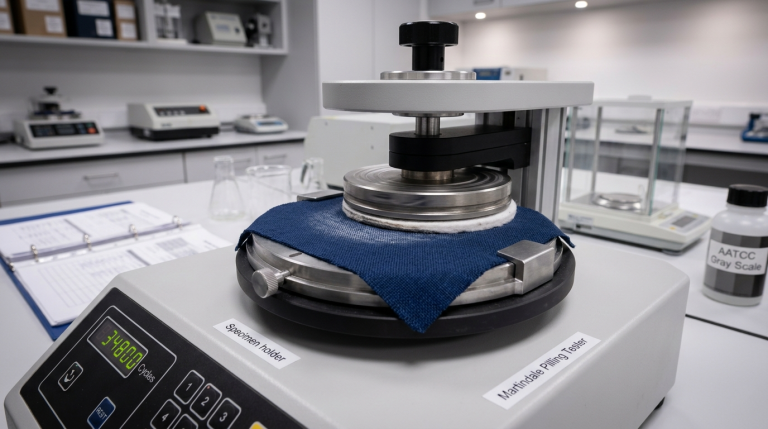
Not every order needs lab testing, but certain situations demand it. If the fabric is for children’s wear, medical applications, or destined for the EU market, lab tests for colorfastness, tensile strength, and chemical residue are mandatory. Thresholds matter: colorfastness to washing should be ≥ Grade 4 per ISO 105-C06, and tensile strength for a warp-knit power-net should be ≥ 200 N (45 lbf). Compliance with OEKO-TEX Standard 100 and EU REACH is often a baseline requirement. This is where a factory with an integrated production line and in-house testing capabilities—like the one at XO Fabric’s facility with 50+ technical staff—can be a real advantage, because lab tests can be run on-site without shipping samples to third-party labs, saving days of lead time.
After all gates are cleared, you make the call: accept, reject, or hold. Accept means the lot ships. Reject means it doesn’t—simple. But “hold” is where things get nuanced. A hold status should trigger a written Corrective Action & Prevention Report (CAPR) within 48 hours. Who has authority to release a marginal lot? That should be defined in your PO: typically the buyer’s QC team or a designated third-party agency, never the factory alone. I’ve seen factories try to self-release lots on hold, which defeats the entire purpose of the inspection.
A mid-size EU brand ordered 200 rolls—approximately 6,000 m (6,562 yd)—of power-net elastic fabric for a compression leggings line. The PO specified AQL 2.5 for major defects but never defined what “major” meant. The factory’s internal standard treated uneven mesh density (± 15% variation) as a minor defect. The buyer considered it major because inconsistent mesh caused visible pattern irregularities on finished garments. Both sides had a point: the defect was cosmetic at the fabric level but functional at the garment level.
The trial-and-error process was painful. First, the buyer requested a full re-inspection at AQL 1.5, which rejected 23% of the rolls. The factory refused to absorb the cost, arguing the fabric met their internal spec. Second, the buyer proposed downgrading to a lower-spec product line at a reduced price, but the factory said the MOQ for that line was 500 m (547 yd)—not viable for a patch order. Third, a third-party lab tested mesh uniformity and found 12% of rolls outside ± 10% tolerance. That was within the factory’s ± 15% but outside the buyer’s unwritten ± 10% requirement.
The compromise wasn’t perfect, but it was realistic. Both sides agreed to a written defect annex for all future orders. The factory absorbed a one-time credit of $1,200 for the out-of-tolerance rolls. The buyer accepted ± 12% as the new mesh uniformity spec, acknowledging that ± 10% was achievable but would increase unit cost by 8–10%. On the next PO, the buyer paid slightly more per meter, and the factory invested in a mesh-density scanner. Both parties signed off on a defect photo library. It wasn’t a fairy-tale resolution, but it prevented a complete breakdown of the relationship and established a framework for future orders.
This case underscores a critical lesson: what does 1% AQL mean in practice? It means very little if the defect categories aren’t clearly defined. The AQL number only works when both parties agree on what constitutes a defect in the first place.
Having the right reference materials on hand can save hours of back-and-forth during an inspection. Here’s how to navigate the most common tools.
The logic flows in steps: start with your lot size, choose an inspection level (General Level II is the default for most textile orders), find the corresponding code letter, then look up the sample size and accept/reject numbers for your chosen AQL level. For example, a lot of 3,200 m (3,499 yd) at General Level II gives you Code Letter L, which requires a sample of 200 units. At AQL 2.5, you’d accept the lot if you find 10 or fewer defects in that sample, and reject if you find 11 or more. An AQL chart makes this lookup instant, and many buyers keep a printed copy in their inspection kit.
| Lot Size (m) | Code Letter | Sample Size | Accept / Reject (AQL 2.5) |
|---|---|---|---|
| 2–8 | A | 2 | 0 / 1 |
| 9–15 | B | 3 | 0 / 1 |
| 16–25 | C | 5 | 0 / 1 |
| 26–50 | D | 8 | 0 / 1 |
| 501–1,200 | J | 80 | 5 / 6 |
| 1,201–3,200 | K | 125 | 7 / 8 |
| 3,201–10,000 | L | 200 | 10 / 11 |
The ISO 2859-1 standard includes switching rules that adjust inspection intensity based on recent performance. If two consecutive lots are rejected, you switch to tightened inspection—larger sample sizes and lower accept numbers. If ten consecutive lots pass, you can move to reduced inspection with smaller samples. Be cautious with tightened inspection: it increases costs by 40–60% and can delay shipment by 2–3 days while the larger sample is processed. I generally advise against jumping to tightened inspection unless there’s a clear pattern of quality issues—it can strain the supplier relationship without proportional benefit.
For deeper dives, you can request a fabric inspection AQL standard PDF checklist from your supplier or download ISO 2859-1 summary charts from accredited sources. A well-prepared PDF should include defect photo libraries, measurement tolerances, and AQL tables for common lot sizes. The knowledge hub contains additional technical guides on fabric testing standards and quality control workflows that complement the AQL framework covered here. An AQL chart for garment inspection PDF is also a useful reference if you’re inspecting finished garments rather than raw fabric.
Every inspection is a cost-benefit calculation. Spend too little on QC, and you risk a rejected shipment. Spend too much, and you erode your margin on a perfectly good order. Finding the balance is part science, part experience.
Third-party inspection in China typically runs $200–$400 per man-day (2025 rates). A standard fabric inspection for a 5,000 m (5,468 yd) lot takes 1–2 man-days, so you’re looking at $200–$800 total. Compare that to the cost of a rejected shipment: rework labor, air-freight for replacement fabric, retail markdowns on delayed product—easily 5–15 times the inspection cost. An AQL calculator can help you determine the sample size, which directly affects how many man-days the inspection will take. The math almost always favors inspection.
Here’s a simple framework I use. If the order value exceeds $3,000, or it’s a first order with a new supplier, always go third-party. For repeat orders with a proven supplier showing less than 2% historical defect rate, an in-house spot-check may be acceptable. But for any fabric with critical compliance requirements—children’s wear, medical textiles, anything requiring OEKO-TEX or REACH certification—third-party inspection is mandatory regardless of order size or supplier history. The risk is just too high. Understanding what is AQL 2.5 quality standard in the context of your specific product category helps calibrate this decision.
Every PO should include an inspection clause with four elements: (1) specify the AQL level per defect tier (e.g., AQL 0.65 for critical, AQL 1.5 for major, AQL 2.5 for minor), (2) name the inspection standard—ISO 2859-1 is the baseline, (3) define who pays for inspection and any re-inspection costs, and (4) set hold-release authority clearly (buyer or buyer’s agent only). A factory’s willingness to accept these terms is itself a quality signal. If they resist transparency, that tells you something. You can find detailed specifications for products like power-net elastic fabric that serve as excellent baselines for defining dimensional tolerances in your inspection protocol—things like composition (85% polyester / 15% spandex), GSM, width, and stretch recovery.
There’s no single “standard” AQL size—it depends on your lot size, chosen inspection level, and defect tier. For textile orders of 1,201–3,200 m (1,312–3,499 yd), General Level II typically requires a sample of 125 units at AQL 2.5. Use an AQL calculator or reference chart to determine the exact numbers for your specific order.
An AQL of 0.65 means the buyer will accept a maximum of 0.65% defective units in the inspected sample. This is a very strict level, typically reserved for critical safety defects like needle contamination or chemical residues above OEKO-TEX limits. It requires larger sample sizes and tighter accept/reject numbers.
1% AQL (equivalent to AQL 1.0) means the acceptable defect rate is 1 defective unit per 100 inspected. It’s commonly used for high-value export orders where brand reputation is at stake. The sampling plan will have specific accept and reject numbers based on your lot size—for example, a lot of 2,001–3,200 units requires a sample of 200 with accept 5 and reject 6.
AQL 2.5 is the most commonly used level for general textile major defects. It allows up to 2.5% defective units in the sample—widely accepted in the apparel industry for non-critical defects like minor shade variation or small surface marks. You’ll often see it referenced alongside AQL 1.5 chart major and minor classifications when defining inspection protocols for woven and knit fabrics.
Absolutely—but for custom fabrics, the defect classification must be agreed upon before sampling begins. Request a pre-production sample of 1–3 m (1.1–3.3 yd) and define tolerances based on that sample’s characteristics. This is especially important for specialty fabrics where standard industry defect definitions may not apply. If you’re ready to discuss custom fabric tolerances or request a sample, the contact form accepts spec sheets and design drawings as attachments, and technical engineers respond within 48 hours with feasibility assessments and quotes.
Fabric inspection and AQL standards aren’t about distrust—they’re about clarity. The best supplier relationships I’ve seen are the ones where both parties agree on definitions before production starts, inspect with a shared standard during the process, and resolve issues based on documented evidence after. The AQL framework gives you a common language, but it only works if you actually use it. Define your defect categories, write them into the contract, and inspect consistently. Your margin—and your sanity—will thank you.