Address
Nanlang Industrial Zone, Xingtan Town, Shunde District, Foshan, Guangdong, China
Work Hours
Mon–Fri, 9:00 AM – 6:00 PM (CST/UTC+8). We aim to respond to all inquiries within 48 hours.

Address
Nanlang Industrial Zone, Xingtan Town, Shunde District, Foshan, Guangdong, China
Work Hours
Mon–Fri, 9:00 AM – 6:00 PM (CST/UTC+8). We aim to respond to all inquiries within 48 hours.
You know that feeling when you run your thumb over your favorite wool sweater and catch a dozen tiny, fuzzy knots along the cuffs? That’s fabric pilling resistance failing in real time. It’s just small balls of tangled fibers that work their way to the surface after repeated friction. While it might look harmless, pilling does real damage.
It ruins the clean look of a garment. It tanks perceived quality. It quietly spikes return rates for brands who cut corners on material selection. More importantly, it directly impacts long-term fabric durability. Over the next few sections, we’ll walk through exactly why pills form, how labs measure textile integrity, what mills do behind the scenes to fight it, and how you can spot resilient textiles before you cut them.
We’ll also cover washing habits that either save your knits or accelerate the fuzz. If you’ve ever wondered why one batch holds up while another unravels, you’re about to see the mechanics behind it. Let’s dive in.
Pilling doesn’t happen overnight. It follows a predictable mechanical cycle that anyone who’s washed a heavy fleece or sat in the same office chair for eight hours a day can recognize. The process breaks down into three distinct stages. First, repeated abrasion weakens the outer filaments until they snap or detach from the yarn core.
Second, those loose fibers migrate toward the surface. Movement, washing agitation, or even just sitting down pushes them out. Third, the exposed fibers catch on each other. They twist into tight loops that eventually lock into stable pills.
It’s easy to confuse this with simple fuzzing, but there’s a mechanical difference. Fuzzing just means loose fibers are hanging out on the surface. They often brush right off with a lint roller. Pilling is structural. The fibers have essentially knotted themselves into micro-spheres anchored by friction and static.
Once they lock, they won’t come off without mechanical removal. You’ll always see it first in high-contact zones. Elbows on blazers. Underarms on merino tees. The seat and lumbar supports of performance upholstery. Even collar edges rub against necklaces and backpack straps enough to trigger the cycle.
I’ve lost count of how many clients blame a “defective dye lot” when it’s just basic textile physics doing what it does. Pilling is a normal wear result, not a manufacturing failure. In fact, some tightly spun cottons will naturally shed those little balls after three or four wash cycles once the weak anchors finally break. Give it time, and sometimes the fabric sorts itself out.
Understanding this cycle changes how you approach fabric pilling resistance. You stop fighting friction and start designing around it. That mindset shift saves production headaches later.
If you want to predict how a textile will age, you have to look at the variables stacked on top of each other before the fabric even leaves the mill. It starts at the fiber level. Staple length dictates everything. Short fibers have more ends per unit of length, and every end is a potential anchor point for a pill.
Long-staple cottons like Supima or high-grade Egyptian simply don’t shed nearly as much. Then there’s fiber type. Continuous filament yarns, like virgin polyester or nylon, pill dramatically less than staple fibers because there are no loose ends to migrate in the first place. Fiber strength and elasticity matter too. If a fiber snaps instead of stretching under tension, you’re looking at early breakage.
Move up to the yarn level, and twist becomes the controlling factor. Low-twist yarns lay loose and soft. They feel luxurious against the skin but leave the structure vulnerable. Higher twist locks fibers in place, though it can stiffen the hand. Ply count and spinning method play supporting roles.
Ring-spun yarns generally hold together better than open-end alternatives. Plied constructions add redundancy when one strand fails. At the fabric level, construction density wins out every time. Tight weaves and compact knits physically block fibers from reaching the surface. Finishing treatments can help, but they’re only as good as the base structure.
| Variable | High Pilling Risk | Low Pilling Risk |
| Fiber Staple | Short (< 1.25″) | Long / Continuous Filament |
| Yarn Twist | Low / Mismatched rotation | High / Balanced ply |
| Construction | Loose knit / open weave | Tight twill / compact jersey |
| Care Method | High heat / heavy agitation | Cold wash / air dry |
Then you have usage variables. Friction frequency, washing temperature, and drying methods either accelerate or slow the entire cycle. I’ve run side-by-side wash tests where cold water and low spin speeds cut pill formation by nearly half compared to hot cycles. When you stack short-staple cotton against long-staple equivalents in standard lab testing, the shorter fibers consistently pill three times faster. It’s not magic. It’s just math and friction working against you.
Labs don’t guess when they measure durability. They follow rigid protocols designed to simulate years of wear in a matter of hours. The International Organization for Standardization, the American Society for Testing and Materials, and the American Association of Textile Chemists and Colorists all maintain baseline guidelines for textile testing. Depending on your region and end use, you’ll likely encounter one of three standard pilling test methods.
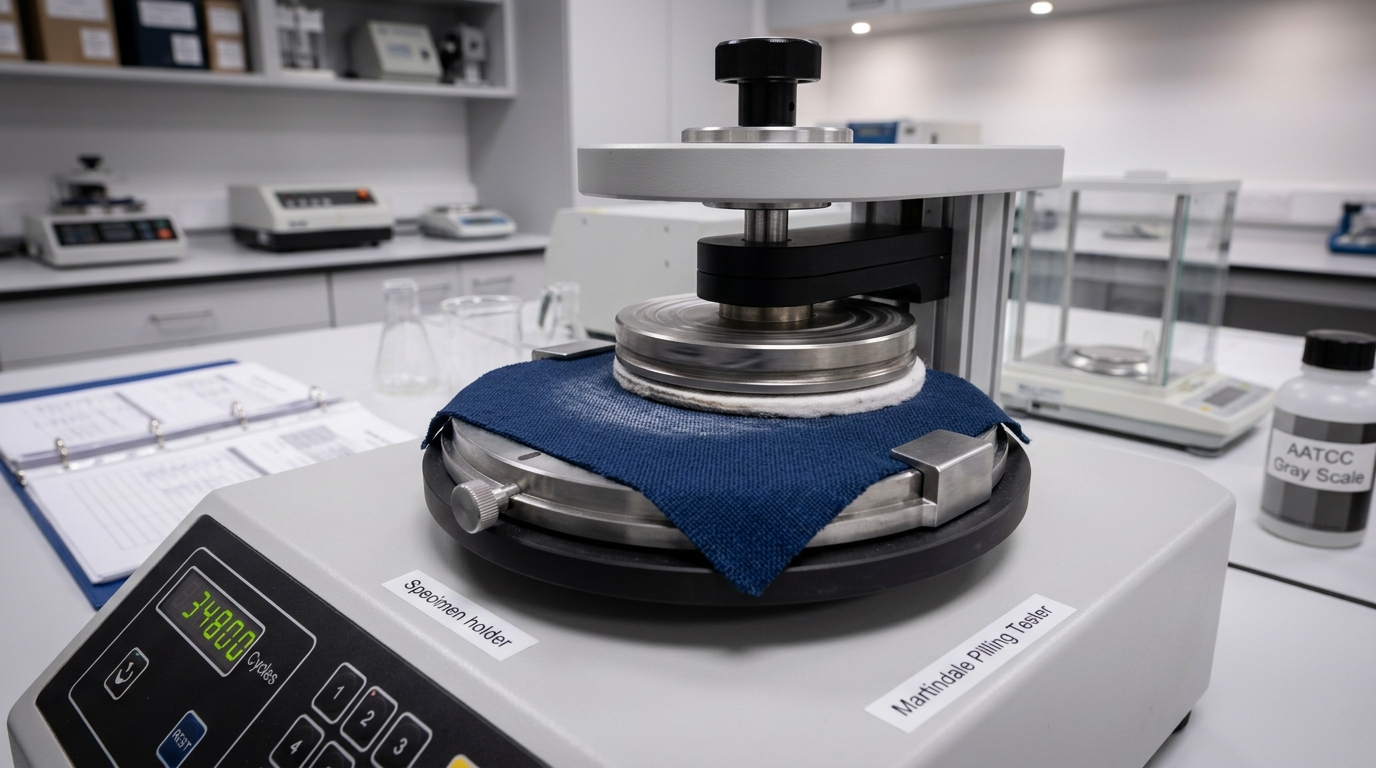
The Martindale Abrasion Test rubs a circular sample against an abrasive disc in a Lissajous figure motion. It’s brutal and highly repeatable. I’ve always preferred it for upholstery and heavy outerwear because it mimics the sustained, directional friction people actually experience when shifting in a chair or leaning against a counter. The Pilling Box Test, on the other hand, tumbles a fabric swatch inside a rotating drum lined with abrasive wool.
It excels with knits and apparel because the multi-axis tumbling replicates how garments rub against each other in a dryer or against backpack straps. The Random Tumble Pilling Test follows a similar drum concept but uses a specific temperature and rotation speed calibrated for lightweight synthetics. Every sample enters the machine conditioned at exactly 65% relative humidity and 20°C for twenty-four hours. Skip that step, and moisture content alone will skew your results by a full grade.
Once the cycle finishes, graders score the surface on a five-point scale. A five means the surface is pristine with zero visible pills. A four shows negligible fuzz. Three indicates light pilling that’s noticeable but not distracting. Two drops into moderate territory where pills are clearly visible and clustered. One is severe, with heavy fuzzing that obscures the base weave.
I remember a run of performance track pants where the initial batch scored a hard two. The client wanted a four. We tore into the decision process, weighing faster production speeds against yarn twist levels and chemical finishes. We tried bumping the twist, but the hand grew boardy. We tested a light singeing pass, which helped but left scorch marks on lighter shades.
Eventually, we compromised on a moderate twist increase paired with a targeted resin finish. It cost us twelve hours per batch and added marginally to the GSM, but the rebound score hit a solid four. The client kept it, and we learned that chasing perfect grades sometimes means accepting trade-offs in drape or cost. Lab reports typically turn around in one to three business days. If you’re sampling for a production run, build that window into your timeline.
When a mill wants to push a textile past its natural limits, they work backward from the loom. It starts with raw material selection. Filament polyester and nylon get blended in specifically to bind loose fibers. Long-staple cottons replace shorter alternatives whenever the target market expects premium longevity. Some suppliers even source modified fibers with cross-sectional grooves that physically lock neighboring strands together.
Yarn processing is where the real control happens. Mills will increase twist levels to bind fiber ends, though they have to watch the hand closely. Compact spinning has become the industry standard for anti-pilling because it condenses the yarn structure during drafting, pushing loose fibers inward before they can escape. Plying multiple singles together adds redundancy, and balanced Z/S twists prevent unraveling during wash cycles.
Once the fabric leaves the knitting or weaving stage, finishing treatments take over. Singeing passes the material over open flames or heated metal plates to literally burn off protruding fibers. It’s aggressive but incredibly effective on cottons and blends. Calendering runs the cloth through heated rollers to flatten the surface. Chemical anti-pilling treatments deposit a thin polymer layer that glues loose ends to the base fabric. Heat setting stabilizes synthetic structures so they don’t relax and shed later.
Quality control teams run batch testing against minimum grade thresholds. Sportswear lines usually demand a four or better. I’ve seen factories pull entire production runs over a half-grade drop because the client’s compliance sheet didn’t leave room for negotiation. If you’re looking at high-compression or performance base layers, you’ll notice how the supplier Functional Rib Compression lines handle repeated friction.
They typically combine mechanical singeing with a light resin crosslinker. This keeps the surface smooth without sacrificing stretch recovery. It’s a deliberate balance, not an accident. The mill adjusts the finish weight carefully so the fabric breathes while holding the polymer barrier in place. You only notice the difference once the garment survives its first winter of daily wear.
You don’t have to run a lab to spot resilient textiles. You just need to know where to look on a spec sheet. Always ask for the ISO 12945-2 pilling grade. If you’re sourcing for high-wear applications like activewear, work uniforms, or commercial upholstery, anything below a four is going to show wear faster than you want. Filament synthetic knits are your safest bet for daily abrasion.
Tightly woven twills and heavy denim hold up remarkably well because the dense structure physically traps fibers before they can migrate. Double-knit performance fabrics add an extra layer of stability that reduces surface movement. On the flip side, stay away from low-twist, single-ply knits unless you’re aiming for a deliberately vintage, slubbed look. Unbrushed short-staple cotton without a finishing treatment will fuzz within weeks of regular wear.
Always check product specifications for verified test reports. Vague claims like “long-lasting” or “premium feel” don’t hold up against a documented grade four score. When I’m spec’ing materials for a brand that expects heavy rotation, I lean heavily into Performance Functional Knits because the yarn architecture is built for abrasion from the start.
If moisture management is also in play, I’ll cross-reference with Antibacterial Fabrics to ensure the treatment process doesn’t compromise the anti-pilling finish. Some antimicrobial coatings actually increase surface friction if applied too heavily, so I always request a wash durability sample before committing to a bulk order. Fabric durability isn’t just about how something feels on day one. It’s about how the mechanical structure holds up when reality starts rubbing it the wrong way.
Even the best-constructed textile will eventually show wear if you treat it like a disposable. Washing habits dictate more longevity than most designers realize. Always run delicates on a gentle cycle with cold water. Hot water relaxes fiber tension and essentially primes the surface for migration. Turn everything inside out before loading the machine.
It exposes the seam allowances instead of the face fabric, taking the brunt of the drum friction. Stick to mild detergents without optical brighteners or aggressive enzymes. Skip the tumble dryer whenever possible. High heat weakens polymer chains and causes natural fibers to shrink and tighten, which pulls loose ends to the surface.
Air drying preserves the yarn structure and keeps the anti-pilling treatments intact. I can’t stress this enough: ditch the fabric softeners. They coat fibers with a waxy residue that actually increases surface friction over time, making pills form faster and stick harder. When pills do appear, grab a fabric shaver or a sweater stone. Never pull them by hand.
Yanking a pill drags more anchored fibers to the surface, creating a larger knot. Always separate heavy items like denim and towels from lightweight knits in your laundry loads. The abrasion difference is massive. Follow that routine, and you’ll easily double the visual lifespan of most knits. Simple discipline beats expensive finishes every single time.
Pilling is rarely a sign of poor quality. It’s just friction winning a slow mechanical argument with your yarn structure. When you understand the fiber mechanics, test standards, and finishing trade-offs, you stop guessing and start specifying with confidence. The best fabrics aren’t the ones that never show wear. They’re the ones designed to handle it gracefully, backed by honest testing and realistic care expectations.
Pick your materials like you’re building for Tuesday morning, not showroom Friday. The rest usually takes care of itself. Keep your twist levels honest, your finishes measured, and your wash cycles gentle. Your garments will thank you long after the first season ends.