Address
Nanlang Industrial Zone, Xingtan Town, Shunde District, Foshan, Guangdong, China
Work Hours
Mon–Fri, 9:00 AM – 6:00 PM (CST/UTC+8). We aim to respond to all inquiries within 48 hours.

Address
Nanlang Industrial Zone, Xingtan Town, Shunde District, Foshan, Guangdong, China
Work Hours
Mon–Fri, 9:00 AM – 6:00 PM (CST/UTC+8). We aim to respond to all inquiries within 48 hours.
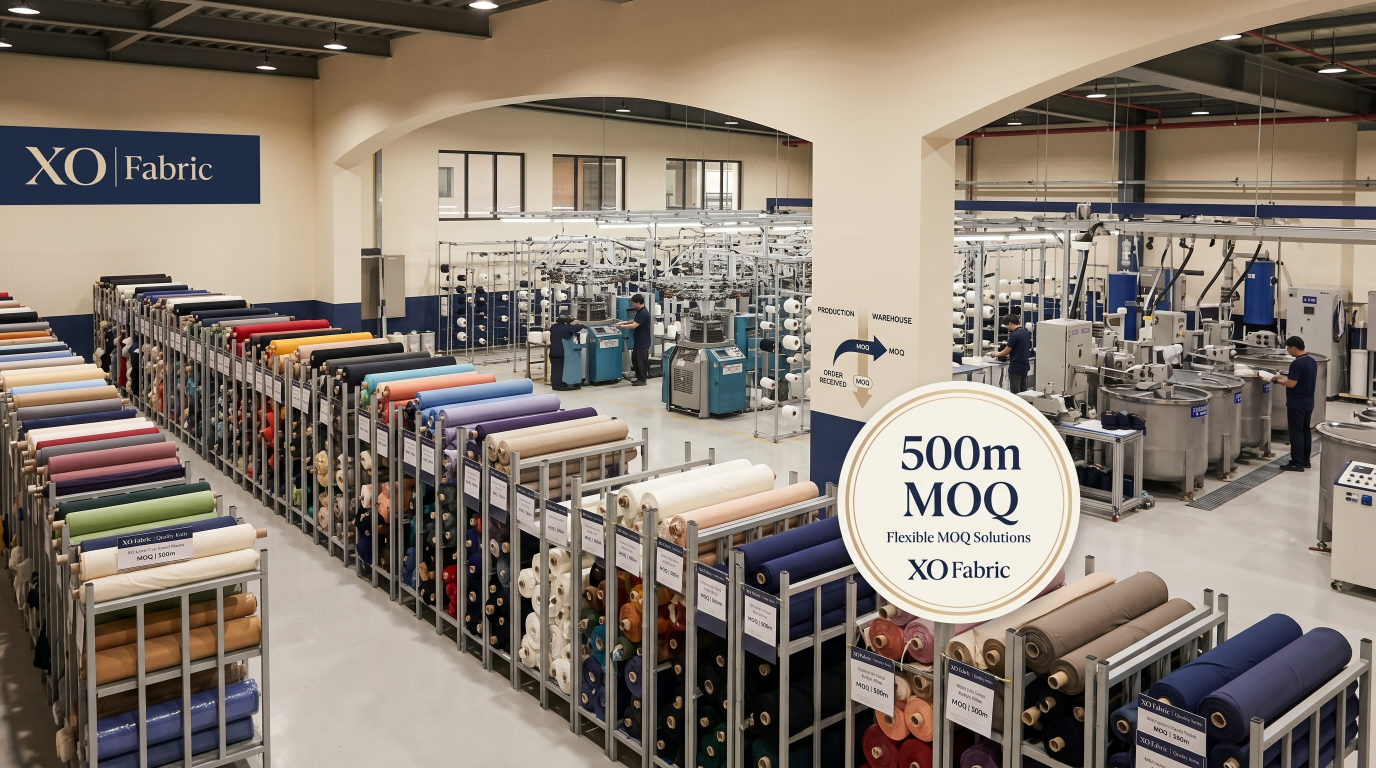
For apparel brands and clothing startups, Minimum Order Quantity (MOQ) can be both a blessing and a curse. While MOQs help manufacturers maintain efficiency and keep costs down, they can also create significant barriers for emerging brands with limited capital or uncertain demand.
Many new brands face a common dilemma: they need high-quality fabrics to build their reputation, but suppliers demand order quantities that exceed their current needs or budget. This often leads to overstocking, tied-up capital, or compromising on fabric quality.
Understanding MOQ strategies isn’t just about meeting supplier requirements—it’s about optimizing your entire supply chain, managing cash flow, and scaling your business sustainably. The wrong approach can drain your resources; the right strategy can give you a competitive edge.
In this comprehensive guide, we’ll explore what MOQ really means, how it varies by fabric type, proven strategies to reduce MOQ burden, how to calculate true cost per unit, negotiation tactics that work, and how XO Fabric’s flexible options can support your growth.
At its core, MOQ (Minimum Order Quantity) is the lowest quantity of a product that a supplier is willing to produce or sell in a single order. It’s not an arbitrary number designed to annoy small buyers. It exists because suppliers need to cover setup costs, minimize waste, and ensure production efficiency.
You’ll see MOQs expressed in meters or yards for fabrics, pieces for finished garments, or even as a monetary value. Sometimes you might encounter minimum order value (MOV), where the supplier cares less about the yardage and more about hitting a specific dollar threshold. Both serve the same purpose: ensuring the order is economically viable for the manufacturer.
It helps to look at this from the factory floor perspective. Why do they insist on 500 meters when you only want 100?
Not all MOQs are created equal. Understanding the structure helps you navigate negotiations.
For example, our Knit Base Fabrics have a 500m MOQ per color, which balances quality production with accessibility for growing brands. We believe in transparency here—knowing the rules upfront prevents awkward conversations later.
Realistic expectations start with knowing the industry standards for your specific material. Different fabrics have different mechanical constraints during production.
Standard MOQ: 500m per color
Basic knitting setup is efficient, but dyeing requires minimum bath sizes. If you’re making T-shirts, loungewear, or basics that sell in volume, this is your bread and butter. The risk is lower here because these styles tend to be evergreen. At XO Fabric, we leverage our 2,000㎡ warehouse with stock programs to reduce risk for these staples.
Standard MOQ: 300m per color/pattern
The flocking process has specific setup requirements involving adhesive application and fiber embedding. However, patterns can be produced efficiently once the screen is set. These are best for statement pieces, fashion-forward designs, or seasonal collections where trend velocity is high. Our in-house flocking production allows for better control and slightly lower thresholds than many competitors.
Our Flocked Printed Fabrics start at just 300m MOQ, making them ideal for brands wanting to test unique textures without overcommitting.
Standard MOQ: 400m per color
These require specialized knitting equipment. The open structure means more tension management during production. They are perfect for sportswear, lingerie, and overlay applications. Because the machinery is specialized, the setup time is distinct, hence the specific MOQ.
For sportswear and lingerie brands, our Mesh Net Knit Fabrics offer a 400m MOQ with excellent breathability and stretch properties.
MOQ varies: 500-1000m depending on finishing requirements
Think moisture-wicking, antibacterial, or UV-protection treatments. These require dedicated production lines and chemical baths. The higher MOQ reflects the higher value per meter and the technical complexity. If you’re building activewear, you pay for performance, and that comes with stricter manufacturing parameters.
| Fabric Type | XO Fabric MOQ | Industry Average | Best Use Case |
|---|---|---|---|
| Knit Base | 500m/color | 500-1000m | Basics, volume styles |
| Flocked/Printed | 300m/color | 300-800m | |
| Mesh/Net | 400m/color | 400-800m | Sportswear, lingerie |
| Performance | 500-1000m | 800-1500m | Technical apparel |
You don’t always have to meet the full MOQ head-on. There are practical, actionable strategies that brands can implement immediately to lighten the load.
Many suppliers, including us, maintain ready stock of popular base fabrics. Ordering from available stock allows you to bypass full MOQ requirements entirely. The trade-off? Limited color selection. But for testing fit or launching a MVP (Minimum Viable Product), immediate availability beats waiting 6 weeks for a custom dye lot.
Strategy: Use stock programs for testing, then move to custom colors at MOQ once you’ve validated sales.
This is one of my favorite tactics. Negotiate to mix multiple colors within the same MOQ. For instance, if the MOQ is 500m, ask if you can split it: 250m Navy, 150m Black, 100m Grey. Some suppliers allow “color families” where shades of blue count as one color for setup purposes.
Benefit: You test multiple colorways without doubling your financial commitment. Always discuss color mixing options during your initial inquiry.
It sounds risky, but partnering with complementary brands to share MOQ commitments works surprisingly well. Imagine two brands each taking 250m of the same base fabric in different colors. You split the setup cost.
Considerations: Requires trust, aligned timelines, and compatible quality standards. Alternatively, join sourcing groups or cooperatives where this pooling is already structured.
Negotiate a “first order discount MOQ” with a commitment to reorder. Some suppliers will offer reduced MOQ for confirmed follow-up orders. Example: “Order 300m now, commit to 500m within 6 months.” This shows intent and reduces their risk of a one-off buyer disappearing.
Never skip sampling. Order samples first to validate fabric quality and market demand. Some suppliers apply sample costs toward your first bulk order. Test with small quantities before committing to full MOQ. It’s cheaper to lose $50 on samples than $5,000 on deadstock.
Here’s where many brands get burned. They look at the price per meter and think they’re saving money by hitting a higher MOQ tier. But order quantity optimization requires looking at the total landed cost.
MOQ isn’t just about meeting minimums—it’s about cost optimization. True cost includes:
Example calculation: You buy 500m at $3/m = $1,500. But add shipping ($200), duties ($150), and storage ($50) = $1,900 total. Your cost per meter becomes $3.80, not $3.00. If you bought 1,000m at $2.50/m, the math changes, but so does the risk.
Higher MOQs often come with lower per-unit prices. But if you can’t sell or use the excess, the “savings” become losses. Run a break-even analysis. Calculate how much you need to sell to justify the higher MOQ.
If 500m at $3/m yields a profit, but 1,000m at $2.50/m sits in your warehouse for a year eating into your cash flow, the smaller order was actually more profitable.
Don’t ignore the hidden costs of inventory.
Formula: Total carrying cost = storage + capital cost + risk premium.
Find your “sweet spot” quantity: enough for efficiency, not too much for risk. Factor in sales velocity, seasonality, and storage capacity. Start conservative, scale up as you validate demand.
Negotiation isn’t about demanding; it’s about finding a win-win. Here’s how to prepare and execute.
Research industry standard MOQs for your fabric type. Know your numbers: realistic order volume, growth projections, and budget. Build a business case. Show the supplier you’re a growing brand with potential, not a hobbyist. Prepare to offer something in return: faster payment terms, longer-term commitment, or a larger first order after the trial.
Don’t lie about your order volume or intentions. Trust is hard to rebuild. Don’t be aggressive or demanding—relationships matter in textiles. Don’t negotiate on price AND MOQ simultaneously; pick one focus. And never accept quality compromises just to get a lower MOQ. Cheap fabric that fails QC is expensive in the long run.
Don’t burn bridges if they say no. Ask what WOULD work instead. Maybe they can’t lower the MOQ, but they can improve lead times.
Suppliers are more flexible with proven, reliable partners. Pay on time, communicate clearly, and respect their processes. Long-term relationships yield better terms, priority production, and access to new fabrics. For more advanced negotiation tactics, especially when dealing with Chinese manufacturers, read our dedicated guide on supplier negotiations.
We understand the challenges emerging brands face—we’ve been in the industry since 2005 and have seen brands grow from garage startups to established labels. Our MOQs are structured to be fair: 500m for knit bases, 300m for flocked, 400m for mesh.
We’re transparent about MOQs upfront—no hidden surprises or sudden increases. Our goal is to support brand growth while maintaining our own production efficiency.
Explore our Knit Base Fabrics with transparent 500m MOQ and stock program options.
Emerging brands often start with our stock programs, scaling to custom colors at MOQ once they find their footing. Mid-size brands use color mixing to test 3 colorways within one MOQ, reducing risk. Established brands leverage our efficient MOQs for faster collection turnaround. All benefit from our 20+ years of expertise, in-house production, and 50+ QC technicians.
Understanding and optimizing MOQ strategies is a critical skill for any apparel brand. From knowing what MOQs to expect by fabric type, to implementing strategies that reduce burden, calculating true costs, and negotiating effectively—each element helps you make smarter sourcing decisions that protect your cash flow and support sustainable growth.
At XO Fabric, we believe in transparent, fair MOQ structures that help brands grow. Whether you’re just starting out and need stock program flexibility, or you’re scaling up and optimizing bulk orders, our team is here to support your journey.
Ready to optimize your fabric sourcing strategy? Contact XO Fabric to discuss MOQ options and request samples.