Address
Nanlang Industrial Zone, Xingtan Town, Shunde District, Foshan, Guangdong, China
Work Hours
Mon–Fri, 9:00 AM – 6:00 PM (CST/UTC+8). We aim to respond to all inquiries within 48 hours.

Address
Nanlang Industrial Zone, Xingtan Town, Shunde District, Foshan, Guangdong, China
Work Hours
Mon–Fri, 9:00 AM – 6:00 PM (CST/UTC+8). We aim to respond to all inquiries within 48 hours.
How to Find a Fabric Manufacturer in China: A Buyer's Roadmap. This guide covers key properties, real-world applications, and a practical sourcing checklist for B2B buyers.

Imagine you’ve just received a 3,000-meter (3,280 yd) shipment of what was supposed to be a perfectly dyed, 180 gsm (5.3 oz/yd²) performance knit. You open the container, and the color is three shades off from the approved swatch. The lab tests show the weight is actually 165 gsm (4.9 oz/yd²). Your brand’s production line is halted, and you’re staring at a direct loss of over $8,000. This isn’t a hypothetical; it’s a story that plays out too often. The core lesson is simple: finding the right manufacturer is infinitely more valuable than finding the lowest price. This guide, written from two decades on the factory floor, gives you the actionable roadmap to avoid that scenario.
The China fabric market is a titan. It consistently accounts for over 50% of global textile exports, a staggering figure that underscores its central role in the supply chain for everything from fast fashion to technical sportswear. But this scale creates a paradox for buyers. On one side, you have immense capacity and competitive pricing. On the other, a fog of information asymmetry where trust is the hardest commodity to find.
For a first-time buyer trying to navigate how to find fabric manufacturer in china, the landscape is littered with pitfalls. The most common mistakes aren’t about technical specs, but about foundational assumptions.
This roadmap is designed to cut through that noise. We’ll walk through a systematic process—from initial search to final shipment—equipping you with the questions to ask, the red flags to spot, and the verification steps that separate professional partnerships from costly experiments.
Knowing where to look is the first filter. Each channel for sourcing in the China fabric market has its own profile of risk, reward, and effort. Your strategy should combine multiple channels to triangulate the best candidates.
| Channel | Pros | Cons | Best For |
|---|---|---|---|
| B2B Platforms (e.g., Alibaba) | Vast supplier database; convenient initial filtering. | High mix of traders and factories; certification verification is your responsibility. | Initial market reconnaissance and generating a long list. |
| Industry Trade Shows (e.g., Intertextile Shanghai) | Face-to-face interaction; ability to touch and feel fabrics; direct access to factory sales teams. | High travel and time cost; limited to show dates. | Deep-dive evaluation for mid-to-large volume partnerships. |
| Vertical Directories / Association Listings | Often pre-vetted by an industry body; higher baseline credibility. | Can be outdated; narrower range of specialties. | Finding niche specialists, e.g., specific cotton fabric manufacturers in china for apparel. |
| Factory Website Direct Inquiry | Most transparent information; direct communication with the source. | Requires you to independently verify all claims. | Targeted outreach when you already know your required fabric category. |
A quick search for “Top 10 textile companies in China” will yield lists dominated by massive, vertically integrated conglomerates or synthetic fiber giants. These are impressive industrial entities, but they are often not the right partners for a brand needing 500 meters (547 yd) of a specialized, functional knit. Their MOQs can be astronomical, and their focus is on commodity-scale production.
The real skill is filtering for match, not mass. Here’s a more effective approach than chasing a generic top-10 list:
This is the step most buyers rush, and it’s where the most expensive mistakes are made. Verification isn’t a single action; it’s a multi-layered process. I recommend the “Three Documents, Three Verifications” framework as a minimum standard.
Certain behaviors are universal warning signs in the world of China fabric clothes sourcing. If you encounter any of these, proceed with extreme caution or simply walk away:
It’s important to note that not all traders are bad actors. Some add genuine value through consolidated sourcing, quality control, and logistics. The key is transparency. You must know whether you are dealing with the factory or an intermediary, and price your expectations accordingly. For a clear example of how a legitimate manufacturer presents its credentials, you can review a sample factory profile page that details its history, integrated production lines, and certification matrix. This kind of transparency is what you should be looking for.
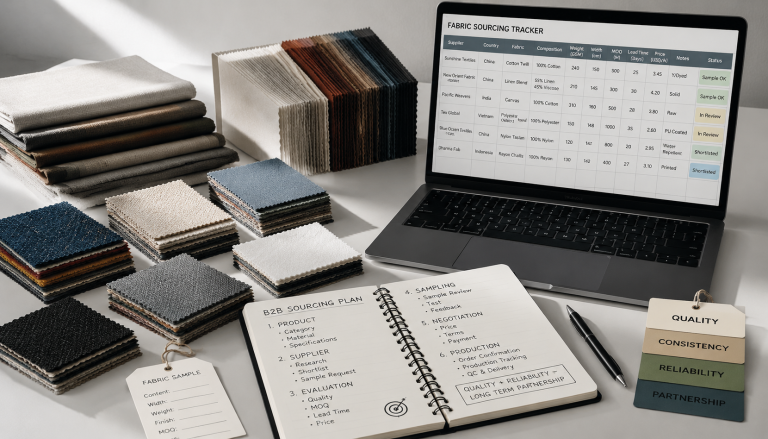
Once you have a shortlist of 3-5 potential suppliers, a structured process is essential for moving from inquiry to order. This is the core of how to find fabric manufacturer in china and build a reliable partnership. Here is an 8-step SOP that works.
Your sample isn’t just about color and feel. It’s a data set. For a functional knit, you should be testing for weight consistency (GSM deviation should be ≤ ±5%), width stability, shrinkage after washing, and colorfastness to washing, rubbing, and light. Don’t rely on a hand-feel judgment alone. Require your supplier to provide the corresponding test report for the sample. For a deep dive into the standards and methods behind these tests, a manufacturer’s technical knowledge base can be an invaluable resource for building your own evaluation protocol.
Let’s dispel the myth that sourcing from the China fabric market means rock-bottom prices and tiny quantities. Realistic commercial terms reflect real costs of production, compliance, and business sustainability. Here’s what to expect for common categories.
| Parameter | Typical Range | Notes |
|---|---|---|
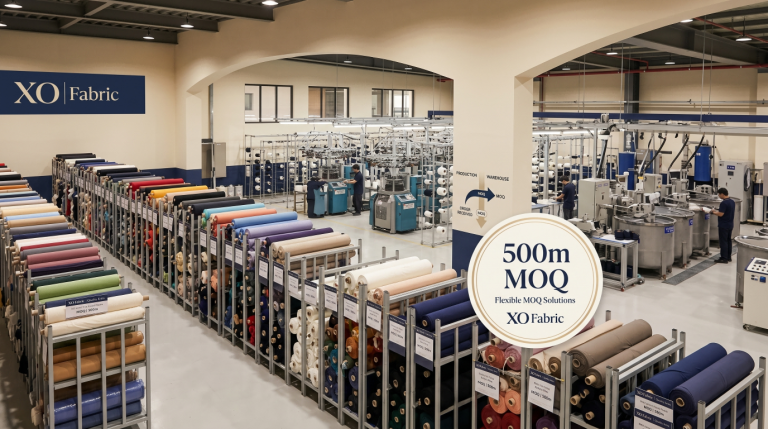
| Knit/Performance Fabric MOQ | 300–500 m (328–547 yd) | Quantities below this often incur a 10–20% surcharge to cover machine setup and dye lot minimums. |
| Mesh/Net Fabric MOQ | 400 m (437 yd) | Higher due to greater weaving waste and complexity. |
| Flocked/Printed Fabric MOQ | 300 m (328 yd) | Driven by minimum runs for the finishing process (flocking, printing screens). |
| Lead Time (Stock Items) | 3–7 business days | Only for popular, standard items kept in inventory. |
| Lead Time (Custom Orders) | 10–20 business days | Clock starts after sample approval. Includes dyeing and finishing. |
| Payment Terms | T/T 30/70 | 30% deposit to start, 70% before shipment. L/C at Sight for orders over $5,000 is sometimes negotiable. |
Remember, the quoted price is typically FOB (Free On Board). This means the cost of ocean freight, destination port charges, customs clearance, and import duties are your responsibility. These can add 15-25% to your landed cost, depending on your country’s tariff schedule (HS code) and logistics choices. Always calculate your total cost, not just the fabric price. When you have a clear spec and are ready for a precise quotation, engaging a supplier directly through their official contact channel is the most efficient way to get a custom quote without intermediary markups.
Even with the best verification, risks exist. Proactive management in your contracts and processes is what separates a hiccup from a disaster, especially in the realm of China fabric clothes production where consistency is king.
Let’s look at a real-world trial-and-error scenario. A European sportswear brand needed a supplier for moisture-management knit fabric with OEKO-TEX certification. They received two quotes: Factory A was 12% cheaper but only had ISO 9001 and no dedicated functional fabric line. Factory B had the full line and certification but demanded an 800 m (875 yd) MOQ and a 5-day longer lead time.
Seduced by the price, they chose Factory A for a 2,000 m (2,187 yd) trial. The result? The fabric’s moisture-wicking performance tested at only 60% of the claimed specification, and the supplier couldn’t provide a valid third-party test report. The entire batch was rejected, resulting in a loss of approximately $6,500 and a production delay.
They then turned to Factory B, accepting the higher MOQ and longer lead time. The fabric arrived with full documentation, performed exactly to spec, and passed all compliance checks. The long-term partnership that followed actually reduced their overall cost by 18% due to zero returns, no rework, and improved brand reputation for quality. The lesson: a quote that is significantly below market rate is a question, not an answer. Always ask: what’s missing?
This checklist distills the entire roadmap into a actionable format. Use it to ensure no critical step is missed when you’re learning how to find fabric manufacturer in china and build a reliable supply chain.
| Phase | Checklist Item | Status |
|---|---|---|
| Requirement Prep | Technical Specification Sheet (composition, GSM, width, color, end-use) | ☐ |
| Factory Screening | Business License + Certification Certificates + Recent Test Reports | ☐ |
| Sample Verification | Physical Tests + Colorfastness + Third-Party Lab Report | ☐ |
| Commercial Negotiation | MOQ / Price / Lead Time / Payment Terms / Incoterms | ☐ |
| Contract Signing | Color Tolerance / Delay Penalty / IP Clauses / NDA | ☐ |
| Bulk Production QC | Pre-Shipment Inspection / Third-Party Inspection Report | ☐ |
In the requirement prep phase, precision is everything. A miscalculation on weight can derail your entire cost structure. To avoid this, you can use an online fabric GSM calculator to quickly convert between metric (gsm) and imperial (oz/yd²) units, ensuring your tech pack is accurate from the start.
Absolutely, but it’s a process governed by regulations. You need to be aware of three key things: 1) Your destination country’s import laws (e.g., EU REACH for chemical compliance, US CPSIA for children’s products). 2) The correct HS code for your fabric type, which determines the tariff rate. 3) Your supplier’s ability to provide all necessary compliance documentation. Starting with a small trial order is the wisest approach for first-time importers.
The most effective method is a hybrid approach. Use B2B platforms for initial discovery and long-listing. Attend a major trade show like Intertextile for hands-on evaluation and direct contact. Supplement this with targeted searches in vertical directories or by finding factory websites directly. The goal is to move from a broad search to a shortlist of 3-5 verified candidates for deep evaluation.
At a minimum, look for OEKO-TEX Standard 100 for product safety and ISO 9001 for quality management systems. If your products use recycled content, GRS (Global Recycled Standard) is essential. For the European market, ensure they can provide REACH compliance documentation. The specific certifications needed always depend on your final product’s end-use and destination market. When evaluating a supplier’s capabilities in technical textiles, browsing their product category for performance and functional knits can give you a concrete sense of whether their production line aligns with your needs.
Finding the right fabric manufacturer in China is less about luck and more about disciplined process. It’s about moving from a price-driven search to a value-driven partnership. The roadmap outlined here—from rigorous verification to structured sourcing and proactive risk management—is designed to protect your investment and your brand’s reputation. The goal isn’t just to find a supplier, but to find a partner who can grow with you, consistently delivering the quality and reliability your business depends on. Take the time to build that foundation correctly, and it will pay dividends for years.