Address
Nanlang Industrial Zone, Xingtan Town, Shunde District, Foshan, Guangdong, China
Work Hours
Mon–Fri, 9:00 AM – 6:00 PM (CST/UTC+8). We aim to respond to all inquiries within 48 hours.

Address
Nanlang Industrial Zone, Xingtan Town, Shunde District, Foshan, Guangdong, China
Work Hours
Mon–Fri, 9:00 AM – 6:00 PM (CST/UTC+8). We aim to respond to all inquiries within 48 hours.
How to Import Fabric from China: Step-by-Step for First-Time Buyers. This guide covers key properties, real-world applications, and a practical sourcing checklist for B2B buyers.
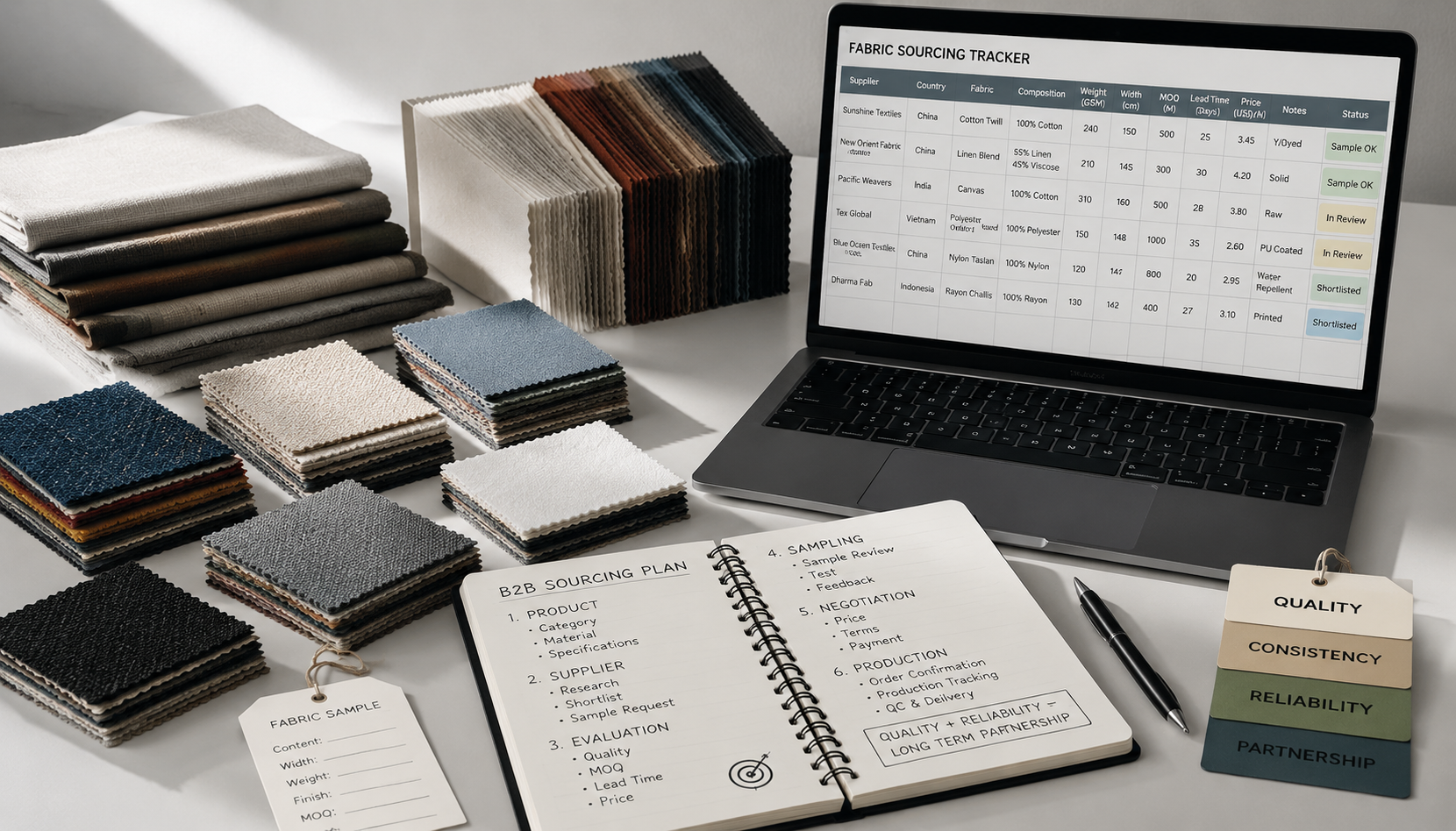
一个欧洲买家在2023年首次从中国进口面料,因未确认OEKO-TEX认证批次号,整柜12,000 m (13,124 yd)的弹力网布在目的港被海关扣留47天,额外产生仓储费€3,800。这篇文章不是泛泛的”中国市场介绍”——它是一份基于20年工厂端经验、按采购流程逐步拆解的实操SOP,帮你在下单前就规避这类代价高昂的失误。
Let’s be honest: the China fabric market is enormous. According to China’s General Administration of Customs data, textile and apparel exports consistently exceed $300 billion annually, making it the world’s largest supplier by a wide margin. For a first-time buyer, that scale feels like a goldmine — until you realize it also means thousands of weaving mills, dyeing houses, and trading companies competing for your attention, each with different capabilities, certifications, and quality standards.
The real problem isn’t finding a supplier. It’s filtering through the noise to find one that actually matches your technical requirements, compliance needs, and budget constraints. I’ve watched buyers spend three months just on initial outreach — sending inquiries to 40+ factories, receiving wildly inconsistent quotes, and still feeling uncertain about who to trust.
Fabric in China is not a commodity you can source on autopilot. It demands structured evaluation, and that’s exactly what this guide provides.
When we talk about how to import fabric from China, we’re really talking about a seven-stage pipeline. Each stage has its own decision points, risk factors, and documentation requirements. Miss one, and the downstream consequences multiply fast.
This article walks through every one of these nodes. Not theory — the kind of operational detail that separates a smooth first order from a six-week headache.
The single biggest mistake first-time buyers make is sending vague inquiries. “We need stretch mesh, medium weight, good quality” — that kind of language invites miscommunication. A professional spec sheet eliminates ambiguity by converting every design intent into a physical, measurable value.
Here’s what a proper specification sheet must include. I’ve seen too many projects derail because one of these fields was missing or left to subjective interpretation.
| Field | Example Value | Metric | Imperial |
|---|---|---|---|
| Composition | Polyester / Spandex | 82/18% | 82/18% |
| Weight (GSM) | 135 gsm | 135 g/m² | 4.0 oz/yd² |
| Width | 57/58″ | 145–147 cm | 57–58 in |
| Construction | Warp-knit power-net | — | — |
| Colorfastness (Washing) | Grade 4+ | ISO 105-C06 | AATCC 61 |
| Tensile Strength | ≥ 180 N | ISO 13934-1 | ASTM D5035 |
| Finish | Moisture-wicking, anti-pilling | — | — |
Notice how every row points to a specific test standard. That’s intentional. When you specify “colorfastness Grade 4+ per ISO 105-C06,” the factory knows exactly which testing protocol to follow. When you write “nice color,” you’re inviting a subjective interpretation that will haunt you at the pre-shipment inspection stage.
If you’re sourcing from categories like performance functional knits — moisture-wicking, antibacterial, thermal-regulating fabrics — the spec sheet becomes even more critical because performance claims require lab verification. You can explore different functional knit categories and their typical parameter ranges to understand how specifications vary across fabric types.
This is where China fabric clothes sourcing gets legally complex. Different destination markets enforce different chemical and safety standards, and ignorance is not a defense at customs.
For European Union imports, REACH Regulation Annex XVII restricts specific substances — formaldehyde limits, azo dye bans, heavy metal thresholds. For the US market, CPSIA (Consumer Product Safety Improvement Act) governs children’s products with lead and phthalate limits. And globally, OEKO-TEX Standard 100 remains the most widely recognized safety certification for textiles.
The critical point: do not wait until shipment to verify certifications. Demand the factory’s current OEKO-TEX certificate number during your first inquiry, and cross-reference it on the OEKO-TEX official verification portal. A certificate issued three years ago may have expired. A certificate held by the weaving mill may not cover the dyeing house that processed your order. These distinctions matter enormously.
For a deeper dive into certification frameworks and what each standard actually tests for, the manufacturer’s knowledge base on fabric technical standards and certification systems provides detailed breakdowns that go well beyond what most buyer guides cover.
When buyers ask “where to buy fabric from China,” the answer depends entirely on their order volume, technical complexity, and risk tolerance. Each sourcing channel has distinct advantages — and distinct pitfalls.
| Channel | Advantages | Disadvantages | Best For |
|---|---|---|---|
| B2B Platforms (Alibaba, Made-in-China) | Massive supplier database; easy initial contact; price transparency | Mix of factories and trading companies; certification claims often unverified; lowest-price race to bottom | Small orders (<1,000 m / 1,094 yd); commodity fabrics; initial market exploration |
| Trade Shows (Intertextile Shanghai, Canton Fair) | Face-to-face evaluation; physical sample comparison; direct factory relationships | Travel costs; limited to exhibitors; show pricing may differ from production pricing | Mid-volume orders (1,000–10,000 m / 1,094–10,936 yd); custom development; building long-term partnerships |
| Factory-Direct (Referrals, Industry Networks) | Full production chain visibility; no middleman markup; direct QC communication | Harder to find without existing network; requires more due diligence upfront | High-volume orders (>5,000 m / 5,468 yd); technical fabrics; ongoing supply relationships |
I’ll be direct: for first-time buyers learning how to import fabric from China, the temptation is to start on Alibaba because it feels safe and familiar. And for basic, low-risk orders, that’s reasonable. But the moment you need functional performance fabrics with specific certifications and tight Fabric GSM Calculator tolerances, factory-direct sourcing becomes significantly more reliable — because you’re dealing with the actual production team, not a trading company that may subcontract your order to an unknown mill.
The China fabric market rewards skepticism. Here are the warning signs that experienced buyers treat as deal-breakers, not yellow flags.
On the positive side, look for factories that can demonstrate an integrated production chain — weaving, dyeing, and finishing under one roof — along with a substantial finished goods warehouse, current OEKO-TEX and ISO certifications, and a track record spanning at least a decade. A facility like the one profiled on its about page, which has operated since 2005 with a 2,000 m² (21,528 ft²) stock warehouse and full vertical integration, represents the kind of operational maturity that reduces first-order risk substantially.
Sampling is where your spec sheet gets tested against reality. There are three distinct sample types, and each serves a different verification purpose.
Lab-dip is a small color swatch — typically 10 cm × 10 cm (4″ × 4″) — dyed to match your target Pantone or color standard. It confirms the dyeing house can reproduce your color within an acceptable tolerance (usually ΔE ≤ 1.0 on a spectrophotometer). Expect 5–7 business days and a cost of $15–$30 per color.
Strike-off applies to printed fabrics. It’s a full-width trial print that verifies pattern registration, color accuracy, and hand feel after printing. Lead time runs 7–10 business days; costs range $50–$150 depending on print complexity.
Proto sample (or hand-feel sample) is a full-width, production-representative swatch — usually 1–2 m (1.1–2.2 yd) — that lets you evaluate the actual fabric weight, stretch recovery, drape, and surface texture. This is the sample that matters most. Request it with the factory’s test report attached, showing GSM, width, and colorfastness results from that specific production batch.
One thing I always insist on: the proto sample must be cut from the same yarn lot and processed through the same dyeing line that will handle your bulk order. I’ve seen cases where the sample was perfect but bulk production used different yarn suppliers, resulting in a GSM deviation of 8–12% — enough to ruin garment fit and trigger customer returns.
Not every order justifies a factory visit. But certain triggers should make it non-negotiable.
During the visit, focus on four dimensions: equipment inventory and whether it matches the claimed capacity; QC process documentation (do they have written inspection protocols, or is it all verbal?); storage conditions (humidity-controlled for sensitive fabrics? organized by order?); and environmental compliance (wastewater treatment, chemical storage safety).
When you receive a quotation from a China fabric supplier, you’re looking at a number that bundles multiple cost layers. Understanding those layers gives you negotiating leverage — and helps you spot when a price is suspiciously low.
| Category | Typical Price Range (FOB) | Key Price Drivers |
|---|---|---|
| Basic knit fabrics (jersey, rib) | $1.80–$3.50/m ($1.65–$3.20/yd) | Yarn type, GSM, order volume |
| Functional performance knits | $3.00–$6.50/m ($2.74–$5.94/yd) | Specialty yarns, finish complexity, certification requirements |
| Power-net / mesh fabrics | $2.50–$5.00/m ($2.29–$4.57/yd) | Construction density, spandex content, width |
| Flocked / printed fabrics | $4.00–$8.00/m ($3.66–$7.32/yd) | Print colors, flock density, pattern complexity |
The raw material component typically accounts for 50–65% of the total price. Weaving or knitting adds 15–20%. Dyeing and finishing contribute another 10–15%. The remaining 5–10% covers packaging, testing, and the factory’s margin. Cotton futures, spandex spot prices, and dye chemical costs all fluctuate — sometimes weekly — which is why quotes usually carry a validity period of 15–30 days.
Understanding industry-standard commercial terms helps you separate reasonable expectations from wishful thinking. Here’s what to expect — and where there’s room to negotiate.
| Term | Industry Standard | Negotiation Room | Hard Bottom Line |
|---|---|---|---|
| MOQ — Knit/Functional | 500 m (547 yd) | First orders sometimes accepted at 300 m (328 yd) with surcharge | Below 300 m is rarely viable for dyeing economics |
| MOQ — Mesh/Net | 400 m (437 yd) | Stock colors available at lower MOQs | Custom colors require minimum dye lot volumes |
| MOQ — Flocked/Printed | 300 m (328 yd) | Screen setup costs make very small runs expensive per meter | Print complexity directly impacts minimum viable volume |
| Lead Time — Stock | 3–5 business days | Same-day dispatch possible for in-stock items | Depends entirely on warehouse inventory levels |
| Lead Time — Custom | 10–20 business days | Longer for specialty finishes; shorter for repeat orders | Yarn sourcing alone can add 5–7 days |
| Payment — Samples | PayPal or credit card | Sample fees often credited against first bulk order | Free samples rare for custom development |
| Payment — Bulk | T/T 30% deposit / 70% before shipment | L/C at Sight for orders >$5,000; some factories accept 20/80 | 100% post-shipment payment is virtually unheard of for new buyers |
A practical tip: if you’re committing to a long-term relationship with a supplier, negotiate framework agreements that lock in pricing for 6–12 months with quarterly volume commitments. This protects you from raw material price spikes while giving the factory production planning stability. Both sides benefit.
Quality control is not a single event — it’s a spectrum of interventions that you calibrate based on order size, fabric complexity, and your trust level with the supplier.
In-line inspection happens during production. A QC inspector visits the factory floor while fabric is being woven, dyed, or finished, checking parameters in real-time. This approach catches problems early — before 5,000 m (5,468 yd) of off-spec fabric is produced. It’s most valuable for large orders exceeding 5,000 m (5,468 yd), first-time production runs, or fabrics with tight tolerances (GSM ±3%, width ±1 cm / 0.4 in).
Pre-shipment inspection (PSI) occurs when production is 80–100% complete. An inspector randomly samples finished rolls — typically following AQL 2.5 standards — and checks for defects including color variation between rolls, GSM deviation, width inconsistency, surface defects (holes, stains, oil marks), and colorfastness via quick-test methods.
For orders under 3,000 m (3,281 yd) with a trusted supplier, PSI alone is usually sufficient. For larger or riskier orders, combining in-line and pre-shipment inspections provides the best protection. Third-party agencies like SGS, Bureau Veritas, and Intertek all offer textile-specific inspection packages — expect costs of $300–$600 per inspection day, depending on location and scope.
The logistics stage is where many first-time importers of China fabric discover unexpected costs and delays. Getting your Incoterms and documentation right from the start prevents most of these surprises.
Incoterms selection determines who bears responsibility — and cost — at each stage of transit. FOB (Free on Board) Shenzhen or Guangzhou is the most common term for China textile exports: the factory delivers goods to the port and handles export customs; you arrange ocean freight and import clearance. CIF (Cost, Insurance, Freight) adds shipping and insurance to the factory’s responsibility. DDP (Delivered Duty Paid) means the supplier handles everything to your door — convenient but expensive, and you lose control over carrier selection.
For most first-time buyers, FOB is the recommended starting point. It gives you visibility into freight costs (which you can optimize independently) while keeping export-side logistics with the factory.
Freight comparison: Ocean freight for a standard 20-foot container (approximately 15,000–18,000 m / 16,404–19,685 yd of rolled fabric) from Shenzhen to Rotterdam runs $1,500–$3,000 with a transit time of 25–35 days. Air freight for the same volume would cost $8,000–$15,000 but arrives in 3–5 days. For orders under 500 kg (1,102 lb), air courier (DHL, FedEx) at $6–$10/kg may be more practical than consolidating an ocean shipment.
Essential documentation checklist:
Missing any one of these documents can result in customs holds, demurrage charges, or — in the worst case — shipment rejection. Build this checklist into your order confirmation process so the factory prepares everything before goods leave the warehouse.
This case follows a European fast-fashion apparel brand with annual fabric spend around €200,000, entering the activewear segment for the first time. They needed 8,000 m (8,749 yd) of power-net elastic fabric with specific compression and breathability requirements — a technical product, not a commodity.
The buyer started on Alibaba, where they found a supplier offering the fabric at $2.40/m — roughly 30% below the market average for this construction. The price was seductive. The supplier’s page showed professional photos, claimed OEKO-TEX certification, and promised 7-day lead times. What the buyer didn’t notice: the “certification” was a scanned image with no verifiable certificate number, and the “factory” was actually a trading company subcontracting to an unnamed mill.
The first sample arrived six weeks later. Problems were immediately apparent. The GSM measured 180 gsm (5.3 oz/yd²) instead of the specified 135 gsm (4.0 oz/yd²) — a 33% deviation that would have made the compression garments uncomfortably stiff. The colorfastness test came back at Grade 2–3 (on the ISO grey scale), far below the Grade 4+ required for activewear that undergoes frequent washing. Total cost of this failed experiment: six weeks of lost development time and €1,200 in re-sampling fees.
After this setback, the brand shifted strategy. They contacted an established manufacturer with 20 years of production history and a fully integrated weaving-dyeing-finishing line. The unit price was 18% higher at $2.83/m. The lead time was 15 business days instead of the original supplier’s promised 7. But the factory provided verifiable OEKO-TEX Standard 100 certification, submitted a detailed test report with the proto sample showing GSM at 135 gsm (4.0 oz/yd²) with ±3% tolerance, and demonstrated consistent colorfastness at Grade 4–5.
The compromise was real — higher cost, longer wait. But the bulk order landed on specification, on time, with every roll within the agreed tolerance band. The brand’s first activewear collection launched successfully, and the supplier relationship has continued for three subsequent seasons.
Use this checklist as a gate-keeping tool. Every item should be confirmed before you move to the next stage of the procurement process.
What is the minimum order quantity for fabric from China?
It varies by category. Standard knit and functional fabrics typically require 500 m (547 yd); mesh and power-net fabrics start at 400 m (437 yd); flocked and printed fabrics may accept 300 m (328 yd). Some factories will accept lower quantities for stock colors with a per-meter surcharge of 10–15%.
How long does sampling take?
Lab-dips take 5–7 business days. Proto samples with full test reports take 7–15 business days depending on fabric complexity. If the factory needs to source specialty yarn, add another 5–7 days. Budget 3–4 weeks from inquiry to evaluated sample in hand.
How do I verify a supplier’s OEKO-TEX certification?
Request the certificate number and check it directly on the OEKO-TEX website. Valid certificates show the certified product scope, the issuing institute, and the expiration date. If the supplier cannot provide a certificate number — or if the number returns no results — treat it as a disqualifying red flag.
Is FOB or CIF better for first-time importers?
FOB is generally recommended because it gives you control over freight forwarder selection and shipping costs. CIF bundles these costs into the supplier’s price, which can obscure the true cost breakdown. However, if you have zero experience with international logistics, a CIF or DDP arrangement with a trusted supplier reduces complexity for your first shipment.
What happens if the bulk fabric doesn’t match the approved sample?
This depends entirely on your contract terms. A well-written purchase agreement should specify acceptable tolerance ranges (e.g., GSM ±5%, color ΔE ≤ 1.5) and remedies for non-conformance — typically re-production at the factory’s cost, price reduction, or order cancellation with deposit refund. Always include these terms before placing your order.
Can sample fees be deducted from the bulk order?
Many factories — including the one referenced earlier — will credit sample fees against your first bulk order. This is a common goodwill practice, especially for custom development samples. Always confirm this policy in writing before paying for samples.
For buyers ready to take the next step, the manufacturer’s contact page supports technical specification file uploads, and their engineering team commits to responding within 24 hours with feasibility assessments and pricing. It’s a practical starting point whether you’re sourcing a specific product or exploring options across the full range of performance functional knits.
Importing fabric from China for the first time is not inherently risky — it’s unpredictably risky when you approach it without structure. The buyers who get burned are almost always the ones who skipped the spec sheet, trusted unverified certifications, or chose the cheapest quote without understanding what was sacrificed to hit that price.
The process outlined here — from requirement definition through sampling, negotiation, QC, and logistics — is not theoretical. It’s the operational reality of how professional buyers manage China fabric sourcing at scale. The details matter: a GSM tolerance of ±3% versus ±10%, a valid OEKO-TEX certificate number versus a scanned PDF, a 30% deposit structure versus 100% prepayment. These small differences compound into the gap between a smooth first order and a six-month learning experience you’d rather forget.
Start with a clear spec sheet. Verify everything twice. And remember that the cheapest option in the China fabric market is almost never the most affordable one once you account for the cost of getting it wrong.