Address
Nanlang Industrial Zone, Xingtan Town, Shunde District, Foshan, Guangdong, China
Work Hours
Mon–Fri, 9:00 AM – 6:00 PM (CST/UTC+8). We aim to respond to all inquiries within 48 hours.

Address
Nanlang Industrial Zone, Xingtan Town, Shunde District, Foshan, Guangdong, China
Work Hours
Mon–Fri, 9:00 AM – 6:00 PM (CST/UTC+8). We aim to respond to all inquiries within 48 hours.
Fabric Sourcing Agent vs Direct: Cost, Risk & Which to Choose. This guide covers key properties, real-world applications, and a practical sourcing checklist for B2B buyers.
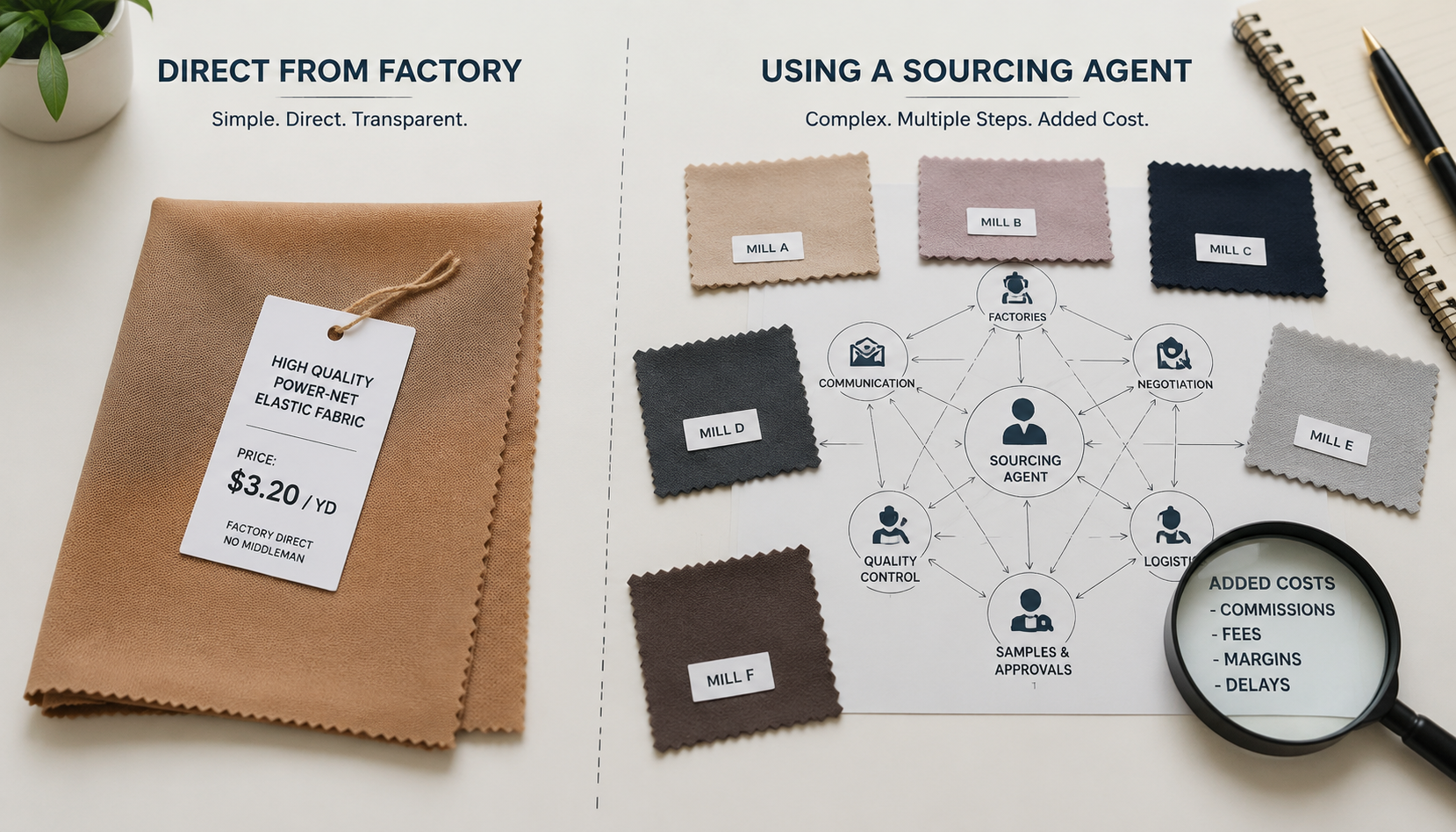
Imagine you’ve just landed your first major order for a new performance fabric line. You find a supplier online with a quote 15% lower than everyone else. Excited, you wire the deposit for 5,000 meters of technical knit. Three months later, you’re staring at a container of fabric that’s two shades off your approved color swatch, with a shrinkage rate that fails your brand’s internal standards. The factory blames your spec sheet; you blame their QC. The final bill for rework, air freight to meet your retail launch date, and a third-party inspection you had to arrange yourself? Over $4,000. This scenario plays out weekly in the world of B2B textile procurement, and it’s the core reason the debate between using a sourcing agent and going direct sourcing matters more than just saving a few percentage points on paper.
The sticker price on a fabric quote is just the tip of the iceberg. Industry analyses consistently show that failures in the textile supply chain—ranging from quality defects to compliance missteps—can inflate total project costs by 15-25%. This isn’t about being unlucky; it’s about supply chain risk being baked into the process when you don’t have the right oversight. A delayed shipment due to failed customs inspection or a batch rejected by your end-client doesn’t just cost you money on that order; it damages your brand’s reputation and can derail future collections.
Common, costly failures include:
This is where the concept of Total Cost of Ownership (TCO) becomes your best friend. TCO looks beyond the unit price to include every expense incurred from the moment you place an order to the moment the fabric is approved in your warehouse. For direct sourcing, this includes international travel for factory audits, fees for third-party quality inspections, the man-hours spent on technical communication and troubleshooting, and the financial risk of quality claims that can take months to settle. A sourcing agent’s fee, typically a 5-10% commission, often covers a suite of these services, effectively bundling risk management into the cost.
Let’s break down a simplified TCO comparison for a hypothetical 5,000-meter order:
| Cost Component | Direct Sourcing Path | Agent Path (Typical) |
|---|---|---|
| Unit Price (per meter) | $8.00 | $8.60 (includes agent margin) |
| Audit/Inspection Fees | $1,200 (third-party) | $0 (included in service) |
| Technical Communication | ~40 hours of internal labor | Managed by agent |
| Contingency/Rework Risk | High (buyer bears 100%) | Lower (agent shares accountability) |
As you can see, the direct path’s lower unit price can be completely eroded by the hidden costs of managing the process yourself. This is the fundamental trade-off in fabric sourcing.
Case Study: The €200K Lesson in Due Diligence
A European outdoor brand with about €200,000 in annual fabric spend decided to bypass their agent for a new line of stretch woven fabric, aiming to save the 8% commission. They found a factory through an online platform and placed an order for 5,000 meters. Without conducting an in-person audit—they relied on photos and a video call—they missed critical red flags about the factory’s dyeing consistency. The first batch arrived with a 12% color deviation rate. The factory initially refused responsibility, claiming the issue was with the brand’s original color card. The brand had to hire SGS to conduct a full inspection, halting their production line for three weeks. The final cost of rework and emergency air freight came to $4,200. For their second order, they spent an additional $1,800 on an independent audit consultant. The “savings” from eliminating the agent’s commission were not only wiped out but reversed into a net loss. This trial-and-error process taught them that the agent’s fee was, in fact, an insurance premium against exactly this kind of supply chain risk.
Let’s demystify these terms. A sourcing agent is far more than a simple middleman. Think of them as your on-the-ground operations team. Their core function is to bridge the geographical, linguistic, and technical gaps between you and the factory. A competent agent doesn’t just find a supplier; they manage the entire procurement lifecycle.
The standard service chain for a textile sourcing agent typically includes these six steps:
Direct sourcing, conversely, means your company assumes responsibility for all the steps listed above. You are the agent. This requires building internal capabilities or outsourcing each function individually to freelancers or specialized service providers.
Not all agents are created equal. Understanding the two primary models is key to setting the right expectations.
| Aspect | Trading Company | Sourcing Consultant / Agent |
|---|---|---|
| Inventory | Often holds stock; buys and resells. | Typically does not hold inventory; acts on your behalf. |
| Pricing Model | Markup on cost (less transparent). | Commission or fixed fee (more transparent). |
| Risk Bearing | Assumes some inventory risk. | Risk is primarily with the buyer; agent manages it. |
| Primary Motivation | Sell their existing products. | Find the right product for your needs. |
A trading company might be ideal for standard, off-the-shelf items where speed is critical. A sourcing consultant is better for complex, custom development projects where deep technical understanding and supplier neutrality are required.
Going direct is a significant operational commitment. It’s not just about sending an email to a factory you found online. You need to build or hire a capability stack that includes: technical experts who can write and interpret detailed specification sheets (like for a Power Net Elastic Fabric requiring specific gsm, stretch, and recovery metrics), quality assurance personnel who can define and enforce testing standards (like AATCC or ISO), logistics coordinators familiar with international shipping and Incoterms, and legal/compliance staff to handle contracts and regulatory paperwork like REACH compliance for the EU market. For many small to mid-sized brands, this overhead is prohibitive.
Choosing a path isn’t about which is “better” in a vacuum; it’s about which is better for your specific situation. This decision matrix breaks down seven critical factors to guide your sourcing decision.
| Factor | Agent Path | Direct Path | Best For (Agent/Direct) |
|---|---|---|---|
| Unit Price | Higher (includes agent margin) | Lower (factory gate price) | Price-sensitive, high-volume buyers → Direct |
| Total Cost (TCO) | Often lower (bundled services) | Can be higher (hidden costs) | Buyers without in-house procurement teams → Agent |
| Communication | Streamlined (single point of contact) | Direct but complex (time zones, language) | Teams with limited Mandarin capacity → Agent |
| QC & Inspection | Professional, systematic (agent’s reputation at stake) | Buyer’s responsibility (must self-manage) | Brands with strict quality standards → Agent |
| Lead Time Control | Agent can prioritize with partner factories | Dependent on your relationship & order size | Large, consistent buyers with leverage → Direct |
| Compliance & Certs | Agent navigates complex regulations | Buyer must research and verify independently | Exporting to regulated markets (EU, US) → Agent |
| Scalability | Easier to add new suppliers/categories | Harder; each new supplier is a full vetting project | Rapidly growing brands with diverse needs → Agent |
The agent model is particularly advantageous for three types of buyers. First, brands new to sourcing from China or Southeast Asia who lack local knowledge and networks. Second, companies with a wide SKU range but low volume per item, where managing dozens of direct factory relationships becomes inefficient. Third, businesses without a dedicated, technical procurement team; the agent effectively outsources that entire department.
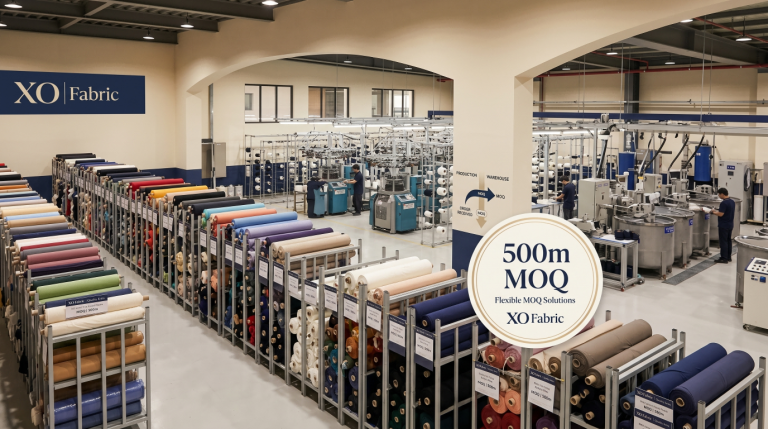
Direct sourcing becomes viable and often preferable for mature buyers. This includes companies with an annual fabric spend exceeding $500,000, giving them significant leverage. It also suits those with an existing on-the-ground team in the manufacturing region or a long-term, trusted relationship with one or two factories. Finally, it’s for procurement managers with deep technical expertise in their specific fabric category—someone who knows the exact specs for a performance functional knit and can hold a factory accountable on technical grounds. When evaluating a direct supplier, look for integrated manufacturing capabilities. For instance, a factory that has operated since 2005 with its own weaving, dyeing, and flocking lines, plus a 2,000-square-meter (21,500 sq ft) ready-stock warehouse, demonstrates the kind of hard infrastructure that supports reliable direct partnerships. You can often verify such claims through a supplier’s about us page.
Consider a mid-size US activewear brand with $1.2 million in annual fabric spend. For three years, they used a trusted sourcing agent for all their needs, benefiting from consistent quality and smooth logistics. The agent’s 7% commission, however, felt like a growing expense. They made a strategic decision to transition 60% of their orders to direct sourcing to capture that margin.
The first direct order was for a batch of recycled polyester jersey. They sent a detailed spec sheet but failed to explicitly state the required testing standard, assuming the factory would use the common AATCC method. The factory defaulted to the Chinese GB standard. The resulting fabric had a shrinkage rate 3% higher than acceptable, leading to a spike in customer returns. For the second direct order, they corrected the spec sheet meticulously. However, as a new, smaller client for this particular factory, their order was deprioritized in the production schedule, resulting in an 11-day delay that disrupted their entire launch calendar.
The compromise they reached was a hybrid sourcing model. They kept 40% of their business with the agent, specifically for new fabric categories and new supplier trials where the agent’s vetting and QC were invaluable. The remaining 60% went direct, but only with their two most established, long-term suppliers where trust and communication were already built. The net savings from eliminating the agent’s commission on the direct portion were partially offset by the costs of hiring a freelance QC inspector for final shipments. Their bottom-line improvement was a more modest, but sustainable, 4-5%. This procurement strategy acknowledged that supplier management isn’t one-size-fits-all.
The hybrid approach is the pragmatic end-state for many seasoned buyers. It balances cost control with risk mitigation. You leverage the deep relationships and cost benefits of direct sourcing for your core, predictable product lines. Simultaneously, you use an agent’s expertise to explore new materials, onboard new suppliers, or handle orders in unfamiliar regions. This dynamic sourcing strategy allows a company to be both cost-efficient and agile.
This is arguably the most critical differentiator between the two paths. With an agent, quality control is their core deliverable. Their business depends on it. They have established QC protocols, often with dedicated inspectors or partnerships with reputable third-party labs. When you go direct, quality control falls squarely on your shoulders. You must define every checkpoint.
For a direct sourcing path, you must personally manage these five QC nodes:
Skipping any of these steps is gambling with your shipment.
Whether you use an agent or go direct, certain non-negotiables exist. Always demand proof of relevant certifications. For most global markets, OEKO-TEX Standard 100 is a baseline for harmful substance testing. If you’re using recycled materials, the Global Recycled Standard (GRS) is essential. For the European market, understanding EU REACH regulation is mandatory. Don’t just take a PDF at face value. Verify the certificate’s validity directly on the issuing body’s website. For example, you can check an OEKO-TEX certificate number on the official OEKO-TEX Standard 100 database. Furthermore, ensure the certificate covers the specific product you are ordering, not just the factory in general. To streamline this, you can request a supplier’s full certification portfolio and test reports through their official contact channels; a responsive supplier will have these readily available and may even offer a preliminary technical feasibility assessment based on your spec sheet.
Before you issue a purchase order, run through this sourcing checklist. It’s your due diligence framework for effective supplier vetting.
Supplier Vetting (4 Questions):
Production & QC (4 Questions):
Commercial Terms (4 Questions):
During your procurement due diligence, certain red flags should give you immediate pause. Be wary of any supplier who refuses a factory audit or only offers virtual tours. A quote that is drastically lower than the market average (e.g., 20%+ below) often indicates corners will be cut on materials or quality. An inability to provide recent, relevant textile testing reports is a major concern. Finally, be cautious of demands for 100% payment via Telegraphic Transfer (T/T) upfront; standard practice involves a deposit with the balance payable against the copy of the Bill of Lading. When assessing a supplier’s technical depth, review their product range. A manufacturer with a dedicated category for performance functional knits, for instance, demonstrates a focused capability in high-value, technical fabrics.
Not necessarily on the unit price, but often on the total cost. Agent commissions typically range from 5-10%, but this fee covers supplier vetting, QC, and logistics coordination—services you’d have to pay for separately or manage internally when sourcing direct. The “cheaper” path depends entirely on your company’s existing procurement capabilities and order volume.
Never just accept a PDF. Ask for the certificate number and issuing body. Then, go directly to that organization’s official online database to confirm its validity. For example, use the OEKO-TEX or GRS online verification tools. Crucially, check that the certificate’s scope explicitly includes the specific product or material you intend to purchase.
This varies dramatically. Factories with large ready-stock warehouses, often holding 2,000+ square meters of inventory, can support very low MOQs for standard items, sometimes as little as 100-300 meters (110-330 yd) per color. For custom-dyed or developed fabrics, MOQs typically start at 1,000-3,000 meters (1,100-3,300 yd) per color to justify the dyeing setup and production run costs.
This is highly discouraged. Switching paths mid-stream introduces confusion, potential contract breaches with your agent, and significant risk to the project timeline and quality. The best practice is to evaluate and decide on the sourcing path at the very beginning of a new project. Any transition should be planned for future orders, not executed on active ones.
The choice between a sourcing agent and direct sourcing isn’t a moral one about “middlemen.” It’s a strategic calculation about where you want to allocate your company’s resources and risk. The agent model externalizes complexity and risk at a known cost. The direct model internalizes that complexity, offering potential savings but demanding significant investment in people, processes, and expertise. Most successful brands don’t pick one forever; they evolve a blended procurement strategy that matches their current scale, capability, and appetite for operational involvement. The goal isn’t to eliminate the agent, but to understand precisely what you’re paying for—and to ensure that, whether through a partner or through your own team, someone competent is always watching the factory floor.