Address
Nanlang Industrial Zone, Xingtan Town, Shunde District, Foshan, Guangdong, China
Work Hours
Mon–Fri, 9:00 AM – 6:00 PM (CST/UTC+8). We aim to respond to all inquiries within 48 hours.

Address
Nanlang Industrial Zone, Xingtan Town, Shunde District, Foshan, Guangdong, China
Work Hours
Mon–Fri, 9:00 AM – 6:00 PM (CST/UTC+8). We aim to respond to all inquiries within 48 hours.
Fabric Strike-Off vs Bulk Production: Avoiding Color & Hand Differences. This guide covers key properties, real-world applications, and a practical sourcing checklist for B2B buyers.
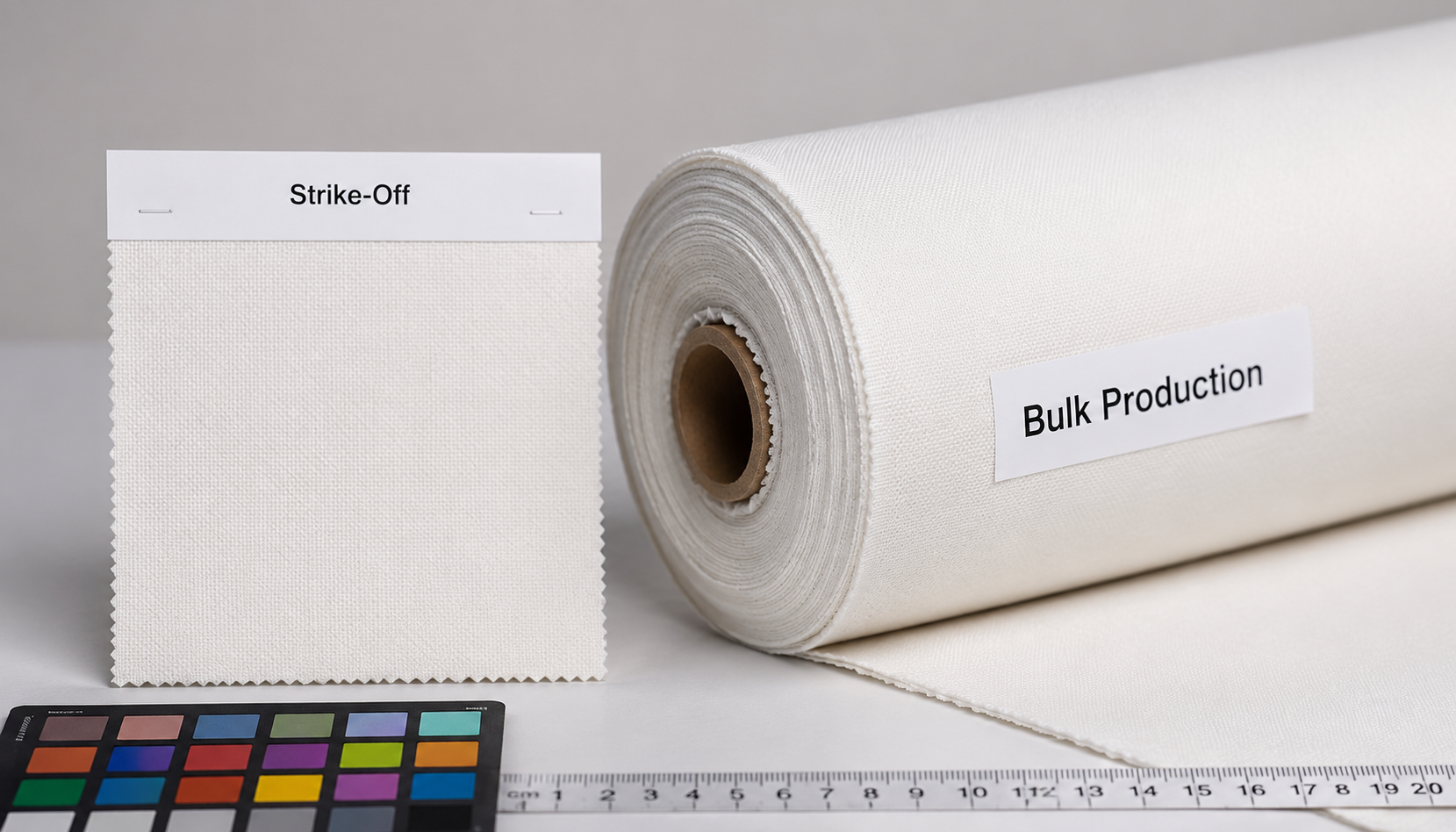
Picture this: a European apparel buyer approves a dusty-rose TR-blended strike-off that matches Pantone 14-1316 TPX perfectly on the lab bench. Five weeks later, 12,000 pieces arrive at the warehouse — and under D65 daylight, the color is visibly pinker. The delta sits at ΔE 2.4, well above the brand’s 1.0 tolerance. The entire shipment is rejected. This scenario plays out more often than anyone in sourcing likes to admit, and it stems from a blind spot baked into how the industry treats fabric strike-off vs bulk production as two interchangeable checkpoints.
At its simplest, a strike-off is a confirmation sample — a small piece of fabric produced to show you what a specific color, print pattern, or finish will look like before you commit to thousands of meters. Bulk production, on the other hand, is the scaled-up execution of that confirmed sample across multiple dye lots, machine runs, and operator shifts. One is a precision instrument. The other is an industrial marathon.
The confusion starts when buyers treat the strike-off as a guaranteed preview of the final product. It is not. It is a directional sample — close enough to guide decisions, but produced under fundamentally different conditions. Understanding those differences is the single most important skill in textile sourcing.
A strike-off sample is typically produced on a lab-scale machine using controlled parameters: a 0.5–2 kg (1–4 lb) dye lot, manual temperature ramping, and hands-on monitoring by a senior technician. The goal is to confirm that the chosen color formula, print design, or finish treatment achieves the target aesthetic. Once approved, that strike-off becomes the physical benchmark — the “gold standard” — against which every meter of bulk fabric is judged.
But here is the catch: a strike-off is a snapshot under laboratory conditions. It shows you what is achievable, not what is repeatable at 500× scale. That distinction matters enormously.
The term print strike off meaning often trips up buyers new to textile development. A print strike-off is produced on a flatbed lab printer or a small-format rotary screen — machines operating at 2–5 m/min (6.5–16 ft/min) with hand-mixed inks and minimal pressure variation. Compare that to a production rotary screen running at 30–60 m/min (98–197 ft/min) with automated ink delivery, different squeegee pressures, and paste rheology tuned for speed rather than precision. The result? Color saturation, penetration depth, and edge sharpness can all shift between the two.
Woven and knit strike-offs have their own scaling issues, but print workflows amplify the variables because ink behavior is inherently more sensitive to mechanical settings than dye liquor.
Many sourcing teams conflate these two processes, but lab dip vs strike off is a critical distinction. A lab dip confirms a color — it matches to a Pantone swatch or a color standard, nothing more. A strike-off confirms the complete fabric effect — color, hand feel, print placement, finish texture, and drape. They are sequential approval gates: you pass the lab dip first, then request the strike-off to validate the full material experience. Skipping one does not replace the other.
So why can’t factories just “do the same thing but bigger”? Because scaling is never linear in textile manufacturing. Fabric strike off vs bulk production divergence comes down to five structural variables that most procurement teams overlook until the damage is done.
Lab dyeing machines typically handle 0.5–2 kg (1–4 lb) of fabric at a liquor ratio of 1:10 to 1:15. Production dye jigs and jets run 300–500 kg (660–1,100 lb) lots at ratios that vary with machine geometry. The heating curves, agitation intensity, and flow dynamics are completely different. A color that “hits” perfectly in a 1 kg bath may shift 3–5% in hue when the same formula runs through a 400 kg (880 lb) jet.
Even when the buyer specifies the same fabric construction, greige goods come from different loom runs with varying yarn lots. Moisture content, sizing residue, and fiber crystallinity can fluctuate ±5–8% between batches. These directly affect dye uptake. A strike-off made with Batch A greige fabric will not absorb color identically to a bulk run using Batch D.
I once watched a well-run factory in Shunde spend two full days chasing a shade on a polyester-rayon blend because the polyester staple fiber had a higher crystallinity index than the strike-off batch. Same yarn supplier, same spec sheet — different shipment. That is the kind of invisible variable that sinks timelines.
Lab formulas are calculated by weight of fabric (owf) with precision down to 0.01 g. When those formulas are scaled up, electrolyte concentrations, leveling agents, and pH buffers behave non-linearly. A 0.3% owf addition of blue tint that perfectly corrects a 1 kg sample might overcorrect at 400 kg (880 lb), swinging the shade in the opposite direction. This is not a measurement error — it is chemistry at scale.
Factory floor temperature in Guangdong can swing 15°C (27°F) between dry winter and monsoon summer. Ambient humidity affects drying rates, cure temperatures, and the final moisture content of the finished fabric — all of which subtly change hand feel and color appearance. A strike-off made in January may feel slightly different from a bulk roll produced in July, even with identical machine settings.
Strike-offs are usually run by the most experienced technician on the floor. Bulk production involves teams of line operators following SOPs but applying judgment calls in real time. Human variability is the fifth and often underestimated variable in the gap between strike offs and full production output.
| Variable | Strike-Off Condition | Bulk Production Condition |
|---|---|---|
| Dye lot volume | 0.5–2 kg (1–4 lb) | 300–500 kg (660–1,100 lb) |
| Liquor ratio | 1:10 – 1:15 | 1:6 – 1:12 (machine dependent) |
| Substrate control | Selected single batch | Multiple greige lots |
| Operator | Senior technician, manual | Line crew, SOP-driven |
| Environment | Climate-controlled lab | Production floor (uncontrolled) |
Let me walk through a case that illustrates exactly how costly this gap can become — and why shortcuts in the approval chain often backfire.
A European fast-fashion buyer sourcing from a mid-tier Guangdong supplier needed 12,000 pieces (roughly 13,100 yd) of a TR-blended fashion fabric in a specific dusty-rose tone. The lab dip matched Pantone 14-1316 TPX perfectly on a 1 kg sample. To save five business days, the buyer approved the color and skipped the full strike off sample on production-weight goods. The factory moved straight to bulk dyeing.
The first bulk lot came out at ΔE 2.4 — visibly pinker under daylight. The root cause? A different polyester staple batch with higher crystallinity had shifted the dye uptake curve. The factory attempted correction by adding 0.3% owf blue tint, which overcorrected to ΔE 1.8 in the opposite direction. An additional 800 m (875 yd) of fabric and three extra dyeing days were wasted.
The buyer eventually accepted a ΔE 1.5 deviation — outside their original ΔE ≤ 1.0 spec — to avoid missing the shipping deadline. They negotiated a 4% price reduction and agreed to restrict the garment to in-store warm lighting displays, accepting a color that would look acceptable under 3,000K retail spots but fail under outdoor daylight. It was a compromise born from a rushed approval process, and it cost both parties time, money, and trust.
Color difference in textiles is measured using the CIE ΔE (Delta E) calculation system. Practically speaking, ΔE below 0.5 is invisible to the untrained eye. ΔE between 1.0 and 2.0 is noticeable to a trained observer but often acceptable for commercial goods. Above 2.0, the shift is obvious — and most brand-level quality teams will reject outright. The case above at ΔE 2.4 was a clear fail by any standard.
Understanding where your order sits on this scale — and insisting on a tolerance before approving the strike-off — saves you from painful renegotiations later.
Hand feel is even harder to control than color. A ±5°C (±9°F) variation in stenter frame temperature can shift a polyester-rayon blend from “soft and peachy” to “slightly boardy.” For finishes like peach-skin or soft-hand wash, the margin is even tighter. Bulk production involves multiple dye lots passing through the stenter across different shifts — each operator has a slightly different definition of “right.”
Common “failure modes” between strike-off and bulk:
Not every order demands a full strike-off on production-weight goods. But knowing when to insist — and when a lab dip is sufficient — is a judgment call that separates experienced buyers from those learning the hard way.
Use this framework to assess risk and allocate approval resources accordingly.
| Order Scenario | Risk Level | Recommended Approval |
|---|---|---|
| New color on established fabric | Medium | Lab dip + production-weight swatch |
| New fabric + new color | High | Full strike-off mandatory |
| Repeat order, same specs | Low | Lab dip confirmation only |
| Color change on repeat fabric | Medium-High | Lab dip + strike-off on production fabric |
| Complex print or specialty finish | Very High | Full strike-off + pre-production sample |
The general rule: the more variables that have changed since your last approval, the more validation you need at the strike-off stage. New construction, new color, new finish — each one adds a layer of risk.
Embroidery strike off follows a completely different logic from fabric dyeing or printing. Here, the variables include thread color matching, stitch density, underlay patterns, backing fabric type, and hoop tension. A 5% shift in thread tension can change the appearance of satin stitches from smooth to slightly ridged. Embroidery strike-offs must be run on the exact same machine model as bulk production, because needle bar mechanics vary between manufacturers. If your supplier outsources embroidery, ask which machine brand and model will run your production — then request the strike-off on that same setup.
A typical strike-off costs $50–$200 per colorway, depending on complexity, and takes 5–10 business days. Complex prints or specialty finishes may require 10–15 business days. Compare that to the cost of rejecting a bulk shipment: if a 5,000 m (5,470 yd) order at $4.50/m needs to be reworked or scrapped, you are looking at $22,500 in direct fabric cost alone, plus weeks of delay and irreparable damage to your retail window.
For any order above 500 m (547 yd) in a color-sensitive application, the strike-off is the cheapest insurance you will ever buy. If you are developing custom fabrics or working with novel blends, it is worth discussing your specific parameters with the factory’s technical team to scope the right level of sampling — our contact page supports direct technical spec uploads and connects you with an engineer who can assess feasibility within 48 business hours.
The gap between strike-off and bulk cannot be eliminated — physics and chemistry prevent it. But the gap can be managed through disciplined SOPs that constrain the variables before they compound into visible defects. This is where disciplined factories separate themselves from the rest.
The PPM is the single most important handshake between your strike-off approval and the start of bulk. At a minimum, the PPM should lock the following: the approved color reference (with physical swatch, not digital), the target ΔE tolerance, the hand-feel benchmark sample, the shade-banding policy, and any special handling instructions. Treat the PPM as the moment your preferences stop being negotiable.
Three critical inspection gates during bulk production — skipping any one of them is asking for trouble at final inspection:
First, the out-of-dye-vat color check: compare the greige-to-dyed fabric against the approved swatch under standardized light (D65 or TL84) within 30 minutes of unloading. Catch shade drift early, before the fabric enters the stenter. Second, the post-setting hand-feel confirmation: after stenter and compaction, pull a 1 m (1.1 yd) sample and evaluate hand feel against the strike-off benchmark by touch and, optionally, using a fabric stiffness tester. Third, the finished roll inspection: 4-point grading of every roll for surface defects, width consistency, and final color verification under the buyer’s specified light source.
Shade banding is the practical reality that different dye lots within a single production order will have minor color variation. The industry standard — referenced across major compliance frameworks including ISO 105 textile color fastness testing standards — generally accepts a rating of ≥ 3.5 on the grey scale for lot-to-lot variation. Smart buyers also specify that same-shade garments must be cut from the same dye lot to prevent panel-level color mismatch on a finished garment.
Factories with robust QC systems — like those at established vertically integrated manufacturers that have operated continuous production lines since 2005 with 50+ technical staff, as described in their facility overview — typically run dye-lot tracking tags on every roll to enable post-production traceability.
Before you sign off on any strike-off sample, walk through these questions with your supplier. Print this list. Pin it above your desk. Use it every single time.
Question 7 is the one most often ignored — and the one that causes the most expensive problems. A factory might tell you “we control shade within 4 levels,” but if they do not specify whether that control applies to all rolls across the order or only within a single dye lot, you have a gap wide enough to drive a color mismatch through.
For deeper technical reading on fabric properties and sourcing best practices, the textile knowledge hub maintains a library of articles that complement this checklist.
In textile sourcing, a strike-off is a pre-production sample produced to confirm the color, print pattern, hand feel, and finish of a fabric before full-scale manufacturing begins. It serves as the physical benchmark — the “gold standard” — against which all subsequent bulk production is measured and approved.
A lab dip confirms only color — it matches a dye formula to a Pantone or custom swatch on a small piece of fabric. A strike-off confirms the complete material effect: color plus print design, hand feel, drape, and finish. In the lab dip vs strike off workflow, the lab dip comes first as a color-level gate, then the strike-off validates the full fabric experience. They are sequential and non-interchangeable.
Batch production refers to the large-scale manufacture of fabric in discrete dye lots or production runs, each adhering to the parameters confirmed during strike-off approval. The core challenge of batch production is maintaining consistency — color, hand feel, width, and finish — across multiple lots that may differ in raw material, environmental conditions, and operator handling.
A standard strike-off typically costs $50–$200 per colorway and requires 5–10 business days. Complex prints or specialty finishes — especially on blended substrates like TR blended fashion fabrics, where the polyester and rayon components absorb dye at different rates and demand tighter process control — may take 10–15 business days and cost toward the higher end of that range.
The gap between a strike-off and bulk production is not a flaw in the system — it is a fundamental characteristic of scaling textile processes from laboratory art to industrial science. The buyers who consistently deliver good product are not the ones who eliminate the gap. They are the ones who measure it, control it, and plan for it in their sourcing process.
Treat your strike-off as what it truly is: a qualified starting point, not a finished guarantee. Demand transparent data from your factory. Lock your tolerances in writing before production begins. And when the variables stack up in ways you did not predict — because they will — have a decision framework ready that lets you assess risk, negotiate smartly, and ship with confidence. The cost of a $150 strike-off looks very different when you compare it to the cost of a $25,000 rejected shipment.