Address
Nanlang Industrial Zone, Xingtan Town, Shunde District, Foshan, Guangdong, China
Work Hours
Mon–Fri, 9:00 AM – 6:00 PM (CST/UTC+8). We aim to respond to all inquiries within 48 hours.

Address
Nanlang Industrial Zone, Xingtan Town, Shunde District, Foshan, Guangdong, China
Work Hours
Mon–Fri, 9:00 AM – 6:00 PM (CST/UTC+8). We aim to respond to all inquiries within 48 hours.
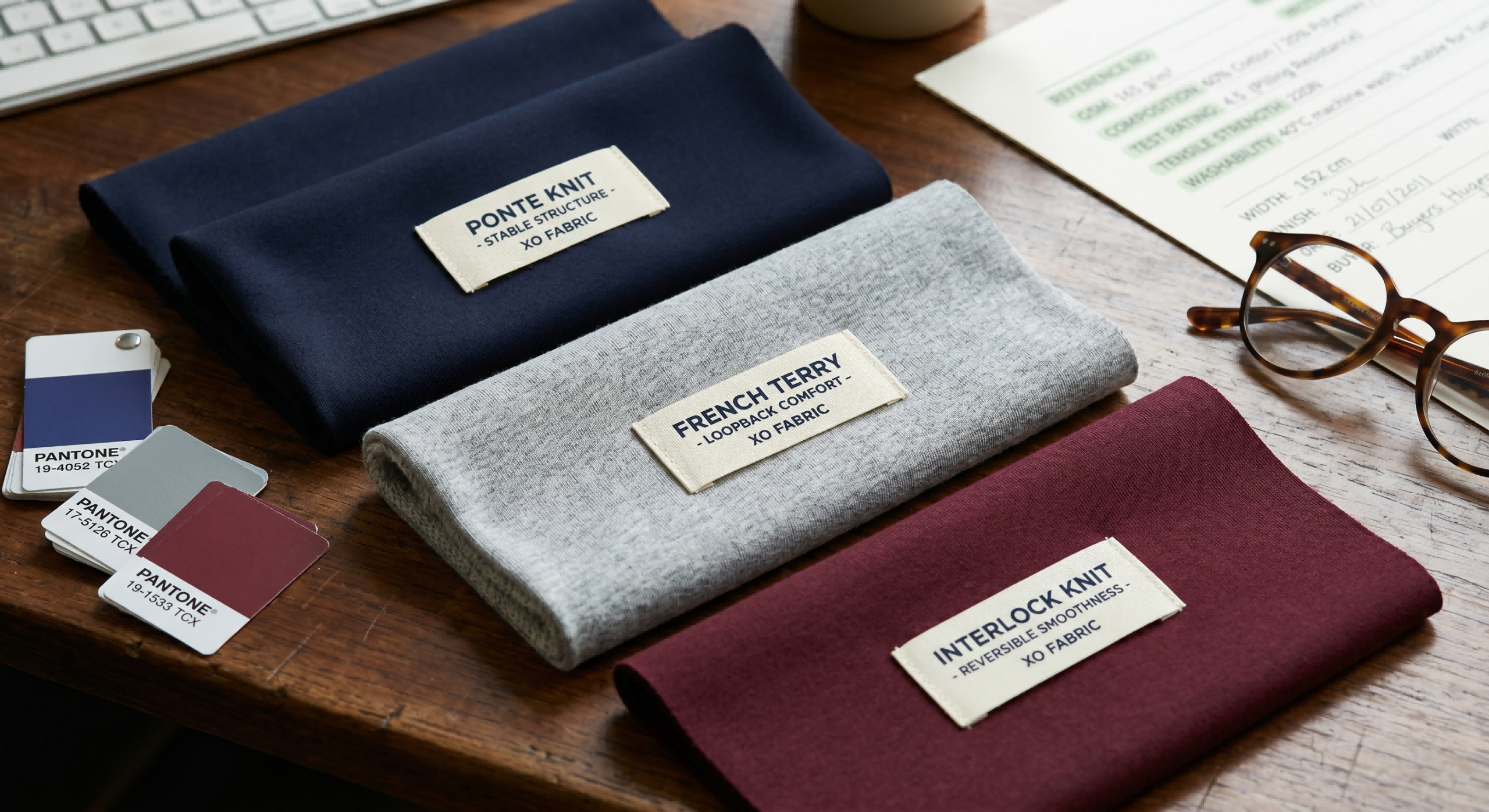
Walking into a fabric store and asking for a nice stretchy knit is like ordering some food at a restaurant. The options are wildly different, and picking the wrong one quietly ruins your entire project. I have seen too many beautiful patterns fail because the material just would not behave. Ponte, french terry, and interlock are three of the most reliable workhorses in the knit world. Yet even experienced sewists mix them up. Each fabric moves, breathes, and recovers differently. Mischoosing leads to garments that bag out, cling awkwardly, or simply feel off. This guide breaks down the actual structure, weight, drape, and performance traits so you can pick the right knit every time.
Knits do not just stretch. They move with you. That is why they have taken over everything from high-end activewear to boardroom blazers. The loops in the yarn structure act like tiny springs. They conform to body movement without restricting it. Wovens rely on thread tension and rigid grids. Knits breathe and flex naturally. Production-wise, they are faster to knit than weave. That keeps costs down and speeds up sample turns. Consumers now expect that four-way give in everything. It pushes mills to innovate constantly.
If you want to grasp why your leggings or shirts behave the way they do, start with the basics. Read up on Understanding Knit vs Woven Fabrics to see how loop geometry changes everything. The mechanics are completely different. Wovens tear along the grain. Knits distort and recover. Knowing that difference saves hours of pattern tweaking.
I remember cutting my first draped top on a tight woven. It fought me at every curve. Switching to a medium-weight knit changed the entire construction process. The fabric yielded instead of resisting. That shift in mindset is what separates comfortable garments from restrictive ones.
Before diving into specific fabrics, you need a shared vocabulary. Gauge tells you how many needles are used per inch. A higher gauge means finer, lighter fabric. Apparel usually falls between eighteen and thirty-two. Then there is stretch direction. Two-way gives crosswise only. Four-way moves both ways, which is essential for fitted pieces. Recovery is where most projects fail.
Recovery is the fabric ability to snap back after stretching. If it stays deformed, your seams will bag and your hems will ride up. Hand feel matters too. Some knits are crisp. Others are drapey or plush. You will also hear about courses and wales. Courses run horizontally. Wales run vertically. Weight and density do not always match. A heavy fabric can be airy if the construction leaves room between loops.
Check out Understanding Fabric Weight and GSM for a clear breakdown of how thickness actually translates to on-body performance. The numbers look simple on paper. In practice, they dictate how your garment hangs after six hours of wear.
Ponte is not just thick jersey. It is a double-knit structure. Two layers are interlocked during production. That gives it a signature firm hand and incredible stability. The name traces back to Rome, where it was originally developed as a luxury material. Today, you will find it running between two hundred fifty and four hundred GSM.
It is substantially heavier than single knits. Yet it does not feel bulky. Most ponte offers two-way stretch with tight recovery. Blending it with rayon, polyester, and three to five percent spandex locks in the shape. I love how it refuses to curl at the cut edge. That makes it so much easier to pin and stitch. It drapes smoothly without the stiffness of wovens. It holds sharp seams beautifully.
If you are curious about how those two layers actually fuse together, Warp Knit vs Weft Knit explains the machinery behind it. The interlocking process creates that rigid yet flexible hand. You can press it aggressively and the creases stay put. That stability is why it works so well for structured separates.
French terry gets its identity from the back. Those uncut loops are not just decorative. They increase surface area. That boosts moisture absorption and gives the fabric a naturally breathable feel. You will typically see it run from two hundred to three hundred fifty GSM. That range makes it flexible enough for spring tees or winter joggers.
The loops can stay intact for that cozy, slightly unfinished vibe. Or they get sheared off for a cleaner surface. Do not confuse it with fleece. Fleece is brushed and sheared to create a nap. Terry keeps those loops. Stretch is usually two-way. Adding elastane pushes it toward four-way. I have used it for everything from heavyweight hoodies to breezy summer dresses. It is forgiving, washes well, and feels lived-in from day one.
If you are trying to decide between terry and brushed alternatives, a Complete Guide to Fleece Fabrics will clear up the texture differences. The manufacturing steps diverge completely after the base knit forms. Terry prioritizes absorption. Fleece prioritizes insulation. Choosing the right one depends entirely on your climate and styling goals.
Interlock looks like jersey but behaves like a completely different material. It is made by interlocking two rib knits. That eliminates the annoying edge curling. Both sides finish smooth. You do not have to worry about which side faces out. The weight usually sits between one hundred eighty and two hundred eighty GSM.
It is medium-heavy and substantial without being stiff. Recovery is excellent. That is why it rarely bags out at the knees or elbows. It is also more breathable than ponte because the structure is not as tightly compressed. I have switched to interlock for baby clothes and fitted dresses. It lays flat against the skin and holds precise seams. It is basically the upgrade from basic jersey.
For those wondering how the double-rib structure actually forms, Warp Knit vs Weft Knit breaks down the mechanics. The interlacing creates a balanced tension. You get stability without sacrificing movement. It is the quiet workhorse of the knit world.
Numbers matter when you are scaling from a muslin to a full production run. Here is how the three stack up in practice:
| Fabric | GSM Range | Typical Feel |
| Ponte | 250–400 | Heavy, structured, minimal drape |
| French Terry | 200–350 | Medium-heavy, plush, breathable |
| Interlock | 180–280 | Medium, smooth, stable |
A two hundred fifty GSM ponte will hold a sharp crease. It feels almost tailored. Push it to three hundred fifty GSM and it starts behaving like a lightweight canvas. French terry at two hundred fifty GSM makes a breezy sweatshirt. Hit three hundred fifty GSM and you are looking at jogger weight. Interlock at two hundred GSM drapes lightly. It mimics a heavy woven linen. At two hundred eighty GSM, it gains enough body to stand up on its own.
Climate plays a huge role here. Lighter weights survive humid summers. Heavier weights lock in warmth. Mid-range weights around two hundred fifty to three hundred GSM are my go-to for year-round layering. Just remember that heavier fabrics limit how many layers you can comfortably stack underneath. If you need a deeper dive into how weight translates to drape and durability, Understanding Fabric Weight and GSM covers the testing methods.
You cannot drape properly if the fabric fights you. Ponte has a firm, structured hand. It resists folding and creates clean, architectural lines. French terry feels soft and slightly plush. The loops catch on each other. That gives it a relaxed, moderate fall. Interlock sits in the middle. It is smooth and substantial. It offers a refined drape that follows the body without clinging.
How drape affects your pattern is huge. Structured drapes like ponte work for tailored pants and sheath dresses. Moderate drapes like interlock suit fitted tops and A-line skirts. Soft drapes like french terry thrive in relaxed silhouettes and casual dresses. When I am testing drape, I hold a square at one corner and watch how it drops. Does it pool? Does it spring back?
Recovery ties directly into this. Fabrics that lose tension will sag over time. That ruins the original drape. For a technical breakdown of how drape is measured and manipulated, check Fabric Drape Explained. The physics are simple. Gravity pulls. The loops resist. Matching the two determines whether your garment looks intentional or sloppy.
Stretch is not just about how far it pulls. It is about how it comes back. Ponte usually gives twenty to forty percent crosswise and ten to twenty percent lengthwise. Recovery is tight when spandex is included at three to five percent. French terry tends to stretch twenty-five to fifty percent crosswise. Lengthwise stretch varies.
The loops can compress with heavy wear. Recovery depends heavily on the elastane ratio. Interlock often offers thirty to fifty percent crosswise and twenty to thirty percent lengthwise. It is the most stable of the three. It rarely bags. All three benefit from that two to five percent spandex window. Too little and the seams distort. Too much and the fabric feels rubbery.
I always test recovery before committing to a pattern. If the fabric holds a dent, it will ruin your waistline. For a deeper look at elastane blends and stress testing, read Stretch Fabrics and Spandex Guide. The chemistry behind the recovery is fascinating. But you only need to care about how it behaves on your machine.
Matching fabric to pattern saves hours of frustration. Ponte shines in fitted pants, structured pencil skirts, tailored blazers, and sheath dresses. It is built for professional silhouettes that need to hold their shape all day. French terry belongs in sweatshirts, hoodies, joggers, lightweight jackets, and casual dresses. It is the comfort fabric that transitions easily between lounging and running errands.
Interlock excels in fitted tees, baby clothes, intimate apparel, athletic wear, and dresses that require smooth drape without stiffness. There is definitely crossover territory. Heavier interlock can step in for lightweight ponte in summer dresses. French terry works for casual ponte-style pants if you are aiming for a relaxed fit.
I once spent three weeks tweaking a client capsule collection meant for ponte. I kept switching to interlock because the summer heat made heavy knits unbearable. The hem kept riding up. The shoulders stretched out after one wear. I finally compromised by using a two hundred fifty GSM interlock with a four percent elastane blend. I also switched to a twin needle and added a lightweight knit stabilizer at the seams. The trial-and-error process taught me that structure and breathability often require trade-offs. If you are designing activewear or performance pieces, Choosing Fabrics for Sportswear walks through moisture management and stretch mapping.
Sewing knits requires a slightly different machine setup. Ballpoint or stretch needles are non-negotiable. Size seventy-five slash eleven works for lighter weights. Size ninety slash fourteen handles ponte and heavy terry. Straight stitches will pop. Use a three-step zigzag or a narrow stretch stitch. Twin needles create clean hems that flex with the garment.
Lower your presser foot pressure. Reduce thread tension slightly. Thick knits sometimes need a walking foot to prevent feed dog skipping. Cut with a rotary cutter and weight your pattern pieces down. Knits shift easily under scissors. Ponte is forgiving. It barely shifts. Use a slightly longer stitch length to prevent tunneling.
French terry loops can catch on the feed dogs. Slide a piece of masking tape over the machine plate to create a smooth glide. Sheared terry cuts and sews much faster than uncut. I always press seams open with a medium steam setting and a press cloth. It keeps the texture crisp. For finished quality benchmarks, review Quality Control Checklist for Shipment. Consistency in tension and needle choice matters more than expensive equipment.
Knits live hard. They need care that matches their construction. Turn everything inside out before washing. It drastically reduces pilling, especially on french terry. Stick to cold or warm water around thirty to forty degrees Celsius. Gentle cycles preserve the elastane. Never overload the drum.
Air drying flat is ideal. It prevents gravity from stretching the hem. Tumble dry low only if necessary, and pull them out immediately. Ironing requires low heat. Use the synthetic setting. Ponte benefits from a press cloth to protect the surface. Steam helps wrinkles relax without crushing the fibers. Avoid direct high heat on spandex blends.
Pilling happens most on terry because the loops rub together. Toss them in mesh laundry bags. A fabric shaver keeps them looking fresh. Store heavy knits folded. Hangers will distort the shoulders over time. If you are ever unsure about safe washing limits, How to Read Fabric Lab Reports shows you exactly where to find the care data. Following the manufacturer specs extends garment life by years.
Budget planning changes when you are buying by the meter. Here is a realistic baseline for standard production runs:
| Fabric Tier | Price Range per Meter |
| Basic Ponte | $8–$15 |
| Premium Ponte | $15–$25 |
| Basic French Terry | $6–$12 |
| Premium French Terry | $12–$20 |
| Basic Interlock | $5–$10 |
| Premium Interlock | $10–$18 |
Fiber composition drives the cost. Rayon and high-spandex blends push prices up. Cotton is usually more affordable. Width matters too. Wider cuts mean fewer yardage calculations per garment. Heavier fabrics use more weight per piece. But you often need fewer total yards because the structure does not require complex easing.
I have found the sweet spot sits between twelve and eighteen dollars per meter. It usually means better dye consistency and tighter recovery without boutique pricing. Most suppliers drop the price by ten to twenty percent once you cross one hundred meters. If you are scaling production, Understanding MOQ and Strategies covers how to negotiate without sacrificing quality. Bulk buying only works if the mill maintains tight tolerances across every roll.
Start with the garment silhouette. Tailored pants and structured skirts almost always call for ponte. Sweatshirts and joggers belong with french terry. Fitted tops and smooth dresses lean toward interlock. Next, evaluate drape. Want sharp lines? Ponte. Need relaxed flow? Terry or interlock. Check climate needs. Warm climates demand lighter ponte or interlock around two hundred to two hundred fifty GSM.
Cold weather handles heavy ponte or three hundred fifty GSM terry. Terry also breathes better when layering. Skill level matters more than people admit. Ponte is beginner-friendly. It is stable and refuses to curl. French terry takes a bit more patience because the loops catch and shift. Interlock requires confident stretch stitching techniques.
Finally, think about care routines. Activewear and loungewear thrive in terry. Professional garments demand ponte resilience. Everyday versatility points to interlock. I once spent a full weekend testing three different interlock weights for a client’s summer dress line. I kept rejecting the two hundred GSM version because it clung too much to seams. I moved up to two hundred sixty GSM, added a light interfacing at the neckline, and finally achieved the crisp drape we wanted. The process felt messy until the numbers aligned with the pattern engineering. If you are designing performance wear, Choosing Fabrics for Sportswear breaks down moisture testing and stretch mapping.
The mill I work with regularly stocks a tight range of knits that hold up under repeated stress testing. Their ponte di Roma selection runs between two hundred eighty and three hundred fifty GSM. It mostly uses rayon, polyester, and spandex blends. Every batch comes Oeko-Tex certified, and custom color matching is standard.
French terry arrives in both sheared and uncut options. They also carry organic cotton versions and recycled blends with moisture-wicking finishes. Interlock spans two hundred to two hundred eighty GSM. It ranges from one hundred percent cotton to technical synthetic mixes. The stretch consistency across rolls is unusually tight.
I have run dye lots side by side and barely noticed a difference. They attach full technical data sheets to every shipment. You can order swatch packs before committing to bulk runs. Their technical support team actually answers questions about grain alignment and pressing temps. If you want to see how they test every batch before it leaves the warehouse, check the XO Fabric Quality Control Process. Reliable sourcing removes the guesswork from production.
Even seasoned sewists trip over the same knits. Do not assume every double knit is ponte. Ponte has a specific firm hand and tight recovery. Cheaper double knits often sag. Not all french terry weighs the same. Sheared terry feels dramatically lighter and smoother than uncut. I have made that mistake twice.
Choosing interlock for jersey patterns without adjusting the seam allowances leads to bulky hems. Ignoring stretch direction ruins fit instantly. Cutting ponte with the stretch running perpendicular to your intended grainline changes the drape completely. Over-washing terry compresses those loops. They lose softness and start pilling.
Skipping pre-wash is another trap. All knits shrink. Usually two to five percent crosswise. Washing after cutting guarantees warped seams. Using woven techniques on knits is the fastest way to ruin a good yardage. Wrong needle, straight stitch, and tight tension will pop your seams within hours. If you are transitioning from wovens, Understanding Knit vs Woven Fabrics explains why the mechanics demand different handling. Respect the loop structure and the fabric will reward you.
Fabric choice is not just about texture or color. It is about how the material will behave under tension, heat, and repeated wear. Ponte, french terry, and interlock each solve different problems. One gives structure. One brings comfort. One offers balanced stability. Pick the one that matches your pattern engineering, not just its aesthetic. Your seams will thank you.