Address
Nanlang Industrial Zone, Xingtan Town, Shunde District, Foshan, Guangdong, China
Work Hours
Mon–Fri, 9:00 AM – 6:00 PM (CST/UTC+8). We aim to respond to all inquiries within 48 hours.

Address
Nanlang Industrial Zone, Xingtan Town, Shunde District, Foshan, Guangdong, China
Work Hours
Mon–Fri, 9:00 AM – 6:00 PM (CST/UTC+8). We aim to respond to all inquiries within 48 hours.
French Terry Knit Fabric: Properties & Loungewear Applications. This guide covers key properties, real-world applications, and a practical sourcing checklist for B2B buyers.
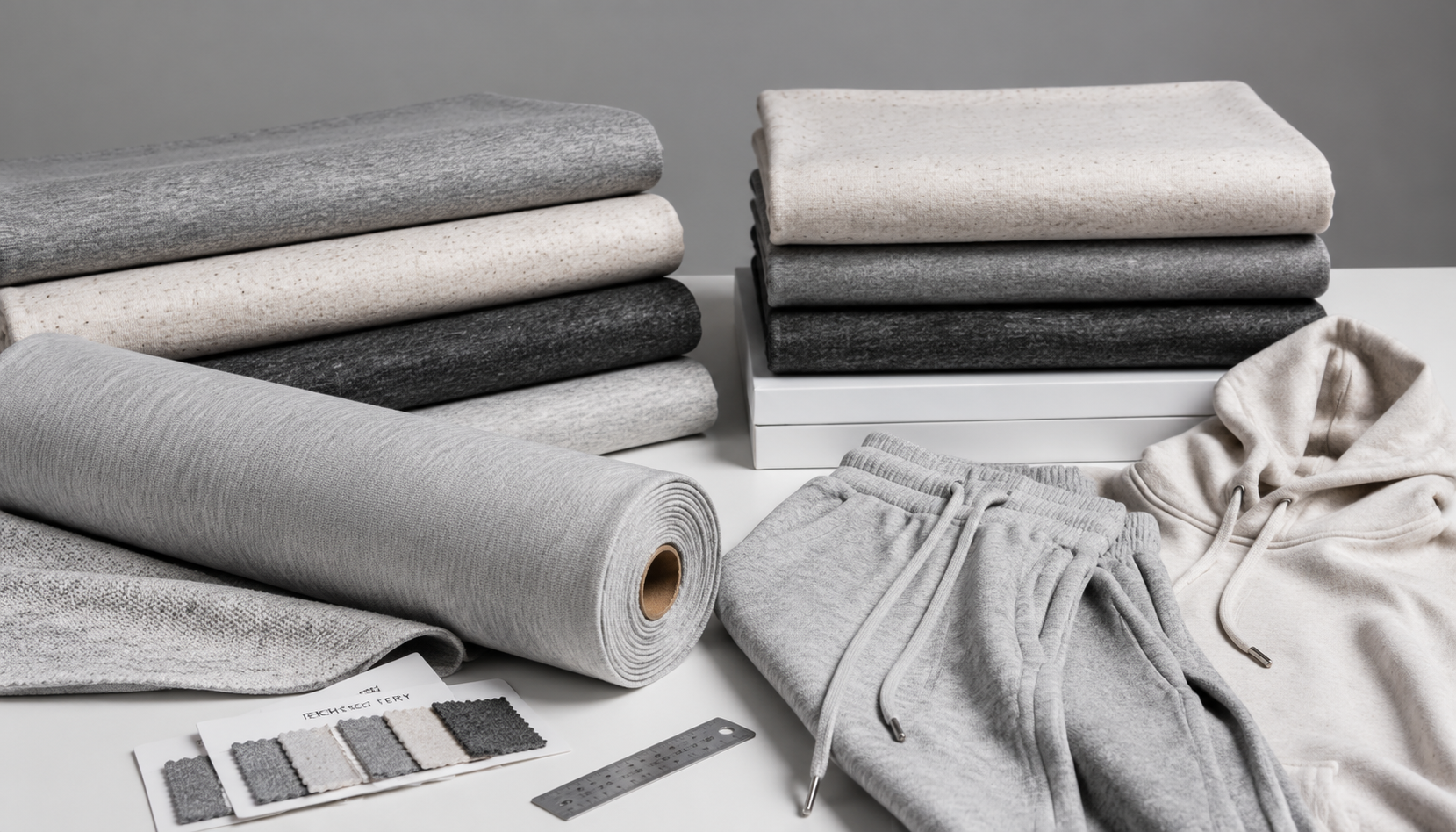
Ever been halfway through a loungewear line development, only to realize the fabric sample you received feels nothing like the tech pack promised? The culprit is often a simple mix-up between French terry and fleece—a distinction that can derail your budget, timeline, and final product hand feel. This guide cuts through the noise to give you the technical clarity needed for confident sourcing.
Let’s start with the fundamentals. French terry knit fabric is a weft-knit textile characterized by its distinctive loop-pile construction on the back side, while the face presents a smooth, jersey-like surface. This “bare-back” structure is its defining feature, setting it apart from its cousins in the knit family.
People often confuse it with terry cloth—the fluffy material of bath towels. But that’s a woven fabric, not a knit. The loops in woven terry are integral to a stable, non-stretch structure. French terry, being a knit, offers inherent stretch and recovery, which is why it dominates the activewear and loungewear markets.
Then there’s fleece. Fleece starts its life as French terry. The back loops are mechanically sheared and brushed to create that familiar soft, napped surface. So, if you want a brushed interior, you’re looking at fleece. If you want the breathable, moisture-wicking loops, you’re specifying French terry. It’s a critical line item on any spec sheet.
The name itself is a bit of a mystery, likely a market-driven term rather than a technical one. Some attribute it to its popularity in French fashion circles, but the construction is universal. You’ll also hear it called “loopback” in some regions, which is honestly more descriptive.
| Feature | French Terry Knit | Fleece | Terry Cloth (Woven) |
|---|---|---|---|
| Construction | Weft knit, loops on back | Weft knit, sheared/brushed back | Woven, loops on both sides |
| Stretch | High (4-way stretch common) | High | Low (minimal give) |
| Primary Use | Loungewear, hoodies, joggers | Cold-weather apparel, blankets | Towels, robes, bath linens |
| Hand Feel | Smooth face, textured back | Soft, napped face and back | Lofty, absorbent |
| Typical GSM Range | 250-350 (7.4-10.3 oz/yd²) | 280-400 (8.3-11.8 oz/yd²) | 300-600 (8.9-17.7 oz/yd²) |
Understanding what French terry is made of is one thing. Knowing how it’s built and how that build affects performance is where real sourcing decisions are made. The anatomy of this fabric is a story of yarn, machine gauge, and finishing chemistry.
The heart of the debate for many designers is the fiber blend. A 100% Cotton French Terry Fabric is the benchmark for natural comfort and breathability. It absorbs moisture beautifully and has a distinct, lived-in hand feel that synthetics struggle to replicate. However, pure cotton has its weaknesses: it can be prone to pilling, especially with shorter staple fibers, and it loses shape faster without elastane.
That’s where blends enter the picture. A CVC (Chief Value Cotton) blend, typically 60% cotton/40% polyester or 80/20, aims to marry the best of both worlds. The polyester adds durability, reduces pilling, and can lower the cost. The downside? It can feel less “natural” and may trap heat if the polyester content is too high. For a 100% french terry knit fabric specification, you’re committing to all-natural performance, which commands a premium but delivers an authentic product.
I’ve seen buyers get burned by focusing solely on composition percentages. The yarn quality matters immensely. A 100% cotton French terry made from ring-spun, combed cotton will outperform a cheaper open-end cotton version in softness and longevity every time. It’s a detail that doesn’t always show up on a basic spec sheet but shows up immediately in hand-feel samples.
So, is french terry fabric good? For its intended applications, it’s exceptional. The looped back creates tiny air pockets that provide insulation without excessive weight, making it a true 3-season fabric for moderate climates. It’s ideal for spring and fall layering and comfortable in winter under a jacket. For high summer, it can be too warm for active use, but perfect for cool evenings.
Its thermal regulation is a key selling point. The loops allow for air circulation, which aids in moisture wicking. A standard mid-weight French terry around 280 Fabric GSM Calculator (8.3 oz/yd²) offers a great balance of substance and breathability. The stretch recovery is another major benefit, especially when blended with 2-5% elastane, allowing for comfortable movement in joggers and hoodies without sagging at the knees.
Absorbency is high with cotton versions, making it suitable for post-workout wear. However, this also means it can feel heavy when wet and takes longer to dry than a synthetic fleece. For brands in humid markets, this is a critical consideration. You’re trading quick-dry performance for superior comfort against the skin.
Now we move from the fabric’s skeleton to its skin. The look and feel of the final garment are almost entirely determined by the finishing processes applied after knitting. This is where “vintage” aesthetics are born.
A vintage French terry knit fabric isn’t a different base material; it’s a standard French terry that’s been through specific treatments. The goal is to create a soft, slightly faded, lived-in appearance and hand feel right off the production line. It’s about replicating the character of a well-loved garment from day one.
The magic happens in the dye house and finishing line. Here are the key techniques that define the aesthetic:
Choosing the right finish is a balancing act. A heavy enzyme wash combined with a peach finish will yield an incredibly soft, vintage-feel fabric, but it will also reduce the fabric’s tensile strength and may increase pilling potential. It’s a compromise between ultimate softness and long-term durability.
French terry is the undisputed king of modern loungewear and athleisure. Its comfort, stretch, and aesthetic versatility make it perfect for hoodies, sweatpants, joggers, and casual dresses. But its applications extend further than you might think.
The weight, or GSM, is the primary dictator of end-use. A lighter 250 gsm (7.4 oz/yd²) fabric is ideal for summer-weight lounge pants or fitted t-shirts. A standard 280-300 gsm (8.3-8.9 oz/yd²) is the workhorse for classic hoodies and sweatshirts. Heavier weights above 320 gsm (9.4 oz/yd²) move into structured outerwear or premium, heavyweight sweats.
Beyond apparel, you’ll find French terry in home textiles like casual throw blankets and cushion covers, where its softness is prized. In children’s wear, its comfort and durability make it a go-to for playwear and pajamas. Some designers even use it as a soft lining in lightweight jackets.
Let’s look at a real-world sourcing challenge that illustrates these trade-offs.
Case Study: The EU Loungewear Brand’s Pilling Problem
A mid-tier European brand was developing a unisex jogger line. Their non-negotiables were OEKO-TEX Standard 100 certification for chemical safety and a soft hand feel that would last through 50 industrial washes. Their initial spec called for 100% organic cotton at 300 GSM (8.9 oz/yd²).
The conflict emerged in testing. The 100% organic cotton sample, while feeling luxurious initially, failed pilling tests miserably after just 20 washes. The loops on the back abraded and balled up. Their next attempt used a poly-cotton blend, which passed durability tests with flying colors but was rejected by their touch panel for feeling “synthetic” and clammy.
The trial-and-error process was costly. They went back to the drawing board with the mill. The solution was a compromise: an 80/20 CVC blend using a higher-quality, ring-spun combed cotton yarn. This improved the hand feel significantly. They paired it with a light enzyme wash to soften the fabric further. The result passed both their hand-feel panel and the 50-wash pilling test.
The compromise? The final fabric had a slightly heavier drape than the designer’s original mood board envisioned, and it came in at a 5% cost premium over their initial target. But it met all critical performance KPIs, proving that in textile sourcing, the perfect spec often lives in the realm of “good enough.”
Knowing the fabric is half the battle. Getting it made to spec, on time, and on budget is the other half. Here’s a practical, step-by-step SOP for sourcing French terry knit fabric.
Once your spec sheet is bulletproof, the next logical step is to engage with a manufacturer. For a formal quotation and to request those all-important samples, the most direct channel is through a supplier’s dedicated B2B inquiry portal. You can submit your tech pack and requirements here to get a feasibility assessment and quote from a technical engineer.
In the textile supply chain, you’ll encounter traders, sourcing agents, and mills. For a technical fabric like French terry, working directly with a vertically integrated mill offers distinct advantages that impact quality, speed, and cost.
A full-mill supplier controls the entire production chain: from yarn sourcing and knitting to dyeing, finishing, and quality control. This integration means fewer hands in the pot, leading to greater consistency. When the same team that knits the fabric also dyes and finishes it, they can fine-tune the process to your exact specifications. Color matching is more accurate, and hand feel is more uniform from batch to batch.
Lead times for custom work are often shorter. A trader has to coordinate between separate knitting and dyeing factories, adding days or weeks. An integrated mill can move your order directly from one production stage to the next internally. Cost transparency is another benefit; you’re paying for the manufacturing process, not multiple middlemen’s markups.
When evaluating a supplier, look for evidence of this integration and longevity. A company’s history and facility scale are good indicators of stability and capability. For instance, a manufacturer established in 2005 with a 2,000 square meter finished-goods warehouse and a full matrix of certifications like OEKO-TEX, GRS, and ISO 9001 demonstrates the infrastructure to handle complex B2B orders reliably. You can review such credentials and production capabilities on a supplier’s company profile page, which is a key part of your due diligence.
French terry is a weft-knit fabric with a smooth, jersey-like face and a back covered in uncut, upright loops. This loop-pile construction provides breathability, moisture-wicking properties, and inherent stretch, making it distinct from woven terry cloth and sheared fleece.
It’s best described as a 3-season fabric for spring, fall, and winter in moderate climates. The air pockets in the loops provide insulation without excessive weight. For high summer, it can be too warm for vigorous activity but is perfect for cool evenings. In extreme cold, it works well as a mid-layer under a jacket.
“Good” depends entirely on the application. For loungewear, hoodies, and casual athleisure, it is an excellent choice—offering a superb balance of comfort, stretch, and aesthetic versatility. For performance sportswear requiring rapid moisture evaporation, synthetic blends may be superior. For formal or tailored wear, it is not appropriate. Its quality is defined by its fiber composition, yarn quality, and finishing, not just the fabric type itself.
This is often a redundant phrasing, as “French terry” already refers to the material/fabric. It is a knit textile, not a woven one. The term “material” is typically used interchangeably with “fabric” in this context, referring to the same loop-pile knit construction used in apparel manufacturing.
Specifying French terry knit fabric is a series of informed trade-offs. You’re constantly balancing hand feel against durability, natural fiber benefits against cost, and aesthetic finishes against long-term performance. The “right” choice isn’t universal; it’s the one that best aligns with your brand’s specific product promise and your customer’s expectations.
Don’t let the spec sheet be a static document. Use it as a conversation starter with your supplier. Ask them, “What happens if we change the Yarn count?” or “Can we test a lighter enzyme wash?” The best outcomes come from collaborative problem-solving, not just placing an order. That’s how you turn a technical specification into a product that truly resonates in the market.