Address
Nanlang Industrial Zone, Xingtan Town, Shunde District, Foshan, Guangdong, China
Work Hours
Mon–Fri, 9:00 AM – 6:00 PM (CST/UTC+8). We aim to respond to all inquiries within 48 hours.

Address
Nanlang Industrial Zone, Xingtan Town, Shunde District, Foshan, Guangdong, China
Work Hours
Mon–Fri, 9:00 AM – 6:00 PM (CST/UTC+8). We aim to respond to all inquiries within 48 hours.
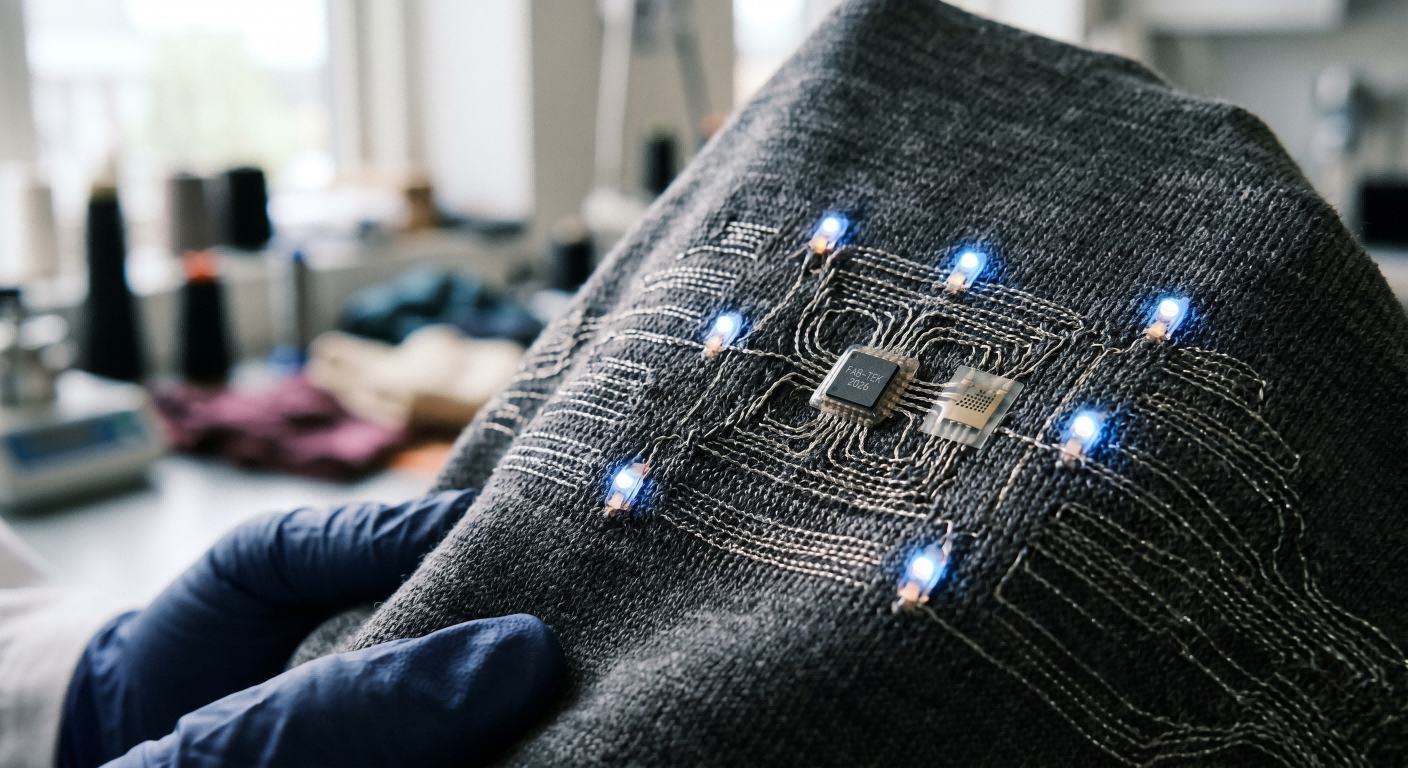
Imagine a jacket that reads your heart rate, adjusts to your core temperature, and slowly charges your phone, all woven directly into the shell. It used to sound like something pulled from a sci-fi script.
Now, it is sitting on cutting tables and running through pilot production lines. The shift from novelty to necessity is accelerating across sports, healthcare, and performance outerwear. Brands that treat fabric as just a barrier against the elements are quietly losing ground.
Shoppers expect their gear to work as hard as they do. This guide cuts through the marketing noise to look at what is actually viable in 2026. We will walk through conductive yarns, phase-change buffers, and embedded biosensors.
You will see where the tech holds up under real wash cycles, where the costs actually come from, and how to integrate these systems without compromising hand feel or durability. The revolution is not coming. It is already in the prototype phase.
At its core, a smart textile senses environmental shifts or user input and reacts accordingly. We generally split them into three tiers. Passive fabrics simply collect data, like a shirt with woven strain gauges.
Active textiles take that a step further by adding actuators that respond to the signals. Ultra-smart fabrics close the loop entirely, combining sensing, actuation, and adaptive learning into a single weave.
This is fundamentally different from strapping a plastic smartwatch to your wrist. Here, the electronics disappear into the fiber matrix itself. The material science relies on bridging textile engineering with flexible circuitry.
You are dealing with impedance matching, signal noise, and wash durability from day one. In 2026, we are past the lab curiosity stage. Production runs are happening, but the technology still demands careful handling during garment construction.
Expect realistic performance gains, not magic. The foundation sits in how well the fiber accepts electrical pathways without sacrificing drape or breathability.
Conductive yarn is the plumbing that makes everything else work. Most commercial lines rely on stainless steel microfibers or silver-coated nylon filaments. Carbon-based options, like graphene-infused polyester, are gaining ground for their corrosion resistance.
You will also see conductive polymer dips, primarily PEDOT:PSS, applied as surface treatments. Integration usually happens through core-spinning or hybrid knitting. The goal is to maintain a continuous electrical pathway without creating stiff patches that ruin drape.
When sewing these fabrics, switch to a 75/11 or 90/14 ballpoint needle. A sharp point will pierce the metal coating and break conductivity. Aim for a 3.0 mm stitch length to prevent short circuits during laundering.
Durability is the real hurdle. After fifty industrial wash cycles at 95°C, resistance can jump by 40 percent if the coating delaminates. Test your samples early. Here is a quick troubleshooting checklist for signal loss:
| Coating Type | Typical Resistance | Best Use Case |
| Silver-Coated Nylon | 0.1–0.5 Ω/cm | High-speed data transmission |
| Stainless Steel Core | 1.0–2.0 Ω/cm | Grounding and power routing |
| Carbon Ink Print | 5.0–10 Ω/cm | Touch pads and simple circuits |
Scalability is finally improving. Manufacturers are moving away from post-treatment dyes to extruded conductive filaments. This keeps the electrical pathway intact through aggressive mechanical stress.
Phase-change materials operate on a simple thermodynamic principle. Microencapsulated paraffins or salt hydrates absorb excess body heat as they melt, then release it back as they solidify. The transition usually triggers between 15°C and 35°C, depending on the polymer shell.
This creates a thermal buffer rather than active heating or cooling. You will recognize branded versions in performance sleepwear and winter base layers. The material gets microencapsulated at roughly 30 microns and bound into the fiber matrix or applied as a fabric coating.
Thermal buffering capacity typically ranges from 20 to 40 J/g. That is enough to delay temperature spikes during high-output activities. The tricky part is wash durability. If the capsules rupture during agitation, the PCM leaches out and the fabric loses its regulation capacity after ten cycles.
I always recommend gentle wash protocols for PCM-lined garments. For broader context on temperature regulation strategies, check out our breakdown of Thermal Fabrics Technology. It covers insulation and moisture management alongside these active buffers.
Military workwear and outdoor athletic gear currently drive the highest adoption rates. The chemistry is mature, but placement design dictates real-world performance.
Strain sensors rely on resistive changes when the fabric stretches. Manufacturers print carbon-based inks in serpentine patterns or weave conductive elastomer composites directly into the knit structure. When a joint bends, the conductor lengthens, resistance spikes, and the microcontroller logs the movement.
This enables precise gesture recognition and posture monitoring without bulky external devices. The real trade-off sits between sensitivity and mechanical fatigue. High-sensitivity inks detect micro-movements but crack after repeated washing.
Ruggedized elastomer threads survive thousands of stretch cycles but require larger deflections to trigger a readable signal. I usually run a calibration test at 10 percent, 25 percent, and 50 percent strain to map the response curve before cutting patterns.
Data transmission relies on near-field communication or low-energy Bluetooth modules sewn into hidden pockets. Maintaining function through home laundering still demands careful sealant application at the sensor edges.
Athletic trainers and physical therapists are adopting these fabrics for real-time feedback. The goal is clean signal capture without compromising garment comfort. Pattern drafting must account for sensor placement over high-flex zones.
Dry electrode fabrics have replaced sticky gel patches for continuous ECG tracking. The conductive yarns make direct skin contact, capturing P-wave and QRS complex signals through the chest knit. Respiration monitoring works similarly by measuring impedance changes across the ribcage as the fabric expands and contracts.
Distributed temperature sensors can flag early fever signs, while integrated EMG pads track muscle firing rates during recovery protocols. Sleep tracking systems use the same strain and impedance data to map movement cycles and detect apnea events.
The leap from consumer gadget to medical-grade device hinges on signal noise reduction. Regulatory bodies demand clinical validation, which means rigorous testing against hospital-grade monitors. Data privacy also becomes a legal minefield. Biometric streams must be encrypted locally before transmission to telehealth platforms.
We recently helped a rehabilitation clinic prototype a post-surgical monitoring shirt. The initial design used thick carbon ink electrodes for maximum signal clarity. It failed instantly. Patients complained of stiff patches that rubbed against sensitive incision sites.
We pivoted to a silver-polyester blend woven into a 180 GSM French terry base. The signal dropped slightly, so we added a firmware filter to smooth out motion artifacts. The compromise worked. Patients wore it for fourteen days straight.
We sacrificed perfect clinical precision for consistent real-world compliance. Sometimes less sensitivity actually saves the project. Designers must prioritize wearer tolerance over raw data density.
Heated garments rely on low-voltage resistance circuits woven directly into the lining. Carbon fiber meshes and flexible graphene panels dominate the space because they flex with the body. Wire-based heating is fading due to stiffness and puncture risks.
Power typically comes from 3.7V lithium polymer packs rated between 2200 and 5000 mAh. Strategic zone placement matters more than total wattage. Core heating targets the chest and lower back, while secondary loops warm the hands and neck.
Most systems offer three temperature tiers, controlled via magnetic connectors or wireless apps. Overheat protection is non-negotiable. Thermostatic cutoffs at 45°C prevent skin burns during prolonged outdoor exposure.
Battery weight quickly becomes a drag. A 5000 mAh pack adds roughly 180 grams to a lightweight shell. That is acceptable for workwear, but problematic for racing gear. Engineers constantly juggle runtime against pack density.
For temperature regulation context in heated design, see our guide on Thermal Fabrics Technology. Winter athletes, motorcycle riders, and cold storage workers drive the market. The interface design now matches consumer electronics standards.
Self-powered garments are the holy grail, but physics remains stubborn. Thermoelectric generators sandwiched between the skin and outer shell convert body heat differentials into milliwatts. Piezoelectric filaments harvest kinetic energy from walking or joint flexion.
Solar-integrating fabrics weave flexible photovoltaic threads into high-visibility vests or backpack straps. Storage is equally experimental. Textile batteries use liquid electrolytes bound into fiber mats, while supercapacitor yarns offer rapid charge and discharge cycles.
The goal is eliminating external power banks entirely. Current efficiency limits are sobering. A full day of hiking might generate 50 to 100 millijoules through piezoelectric means. That powers low-energy sensors, not phone chargers.
Realistically, these systems act as trickle chargers that extend battery life rather than replace it. Designers must manage expectations. Hybrid approaches, combining minimal solar panels with motion harvesting, currently offer the most viable path forward for autonomous garment electronics.
Chromic textiles shift appearance based on environmental triggers. Thermochromic inks use leuco dyes that alter molecular structure with heat, revealing hidden patterns as body temperature rises. Photochromic variants react to UV exposure, darkening under direct sunlight.
Electrochromic materials require a small current to change hue, enabling dynamic branding or signaling. Hydrochromic fabrics respond to moisture, which proves useful for rain detection in outerwear. Commercial adoption leans toward lifestyle and safety applications.
Kids wear temperature-indicating jackets, while athletes use exertion-mapping shirts to track heat zones. Wash fastness remains a persistent headache. Chromic particles degrade under UV light and aggressive detergents.
I once tested a batch of thermochromic knit that completely lost its reactive trigger after three industrial washes. Always lock the dyes with a silicone overprint. Future iterations aim for adaptive camouflage and mood-responsive fashion. The chemistry is advancing, but long-term durability still dictates practical use.
Defense applications push smart textiles into harsh environments. Chemical-biological detection relies on colorimetric fibers that react to nerve agents or airborne toxins, alerting personnel before symptoms appear. Ballistic vests now integrate pressure-sensitive matrices that log impact location and force distribution for post-mission analysis.
Conformal antennas woven into uniform collars maintain comms without adding rigid hardware. Soldier systems also leverage embedded health monitoring. Biometric patches track core temperature, hydration levels, and fatigue markers to prevent heat stress.
Energy harvesting modules power radios and GPS units during extended deployments. Active camouflage research explores electrochromic panels that match surrounding terrain, though weight and power draw remain hurdles.
Government R&D funding accelerates breakthroughs that eventually filter into civilian markets. Ballistic sensors now inform automotive seatbelt tensioners. Chemical detection chemistry adapts for industrial safety gear. The military budget effectively subsidizes early-stage textile innovation.
The global smart textile market sits around 2.5 to 3 billion dollars in 2026. Analysts project a 10 to 15 percent compound annual growth rate through 2030. That trajectory points toward a 5 to 7 billion dollar industry.
Healthcare monitoring commands the largest slice, driven by chronic disease management and remote patient tracking. Sports and fitness follow closely, while military contracts provide steady baseline revenue. North America currently leads in commercial adoption.
Europe dominates luxury integration and sustainable tech development. Asia-Pacific shows the fastest manufacturing scale-up, particularly in conductive yarn production. Venture capital flows heavily into sensor miniaturization and flexible battery startups.
Traditional mills are acquiring tech firms to secure supply chain control. Consumer awareness and price premiums still act as friction points. Standardization gaps slow widespread retail rollout. For broader industry context, review our analysis on 2026 Textile Market Trends.
The growth curve is steady, but profitable scaling requires solving wash durability and cost barriers first. Market adoption will accelerate once maintenance routines match conventional apparel.
Major players approach smart textiles from different angles. Athletic labels focus on performance analytics, embedding sensors into compression gear and footwear. Luxury houses experiment with embedded NFC threads for authentication and interactive retail experiences.
Tech giants file patents for neural-linked fabrics, though consumer rollout remains cautious. Specialty pioneers built entire business models around data-driven garments. Textile manufacturers develop smart fiber bases that scale across multiple product lines.
Startups are disrupting traditional supply chains by offering modular sensor kits that integrate off-the-shelf fabrics. Partnership models now favor co-development over vertical integration. Failed projects teach valuable lessons about battery placement and washing instructions.
The early connected jacket market collapsed twice because companies prioritized app features over actual garment comfort. Hardware without wearability always fails. When selecting bases for performance lines, consult our guide on Choosing Fabrics for Sportswear Collection.
Successful brands treat electronics as secondary to textile engineering. The fabric must breathe, stretch, and survive washing before the circuit matters.
Scaling smart textiles from lab samples to production runs exposes every weakness in the supply chain. Prototype circuits work flawlessly on a sewing machine table but fail under industrial pressing heat.
Integrating rigid components like connectors and battery pockets demands careful pattern engineering. You cannot simply stitch a PCB onto a 160 GSM jersey and expect it to survive a home wash. Flexibility and comfort require soft circuits and elasticated wiring channels.
Quality control becomes a nightmare when you are testing electrical continuity alongside seam integrity. Supply chains now span textile mills, component assemblers, and firmware developers. Coordinating lead times requires advanced planning.
We tried to integrate a flush-mounted battery compartment into a technical softshell. The initial design used laser-cut TPU layers sealed with ultrasonic welding. It looked clean but created a rigid ridge that chafed during movement.
We scrapped it and switched to a hidden gusseted pocket with a magnetic charging port. The bulk increased by 4 millimeters, but drape improved drastically. We lost the sleek aesthetic but gained actual wearer compliance.
Sometimes ugly seams outperform perfect engineering. Cost reduction relies on simplified designs and economies of scale. Standardization gaps mean every brand reverse-engineers basic testing protocols. The learning curve is steep but necessary.
Smart textile products currently carry a 50 to 200 percent price premium over conventional gear. The cost breakdown leans heavily toward microcontrollers, flexible batteries, and conductive threading. Sensors alone can double the material cost per square meter.
Volume economics dictate whether a line makes financial sense. Runs under 500 units rarely justify the setup costs for custom circuitry. Value proposition hinges on solving real problems. Continuous health tracking or active thermal regulation justifies higher price tags.
Consumers show willingness to pay for durability and actionable data, not gimmicks. Historical trends suggest component costs will drop as manufacturing matures. Subscription models are emerging, with brands charging monthly fees for analytics and firmware updates.
Total cost of ownership includes battery replacement cycles and repair protocols. If the electronics fail but the fabric remains sound, the garment becomes e-waste. Designers must plan for modular upgrades to protect consumer investment.
Navigating compliance for smart garments requires juggling multiple regulatory frameworks. Electronic safety standards like UL and CE dictate battery containment and circuit insulation. RF exposure regulations govern wireless modules, ensuring emissions stay within safe limits.
Biometric data collection triggers GDPR and CCPA requirements, demanding local encryption and transparent user consent. Traditional textile safety rules still apply. Chemical restrictions and flame resistance certifications must be met alongside electronic testing.
Health monitoring claims push products into medical device territory, requiring FDA clearance or CE marking. Industry groups like ASTM and ISO are drafting unified testing standards, but gaps remain. Environmental directives increasingly target e-waste from embedded electronics.
Manufacturers face recycling mandates for mixed-material garments. Tariffs and export controls can complicate component sourcing across borders. For a complete overview of compliance landscapes, review our breakdown of Sustainable Textiles Regulations 2026.
Regulatory readiness should dictate product launch timelines. Ignoring compliance early creates expensive redesigns later.
Looking past 2026, the technology shifts from passive monitoring to active interaction. Brain-computer interface research explores neural sensor fabrics that translate muscle signals into device commands. Self-healing polymers will repair micro-tears in conductive pathways using embedded capillary systems.
AI algorithms will continuously optimize thermal regulation and data filtering based on individual physiology. Haptic feedback fabrics will communicate through precise touch patterns, replacing screen notifications with physical cues.
Environmental adaptation could mean garments that alter permeability based on pollution levels or UV intensity. Medical applications will likely include continuous biomarker analysis and targeted drug delivery through micro-reservoirs in the weave.
Sustainable smart tech will prioritize biodegradable substrates and self-powered systems. Mass adoption probably arrives when maintenance disappears entirely. We are likely three to five years away from seamless integration in everyday apparel.
Brands should approach smart textiles with measured caution. Pilot runs and limited drops test market response without locking capital into unproven tech. Partnering with established component suppliers reduces development risk compared to building internal engineering teams.
Consumer education requires clear messaging about care instructions and data usage. Differentiation happens through thoughtful integration, not feature dumping. Identify audiences that genuinely need continuous monitoring or active climate control.
Verify that your current supply chain can handle mixed-material assembly and electronic testing. Post-sale support must address firmware updates and hardware troubleshooting. Upgrade planning prevents premature product obsolescence. Start narrow, validate performance, then scale.
Smart textile technology has crossed the threshold from experimental to commercially viable. Brands that ignore this shift will eventually find their product lines feeling outdated. The 2026 landscape demands realistic expectations. The tech works, but it requires careful engineering and honest care instructions.
XO Fabric is positioned to support brands navigating this transition. We maintain direct relationships with conductive yarn mills and sensor integrators. If you are ready to explore functional fabric development, let us help you build it right. Discover our collaborative process through the XO Fabric Advantage Partnership.
The next generation of gear is woven now. Prepare your supply chain, test early, and prioritize wearer comfort over flashy specs.