Address
Nanlang Industrial Zone, Xingtan Town, Shunde District, Foshan, Guangdong, China
Work Hours
Mon–Fri, 9:00 AM – 6:00 PM (CST/UTC+8). We aim to respond to all inquiries within 48 hours.

Address
Nanlang Industrial Zone, Xingtan Town, Shunde District, Foshan, Guangdong, China
Work Hours
Mon–Fri, 9:00 AM – 6:00 PM (CST/UTC+8). We aim to respond to all inquiries within 48 hours.
Designing a sportswear line? Fabric choice can make or break your garments.
The wrong pick leads to discomfort, poor performance, and customer complaints.
Many new brands choose based on appearance alone, then face quality issues and returns.
Sportswear fabrics must perform. They need to wick moisture, allow full range of motion, and survive repeated washes without losing their hand feel.
This guide covers the key factors in choosing sportswear fabrics. We will look at activity demands, material mechanics, and the practical decisions that separate functional gear from fast fashion.
You cannot engineer a garment until you know what the body will actually do inside it. Movement dictates everything.
Yoga, pilates, and stretching demand softness and drape. You want a four-way stretch that moves with slow, deliberate transitions.
Cotton-modal blends work well here. Lightweight jersey and bird eye mesh in a cotton blend also deliver the right drape.
Target a GSM between 160 and 180. Anything heavier starts to drag when a model goes into downward dog. The fabric should feel cool against the skin but not cling like plastic.
Yarn denier matters. Finer fibers around 40 to 60 denier create that buttery hand. Heavier yarns feel structured but restrict subtle articulation. You also want a low twist count to prevent surface stiffness.
Gym training, cycling, and jogging introduce friction and sweat. You need moisture management and moderate compression to keep the garment anchored.
Polyester bird eye mesh and honeycomb constructions handle this range beautifully. Moisture-wicking jersey blends also perform reliably.
Look for a GSM around 180 to 210. Keep the spandex content between 8 and 12 percent. This gives enough support without restricting cardiovascular movement.
Knitting gauge shifts here. An E14 gauge provides tighter stitch formation than E12. It reduces seam slippage during repetitive squat cycles. You also want a covered elastane core to prevent rubber degradation from sweat acids.
Running, HIIT, and team sports push materials to their mechanical limits. Sweat output spikes, and joint impact increases.
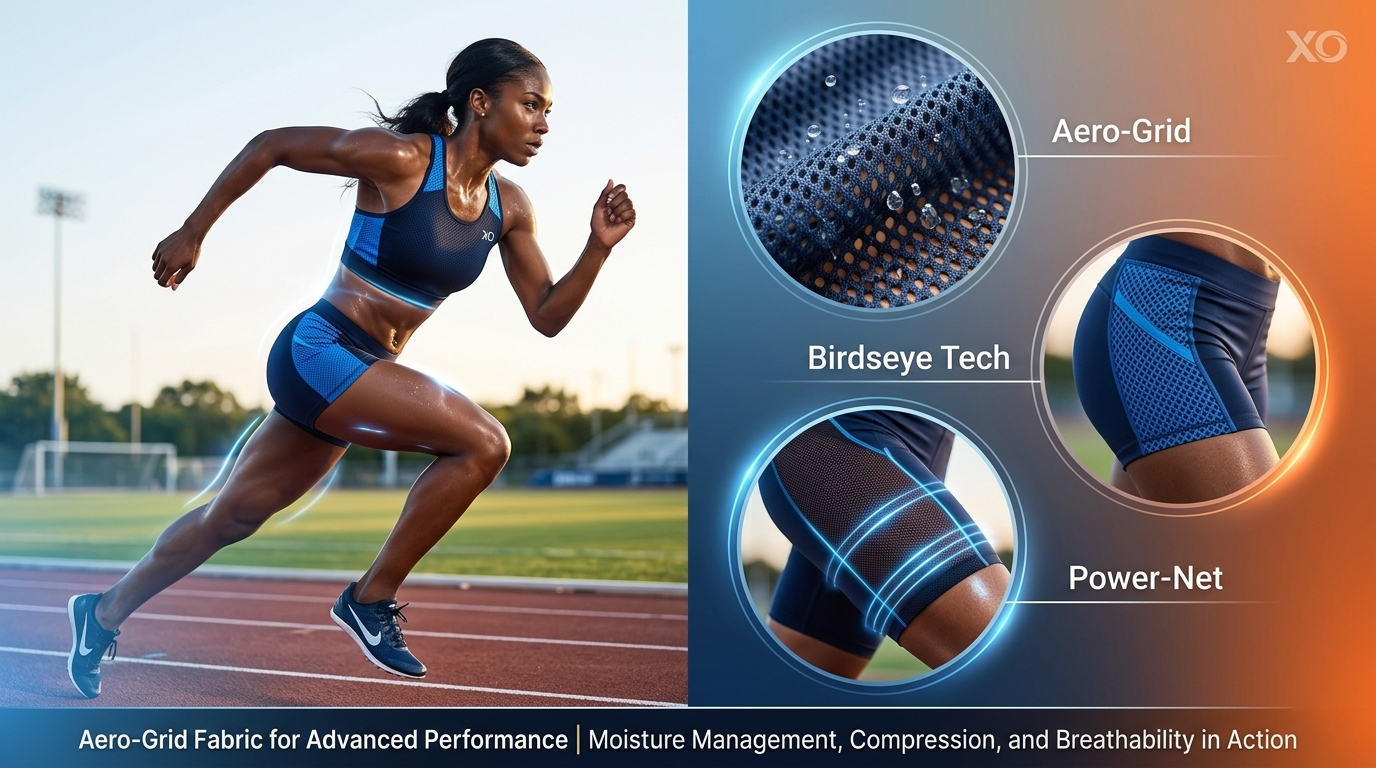
You need high moisture management, firm compression, and abrasion resistance. Honeycomb mesh, power net, and heavy compression knits are standard here.
Push the GSM to 200-240. Elastane jumps to 15-20 percent. The yarn count needs to be finer to prevent seam slippage during rapid directional changes.
Flatlock seams become mandatory. Bulkier overlock stitches create chafe points during long runs. A 4.5mm stitch length with nylon coverstitch thread handles the tension without popping.
Hiking, skiing, and surfing introduce weather variables. Thermal regulation and wind or water resistance take priority over sheer stretch.
Polar fleece, thermal knits, and fabrics with DWR finishes handle these environments. GSM often climbs to 250 or higher for insulation.
Remember that breathability still matters. Trapped vapor causes chilling faster than cold air. You want a shell that blocks elements while letting core heat escape through strategic venting.
If you are planning to engineer ventilation zones, understanding the structural differences between open-weave and engineered open-knit is crucial. Mesh Fabric 101 breaks down exactly how these constructions move air without sacrificing durability.
I once watched a startup spec pure cotton for a yoga capsule. It looked pristine on the swatch board. During the first tech fitting, the fabric bunched at the knees and restricted hip articulation. We swapped to a modal-cotton blend at 170 GSM. The drape improved instantly, and recovery held after three wash cycles.
This is where theory meets the wash cycle. Performance claims mean nothing if the material mechanics fail under stress.
Wicking and absorption are opposites. Polyester actively pushes water outward through capillary channels. Cotton soaks it up and holds it.
Fast drying prevents chafing and odor buildup. You want a finish that accelerates evaporation without feeling waxy. Hydrophobic treatments help, but the knit structure does the heavy lifting.
The physics behind capillary action and hydrophobic yarn alignment is often overlooked. Science of Moisture-Wicking dives into the chemical treatments and fiber structures that actually move sweat away from the skin.
Surface tension dictates how quickly droplets bead or spread. Cross-sectional yarn engineering creates micro-valleys that pull moisture laterally. Flat yarns perform poorly here. Tri-lobal or Y-shaped cross sections dramatically increase surface area for faster dispersion.
Four-way stretch allows diagonal movement. Two-way only works on the warp or weft. For activewear, four-way is non-negotiable.
Spandex content typically ranges from 5 to 20 percent. Higher percentages mean more compression but also more tension on the seams.
Run a manual recovery test. Pull the swatch to 150 percent of its original length. Release it. Measure the residual stretch. Anything over 10 percent failure will sag after the first workout.
Elastane degradation happens faster in humid environments. Chlorinated pool water and acidic sweat break down the polyurethane core over time. Heat setting the fabric at 140 degrees Celsius for ten minutes stabilizes the polymer chain. It extends garment life significantly.
Solid knits trap heat. You need strategic mesh panels at high-sweat zones like the underarms and upper back.
Open-knit constructions create micro-channels for airflow. The hole size determines ventilation volume, but smaller holes resist snagging better.
Geometric spacing matters more than raw hole count. Hexagonal patterns distribute stress evenly. Square grids concentrate tension at the corners, leading to early tearing.
Sportswear undergoes repeated friction against itself and equipment. Brushing creates surface fibers that eventually ball up.
An anti-pilling finish is mandatory for longer wear. The mill usually applies a silicone or resin treatment, followed by a controlled heat cure. It sacrifices a tiny bit of softness but extends garment life dramatically.
| Common Failure | Mechanical Cause | Fix / Prevention |
| Pilling | Short fiber migration & friction | Use longer staple fibers, apply anti-pill finish |
| Shrinkage | Residual tension from knitting/dyeing | Sanforize or heat-set at 60°C before cutting |
| Seam Slippage | Loose stitch structure + high stretch | Increase stitch length to 3.5mm, use coverstitch |
Thermal regulation splits into two camps. Cold-weather sports need polar fleece or thermal knits to trap body heat. Hot-weather sports require lightweight mesh or cooling jersey that reflects infrared radiation.
A manufacturer I consulted wanted maximum four-way stretch for compression leggings but kept getting seam slippage after wash fifteen. We dialed the elastane down from 22 percent to 18 percent. We also switched to a tighter circular knit gauge and adjusted the overlock tension. The trade-off was slightly less initial give. But the garment kept its shape for fifty wears. Chasing extreme specs usually breaks the mechanics.
Jersey, mesh, compression knits, and fleece form the backbone of technical apparel. Each solves a different problem.
Jersey remains the most versatile base. Single knit offers drape and lightweight feel. Double knit adds stability and prevents curling at the raw edges.
Cotton feels soft but absorbs moisture. Polyester wicks efficiently but can feel synthetic. Blends hit the middle ground. Cotton-modal or cotton-polyester mixes balance hand feel with durability.
When you start mixing these constructions across a single garment, the engineering gets interesting. Performance and Functional Knits shows how different weaves can be combined without causing differential shrinkage.
Single jersey curls at the cut edge. You must use bias binding or coverstitch hems to stabilize it. Double jersey lies flat naturally. It costs more per meter but saves hours on the sewing line. The choice depends entirely on your production timeline.
Mesh is essential for breathability. Sports mesh covers general ventilation needs. Bird eye mesh offers a more structured grid with better moisture dispersion. Honeycomb mesh delivers high stretch, making it ideal for compression zones.
I have seen too many designers treat compression fabric like regular interlock. It is not. The tension requirements on the flatlock machine change completely. You will need a coverstitch foot that handles high elastane without eating the seam allowance. A 4.5mm stitch length usually saves the day.
Open knit density dictates airflow volume. Larger holes move more air but compromise abrasion resistance. You must balance ventilation against durability based on the garment zone. Underarms need max airflow. Outer thighs need max abrasion resistance.
Compression improves blood circulation and reduces muscle oscillation. It usually carries 15 to 20 percent spandex. Recovery must be exceptional. Graduated compression requires engineered stitch density, not just tight knitting.
Uniform compression feels like a vice. Graduated compression mimics venous return. You achieve this by programming the knitting machine to vary stitch count per inch. The distal zones get tighter formations. The proximal zones relax slightly.
Yarn alignment matters. Spiral knit structures distribute pressure evenly. Plain knit structures concentrate force on the warp threads. You will notice the difference immediately during a downhill run.
Polar fleece traps air for warmth. Microfiber fleece offers a lighter hand and less bulk. Anti-static treatments prevent lint buildup, which is critical for synthetic insulation.
Brushing depth controls loft. Deep brushing increases warmth but reduces wind resistance. Light brushing maintains surface integrity. You want a tight outer face and a fluffy inner face for optimal thermal retention.
Heat setting is mandatory before cutting. Fleece memory shrinks unpredictably if skipped. A controlled pass through the stenter frame locks the dimensions. It saves you from mismatched panels during assembly.
Swatches lie. You need to stress-test the material before committing to a tech pack.
Drop water on the inner face. Time the absorption. It should wick within seconds, not bead up or soak like a towel.
Run the stretch test. Pull to 150 percent. Release. Measure residual distortion. Calculate the percentage. Fail the batch if it exceeds 10 percent.
Rub the surface vigorously against itself. Check for fuzz migration. You want a clean surface after fifty cycles.
Use a standard pilling tester. Set it to two hundred revolutions. Inspect under bright lighting. Grade the fuzz formation. Anything below grade four indicates poor fiber stabilization or skipped brushing controls.
Sew a full sample. Wear it during the actual intended activity. Assess moisture management, range of motion, and chafe points.
Wash the garment ten to twenty times. Use standard detergents. Tumble dry on medium. Evaluate color fastness and hand feel retention.
Track dimensional changes after washing. Measure chest, waist, and inseam. Calculate shrinkage percentage. Anything over 3 percent requires pattern adjustment or pre-shrinking protocols.
Physical tests are fast, but labs provide defensible data. AATCC TM79 measures moisture transport. AATCC 61 tracks color and dimensional stability. ISO 12947 standardizes pilling resistance.
Lab reports look intimidating at first glance, but once you know where to look, they tell you everything about batch consistency. How to Read Fabric Lab Report walks you through the critical columns that actually matter for activewear.
If you want to run these tests on your own bench, you need physical swatches first. Request Samples to get a test kit delivered to your workspace.
| Test Type | Standard | Pass/Fail Threshold |
| Moisture Wicking | AATCC TM79 | Vertical rise ≥ 50mm in 30 min |
| Color Fastness | AATCC 61 | Grade ≥ 4 for wash & crocking |
| Pilling Resistance | ISO 12947-2 | Grade ≥ 4 after 50 cycles |
Red flags are usually obvious. Water sitting on the surface means the finish failed or the fiber blend is wrong. Poor recovery warps seams. Excessive pilling after ten washes signals cheap staple length or skipped brushing controls. Trust the data over the sales sheet.
Working with a mill that handles knitting through finishing under one roof cuts out translation errors. Lead times drop to ten to twenty business days. Batch consistency stays within tolerance.
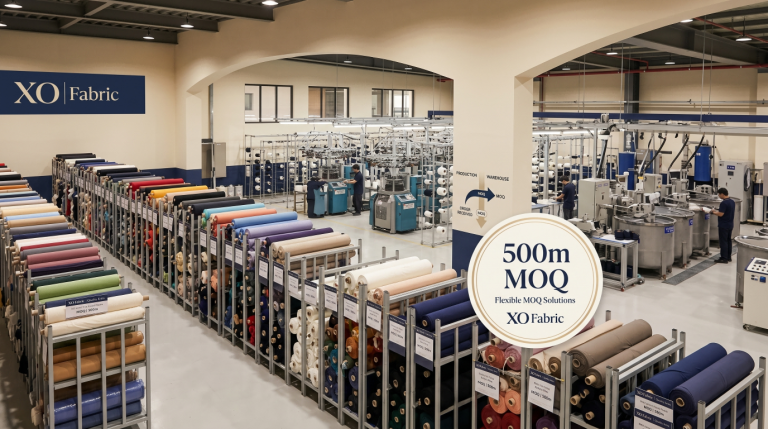
The technical desk handles custom spandex ratios, engineered mesh patterns, and functional finishes without treating them as special orders. MOQs sit around five hundred meters for most knits and four hundred for mesh.
You get lab dip approvals and third-party testing coordination built into the workflow. The production floor runs in-house pilling tests before cutting. Finishes are validated for fifty plus wash cycles. You avoid the variability of outsourcing multiple steps to different vendors.
Technical support includes over fifty specialists for development and QC. Custom color matching uses digital spectrophotometry to minimize dye lots. You get a partner that understands garment mechanics, not just yardage sales.
Integrated production means faster iteration cycles. You can adjust stitch density or finish concentration between dye and knit. This flexibility saves weeks during tech pack revisions. You also get consistent hand feel across production runs.
Choosing sportswear fabrics requires balancing performance properties with activity demands and market expectations. Jersey, mesh, compression knits, and fleece each solve different mechanical problems on the body.
The right pick survives the wash, moves with the athlete, and keeps its hand feel. You have to run the numbers yourself before committing to a bulk roll.
If you are ready to test how these constructions behave under real stress, reach out to request a sample pack. We will get swatches to your bench so you can verify the performance firsthand.