Address
Nanlang Industrial Zone, Xingtan Town, Shunde District, Foshan, Guangdong, China
Work Hours
Mon–Fri, 9:00 AM – 6:00 PM (CST/UTC+8). We aim to respond to all inquiries within 48 hours.

Address
Nanlang Industrial Zone, Xingtan Town, Shunde District, Foshan, Guangdong, China
Work Hours
Mon–Fri, 9:00 AM – 6:00 PM (CST/UTC+8). We aim to respond to all inquiries within 48 hours.
When you’re sourcing fabric for a new collection, the difference between a reliable supplier and a risky one often comes down to one thing: who actually controls the production.
Many textile suppliers are trading companies — they outsource production and lack direct quality oversight. You send specs, cross your fingers, and hope the bulk order matches the sample. We’ve all been there.
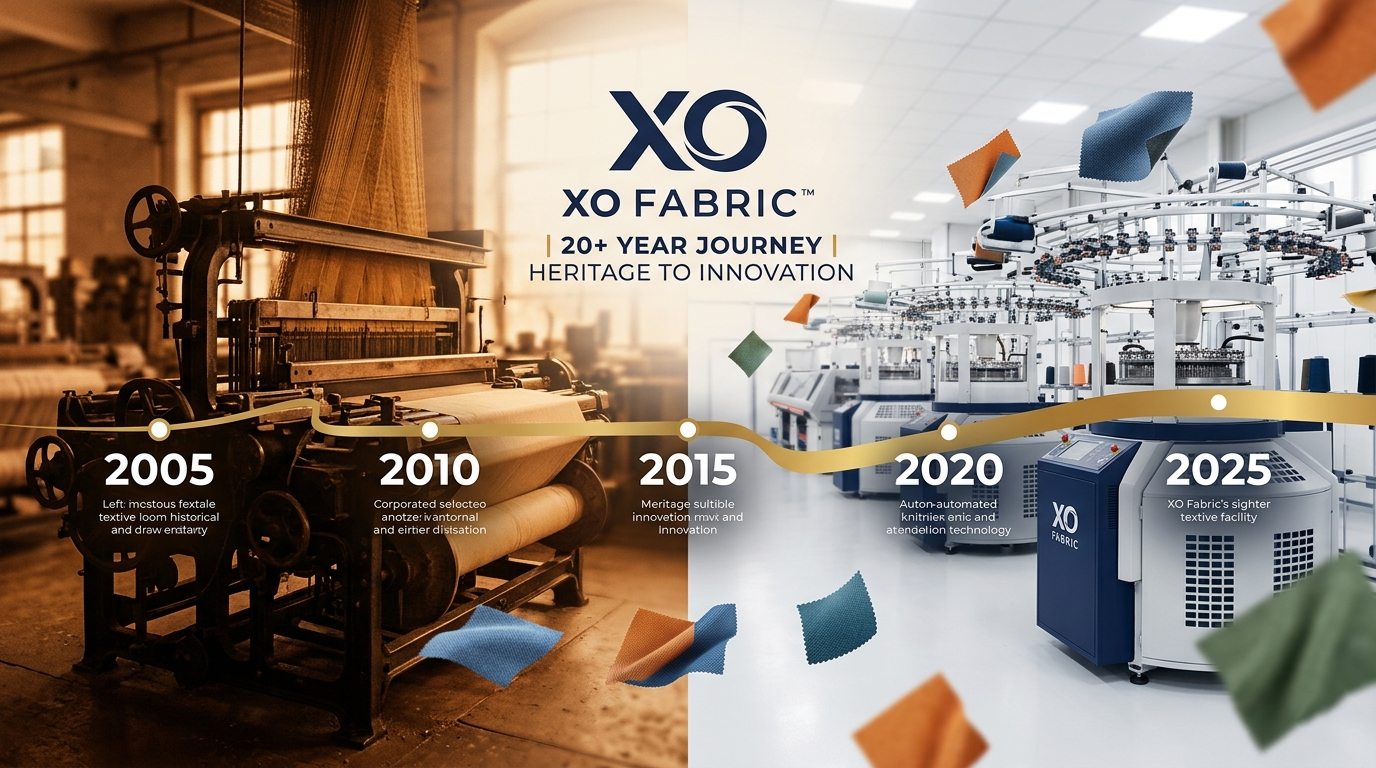
Since 2005, XO Fabric has taken a different path. What started as a small weaving workshop in Foshan, China, has evolved into an integrated textile manufacturer serving 200+ clients worldwide. This XO Fabric story is about more than milestones; it’s about how vertical integration reduces your risk and ensures consistent quality, batch after batch. If you’re evaluating suppliers, understanding this journey could save you headaches down the line.
Back in 2005, the textile landscape in Foshan was fiercely competitive. Small workshops popped up overnight, chasing the same low-margin orders. We started with a handful of looms and a simple goal: deliver quality woven fabrics at prices that made sense for local apparel makers.
Early days meant tough choices. Limited equipment. Tight cash flow. And a market that rewarded speed over consistency. I still remember the first time a client rejected a batch because the hand-feel varied across the roll. That stung. But it also clarified our focus: control the process, or lose the customer.
By 2008, demand for knit fabrics was rising fast — especially for activewear and casual apparel. We made a calculated bet: invest in warp knitting machines. Not just any machines; we hired experienced technicians who understood gauge tension and stitch density. Some of those team members are still with us today, which says something about culture, doesn’t it?
That shift wasn’t just about adding equipment. It changed how we thought about production. Knits offered more versatility, faster turnaround, and — crucially — better margins if you could control the variables. GSM consistency, shrinkage control, color fastness: these became our daily metrics.
The real turning point came with vertical integration. In 2010, we added an in-house dyeing facility. No more outsourcing to third-party dyehouses with unpredictable lead times. Two years later, finishing and flocking lines joined the workflow. Suddenly, we could take a yarn order and deliver a finished, flocked fabric without handing off to another factory.
For designers, this integration means fewer variables. When you’re developing a performance knit at 220 GSM with moisture-wicking finish, having dyeing and finishing in the same building lets us adjust parameters in real time. Want to explore options? Our Knit Base Fabrics collection reflects that depth of capability.
Curious how it all fits together physically? We documented the flow in our factory tour post, production tour, which walks through each stage from yarn to finished roll.
Vertical integration sounds like a buzzword until you’ve dealt with the alternative. For us, it means knitting, dyeing, finishing, and flocking all happen within the same facility. No third-party handoffs. No “we’ll check with our partner factory” delays.
Why does this matter for your projects? Three reasons: speed, consistency, and cost control. When a client needs a lab dip approved and bulk production started within days, having dyeing in-house cuts weeks off the timeline. When shrinkage specs are tight (±3% is our standard), controlling every step reduces variance.
Let’s break down the flow — and the technical considerations at each stage.
We run 50+ knitting machines across warp and weft configurations. Gauge selection depends on your end use: 28-gauge for lightweight jerseys (140-180 GSM), 18-gauge for heavier interlocks (220-280 GSM). Needle type matters too — we use compound needles for smoother loop formation, which reduces pilling risk later.
In-house yarn preparation is non-negotiable. We test tensile strength and elongation before knitting starts. If the yarn variance exceeds 5%, we adjust machine tension or flag it for the client. Better to catch it early.
Piece dyeing for synthetics uses disperse dyes, with temperature profiles calibrated to fiber type. Polyester? 130°C high-temperature dyeing. Blends? We adjust pH and carrier systems to avoid uneven uptake.
Color matching isn’t guesswork. Our lab uses spectrophotometers to hit Pantone standards within ΔE < 1.5. But numbers don’t tell the whole story. I’ve learned that lighting conditions matter — a shade that looks perfect under D65 might shift under store lighting. We now approve lab dips under multiple light sources to avoid that surprise later.
Heat setting stabilizes dimensions. We target residual shrinkage under 3% for knits, verified by AATCC 135 testing. Softening agents are chosen based on hand-feel requirements: silicone-based for fluid drape, cationic for crispness.
Functional finishes add value but require trade-offs. A moisture-wicking treatment might slightly reduce color vibrancy. An antibacterial finish could affect fabric breathability. We’ll walk you through these choices — it’s not about the “best” finish, but the right one for your use case.
Electrostatic flocking lets us add velvet or plush surfaces to base knits. Pile length ranges from 0.5mm (subtle texture) to 5mm+ (bold plush). Pattern flocking is possible with custom screens, though setup costs apply for runs under 500m.
One thing clients don’t always consider: flock adhesion. We test rub fastness (AATCC 8) and wash durability. If the base fabric isn’t properly pre-treated, flock can shed. That’s why integration helps — we control the prep stage.
Quality checks happen at every transition. Here’s a simplified checkpoint list:
For a deeper dive into how we document and track these checks, our Quality Control Process post outlines the full protocol.
Case note: A recent activewear client needed a 200 GSM jersey with < 2% shrinkage after five washes. Initial trials hit 3.5%. Instead of changing the fiber blend (which would affect cost), we adjusted the heat-setting temperature profile and added a relaxation step post-dyeing. Result: 1.8% shrinkage, on spec, without reformulating. Sometimes the fix is in the process, not the material.
Early on, we produced basic polyester knits — commodity fabrics with tight margins and little differentiation. It kept the lights on, but it wasn’t sustainable. The shift toward specialty fabrics wasn’t a sudden pivot; it was a series of small bets based on client feedback and market signals.
Decision-making in action: Around 2015, a sportswear brand asked if we could develop a mesh with better moisture transport than standard bird’s eye. We had two options: license an existing construction (faster, but less unique) or engineer a new stitch pattern (slower, but defensible). We chose the latter. It took three iterations to balance airflow, durability, and production speed. The resulting honeycomb mesh became a bestseller — not because it was perfect on the first try, but because we iterated with the client’s testing data.
Today, our range reflects that iterative mindset:
Customization is where integration pays off. Need a lab dip in a specific Pantone? We can match it in-house. Want to adjust GSM by ±20 points? We’ll tweak stitch density or yarn count. Even custom finishes — water-repellent, flame-retardant, soft-touch — are feasible because we control the finishing stage.
Minimum order quantities reflect this flexibility: 500m for standard knits, 300m for flocked developments. It’s not the lowest MOQ in the market, but it balances setup costs with accessibility for emerging brands.
One product that embodies this evolution is our High-F Shiny Velvet. It started as a client request for a luxe hand-feel with durable pile. We tested multiple fiber deniers and flock adhesives before landing on the 100D/144F construction. The result: a fabric that looks premium but performs in production.
Quick aside: I still prefer matte finishes for most applications, but that shiny velvet taught me that client preferences aren’t about my taste — they’re about the end consumer’s expectation. Humbling, and useful.
Stability isn’t glamorous, but in textile sourcing, it’s priceless. Many suppliers come and go; the mill has been operating continuously since 2005. That longevity isn’t just about survival — it’s about accumulated knowledge. Our team includes 50+ technicians, many with 10+ years of tenure. When a production issue arises, that experience shows up in the solution.
Quality assurance goes beyond final inspection. We build checks into each stage:
| Stage | Key Metric | Standard |
| Knitting | GSM variance | ±5% |
| Dyeing | Color fastness (washing) | Grade 4+ (ISO) |
| Finishing | Residual shrinkage | <3% (AATCC 135) |
| Flocking | Pile adhesion (rub test) | Grade 4 (AATCC 8) |
Test reports are available for every bulk order — AATCC, ISO, or client-specific protocols. Transparency builds trust, especially when you’re ordering from overseas.
Pricing benefits from integration too. No middlemen means cost savings that we can pass along. Volume discounts apply for orders over 5,000m, but we’re upfront about pricing tiers. No hidden fees for “urgent” lab dips or sample shipments.
Communication might be the underrated factor. Our English-speaking sales team responds within 24 hours, but more importantly, they understand technical specs. If you ask about stitch density’s impact on drape, you’ll get a practitioner’s answer, not a sales script.
Ready to discuss your next project? contact our team to start the conversation with our technical team.
Sustainability in textiles isn’t a checkbox; it’s a series of incremental improvements. We’ve focused on areas where integration gives us leverage: energy, waste, and water.
Energy efficiency starts with machinery. Our heat recovery systems capture waste heat from dyeing for pre-heating water. It’s not flashy, but it cuts natural gas use by ~15%. We’re also upgrading to LED lighting across the facility — small changes that add up.
Waste reduction is practical. Fabric scraps go to a recycling program that converts them into insulation material. Not a perfect solution, but better than landfill. We track scrap rates by product line and use that data to optimize cutting patterns.
Water treatment is non-negotiable. Our dyeing wastewater goes through a multi-stage system: pH adjustment, coagulation, biological treatment, and filtration. The output meets local discharge standards, but we’re aiming higher — targeting reuse for non-critical processes by 2027.
Social responsibility means fair wages, safe conditions, and strict age verification. We audit our own practices annually, not just for compliance but because it’s the right thing to do. Community involvement includes local scholarships for textile engineering students — investing in the next generation of makers.
Future goals are ambitious but grounded: increase recycled polyester (rPET) usage to 30% of synthetic orders by 2028, explore bio-based fibers like PLA for niche applications, and pursue ISO 14001 certification for our environmental management system.
Honest take: We’re not perfect. Transitioning to rPET can affect dye uptake, requiring process adjustments. But avoiding the challenge isn’t an option. Progress over perfection, right?
The textile industry moves fast. Staying relevant means investing in R&D while keeping core operations reliable. Here’s where we’re focusing energy for 2026-2027.
We’re expanding our range of functional knits. Current R&D targets: enhanced moisture-wicking (target: 30% faster evaporation than standard), antibacterial finishes with longer durability (50+ washes), and thermal regulation for outdoor applications.
New product launches are planned for late 2026. One in development: a lightweight knit with phase-change material for temperature buffering. It’s tricky — balancing performance, cost, and production scalability. We’ll share updates as prototypes validate.
Automated inspection systems can reduce human error in defect detection. We’re piloting camera-based systems that flag barre, holes, or color variation in real time. Early results: 20% faster inspection with comparable accuracy.
ERP upgrades improve order tracking. Clients will soon see real-time production status — not just “in progress,” but “dyeing stage, estimated completion Thursday.” Transparency reduces anxiety on both sides.
Digital printing exploration is cautious but active. For small-batch customization (<500m), it could reduce minimums and enable rapid prototyping. The challenge: matching color consistency with traditional dyeing. We’re testing, not committing.
We’re targeting more US and EU clients, which means adapting to regional expectations: shorter lead times, specific compliance documentation, and multilingual support. Attending trade shows like Premiere Vision helps us connect directly with designers.
Our website and customer support are expanding language options. Not just translation — cultural context matters in technical communication. A spec sheet that works in Asia might need adjustment for European buyers.
Exploring our expanding range? Check out Performance and Functional Knits for current offerings. Or, if you’re thinking long-term partnership, Partner with Us to discuss how we can align roadmaps.
From a small weaving workshop in 2005 to an integrated textile manufacturer today, the journey hasn’t been linear. There were missteps, market shifts, and lessons learned the hard way. But the core focus remained: quality, reliability, and customer partnership.
For designers and brands, working with a supplier who controls the entire production chain reduces variables. When GSM, shrinkage, and color consistency matter — and they always do — that control translates to fewer surprises and more confidence in your final product.
Whether you’re a startup testing your first collection or an established label scaling production, the mill has the expertise and capacity to support your needs. Fabric development is collaborative by nature; the best outcomes come from open dialogue about specs, constraints, and goals.
Ready to request samples or discuss a custom development? reach out to our team to start the conversation with our technical team.