Address
Nanlang Industrial Zone, Xingtan Town, Shunde District, Foshan, Guangdong, China
Work Hours
Mon–Fri, 9:00 AM – 6:00 PM (CST/UTC+8). We aim to respond to all inquiries within 48 hours.

Address
Nanlang Industrial Zone, Xingtan Town, Shunde District, Foshan, Guangdong, China
Work Hours
Mon–Fri, 9:00 AM – 6:00 PM (CST/UTC+8). We aim to respond to all inquiries within 48 hours.
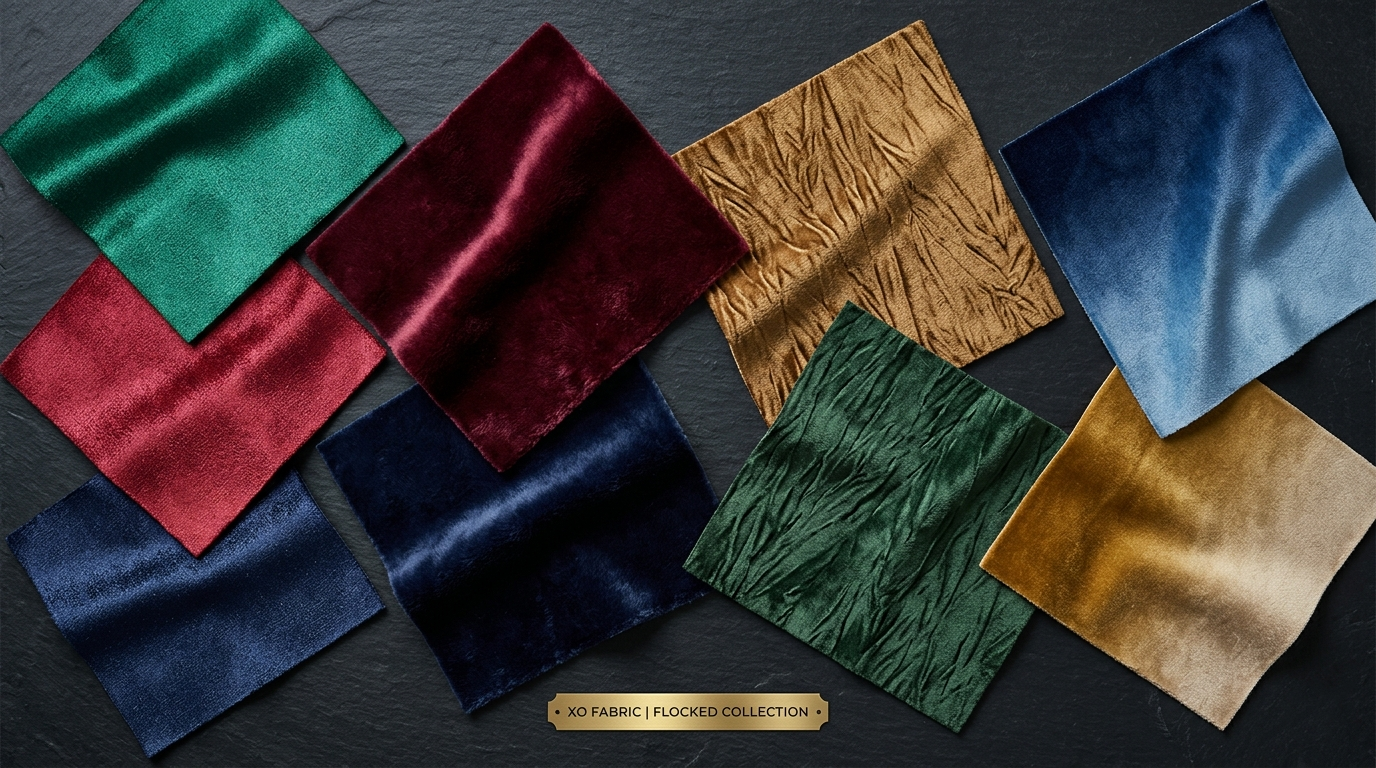
Flocked fabrics always grab attention on the rack, but they quietly trip up patternmakers who haven’t dealt with pile orientation or adhesive curing before. I’ve seen otherwise solid jackets fail because the flocking direction was ignored during layout, or because the wash cycle stripped the backing adhesive too fast.
Understanding how the pile gets bonded to the base changes everything. It stops being about just picking a soft texture. It becomes engineering drape, durability, and cost control. We’ll walk through the electrostatic bonding process. We’ll break down which substrates actually survive production. We’ll look at how to match pile height to garment function.
If you’re sourcing for activewear or high-turnover fashion, these details dictate whether your final piece holds up. Or falls apart after three dry cleanings.
At its core, flocked fabric is an engineered composite. You start with a base textile. You coat it with a specific adhesive. You then electrostatically align short fibers vertically into the wet binder. Once cured, those fibers stand upright. They create that familiar velvet-like surface.
It isn’t woven or knitted like traditional plush textiles. The pile is literally glued down. This means density and height can be dialed in with mechanical precision. You aren’t relying on yarn twist or weft insertion.
I’ve worked with converters who treat flocking as a decorative afterthought. When done correctly, the adhesive cross-links into the substrate. It gives the pile actual structural integrity. The surface behaves predictably under tension.
The machinery uses a high-voltage field to charge loose fibers. Gravity and electrostatic pull align them perfectly perpendicular to the moving fabric belt. Roller coating applies the adhesive evenly before the fibers drop.
The web then passes through a curing oven. Heat triggers cross-linking. If the voltage fluctuates, you get patchy coverage. If the adhesive viscosity is off, fibers lie flat. Consistent oven temperature matters more than people think.
I usually watch the conveyor speed carefully. Rushing the cure leaves the bond vulnerable to washing. A standard 160°C to 180°C hold for 12 to 15 seconds is typical. Going faster causes adhesive bloom. Going slower causes fiber slippage.
Softness is obvious. The real value is customization. You can shift from a barely-there 0.5mm micro-pile for subtle luxury. You can move to a 5mm+ long hair effect for dramatic fashion pieces.
Durability hinges entirely on the adhesive formulation and cure cycle. Properly cross-linked bonds resist abrasion surprisingly well. They often outlast poorly woven velvets in high-friction zones. You can run Martindale tests without seeing immediate shedding.
Design flexibility is where flocking shines. You can mask areas for local flocking. You can run gradient density changes. You can even print patterns directly into the adhesive bed before the fibers drop. Flocked and Printed Fabrics showcase how far that capability stretches.
The cost sits mid-to-high because of the extra processing steps. It beats weaving custom plush structures for small runs. If you want to see how traditional plush compares, reading through High-F Velvet Manufacturing highlights why the two processes serve completely different production needs.
The market keeps pushing flocking beyond basic upholstery. Different pile structures solve different patternmaking headaches. I’ll break down the five types that actually move units. I’ll start with the ones that dominate technical sportswear.
Picking the right type usually comes down to friction zones. I remember working on a winter training line where we initially spec’d a 4mm long hair for the full jacket body. It looked incredible on the swatch board.
The fit session proved it was a disaster. The pile added too much bulk at the seams. The underarm gussets twisted during the flocking roll. The first wash cycle left tiny bald patches where the elbows rubbed. We had to pivot.
We switched to a Pearl Grain Flocked Fabric for the upper torso. We kept the long hair only for the collar and cuffs. That compromise saved the silhouette. We adjusted the seam allowances by 2mm to account for pile compression.
We also switched to a 3-step ultrasonic bonding for the side seams. We avoided piercing the adhesive layer with standard needles. It was a messy trial. The final garment passed the abrasion tests. It actually felt breathable on the track.
The flock itself is just the visible layer. The substrate dictates how the fabric moves. It determines whether it survives the wash. It decides if it can handle tension during cutting. Most beginners focus on pile height. They ignore the backing until production buckles.
This is a warp-knit construction with a remarkably stable face. It grabs adhesive evenly. It stretches predictably in the crosswise direction. I default to tricot for almost all apparel flocking. It balances drape with mechanical recovery.
The surface tension stays consistent. This prevents the electrostatic fibers from clumping. Flocked on Tricot Jersey Base is usually the safest starting point for activewear. It handles 4% to 6% crosswise stretch without distorting the pile alignment.
Woven twill adds structure. The diagonal weave resists distortion under tension. It’s ideal for workwear, outerwear shells, or upholstery. It’s heavier, often running 280 to 320 GSM before flocking.
The pile stands rigid. That can be a pro or con depending on your design. If you need a garment that holds a sharp silhouette without lining, twill backing wins. Just expect higher seam bulk. Use a 90/12 ballpoint needle to prevent skipped stitches.
Bonded fiber mats are the budget option. They absorb adhesive quickly. They cure fast, but they lack tensile strength. You’ll see them in disposable costumes or promotional items. They pill faster at the edges.
They don’t recover from stretching. I only recommend them when the timeline is tight. The garment won’t face heavy wear. Shrinkage stays under 2% after washing. It’s stable enough for short-term use.
A synthetic polymer backing mimics split leather. Flocking it creates a velvet-soft surface that still feels structured. Automotive interiors and high-end handbags use this combo constantly.
It resists water better than cotton twill. Heat sealing is tricky. You have to dial down the iron temperature. You’ll melt the polymer layer and ruin the bond if you exceed 150°C. Test with a silicone press cloth first.
| Application | Recommended Base | Why It Works |
| Sportswear & Activewear | Tricot Jersey | Flexible, excellent drape, consistent stretch recovery |
| Workwear & Outerwear | Twill | Durable, structured, resists seam slippage |
| Promotional & Low-Cost | Nonwoven | Economy pricing, fast adhesive cure, lightweight |
| Luxury Accessories | Leather-Substitute | Premium hand feel, water resistance, structured drape |
Pile textiles sound interchangeable until you pull a seam. Flocking sits in a specific niche between woven plush and knitted terry. Knowing the mechanical differences saves you from costly remakes.
Woven velvet grows the pile directly from the warp threads. It cuts the pile during finishing. The result is a longer, more luxurious drape that shifts beautifully. It’s heavier and usually priced higher.
Flocked fabrics keep the pile shorter. Typically 0.5mm to 5mm. They maintain uniform density across the roll. Choose woven velvet for evening wear. Pick flocking for sportswear or precise pattern masking.
Tufting punches yarn loops through a backing using a needle apparatus. It’s the standard for carpets and heavy upholstery. The structure is thick and chunky.
Flocking aligns fibers electrostatically. It creates a smoother surface that drapes on a human body. Tufted piles resist compression well but feel rigid when sewn. If you’re making garments, flocking wins on hand feel.
Terry and fleece knit the loops directly into the fabric structure. They’re incredibly soft and flexible. The trade-off is uniformity. Knitted piles shift and compress under tension.
Flocked piles are adhered. They stay dense and consistent. Flocking handles structured garments and crisp logos far better. Terry and fleece remain superior for casual loungewear where you want maximum give.
| Property | Flocked | Woven Velvet | Tufted |
| Pile Length Range | 0.5mm – 5mm+ | 6mm – 12mm+ | 10mm – 25mm+ |
| Surface Uniformity | Highly consistent | Natural variation | Chunky, textured |
| Best Use Case | Apparel, sportswear, patterns | Evening wear, luxury drape | Carpets, heavy upholstery |
| Seam Behavior | Compresses slightly, stable | Slips, requires interfacing | Bulky, rigid stitching |
Swatches look identical under studio lighting. They fall apart when they hit the cutting table. I’ve spent too many hours regrading patterns because a mill shipped inconsistent adhesion. Here’s how to actually test what you’re buying.
Rub the surface vigorously with your thumb. Good flocking shouldn’t shed individual fibers. The tape test is more brutal. Press clear packing tape onto the pile. Smooth it down. Peel it back sharply.
If you’re left with a web of fibers, the adhesive didn’t cross-link properly. The oven cure likely ran too short. I usually run this test on three different spots across a single yard. It catches conveyor speed inconsistencies.
Hold the fabric up to a backlight. You’re looking for bare spots or clumped fiber zones. Electrostatic flocking should produce a matte, even surface. Zero directional leaning.
If the pile tilts left or right, the voltage field drifted during production. That tilt shows up as color shifting on the finished garment. It ruins matching panels. I always ask for a roll center sample. Edge effects often mask mid-roll problems.
Run a standard 40°C home wash cycle. Check the pile density after ten cycles. Check it again after twenty. The AATCC 61 standard gives you a reliable baseline. Real-world laundry is harsher.
You want Class 4+ retention with minimal adhesive blooming. If the backing stiffens or turns chalky, the binder formulation is wrong. I keep a log of wash cycles for every new mill lot. Adhesive behavior changes with humidity.
Pinch the fabric between your fingers. Release it. It should snap back without wrinkling sharply. Drape it over your forearm. Walk around. Heavy pile on a weak base will drag.
If you’re unsure whether a sample will survive production, check out our Quality Control Checklist for the exact metrics I use. Not sure if the adhesion will hold up to your specific washing protocol? Request Samples and test them against your existing trims first.
I’ll be straightforward about why we keep the flocking line in-house. Consolidating knitting, dyeing, and flocking under one roof eliminates communication gaps. Those gaps usually ruin pile consistency.
When the dye bath runs cool, we adjust the adhesive viscosity immediately. There’s no waiting for a separate supplier to explain why the substrate changed. Lead times drop to ten or twenty business days.
You save on middleman markups. You get consistent batch-to-batch quality. Variability is the enemy of flocking. A different roller coating machine changes everything. We run fifty technicians through inspection checkpoints. Our warehouse ensures finished goods ship fast.
We keep the customization floor open. You can specify pile lengths from 0.5mm up to 5mm+. You can swap base materials without restarting the dye schedule. Our minimum order quantity sits at 300 meters. It keeps things accessible for emerging brands.
If you need test reports for pile adhesion or wash fastness, they come standard with every bulk approval. After two decades of tweaking voltage fields, the supplier knows exactly where the failure points hide. Contact Us to walk through your spec sheet. We’ll get matched with the right parameters for your next line.
Flocking sits at that rare intersection where tactile luxury meets manufacturing precision. When you match the adhesive cure to the right base, you stop fighting the fabric. You start designing with it.
The upfront technical learning curve pays off the moment your first garment survives the wash. We’ve built our entire production flow around solving those exact friction points. Contact XO Fabric to pull samples. Run your own adhesion tests. Map out a specification that actually survives the cutting floor.