Address
Nanlang Industrial Zone, Xingtan Town, Shunde District, Foshan, Guangdong, China
Work Hours
Mon–Fri, 9:00 AM – 6:00 PM (CST/UTC+8). We aim to respond to all inquiries within 48 hours.

Address
Nanlang Industrial Zone, Xingtan Town, Shunde District, Foshan, Guangdong, China
Work Hours
Mon–Fri, 9:00 AM – 6:00 PM (CST/UTC+8). We aim to respond to all inquiries within 48 hours.
Rib Knit Fabric: Structure, Stretch & Apparel Uses. This guide covers key properties, real-world applications, and a practical sourcing checklist for B2B buyers.
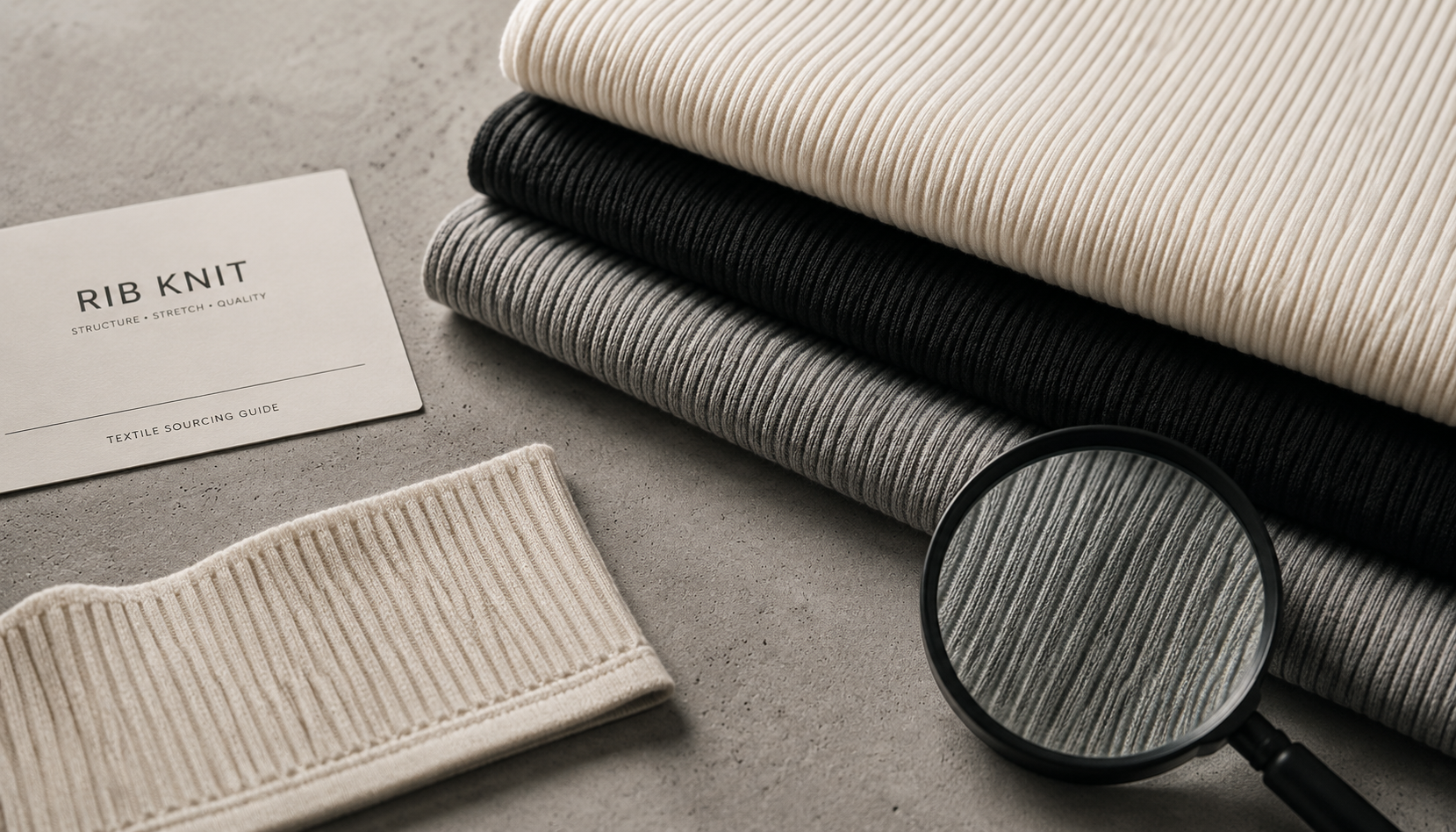
A Turkish garment factory lost €8,000 on a completed sample order because the tech pack specified “rib knit” without clarifying 1×1 versus 2×2 construction. Cuffs relaxed 14% after the first wash cycle, far outside the 5% tolerance their retail partner demanded. That single omission—common across the sourcing workflow—is exactly why a structured understanding of rib knit fabric uses matters before you issue your next purchase order.
Here’s the uncomfortable truth: most procurement teams treat “rib knit” as a single product code. It isn’t. Rib knit is a family of weft-knitted constructions distinguished by alternating knit and purl stitches across every wale, producing visible vertical ribs on the face and back of the fabric simultaneously. That double-sided geometry is what gives rib structures their signature crosswise elasticity—something a plain jersey knit simply cannot replicate on its own.
Sitting inside the broader knit fabric portfolio—alongside jersey, interlock, piqué, and pointelle—rib occupies a specific mechanical niche. Its loops interlock in a way that resists lateral stretching at rest but springs back readily under tension. If you’ve ever noticed a T-shirt collar snapping back after being pulled over a head, that’s 1×1 rib doing its job.
Now, the variations. When a buyer says “rib,” they usually mean one of these:
| Construction | Stitch Ratio | Typical Weight | Common End Use |
|---|---|---|---|
| 1×1 Rib | 1 knit, 1 purl alternation | 150–250 gsm (4.4–7.4 oz/yd²) | T-shirt neckbands, cuffs, fitted tees |
| 2×1 Rib | 2 knit, 1 purl alternation | 180–280 gsm (5.3–8.3 oz/yd²) | Midweight sweatshirts, jogger cuffs |
| 2×2 Rib | 2 knit, 2 purl alternation | 220–400 gsm (6.5–11.8 oz/yd²) | Jacket collars, outerwear trims, chunky knitwear |
| Fancy Rib | Mixed or patterned alternation | 200–350 gsm (5.9–10.3 oz/yd²) | Design-forward outerwear, fashion knitwear |
The quick mnemonic I use with junior merchandisers: “1×1 for skin-touch, 2×2 for structure, 2×1 for the in-between.” It’s oversimplified, yes, but it stops you from specifying a chunky 2×2 rib in a lightweight summer T-shirt neckline—which is exactly the sort of mismatch that drains budgets and timelines downstream.
From a procurement perspective, the failure to lock down rib construction at the RFQ stage cascades into multiple risks: wrong gauge needles on the machine, incorrect shrinkage assumptions in grading, unexpected hand-feel in the proto stage, and potential rejection at the wash-test phase. Each correction loop adds 7–15 business days and renegotiation fees. Buyers exploring the full range available can browse the knit fabric category to understand how rib variants sit alongside interlock, jersey, and other constructions before committing to a specification.
Rib knit fabric is not a line item you copy-paste from a previous season’s tech pack. It demands a deliberate structural choice tied to your garment’s performance requirements.
Let’s get into the physics for a moment, because this is where most sourcing errors originate. In a 1×1 rib structure, every needle alternates between forming a knit stitch on the face and a purl stitch on the back. The face-loop columns pull inward, while the back-loop columns pull in the opposite direction. These opposing tensions cancel each other out, creating a fabric that is elastic in both the crosswise and lengthwise directions without relying on elastane or spandex for recovery.
Compare that to a jersey knit, where all loops face the same direction. Jersey curls at the edges—it’s the reason cut-and-sew jersey panels need immediate binding or overlocking. Rib doesn’t do that. Its balanced double-face structure keeps edges stable, reducing pre-treatment steps on the cutting table.
Now, gauge matters enormously here. Gauge refers to the needle density on the knitting machine—higher numbers mean finer, more tightly spaced needles. A fine-gauge rib at 28G or 32G produces a smooth, compact surface ideal for dress-weight or intimate applications, typically landing at 150–250 Fabric GSM Calculator (4.4–7.4 oz/yd²). A coarse-gauge rib at 12G or 14G yields a chunkier, more textured surface suited for outerwear or structured trims, often weighing 280–400 gsm (8.3–11.8 oz/yd²).
I once specified a 24-gauge 1×1 rib for a women’s fitted top program, thinking it would give a softer hand-feel than a 20-gauge alternative. The hand-feel was beautiful. The problem? The finer gauge reduced crosswise recovery from 42% to about 31% after 20 wash cycles—not a disaster, but outside the brand’s 35% floor. We had to pivot to a slightly coarser gauge with a tighter stitch density to hit the mark. That’s the kind of trade-off gauge selection presents.
For anyone evaluating this construction in detail, a fine-gauge 1×1 rib specimen serves as the baseline reference for stretch recovery, gauge behavior, and dimensional stability across most of the technical arguments in this guide.
One caveat worth flagging: the recovery percentage I cited above assumes proper finishing. A rib knit that skips a controlled pre-shrink or relaxation dry will show inflated initial recovery numbers that collapse after the first few consumer washes. Always validate recovery claims against post-finishing test data, not greige-state lab results.
Here’s a sourcing observation I’ve tracked across multiple buying seasons: cotton-dominant rib knit fabric—any blend with 60% or more cotton content—still accounts for the majority of global B2B rib orders by volume. That’s not changing anytime soon. But what is shifting is the growing willingness of mid-tier and premium brands to weigh cotton-polyester and cotton-elastane alternatives more carefully, especially as sustainability metrics and post-wash performance expectations tighten.
The question isn’t “should I buy cotton rib?” anymore. It’s “which cotton blend makes sense for my specific application and risk profile?”
| Blend Type | Key Advantage | Key Drawback | Best-Fit Application |
|---|---|---|---|
| 100% Cotton | Breathable, soft hand-feel, strong consumer appeal on fiber-content labels | Lower elastic recovery, 3–8% wash shrinkage, slower drying time | Everyday T-shirts, casual neckbands, babywear |
| Cotton/Polyester 65/35 | Improved abrasion resistance, better dimensional stability, reduced shrinkage (~2%) | Reduced moisture absorption, potential heat buildup in warm climates | Athleisure collars, midweight sweatshirt cuffs, school uniforms |
| Cotton/Elastane 92/8 | Excellent recovery (3–5% relaxation after 20 washes), consistent fit retention | 10–20% higher cost per meter, limited recycled-elastane options for GRS compliance | Performance cuffs, body-conscious garments, structured necklines |
Let me break these down from a technical standpoint. A 100% combed cotton rib feels wonderful against the skin—there’s a reason it dominates the premium basics market. But its recovery window is narrower. Expect 3–8% shrinkage after a standard industrial wash unless the fabric undergoes a pre-shrink finishing process, which may still leave you with residual shrinkage above 2% if the finishing parameters are loose.
Cotton-polyester blends solve the shrinkage problem through polyester’s thermoplastic memory, but they sacrifice moisture management. In humid climates—Southeast Asia, southern Europe, the Gulf region—this translates directly into consumer complaints about garment comfort. I’ve seen return rates on cotton-poly rib-collared polos run 15–20% higher than their 100% cotton counterparts in tropical retail markets.
Cotton-elastane is the performance choice, but it comes with caveats. Elastane (spandex) doesn’t currently have a widely adopted recycled fiber pathway comparable to recycled polyester or recycled cotton. If your brand is pursuing GRS 4.0 certification across the full supply chain, you’ll need to document elastane sourcing carefully or accept an exception. Cost-wise, you’re looking at a 10–20% premium over pure cotton per linear meter, though that premium usually pays for itself in reduced quality-claim rates.
For buyers prioritizing natural fibers, the cotton-based fabric category offers a range of compositions worth exploring in parallel with rib-specific sourcing.
Summer sourcing adds another layer of complexity. The target weight range for warm-weather rib applications—particularly T-shirt neckbands and sleeve cuffs—typically sits at 150–180 gsm (4.4–5.3 oz/yd²), using fine-gauge 1×1 construction for maximum breathability and minimal visual bulk. At this weight, 100% combed cotton rib delivers a consumer-pleasing hand-feel that performs well in the lightweight segment.
A practical note on order timing: summer rib knit fabric programs have a notoriously compressed sourcing window. Retail delivery schedules typically demand FOB shipment no later than March or April for Northern Hemisphere summer. That means procurement teams should be locking fabric specifications and placing POs at least 45–60 days ahead of target ship dates to avoid the peak-season bottleneck that hits knitting mills every Q1.
The summer rib segment also favors mercerized or enzyme-washed finishes, which boost luster and reduce surface hairiness—small details, but they matter when the collar is two inches from a consumer’s face on a retail hanger.
Rib knit fabric uses extend far beyond the neckband-and-cuff stereotype that dominates sourcing conversations. For B2B procurement teams, mapping the full application landscape prevents missed opportunities and ensures the right construction variant gets matched to the right garment category.
Let’s start with the obvious one, because it’s where most rib knit volume lands. The 1×1 rib neckband is practically an industry default for T-shirts, polo collars, and crew-neck sweatshirts. Why? Because it delivers the exact compression-to-stretch ratio needed to hug the neckline without sagging after the twentieth head-through.
Typical neckband width sits between 3 cm and 6 cm (1.2″ and 2.4″), and the critical manufacturing control point is the cut-and-sew stretch ratio: the rib band must be stretched 5–12% during attachment to the body panel. Too little stretch and the neck gapes; too much and it puckers or restricts the wearer. This is where rib knit fabric for neckline applications demands specific attention during the sample approval process.
The same elastic-recovery logic applies to sleeve cuffs and waistband ribbing, which is why rib knit fabric for cuffs remains one of the highest-volume trim categories in global knitwear sourcing. A poorly specified cuff rib on a hoodie or bomber jacket can single-handedly tank a garment’s perceived quality rating in consumer testing.
Here’s where rib knit steps out of the trim drawer and onto the main body. Full-garment rib construction—think fitted bodycon dresses, compression base layers, and structured bralettes—leverages the rib’s natural directional stretch to create garments that move with the body without requiring multidirectional elastane content.
For activewear compression layers, a 2×2 rib at 220–260 gsm (6.5–7.7 oz/yd²) provides gentle muscle compression with moisture-wicking capability when blended with performance polyester. In the intimates category, fine-gauge 1×1 cotton rib has long been the construction of choice for baby bodysuits because it stretches gently over infant proportions without the rigidity of woven elastic bands.
The procurement sensitivity for full-garment rib is significantly higher than for trim applications. Weight consistency across a 500-meter (547-yard) roll must stay within ±3% to prevent fit variation across size runs. Dye-lot uniformity tolerance tightens to ΔE 0.5–0.8 compared to the looser ΔE 1.5 acceptable for small trim pieces. These are the specifications that separate a smooth production run from a warehouse full of shade-sorted seconds.
A mid-size European outdoor brand approached its fall/winter hiking jacket program with a clear sustainability mandate: rib knit trim cuffs and collar interiors would be 100% cotton, aligning with the brand’s “natural material” positioning. The tech pack specified “2×2 rib knit, cotton, prewash recovery ≤5% relaxation after 20 wash cycles.” On paper, it looked solid.
The first samples arrived from the factory. A 220 gsm (6.5 oz/yd²) pure cotton 2×2 rib. Hand-feel in the showroom was excellent—soft, substantial, exactly the premium touch the brand wanted. But the wash testing told a different story. By cycle 8, cuff circumference had relaxed 12–18%, causing the jacket sleeve opening to sag visibly. For a hiking jacket, this meant cold-air ingress at the wrist—the exact performance failure the design was supposed to prevent.
The sourcing team tried a fix: swap to a 1×1 fine rib at 180 gsm (5.3 oz/yd²) in the same 100% cotton composition. The lighter gauge felt cleaner, and internal stakeholders approved the hand-feel. But recovery collapsed at cycle 5—relaxation exceeded 15%. The finer construction in pure cotton simply didn’t have the mechanical resistance to maintain crosswise tension over repeated wash cycles.
Attempt number three: upsize to a 240 gsm (7.1 oz/yd²) pure cotton 2×2 rib. Stiffness improved noticeably, and relaxation at cycle 20 dropped to around 7%. Better, but still outside the 5% spec. Worse, the heavier weight created a heat buildup problem at the wrist during field testing—hikers reported discomfort at the cuff line during aerobic uphill sections. The bulk also pushed past the jacket’s design allowance, distorting the sleeve silhouette.
The breakthrough came with a material pivot: cotton/elastane 92/8 blend at 195 gsm (5.7 oz/yd²) in a 2×2 rib construction. It achieved 3.2% relaxation at cycle 20, well within the 5% tolerance. The hand-feel satisfied the design team. Field testers approved the thermal comfort. But the decision came with real trade-offs.
First, per-meter cost increased 8% over the pure cotton option—final impact on the cuff-and-collar trim budget was roughly €0.35 per garment. Second, adding elastane to the fiber content label triggered additional compliance documentation across the brand’s three primary EU markets. Third, the marketing team had to soften the “natural material” positioning to “responsibly sourced natural blend” to accurately represent the composition. Fourth, the custom-batch cotton/elastane rib extended lead time by 7 business days over off-the-shelf cotton rib stock.
This trial-and-error cycle—three failed production runs before arriving at a viable solution—cost the brand approximately €12,000 in re-sampling, re-testing, and timeline slippage. But it surfaced three lessons that apply to virtually every rib knit sourcing decision:
One structural advantage that could have compressed this trial cycle: working with a manufacturer that operates an integrated weave-dye production line with in-house sampling capability. A factory with established technical credentials—a long operating history, multi-stage production under one roof, and stocked inventory for rapid iteration—can turn rib gauge and composition adjustments in days rather than weeks, which is precisely what this brand’s situation demanded at each failed iteration.
After working through the structure, mechanics, fiber trade-offs, and real-world failure modes above, it’s worth distilling everything into a decision framework you can actually use at your desk. Here’s the condensed procurement matrix I’d hand any buyer about to issue an RFQ for rib knit fabric.
| Decision Item | Options | Key Risk if Skipped | Recommended Action |
|---|---|---|---|
| Construction type | 1×1 / 2×1 / 2×2 / Fancy | Wrong gauge, failed recovery, production rework | Lock in tech pack before RFQ—no exceptions |
| Fiber composition | 100% cotton / Cotton-poly / Cotton-elastane | Recovery failure, compliance gaps, cost overrun | Validate composition against wash-test spec AND regulatory requirements |
| Fabric weight | 150–180 gsm (light) / 200–260 gsm (mid) / 280–400 gsm (heavy) | End-use mismatch, thermal discomfort, bulk issues | Match weight to garment category; request weight certificates per roll |
| Gauge specification | Fine (28G–32G) / Medium (20G–24G) / Coarse (12G–18G) | Surface texture mismatch, recovery underperformance | Request gauge confirmation on sample submission |
| Finishing requirements | Enzyme wash / Pre-shrink / Mercerize / Reactive dye | Unexpected shrinkage, color fastness failure | Define finishing in tech pack; validate with wash test post-finishing |
| Compliance certification | OEKO-TEX Std 100 / GRS 4.0 / EU REACH | Shipment detention, retail rejection | Require current certificate copies before PO confirmation |
| Sample vs. bulk MOQ split | 3–5 m sample / 500+ m stock / 1,000+ m custom | Sample yes but bulk rejected; supplier deprioritizes small orders | Negotiate both stages in initial commercial discussion |
| Lead time alignment | Stock: 7–10 days / Custom: 15–20 days | Seasonal missed window, air-freight cost spikes | Map FOB date backwards to PO placement date with 15-day buffer |
The first row—construction type—is the keystone decision. Get it wrong, and every downstream parameter inherits that error. I’ve watched procurement teams spend weeks optimizing fiber blends and finishing specifications only to realize at the wash-test stage that the base rib construction was wrong from the start. Fixing a construction mismatch at that point means restarting the sampling cycle entirely.
Phase your MOQ negotiation deliberately. Sample orders should run at 3–5 meters (3.3–5.5 yards) per colorway for lab-dip and hand-feel evaluation. Stock rib knit fabric typically carries a 500-meter (547-yard) MOQ, while custom colorways or compositions require a 500-meter minimum with new constructions negotiable from 1,000 meters (1,094 yards). Negotiating both stages upfront prevents the scenario where a supplier delivers excellent samples but deprioritizes your 500-meter production order in favor of larger accounts.
Now, when evaluating where to buy rib knit fabric, look beyond the distributor or trading-company layer. Key signals of genuine manufacturing capability include: a technical staff count above 30 across the production line, integrated dyeing and finishing under one roof (rather than outsourced to third-party dyehouses), and a finished-goods warehouse holding stock inventory for rapid fulfillment. These indicators separate a contact-fulfillment operation from a factory that can actually solve problems when they arise.
Once your specifications are locked and your checklist is complete, you can submit your tech pack through the contact and inquiry form for a feasibility assessment and quotation. The inquiry workflow supports direct attachment of specification documents, and a dedicated technical engineer reviews submissions and responds within 24 business hours with detailed feedback on constructability and lead time.
Rib knit fabric serves three primary roles in global apparel supply chains: as trim components (neckbands, cuffs, waistbands) where controlled elastic compression is critical; as full-garment body fabric for fitted silhouettes and active layers; and as structured linings in outerwear collars and plackets. Construction selection directly determines whether the end product delivers acceptable stretch recovery and wash durability over its intended lifespan.
In a 1×1 rib, every alternating stitch column switches between knit and purl on every single row, producing a fine, tight vertical rib pattern with balanced elasticity. In a 2×2 rib, pairs of knit and purl stitches alternate, creating a more pronounced raised rib with greater air space between ridges. The 1×1 construction suits lightweight, body-hugging applications, while the 2×2 construction delivers more texture and structure for outerwear collars, chunky sweaters, and heavier trim applications.
It depends on weight and fiber composition. A fine-gauge 1×1 cotton rib at 150–180 gsm (4.4–5.3 oz/yd²) is a staple for summer T-shirt neckbands and lightweight fitted tops—it breathes well and compresses gently without trapping heat. However, heavier rib constructions above 250 gsm (7.4 oz/yd²), particularly in dense 2×2 structures, are poor choices for warm-weather garments due to the increased thermal mass and reduced airflow.
Stock rib knit fabric generally carries a minimum order quantity of 500 meters (547 yards). Custom colorways or fiber compositions also start at 500 meters (547 yards), while entirely new rib constructions—those requiring machine setup changes—may require 1,000 meters (1,094 yards) minimum. Sample Garment Yardage Calculator for lab-dip and hand-feel evaluation is typically 3–5 meters (3.3–5.5 yards) per colorway.
A 100% cotton rib knit fabric typically exhibits 3–8% shrinkage after the first standard industrial wash cycle. This can be controlled to within 2% or less through a pre-shrink finishing process applied during production. Cotton-elastane blends show significantly lower shrinkage rates—usually under 3%—making them the more stable choice for export markets where tight dimensional tolerance windows apply.
Rib knit fabric sits in a deceptively simple category. It looks like a commodity—just trim, just a neckband, just a cuff. But as this guide has walked through, the distance between a rib specification that performs and one that fails is measured in gauge choices, fiber chemistry, finishing processes, and wash-cycle validation that most buyers don’t think about until something goes wrong on the production floor or, worse, at retail.
The buyers who treat rib knit as a deliberate engineering decision—anchored in construction mechanics rather than catalog copy—consistently deliver garments with tighter fit tolerance, higher durability ratings, and fewer quality-claim headaches. That’s not theory. It’s the pattern I see repeated across programs that hit their deadlines and margins season after season.
Take the time to specify correctly at the RFQ stage. Validate your assumptions with post-finishing test data. And when a specification challenge comes up—and it will—work with suppliers who can iterate at the sample stage rather than discovering failures at bulk. That’s where the real cost savings live.