Address
Nanlang Industrial Zone, Xingtan Town, Shunde District, Foshan, Guangdong, China
Work Hours
Mon–Fri, 9:00 AM – 6:00 PM (CST/UTC+8). We aim to respond to all inquiries within 48 hours.

Address
Nanlang Industrial Zone, Xingtan Town, Shunde District, Foshan, Guangdong, China
Work Hours
Mon–Fri, 9:00 AM – 6:00 PM (CST/UTC+8). We aim to respond to all inquiries within 48 hours.
Walk into any local gym or trailhead and you will immediately notice a pattern. Almost every piece of athletic gear relies on open-weave textiles. You see them on jerseys, inside shoe uppers, and lining performance jackets.
Yet most brands still struggle to pick the right one. They grab the cheapest open-knit option, only to watch seam allowances unravel or moisture trapping ruin the garment. The truth is, mesh is not just a visual shortcut for looking athletic. It is a functional engineering choice that dictates how a garment breathes, moves, and survives the wash cycle. Getting it wrong costs more in returns than in material.
I have spent years watching designers second-guess their mesh selections. The good news is that understanding the structural differences takes the guesswork out of the process. Let us break down the mechanics, the real-world applications, and how to match the right open-weave textile to your actual production needs.
At its core, mesh is simply a textile engineered with deliberate open spaces. These pores are not flaws. They are calculated voids designed to pull heat and moisture away from the skin. Most performance mesh relies on a knitted construction rather than a woven one. Knitting allows the structure to flex with the body without adding bulk.
The manufacturing process usually involves warp or weft knitting machines programmed to skip interlock points. This creates repeating geometric voids. You will see hexagonal grids, diamond lattices, or tighter micro-perforations. The hole size directly controls airflow. Wider pores move air faster but can snag on zippers or rough seams. Tighter pores offer better opacity while still allowing vapor to escape.
Do not confuse mesh with netting. Netting typically uses heavier monofilament or cotton twine for bags and draping. Performance mesh relies on continuous filament synthetics like polyester or nylon. These fibers maintain structural integrity under repeated stretching.
When you order mesh, you are really ordering a specific balance of three variables. Airflow, weight, and recovery all fight for priority. A 140 GSM knit will feel drastically different from a 180 GSM version of the exact same pattern. The heavier option traps more heat but drapes better on structured polos. The lighter version flies off the body during sprint intervals.
If you want to see how these variations translate to real products, you can explore the Mesh and Net Knit Fabrics category to compare constructions side by side. For brands needing a reliable baseline for training tees or lightweight jackets, our Sports Mesh Fabric (General) consistently performs well across mid-tier activewear lines.
I usually tell my team to ignore marketing terms like ultra-breathable. Instead, look at the actual pore size and fiber denier. A tightly knitted 110 GSM mesh will outperform a loosely woven 160 GSM version in humid climates. The structure matters more than the label.
This category covers the workhorse textiles you find in most mid-range athletic lines. It is almost exclusively polyester. The fiber choice keeps costs down while ensuring decent moisture transport. The hole pattern usually sits in the middle range. It balances airflow with enough surface coverage to prevent awkward transparency when the fabric stretches.
You will see it heavily used in casual training tops, gym tank shirts, and breathable backpack panels. It is not built for elite compression or extreme temperature regulation. It is designed to survive daily wear, frequent washing, and inconsistent care instructions from end users.
The main advantage here is straightforward economics. It machines well, prints acceptably, and tolerates standard flatlock stitching without excessive shifting. The limitation is that it lacks the engineered recovery of higher-end constructions. If you need a garment to hug and rebound repeatedly, this is not your starting point.
Care instructions matter more than people admit. Machine washing cold preserves the polymer structure. High heat drying gradually relaxes the knit loops. I have seen garments shrink nearly four percent after just twelve hot cycles. It is not a defect. It is basic polymer science.
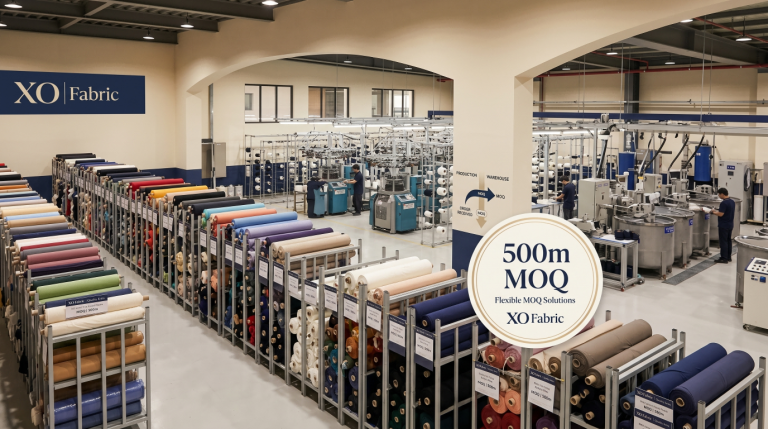
When sourcing, expect widths between 150 and 180 centimeters. Minimum orders usually sit around five hundred meters, though some mills offer reduced thresholds for established categories. The goal is consistency. You want the third roll to match the first roll exactly.
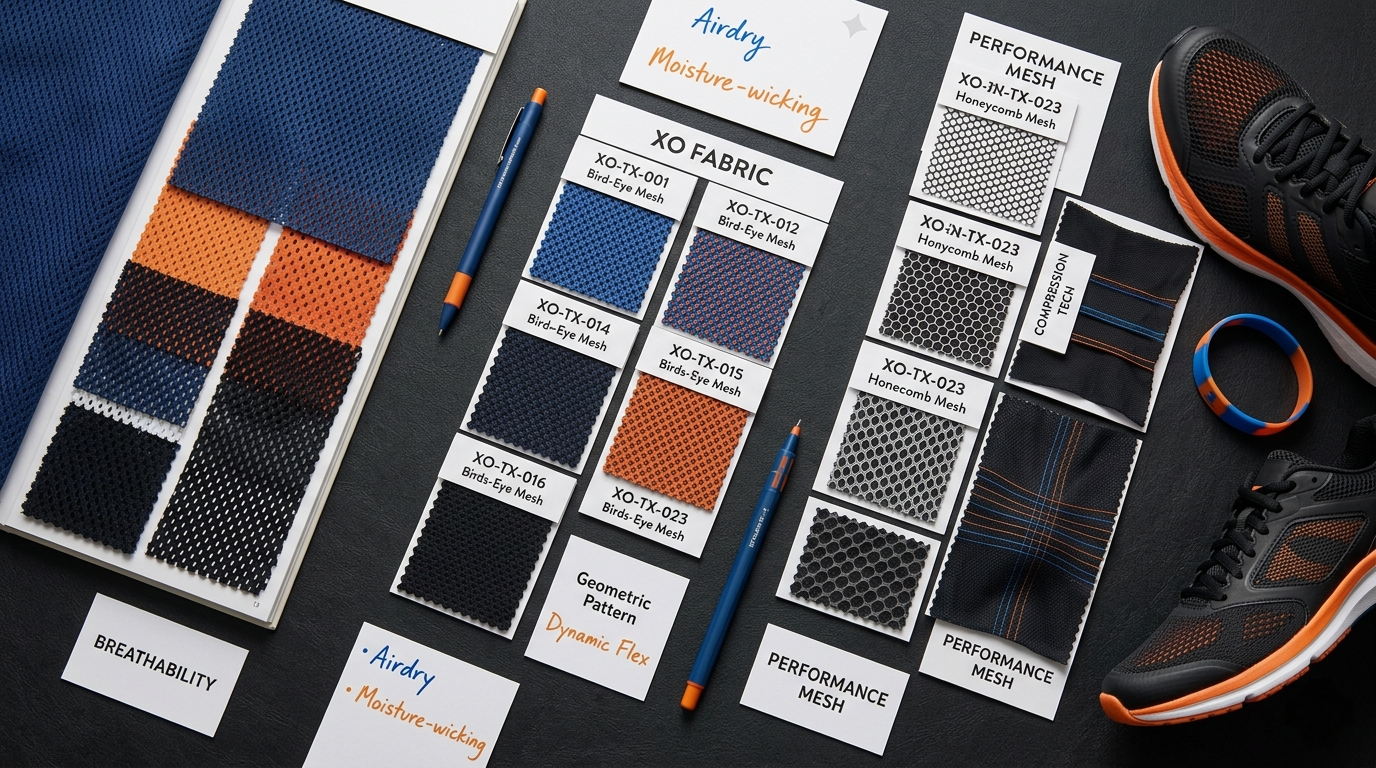
Bird eye mesh gets its name from the repeating geometric pattern that looks like a series of tiny ovals. It feels noticeably more structured than general sports mesh. The loops lock together tighter, which gives the fabric a cleaner drape and better shape retention. You will often find it blended with cotton for next-to-skin comfort, or kept in pure polyester for faster drying times.
It shines in performance polos, golf shirts, and training jerseys that need a tailored silhouette. The structure holds collars better. It also works well in sports bras and base layers where moisture control meets direct skin contact. The cotton blend option feels softer, but it requires careful finishing to prevent pilling.
For designers looking for a reliable cotton-polyester balance, the Classic Bird Eye Mesh (Cotton Blend) provides that exact middle ground. It softens the synthetic hand feel while keeping the drying speed intact.
I remember working with a startup that wanted to launch a premium training tee. They initially picked a lightweight cotton mesh because it felt luxurious on the swatch. We ran three prototypes. The first version shrank seven percent after washing. The second version lost its collar shape completely. The third version finally worked, but only after we switched to a polyester-dominant bird eye with two percent spandex and adjusted the stitch length to 2.8 millimeters.
The decision process was messy. The founders loved the cotton hand feel. I pushed for synthetic durability. We compromised by blending fifty-five percent cotton with forty-five percent polyester. We also added a light anti-pilling finish. It cost twelve percent more per yard. The return rate dropped to nearly zero. Sometimes the expensive choice pays for itself in customer retention.
When cutting bird eye mesh, use a 75/11 ballpoint needle. Standard sharp needles will pierce the cotton fibers and cause micro-snagging along the seam lines. A twin-needle coverstitch at 15 stitches per inch keeps the edges flexible without restricting the knit recovery.
These two categories overlap significantly, but they serve different mechanical purposes. Honeycomb mesh features a hexagonal grid that naturally expands and contracts. It is frequently used in compression leggings, dancewear, and recovery garments. The geometric pattern distributes tension evenly across the fabric surface.
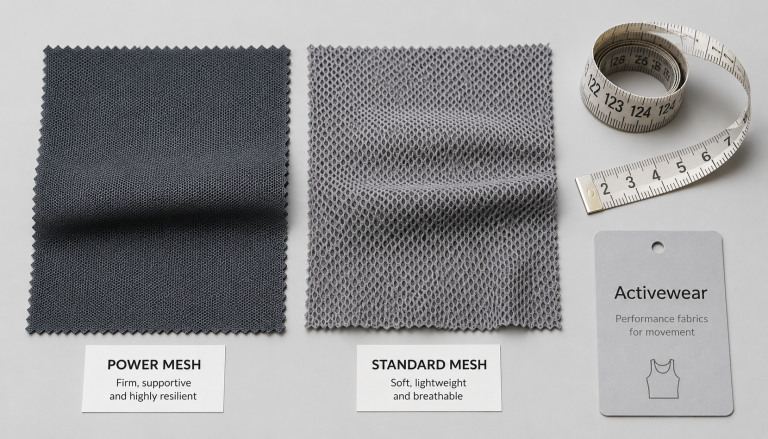
Power net leans heavier on elastane. It contains significantly more spandex content, usually between twelve and twenty percent. This makes it exceptionally resilient. It grips the body firmly and snaps back without permanent deformation. You will find it in shapewear, swim briefs, and high-intensity training bases.
If you need reliable stretch recovery for compression lines, the Honeycomb Elastic Net delivers consistent rebound performance across multiple wash cycles. The hexagonal structure minimizes lateral distortion.
Working with these fabrics requires specific machine adjustments. Standard ballpoint needles will skip stitches on high-spandex constructions. Switch to a 70/10 or 75/11 stretch needle. Drop your tension slightly on the looper thread. High tension cuts the elastane filaments, which leads to seam slippage within weeks of wear.
Heat management is non-negotiable. Spandex degrades rapidly above sixty-five degrees Celsius. Press with a steam iron on low heat, or better yet, use a cool iron with a press cloth. I have seen entire production runs ruined because the finishing department cranked up the tunnel dryer to save ten minutes. The garments lost forty percent of their recovery strength. Speed always costs somewhere.
Selecting the correct construction requires matching the textile to the actual use case. You cannot treat a yoga base layer the same way you treat a trail running jacket. Sweat volume, movement range, and garment silhouette all dictate the right choice.
Low-intensity activities like pilates or light studio workouts benefit from softer blends. A cotton-polyester bird eye mesh keeps the skin comfortable while managing moderate perspiration. Medium intensity training pushes harder on moisture transport. Here, a polyester bird eye or standard honeycomb construction handles rapid evaporation better.
High-intensity sessions demand maximum recovery and directional stretch. Power net or high-elastane honeycomb mesh grips the muscles, reduces vibration fatigue, and transports sweat away from the epidermis. Loose silhouettes can tolerate general sports mesh. Compression fits absolutely require engineered elastane integration.
| Activity Level | Recommended Construction | Key Performance Factor |
| Low (Yoga, Pilates) | Bird Eye Mesh (Cotton Blend) | Soft hand feel, moderate breathability |
| Medium (Gym, Running) | Polyester Bird Eye or Standard Honeycomb | Fast moisture transport, consistent drape |
| High (HIIT, Outdoor Sports) | Power Net or High-Elastane Honeycomb | Maximum stretch recovery, heat dissipation |
| Casual/Everyday | General Sports Mesh | Cost efficiency, easy care, durable structure |
Budget constraints often force compromises. General sports mesh sits at the lowest price point. Bird eye constructions add twelve to eighteen percent depending on fiber content. Power net and high-recovery honeycomb meshes cost more due to elastane integration and tighter knitting parameters.
Durability expectations should match the care label. Polyester meshes survive aggressive washing cycles. Cotton blends require cold water and low heat drying. Elastane-heavy fabrics demand gentle cycles and air drying whenever possible. If your target customer ignores care labels, lean toward pure polyester with a permanent moisture-wicking finish.
If you are still weighing options for your next collection, you can Request Samples to test hand feel, stretch recovery, and dye lot consistency before committing to bulk production.
Integrated production changes how reliably a mill delivers consistent quality. When knitting, dyeing, and finishing happen under one roof, you eliminate the variability that comes from outsourcing each step. Lead times drop significantly. Quality control becomes proactive rather than reactive.
The current lineup covers general sports mesh, multiple bird eye variations, honeycomb elastic nets, and specialized power net constructions. We also handle jacquard open-weave patterns for brands that want fashion-forward activewear with technical performance. Custom GSM targets, width adjustments, and pore geometry tweaks are all standard processes rather than special requests.
Color matching relies on laboratory dips and standardized Pantone references. We adjust dye concentrations to prevent shade variation across large rolls. The finished goods warehouse holds over two thousand square meters of inventory, which allows rapid sampling and quick turnaround on reorder requests.
Quality assurance happens continuously. Technicians monitor loop tension, check for bar faults, and verify stitch density before the fabric leaves the knitting floor. Finished rolls undergo color fastness testing, stretch recovery measurement, and shrinkage evaluation. You get test reports that actually reflect the material you receive.
If you are planning a new activewear line and want to discuss technical specifications or schedule a sample run, you can Contact Us to align on weight targets, fiber blends, and delivery timelines.
Mesh textiles are not interchangeable components. They are engineered systems that dictate how a garment regulates temperature, manages perspiration, and moves with the body. General sports mesh handles everyday training efficiently. Bird eye constructions add structure and refined moisture control. Honeycomb and power net fabrics deliver the compression and recovery that high-intensity athletes actually need.
The right choice depends on your specific use case, budget parameters, and care expectations. Testing physical swatches before bulk cutting saves production headaches later. I always recommend ordering representative samples, running wash cycles, and checking seam stability under tension.
If you are ready to explore high-performance open-weave textiles for your next collection, you can Contact XO Fabric to review technical specifications, request material samples, and discuss custom blending ratios. The right mesh makes the difference between a garment that survives the season and one that defines it.