Address
Nanlang Industrial Zone, Xingtan Town, Shunde District, Foshan, Guangdong, China
Work Hours
Mon–Fri, 9:00 AM – 6:00 PM (CST/UTC+8). We aim to respond to all inquiries within 48 hours.

Address
Nanlang Industrial Zone, Xingtan Town, Shunde District, Foshan, Guangdong, China
Work Hours
Mon–Fri, 9:00 AM – 6:00 PM (CST/UTC+8). We aim to respond to all inquiries within 48 hours.
Waffle Knit Fabric: Thermal Texture for Activewear & Layering. This guide covers key properties, real-world applications, and a practical sourcing checklist for B2B buyers.
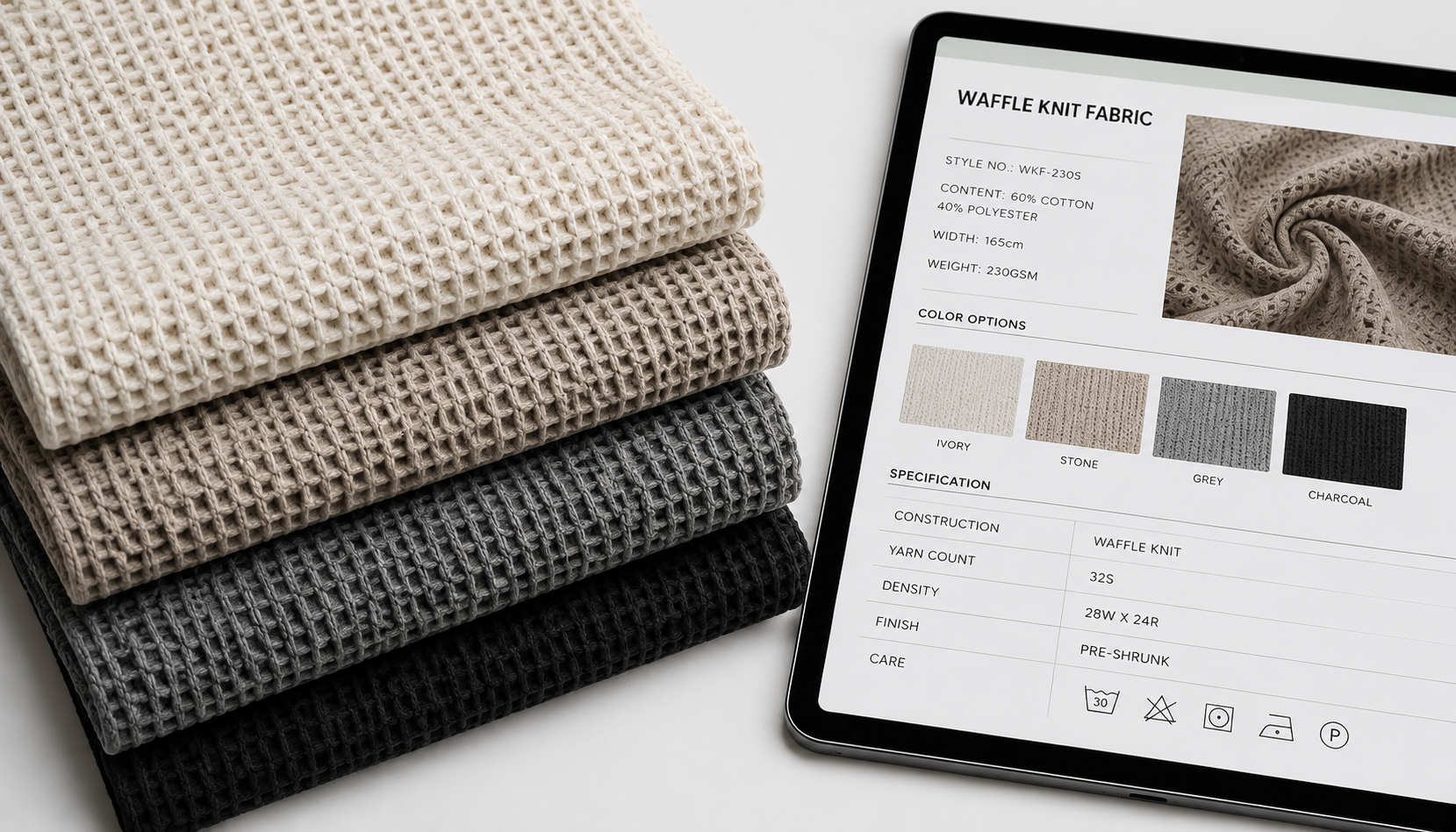
A European activewear buyer once told me his procurement team spent six weeks developing a “thermal waffle” base layer—only to scrap the entire first production run. The fabric’s moisture vapor transmission rate came in at roughly 350 g/m²/24h, half of what the end use demanded. The culprit wasn’t a bad supplier. It was a spec sheet that treated “thermal” and “waffle” as the same word.
Search any sourcing portal for waffle knit fabric thermal, and you’ll hit a wall of mixed terminology. One mill lists “thermal waffle knit,” another calls it “honeycomb jersey,” and a third markets the same structure under “raised diamond knit.” For a B2B buyer building a technical spec sheet, this inconsistency is a procurement nightmare.
The root cause is simple: “waffle” describes a visual texture, while “thermal” describes a performance outcome. They overlap frequently, but they’re not synonymous. A waffle knit can be lightweight and breathable. A thermal knit can use a double-layer construction with zero waffle texture. Treating these labels as interchangeable is how million-dollar orders go sideways.
The waffle pattern traces back to European terry bathrobes of the 1960s, where the honeycomb grid helped absorb water and trap warmth. When synthetic blends entered the activewear market in the 1990s, mills borrowed the “waffle” label for a very different fabric—lighter, stretchier, engineered for moisture management rather than absorption. The name stuck even as the construction evolved.
Today, the same word “waffle” means a 250 gsm (7.4 oz/yd²) cotton bathrobe fabric in one context and a 150 gsm (4.4 oz/yd²) polyester-spandex performance knit in another. Without specifying gauge, Yarn count, and finish type, the label alone tells you almost nothing.
| Attribute | Waffle Knit | Thermal Knit | Pique Knit |
|---|---|---|---|
| Structure | Honeycomb grid, both faces | Varies (single/double layer) | Raised pebble, one side smooth |
| Naming origin | Resembles a waffle iron pattern | Describes heat-retention function | French “piquer” (to quilt) |
| Typical weight | 140–250 gsm (4.1–7.4 oz/yd²) | 160–280 gsm (4.7–8.3 oz/yd²) | 180–260 gsm (5.3–7.7 oz/yd²) |
| Primary market | Activewear, loungewear | Underwear, winter sportswear | Polo shirts, sportswear |
This table is a starting point, not a final answer. The real differences live in the gauge, yarn composition, and finishing process—but at least you’ll know which questions to ask next.
Strip away the marketing language, and waffle knit is a single-face or double-face circular knit where alternating tuck and knit stitches create recessed cells across the fabric surface. Each cell traps a small pocket of still air—and that trapped air is the engine behind both the thermal regulation and the breathable feel that buyers prize.
The depth of those cells depends on three variables: machine gauge, yarn count, and loop density. Get any one of these wrong, and the fabric behaves differently than expected.
Machine gauge refers to the number of needles per inch (2.54 cm) on the circular knitting machine. Coarse-gauge waffle (7–12 gauge) produces deep, pronounced cells suited for outerwear and bathrobes. Fine-gauge waffle (18–28 gauge) yields a subtler texture, closer to the skin, ideal for base layers and women’s thermal underwear. Most activewear-grade waffle knit fabric thermal sits between 20 and 24 gauge.
Yarn count directly determines the fabric’s weight-to-performance ratio. A typical cotton waffle might use 30/1 Ne combed cotton, yielding a finished weight around 180 gsm (5.3 oz/yd²). A polyester-spandex blend for performance base layers often employs 75D/72F textured yarn, landing near 150 gsm (4.4 oz/yd²) with superior stretch and recovery.
For quick unit conversions between grams per square meter and ounces per square yard during your sourcing discussions, you can use our fabric GSM calculator tool—it handles the math in seconds so you can focus on the performance specs that matter.
Cell size—the visible honeycomb grid dimensions—typically ranges from 2 mm × 2 mm (0.08 × 0.08 in) for fine-gauge knits up to 6 mm × 6 mm (0.24 × 0.24 in) for coarse constructions. Larger cells trap more air but risk snagging; smaller cells feel smoother but sacrifice some thermal loft.
| Parameter | Typical Range | Performance Impact | Test Standard |
|---|---|---|---|
| Machine gauge | 7–28 gauge | Higher gauge → finer texture, lower loft | — |
| Yarn count (cotton) | 20/1–40/1 Ne | Finer count → lighter weight, softer hand | ASTM D1907 |
| Finished weight | 140–260 gsm (4.1–7.7 oz/yd²) | Higher GSM → more warmth, less breathability | ASTM D3776 |
| Cell dimensions | 2–6 mm (0.08–0.24 in) | Larger cells → higher air retention | Visual / microscopy |
I should note that for pure cotton constructions, the yarn source and spinning method matter enormously. Ring-spun combed cotton produces a smoother, more consistent waffle cell than open-end cotton, though at a 15–20% cost premium. If you’re exploring natural fiber options for waffle applications, our cotton and natural fabrics category offers several weight and blend configurations worth reviewing.
The common assumption—waffle equals warmth—is only half the story. The honeycomb architecture actually delivers a dual-mode thermal performance that flat knits cannot replicate.
Thermal resistance (Rct) measures how well a fabric resists heat flow. Per the test methodology outlined in ASTM D1518, a typical 180 gsm (5.3 oz/yd²) waffle knit registers an Rct value between 0.10 and 0.15 m²·K/W. By comparison, a flat jersey of similar weight might hit only 0.06–0.08 m²·K/W. The difference comes down to those trapped air pockets in the cell structure.
Moisture vapor transmission rate (MVTR) is where waffle really separates itself from fleece and brushed thermal knits. The cell geometry creates capillary channels that wick perspiration outward. Breathability testing per ISO 9237 shows waffle fabrics achieving air permeability values 30–40% higher than equivalent-weight flat knits—meaning they move moisture faster while maintaining warmth.
This is precisely why waffle knit fabric thermal works so well in the 15–25°C (59–77°F) temperature range—it holds enough warmth for a cool morning run while venting heat fast enough to prevent that clammy midday feeling. The “thermal” label misleads buyers into thinking it’s only for cold conditions, but the sweet spot is actually transitional weather.
Waffle knit’s versatility is both its greatest asset and a sourcing trap. The same structural principles produce radically different fabrics depending on fiber choice, weight target, and finishing. Here’s how the selection logic shifts across three major market segments.
For athletic base layers, the target specs look something like this: weight 150–200 gsm (4.4–5.9 oz/yd²), four-way stretch (minimum 15% in each direction), and MVTR above 800 g/m²/24h. The waffle structure’s air channels make it a strong candidate for waffle knit fabric thermal shirts designed for running, cycling, and hiking in cool-to-mild conditions.
Fiber-wise, polyester-spandex blends dominate here—typically 92/8 or 90/10 ratios. Cotton waffle, while softer, absorbs too much moisture for high-output activities. That said, I’ve seen some well-executed cotton-poly blends (60/35/5 cotton-polyester-spandex) that split the difference for lower-intensity sports like yoga or golf.
If your product line calls for performance-grade options beyond standard waffle, browsing our performance functional knits category will surface additional constructions—moisture-wicking jerseys, mesh panels, and hybrid knit structures—that pair well with waffle in multi-panel garment designs.
The women’s waffle knit fabric thermal market demands a different calculus. Here, hand feel and visual refinement carry nearly as much weight as thermal performance. Fine-gauge construction (22–28 gauge) is non-negotiable—the coarse “bathrobe waffle” that works for outdoor mid-layers looks and feels cheap in a premium loungewear context.
Weight targets sit in the 160–200 gsm (4.7–5.9 oz/yd²) range, with emphasis on softness finishes (enzyme wash, silicon softener) and colorfastness. For European market entry, OEKO-TEX Standard 100 certification is essentially mandatory. According to the OEKO-TEX Standard 100 framework, the finished garment must pass testing for over 100 restricted substances—a requirement that filters out many low-cost suppliers from the candidate pool.
| Application | Recommended Weight | Key Performance Metrics | Certification Notes |
|---|---|---|---|
| Athletic base layer | 150–200 gsm (4.4–5.9 oz/yd²) | MVTR >800, 4-way stretch ≥15% | bluesign preferred |
| Women’s thermal underwear | 160–200 gsm (4.7–5.9 oz/yd²) | Softness ≥3.5 (Kawabata), Rct 0.08–0.12 | OEKO-TEX 100 required (EU) |
| Outdoor mid-layer | 200–260 gsm (5.9–7.7 oz/yd²) | Rct ≥0.14, abrasion ≥20,000 cycles | bluesign / GRS optional |
| Home textiles / robes | 220–280 gsm (6.5–8.3 oz/yd²) | Absorption rate, shrinkage ≤5% | OEKO-TEX 100 |
This is where wool waffle knit fabric enters the conversation. Merino-waffle blends (typically 80/20 merino-nylon for durability) command a significant price premium—often 2–3× over polyester alternatives—but deliver an unmatched thermal-to-weight ratio and natural odor resistance. The classic wool waffle base layer from heritage outdoor brands uses a 200–220 gsm (5.9–6.5 oz/yd²) fabric weight, and that sweet spot has remained largely unchanged for two decades.
For casual knitwear, the texture itself becomes a design feature. Chunky waffle knits in the 220–260 gsm (6.5–7.7 oz/yd²) range work as standalone pieces rather than hidden base layers. The sourcing challenge here shifts from pure performance to aesthetics—consistent cell size, dye uniformity, and a clean selvedge edge matter more than MVTR numbers.
A mid-range European activewear brand (annual knit fabric spend roughly €200K–500K) set out to develop a winter base layer collection under the spec label “waffle thermal.” The target was clear: 200 gsm (5.9 oz/yd²), waffle knit fabric thermal shirts for three-season use in Nordic markets, 45-day lead time from fabric order to garment delivery.
They sourced from two competing mills. Supplier A quoted a 200 gsm waffle that looked perfect on paper. What the spec sheet buried was the gauge—7-gauge, coarse-wall construction. Thermal resistance hit 0.15 m²·K/W, great for warmth. But MVTR tested at just 350 g/m²/24h. For a base layer designed for Nordic skiing and winter running, that number was a dealbreaker. Sweat would pool against the skin within twenty minutes.
Supplier B offered an 180 gsm (5.3 oz/yd²) fine-gauge waffle, 22-gauge, with excellent breathability—MVTR over 850 g/m²/24h. But the thermal resistance came in at 0.09 m²·K/W, and the brand’s retail team balked. “Our customers expect warmth,” the product manager said. “If the Rct reads below 0.12, we’ll get returns.”
Round one: They committed to Supplier A’s coarse waffle. First samples arrived, garment testing confirmed the breathability failure. The brand’s athlete testers reported feeling clammy after 20 minutes of activity. Dead end.
Round two: The team pivoted to Supplier B’s fine-gauge base and added a brushed finish on the inner face—a common trick to boost thermal resistance. The brushed waffle climbed to 220 gsm (6.5 oz/yd²) and hit an Rct of 0.14 m²·K/W. Problem solved? Not quite. The cost per meter rose 18%, and the buyer’s margin targets couldn’t absorb it. The procurement lead came back with a hard “no.”
Round three—the compromise: They negotiated a lighter brushing—single-pass, minimal nap—on Supplier B’s 180 gsm base. Final weight: 195 gsm (5.8 oz/yd²). MVTR held at 720 g/m²/24h. Rct measured 0.12 m²·K/W. Cost increase was contained to 8%.
The trade-off? The garment no longer performed as a pure winter piece. The brand repositioned it as a “three-season technical base layer”—spring, autumn, and mild winter. Not the original vision. But the sell-through data from the first season validated the decision: returns dropped 40% compared to the previous year’s heavier thermal line, and customer reviews consistently praised the “surprisingly breathable warmth.”
The lesson is straightforward. In waffle knit sourcing, gauge, finish, and fiber blend interact multiplicatively—not additively. Changing one variable shifts the others. Buyers who spec in isolation (weight only, or thermal resistance only) end up in the same trial-and-error loop.
Most procurement disasters in waffle knit sourcing trace back to the same root cause: insufficient technical specificity at the request-for-quote stage. A swatch tells you about hand feel. A color card tells you about dye capability. Neither tells you whether the fabric will hit your MVTR target or survive 50 wash cycles without warping. Here’s a structured approach to closing those gaps—whether you’re evaluating a waffle knit fabric thermal sale listing from a new supplier or negotiating a custom development order.
The minimum viable spec sheet for Waffle Knit fabric should include six non-negotiable data points: fiber composition (with tolerance), finished weight in gsm and oz/yd², machine gauge, yarn count, cell dimensions, and finishing process description. If a supplier can only provide a hand-feel swatch and a price quote, you’re negotiating blind.
I’d go further: ask for the knitting program parameters (stitch density, courses per inch, Wales per inch). Not every supplier will share this, but the ones who do are signaling technical confidence. The ones who refuse? That tells you something too.
Sampling is expensive—both in money and time. Before you cut a PO for development Garment Yardage Calculator, insist on third-party test reports from recognized labs (SGS, Bureau Veritas, TÜV). For waffle knit, the three critical tests are:
If the supplier hesitates to provide lab reports, consider it a red flag. Legitimate mills maintain testing documentation as standard practice. Shortcuts here almost always surface later as production defects.
Waffle knit sourcing adds a layer of complexity that flat fabrics don’t have: gauge-specific machinery. Not every mill runs 22-gauge circular knitting machines. If your spec requires a particular gauge, the supplier pool shrinks—and lead times stretch. Always confirm whether you’re ordering from stock or commissioning custom production.
| Evaluation Dimension | Key Checks | Acceptable Baseline | Risk Level |
|---|---|---|---|
| Spec sheet completeness | 6+ parameters documented | All fields populated with test data | High if incomplete |
| Lab test reports | Rct, MVTR, shrinkage at minimum | Reports from SGS/BV
|