Address
Nanlang Industrial Zone, Xingtan Town, Shunde District, Foshan, Guangdong, China
Work Hours
Mon–Fri, 9:00 AM – 6:00 PM (CST/UTC+8). We aim to respond to all inquiries within 48 hours.

Address
Nanlang Industrial Zone, Xingtan Town, Shunde District, Foshan, Guangdong, China
Work Hours
Mon–Fri, 9:00 AM – 6:00 PM (CST/UTC+8). We aim to respond to all inquiries within 48 hours.
Digital vs Screen Textile Printing: Durability, Cost & When to Use. This guide covers key properties, real-world applications, and a practical sourcing checklist for B2B buyers.
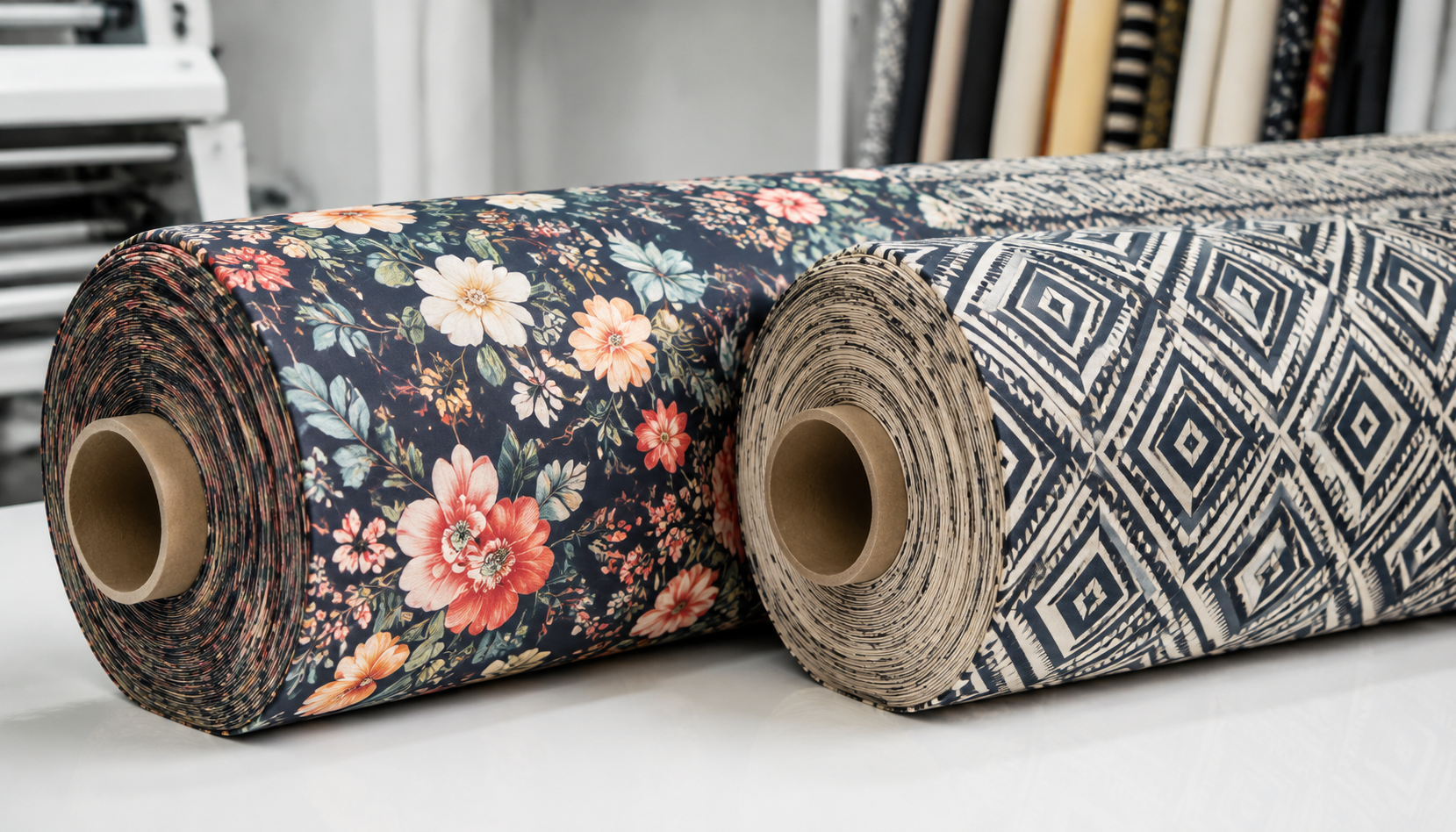
A European sportswear brand once ordered 3,000 polyester performance tops with a six-color gradient print. The buyer chose digital printing for its photographic accuracy and zero plate costs. After five washes, color fastness dropped to grade 2 on the gray scale — the entire shipment was returned, costing the brand roughly $47,000 in lost revenue and air-freight replacements. That single failure crystallized the question every textile buyer eventually faces: in the digital vs screen textile printing debate, which method actually holds up, and when does each one make sense?
Before comparing durability or cost, you need a solid grip on what each technology physically does to a piece of fabric. The mechanisms are fundamentally different — and those differences cascade into every downstream decision you’ll make as a buyer.
Screen printing is a stencil-based process that’s been refined over decades. Here’s the simplified chain: a woven mesh screen (typically 80–300 mesh count) is coated with a photosensitive emulsion, then exposed to UV light through a film positive of the design. The unexposed emulsion washes away, leaving open pores where ink will pass through.
During production, the operator floods the screen with ink and draws a squeegee across it at 30–45 N/cm² of pressure. Ink is pushed through the mesh onto the fabric surface. Each color requires a separate screen and a separate pass through the press — which is why a six-color design needs six individual screens, each aligned to a registration mark.
The critical takeaway: every additional color adds real cost and setup time. This is where screen printing’s economics start to bend in digital’s favor as complexity climbs.
Digital textile printing is essentially an industrial inkjet process. Instead of squeegeeing ink through a stencil, printheads fire droplets of ink directly onto the fabric surface at resolutions between 600–1,200 dpi. No screens, no stencils — the design file drives everything.
The ink chemistry, though, is where it gets interesting — and where buyers need to pay close attention. There are four main ink families used in digital textile printing:
From a digital vs screen printing perspective, the big differentiator is that design complexity has almost zero impact on production cost. A 20-color gradient costs the same per meter as a single-color solid — you’re paying for ink coverage area, not screens.
| Parameter | Screen Printing | Digital Printing |
|---|---|---|
| Screen/Plate Required | Yes — one per color | No |
| Color Limit per Design | Practical limit: 8–12 colors | Unlimited (CMYK + spot) |
| Minimum Order Quantity Impact | High setup cost makes small runs expensive | Minimal — no setup barrier |
| Registration Precision | ±0.5 mm (±0.02″) with auto-press | Sub-pixel alignment, no registration error |
| Resolution | 80–150 lpi (lines per inch) | 600–1,200 dpi |
| Ink Layer Thickness | 30–50 μm | 5–15 μm |
I’ve found that many buyers get fixated on resolution numbers alone. But in practice, the ink layer thickness difference — roughly three to four times thicker for screen printing — is what drives most of the durability and hand-feel trade-offs downstream.
This is the section where screen printing vs digital printing durability claims get quantified. I’ll use industry-standard test frameworks so you can compare apples to apples when reviewing mill reports.
Color fastness to washing is measured per ISO 105-C06, using the gray scale for color change (1 = severe fading, 5 = no change). The test simulates home laundering at controlled temperature and detergent concentration. Here’s what typical results look like across the two printing methods and common fiber types:
| Process & Fiber | 5 Washes (Grade) | 20 Washes (Grade) | 50 Washes (Grade) |
|---|---|---|---|
| Screen / Polyester (plastisol) | 4.5–5 | 4–4.5 | 3.5–4 |
| Digital disperse-sublimation / Polyester | 4.5–5 | 4–4.5 | 3.5–4 |
| Digital pigment / Cotton | 3.5–4 | 3–3.5 | 2.5–3 |
| Screen / Cotton (reactive ink) | 4–4.5 | 3.5–4 | 3–3.5 |
| Digital reactive / Cotton | 4–4.5 | 3.5–4 | 3–3.5 |
| Screen silicone / Nylon outerwear | 4–4.5 | 3.5–4 | 3–3.5 |
A few patterns jump out. On polyester, screen printing with plastisol and digital sublimation perform almost identically — both exploit the thermoplastic nature of the fiber to lock dye into the polymer matrix. The real divergence happens on cotton with pigment inks, where digital pigment ink starts at an acceptable 3.5–4 grade at 5 washes but drops noticeably by cycle 20. This is because pigment inks sit on the fiber surface rather than chemically bonding into it, and surface-deposited particles detach incrementally with each wash.
My own preference for activewear orders, honestly, is to avoid pigment ink entirely on performance fabrics. It’s tempting because pigment works on any fiber, but the wash-fastness gap is real and it only becomes visible after the first few consumer washes — exactly when returns spike.
Screen printing’s thicker ink film — typically 30–50 μm — creates a more robust surface layer. In Martindale abrasion testing (ISO 12947), screen-printed areas on polyester-cotton blends routinely survive 20,000+ cycles before edge chipping appears. Digital prints at 5–15 μm film thickness show edge degradation at 8,000–14,000 cycles under the same conditions.
But here’s the trade-off: that thicker ink layer stiffens the print area. On a fashion blouse or a soft-hand home textile, the plastisol “puck” effect is undesirable. Digital printing wins on hand feel — it’s virtually undetectable to the touch on lighter fabrics (120–180 Fabric GSM Calculator / 3.5–5.3 oz/yd²). Whether you care about abrasion or hand feel depends entirely on end use.
For outdoor applications — think awnings, outdoor cushion covers, sun-protective sportswear — UV stability becomes critical. Testing per AATCC 16 (xenon arc lamp accelerated weathering), plastisol-based screen prints and silicone prints typically withstand 40+ hours of exposure without visible color shift.
Digital pigment inks without UV stabilizers begin showing noticeable fade at around 20 hours. Adding UV absorber formulations extends this to 30–35 hours, but at additional ink cost. Disperse-sublimation prints on polyester sit somewhere in between at 30–40 hours, thanks to the dye being locked within the fiber structure.
In practice, if I’m specifying fabric for outdoor upholstery, I default to screen printing with silicone or plastisol inks and explicitly require xenon arc test data from the mill. Digital can work outdoors, but you need to be more selective about ink chemistry and build UV testing into your QC checklist.
Let me give this some real-world context. A European active-lifestyle brand we consulted on were sourcing 5,000 m (5,470 yd) of polyester-spandex performance fabric for a summer collection. The design featured a six-color gradient — perfect for digital. They required grade 4 wash fastness after 20 cycles. The brand’s initial thinking was straightforward: go digital, save on plate costs.
What happened next was a textbook trial-and-error cycle. The first sample run used digital pigment ink on the polyester blend. The gradient looked superb — photographic-level color gradients that screen printing simply cannot replicate. But wash testing came back at grade 3. Not acceptable for a brand positioning itself in the performance segment.
Switching to digital disperse-sublimation seemed logical — it’s the standard for polyester. The sublimation print hit 4.5 on wash fastness. Problem solved? Not quite. The fabric contained 18% spandex, and sublimation requires a heat press at 190–200°C (374–392°F). At those temperatures, the spandex fibers started losing elasticity. Hand feel shifted from stretchy-comfortable to board-stiff after pressing. They dropped the press temperature to 185°C (365°F) to save the stretch, and the sublimation transfer became incomplete — patches of muted color where full saturation was needed.
The solution ended up being a hybrid approach: digital disperse-sublimation for the gradient base layer at 185°C (365°F), overprinted with two screens of plastisol-opaque ink for the high-density logo elements. It wasn’t the cheapest option. The hybrid added roughly $1.20/m to production cost and extended lead time by 8 days (from 37 to 45 days). But it delivered 4.2-grade wash fastness with 95% gradient accuracy on a technically challenging stretch fabric. Sometimes the “right” method is two methods together.
This is where digital vs screen printing gets economically nuanced. Anyone who tells you “digital is always cheaper for small runs” is oversimplifying. The math depends on plate costs, ink costs per meter, print width, and volume — and those variables intersect differently depending on your specific order.
Screen printing setup costs are front-loaded and color-dependent. A typical breakdown:
| Cost Item | Screen Printing | Digital Printing |
|---|---|---|
| Plate/Screen charge | $80–150 per color | $0 |
| Sample strike-off | $150–300 (includes first screen set) | $50–120 (ink + fabric only) |
| ICC color profiling | N/A | $100–200 (one-time per new ink set, ~2–4 hours engineer time) |
| Design separation labor | $50–150 per design (color separation + film output) | Included in file prep (< 1 hour) |
| 6-color design total setup | $480–900 | $150–320 |
For a one-color design, screen printing’s setup is manageable — maybe $80–150 for the single screen. But scale that to six or eight colors and you’re looking at $480–1,200 before a single meter of fabric is printed. Digital setup stays relatively flat regardless of complexity.
Now let’s look at how setup costs amortize across volumes. Here’s a realistic comparison for an 80% coverage, four-color design on 200 gsm (5.9 oz/yd²) polyester:
| Order Volume | Screen Printing ($/m) | Digital Printing ($/m) | Method Advantage |
|---|---|---|---|
| 100 m (109 yd) | $5.80–6.50 | $3.20–4.00 | Digital – 45% lower |
| 500 m (547 yd) | $3.40–3.90 | $2.90–3.50 | Digital – 12% lower |
| 2,000 m (2,187 yd) | $2.00–2.40 | $2.60–3.00 | Screen – 28% lower |
| 5,000 m (5,468 yd) | $1.60–2.00 | $2.40–2.80 | Screen – 40% lower |
The crossover point — where screen printing becomes cheaper per meter — usually lands somewhere around 800–1,200 meters (875–1,312 yd) for a four-color design. Add more colors and that crossover point shifts upward in digital’s favor. Fewer colors push it lower.
Personally, I think many buyers underestimate how fast screen per-meter costs drop at 2,000+ meter volumes. If you’re ordering 3,000 m (3,280 yd) of a one-color logo print, digital would cost you roughly $2,500 more than screen on a conservative estimate. That’s money better spent on QC testing or fabric upgrades.
Every printing method carries costs that don’t show up on the initial quotation. Screen printing’s hidden costs include screen storage and reuse logistics — a well-maintained screen can be reused for repeat orders within 6–12 months, but beyond that the emulsion degrades and the mesh clogs. If a buyer places a second order 18 months later, new screens must be made. Budget an extra $200–400 for that scenario.
Digital printing’s hidden variable is ink cost volatility. Pigment inks, for instance, are significantly influenced by titanium dioxide pricing — when TiO₂ prices spike (which they do cyclically), white base ink costs climb by 10–15%. Disperse inks are more stable but still subject to petrochemical price swings. Additionally, digital printhead replacement is an expensive maintenance item — a single Epson S3200 head runs $800–1,200, and high-volume operations may replace heads every 12–18 months.
Waste rates also differ materially. Screen printing typically runs 3–5% fabric waste from setup pass-offs, registration adjustments, and screen-change stops. Digital’s waste is tighter at 1–2%, mainly from printhead priming and lead-in/lead-out fabric at roll splicing.
The fiber content of your fabric is arguably more important than volume or cost when choosing a print method. Wrong ink-fiber pairing is the single most common cause of color fastness failure — and it’s entirely preventable with upfront chemistry matching.
Cotton, linen, and rayon are hydrophilic fibers that work beautifully with reactive ink systems. For digital reactive printing, the fabric must be pre-treated with a coating of alginate thickener, urea, and sodium bicarbonate — this pre-treatment determines ink fixation depth and color gamut. Poor pre-treatment is the #1 cause of dull, washed-out digital prints on cotton.
Screen printing on cotton can use either reactive ink (for hand feel and wash fastness) or pigment ink (for simplicity and ink stability). But here’s a screen printing vs digital printing example worth noting: pigment screen prints on cotton feel noticeably stiffer — like a thin rubber patch bonded to the surface — while reactive screen prints or digital reactive prints feel integrated with the fabric.
When evaluating suppliers, ask to see their printed series fabric samples side by side. A manufacturer maintaining an active printed fabrics product line across both digital and screen capabilities gives you a realistic preview of what each process can deliver on commonly sourced substrates — whether that’s a 145 gsm (4.3 oz/yd²) cotton voile or a 280 gsm (8.3 oz/yd²) cotton canvas.
Polyester and sublimation printing are natural partners. Disperse inks, when heated to 180–210°C (356–410°F), enter a gas phase and penetrate the thermoplastic surface of polyester fibers. The result is essentially permanent — the dye becomes part of the fiber structure rather than sitting on top of it. This is why polyester sportswear and swimwear are almost always printed via digital sublimation.
Nylon, however, is trickier. It’s thermally sensitive — sustained exposure above 170°C (338°F) causes yellowing and surface distortion. Sublimation at standard temperatures tends to yield incomplete coloration. Acid inks are the better choice for nylon, but they require steam fixation rather than heat pressing, adding process complexity. Screen printing on nylon with silicone inks avoids the thermal issue entirely — silicone cures at 140–150°C (284–302°F), well within nylon’s comfort zone.
Polyester-cotton blends create another layer of complexity. Neither pure disperse nor pure reactive chemistry works perfectly. The common industrial approach is a two-stage process: disperse ink first (which bonds to the polyester component), then reactive ink or a finishing agent for the cotton component. This works but doubles your fixation steps and adds cost.
Here’s a factor that doesn’t get enough attention: fabric construction matters. Knit fabrics — especially those with elastane — stretch during the printing process. If the fabric elongates more than 15% under the tension of the feed system, digital print heads fire dots onto a stretched surface that relaxes after printing, causing subtle pattern distortion or “ghosting.”
Screen printing handles this better because the squeegee pressure is distributed over a wider area and each color pass happens at consistent tension. For high-stretch knits (single jersey with 20%+ elastane, for example), screen printing’s registration controllability at equal tension gives it a mechanical advantage. Some advanced digital machines now incorporate pre-tensioning and in-line compensation algorithms, but you’ll pay a premium for that capability and not every supplier has updated their equipment.
Enough with individual comparisons — let’s build an actual decision tool. This is what I wish every spec sheet and RFP document included.
Volume is the strongest single predictor of economics, but it needs to be cross-referenced with color complexity. Here’s a practical matrix:
| Order Volume | 1–3 Solid Colors | 4–6 Colors / Fine Detail | 7+ Colors / Gradient / Photographic |
|---|---|---|---|
| ≤200 m (219 yd) | Digital or screen (compare quotes) | Digital — no contest | Digital — only viable option |
| 200–1,000 m (219–1,094 yd) | Screen preferred (20–30% cheaper) | Close call — get both quotes | Digital preferred |
| 1,000–3,000 m (1,094–3,281 yd) | Screen (35–40% cheaper) | Marginal — depends on repeat orders | Hybrid may be optimal |
| >3,000 m (3,281+ yd) | Screen (strong cost advantage) | Screen, if design can be separated into ≤6 spot colors | Evaluate ink chemistry on fiber; hybrid often best |
This matrix is a starting point, not a verdict. You still have to layer in fiber type, end-use requirements, and lead time constraints — but it narrows your evaluation scope quickly.
Different end-use applications prioritize different quality dimensions. Here’s how I’d rank them and what that implies for digital vs screen textile printing:
What is digital screen printing, exactly? The term gets used loosely, but in professional textile manufacturing it typically means a two-stage process — digital base printing combined with screen overlay for specialty effects, opacity, or performance-critical elements. The case study I described earlier (gradient base via digital disperse-sublimation + logo detail via plastisol screen) is a classic hybrid scenario.
Hybrid makes sense when you need both photographic color complexity and high-performance ink characteristics that digital chemistry alone can’t deliver. The cost penalty is typically $0.80–1.50 per meter on top of the cheaper of the two standalone methods. Whether that’s worth it depends on your brand positioning and price elasticity.
Another hybrid scenario I’ve seen work well: digital reactive printing for the main decorative field of a silk scarf, followed by a single screen pass of metallic or pearlescent ink for brand logo elements that need a tactile, raised effect. Digital alone can’t achieve that surface texture; screen alone can’t reproduce the intricate floral pattern.
This section is pure buyer protection. Print quality failures are expensive in B2B textile — typically $15,000–80,000 per incident when you factor in replacement production, air freight, markdowns, and brand damage. Here are the three highest-impact risk controls.
Screen printing has a natural consistency risk: screen mesh degrades with use, emulsion thickness varies between batches, and ink viscosity drifts as ambient temperature and humidity change across shifts. A ΔE (color difference) value above 1.5 is typically visible to the unaided eye. For first production runs this is managed by strike-off approval. For repeat orders, the risk increases as reused screens age — expect ΔE drift of 0.5–1.0 per production cycle on reusable screens.
Digital printing’s advantage here is significant: no physical screen means repeat-order consistency is driven by file reproducibility and ink batch control. If the supplier logs ICC profiles per fabric type and monitors ink ΔE at batch intake, first-run and fifteenth-run colors should be nearly identical. The risk factor becomes ink batch variation — some pigment ink batches can show ΔE 0.3–0.8 shifts even within the same supplier’s product line.
A strike-off or lab sample is not the same as production output. The conditions differ — small-format samples often run at calibrated desktop or lab-scale printers, not production-line machines at full speed. To bridge this gap, a robust pre-production protocol should include:
I cannot emphasize this enough: a pilot run of 10 m (11 yd) printed on the actual production machine, at production speed, onto the actual production fabric lot, is the single most valuable risk-mitigation step in B2B textile printing. It catches 80% of issues that don’t appear in lab samples.
When evaluating a supplier’s printing capability, dig into the equipment. For digital printing, ask about printhead models directly — Epson S3200, Ricoh GH2220, and Konica Minolta 1024i are current industrial standards. Each has different droplet size ranges and industrial reliability profiles. Also confirm ink compatibility: a house that runs one ink chemistry well may not have optimized its curing parameters for another family.
For screen printing, mesh count capability tells you a lot. A shop limited to 80–120 mesh can handle basic solid fills but not fine halftone detail (which needs 230–300 mesh). Confirm whether they run manual, semi-automatic, or fully automatic carousels — automation directly impacts registration consistency on multi-color runs.
Weaving, dyeing, and printing under one roof provides a genuine operational advantage. When a single facility handles the full chain — from fabric construction through pre-treatment, printing, and finishing — there’s typically better traceability and faster problem resolution. If a color isn’t absorbing correctly, the print team can walk 30 meters to the weaving or prep department and adjust pre-treatment in real time. Cross-facility workflows add days to that feedback loop.
When you’re evaluating suppliers for your next printed order, or if you need a feasibility assessment for a specific ink-fiber combination, reaching out to the technical engineering team directly is often the fastest path. You can submit your design files and technical specifications at the factory’s contact page, where engineers typically respond within one business day with a detailed printability assessment and cost quotation.
It depends on your specific order parameters. Digital printing dominates for small-to-medium volumes (under 500 m / 547 yd), complex multi-color designs, and photographic-quality imagery. Screen printing is superior for large-volume orders of simple designs, where per-meter costs are 30–40% lower. There’s no universal “better” — only a better fit for your particular combination of volume, design complexity, fiber type, and end-use performance requirements.
In controlled testing on identical fiber substrates, screen printing with plastisol or silicone inks generally outperforms DTG (Direct-to-Garment) pigment ink in wash fastness and abrasion resistance. On polyester, the gap narrows significantly when comparing screen plastisol to digital disperse-sublimation — both achieve grade 4–4.5 at 20 wash cycles. On cotton, DTG pigment ink’s wash fastness drops to grade 3–3.5 by cycle 20, while screen printing with reactive chemistry holds at 3.5–4.
For cotton T-shirts in volumes under 500 pieces with multi-color or photographic designs, DTG digital printing is the practical choice — zero setup cost, soft hand feel, and good color range. For volumes above 2,000 pieces with designs of four colors or fewer, screen printing with plastisol or water-based ink is typically 25–35% cheaper per unit. Some premium brands prefer the hand feel of screen printing’s water-based ink on fashion tees; others favor DTG’s softness on next-to-skin comfort items.
“Quality” has multiple dimensions. In wash fastness and abrasion resistance, screen printing with plastisol or silicone inks generally scores higher. In design resolution, color gradation accuracy, and repeat-order consistency (no plate degradation), digital printing has the advantage. In color gamut (the range of reproducible colors), high-end digital printers exceed screen printing’s capabilities. The right question isn’t which is universally “better quality” — it’s which dimension of quality matters most for your specific product and customer expectation.
The digital vs screen textile printing decision isn’t a technology debate — it’s a design and business decision. The best printed fabric is the one that meets your performance spec, fits your budget at your actual volume, and arrives on time. Most of the expensive mistakes I’ve seen in this industry come from applying a one-size-fits-all rule — “just go digital, it’s modern” or “screen is always more durable” — without mapping the decision to the specific order’s fiber content, color complexity, end-use environment, and reorder cadence.
Build your specification first. Define your non-negotiables — whether that’s a wash fastness grade, a UV resistance threshold, or a maximum unit cost at a given volume. Then let those specs determine which process (or combination of processes) delivers the result. The technology should serve the product, not the other way around.