Address
Nanlang Industrial Zone, Xingtan Town, Shunde District, Foshan, Guangdong, China
Work Hours
Mon–Fri, 9:00 AM – 6:00 PM (CST/UTC+8). We aim to respond to all inquiries within 48 hours.

Address
Nanlang Industrial Zone, Xingtan Town, Shunde District, Foshan, Guangdong, China
Work Hours
Mon–Fri, 9:00 AM – 6:00 PM (CST/UTC+8). We aim to respond to all inquiries within 48 hours.
Linen vs Cotton Fabric: Which Is Better for Your Climate & Product. This guide covers key properties, real-world applications, and a practical sourcing checklist for B2B buyers.
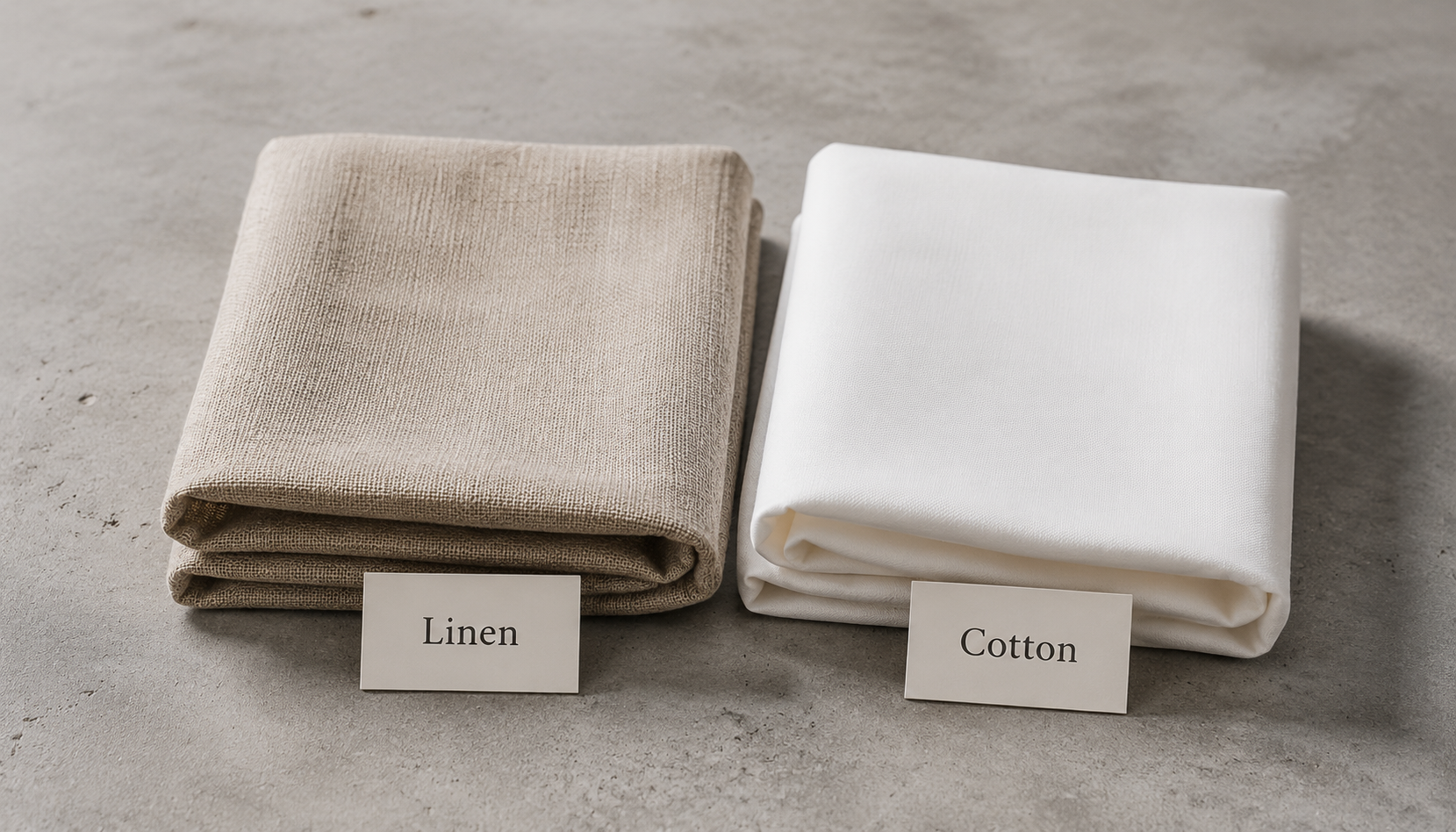
A European home-textile brand once switched its entire summer cushion line from cotton to linen, expecting a 15% cost saving on raw material — only to eat a 22% overrun on finishing and returns because nobody accounted for linen’s higher shrinkage rate during garment washing. That kind of miscalculation is exactly what this guide prevents.
At first glance, both are natural plant fibres. But their botanical origins, extraction methods, and internal structures differ so fundamentally that treating them as interchangeable is a recipe for costly mistakes downstream.
Linen comes from the flax plant (Linum usitatissimum), a bast fibre harvested from the stalk. Cotton, by contrast, is a seed-hair fibre — the fluffy boll that surrounds the seeds of Gossypium species. That distinction matters more than most buyers realise.
Flax thrives in cool, temperate climates with consistent rainfall. The major growing regions are Northern France, Belgium, and the Netherlands — collectively known as the European Flax belt — though China and Egypt also produce significant volumes. The growing season is remarkably short: roughly 100 days from sowing to harvest.
Cotton demands heat. The primary growing regions — Xinjiang (China), India, the southern United States, and Uzbekistan — all share long, hot summers. A typical cotton crop takes 150 to 180 days to mature, which means higher water and pesticide inputs over a longer period.
After harvest, flax stalks undergo retting — a controlled microbial decomposition that separates the bast fibres from the woody core. Dew retting (field exposure) produces a greyish, inconsistent fibre; water retting (submerged tanks) yields a cleaner, more uniform result but requires careful wastewater management. The fibres then pass through scutching and hackling before being spun into yarn.
Cotton processing is comparatively straightforward. Bolls are mechanically harvested, then passed through a saw gin to separate fibres from seeds. The fibres are carded, combed, and spun. Combed cotton yarn can reach extremely fine counts — Ne 30 to 120 — while linen yarns typically range from Nm 10 to 60, reflecting the coarser, stiffer nature of bast fibres.
This yarn-count difference directly affects fabric hand-feel, drape, and end-use suitability. It also explains why linen-cotton blends have become so popular in the mid-market: they combine linen’s texture with cotton’s softness at a yarn level that neither fibre achieves alone.
With over two decades of integrated production experience — from weaving through dyeing to specialty finishes like flocking — the manufacturer has refined these fibre-handling processes across millions of metres of output, maintaining ISO 9001 quality management throughout.
Before diving into application-specific advice, let’s establish a baseline. The table below compares eight critical performance dimensions side by side, using real-world production data rather than textbook ideals.
| Property | Linen | Cotton |
|---|---|---|
| Tensile strength (wet) | +20% vs. dry | −10% vs. dry |
| Moisture regain | 12% | 8.5% |
| Typical gsm range | 120–300 gsm (3.5–8.8 oz/yd²) | 100–400 gsm (3.0–11.8 oz/yd²) |
| Typical cost (FOB) | USD 4.5–12 /m | USD 1.8–6 /m |
| Drying speed | Fast (1.1× cotton) | Moderate (baseline) |
| UV blocking | ~30% higher | Baseline |
| Pilling resistance | Excellent | Good |
| Biodegradability | ~2 weeks (soil) | ~5 weeks (soil) |
Linen’s wet-strength advantage is one of its most underappreciated properties. When saturated, linen fibres actually become stronger — approximately 20% higher tensile strength than in a dry state. Cotton behaves in the opposite direction: it loses roughly 10% of its dry strength when wet.
This matters enormously for products that undergo repeated laundering. Hotel linens, restaurant tablecloths, hospital bedding — all of these are washed dozens of times at high temperatures. In ASTM D5035 strip-test benchmarks, a 140 Fabric GSM Calculator (4.1 oz/yd²) linen shirting consistently outperforms a 150 gsm (4.4 oz/yd²) cotton poplin after 50 industrial wash cycles.
That said, cotton’s dry strength is actually higher in absolute terms for many constructions. For products that are rarely washed — decorative cushions, wall hangings, seasonal curtains — cotton’s strength profile is perfectly adequate.
Here’s where the linen vs cotton for hot weather debate gets interesting. Linen can absorb up to 20% of its own weight in moisture before it starts to feel damp against the skin. Cotton absorbs more in absolute terms — up to 25–27% — but it holds onto that moisture far longer.
The result: linen feels cooler and dries faster. In a controlled humidity chamber at 35°C (95°F) and 80% RH, a linen shirt dries approximately 1.1 times faster than an equivalent cotton shirt. For tropical climates, this difference translates directly into wearer comfort.
Cotton, however, has a softer initial hand-feel. It doesn’t require the same garment-wash finishing that linen does to achieve acceptable next-to-skin comfort. For temperate or dry-heat climates where rapid drying is less critical, cotton’s slower moisture release can actually feel more comfortable — it provides a gentle cooling effect as it dries.
Linen wrinkles. There’s no way around it. The fibre’s low elasticity — approximately 3% elongation at break versus cotton’s 7% — means it creases easily and holds those creases stubbornly. The linen vs cotton ironing question is one of the most common concerns from end consumers, and it directly affects product positioning.
From a production standpoint, the numbers matter more than the aesthetics:
Blended fabrics (55/45 linen-cotton, for instance) can reduce visible wrinkling by roughly 30–40% compared to pure linen, which is why so many mid-market shirting programs use this ratio. The trade-off is a slight loss of linen’s distinctive slubbed texture.
Imagine you’re sourcing 10,000 metres of shirting fabric for a resort-wear brand operating across Southeast Asia and the Mediterranean. The climate is hot and humid. Customers expect comfort, but they also want a premium look. This is where the linen vs cotton fabric comparison becomes a real decision-making exercise, not just an academic exercise.
Linen’s thermal conductivity is approximately five times higher than cotton’s. That means it conducts body heat away from the skin more efficiently — a measurable advantage in ambient temperatures above 30°C (86°F). Combined with its superior UV-blocking properties (linen blocks roughly 30% more UV radiation than cotton of equivalent weight), the case for linen in tropical apparel is strong.
But cotton has its own advantages in hot-weather linen vs cotton fabric clothing applications. It’s softer out of the box. It drapes more fluidly. And it’s significantly cheaper at the raw-material level — often 40–60% less expensive per metre for comparable constructions.
For summer shirting, linen’s breathability is hard to beat. A 120 gsm (3.5 oz/yd²) linen voile feels almost weightless in humid conditions. The trade-off is opacity — lighter linen can be somewhat sheer, which limits its use in women’s blouses without a lining.
When considering linen vs cotton fabric for dresses, drape becomes the deciding factor. Linen has a stiffer, more architectural drape. It holds volume well in A-line and structured silhouettes. Cotton — especially cotton lawn or voile — falls more softly, lending itself to flowing, romantic styles.
Many designers solve this by using linen-cotton blends. A 60/40 linen-cotton blend in a plain weave at 140 gsm (4.1 oz/yd²) offers enough structure for a tailored summer dress while retaining enough softness for comfortable wear. Garment washing with cellulase enzymes can further soften the hand-feel without sacrificing linen’s textural character.
The linen vs cotton fabric for sofa upholstery question hinges on abrasion resistance and aesthetics. In Martindale abrasion testing, a medium-weight linen (250 gsm / 7.4 oz/yd²) typically achieves 18,000–22,000 cycles before showing visible wear. Cotton sateen of similar weight reaches approximately 12,000–15,000 cycles.
Linen also develops a desirable patina over time — a softening of colour and texture that many interior designers actively seek. Cotton, by contrast, tends to look worn rather than aged.
For curtains, lightfastness is critical. Linen retains its colour integrity under prolonged UV exposure better than cotton, which can yellow and weaken over time. ISO 105-B02 testing shows linen consistently achieving Grade 5 or higher, while cotton often falls to Grade 4 after extended exposure.
Bedding is where cotton still dominates. Its softer hand-feel, lower cost, and wider range of thread counts (from 200TC to 1,000TC) give it a clear advantage in the premium bedding segment. Linen bedding exists — and commands a premium — but it appeals to a narrower, design-conscious audience willing to accept wrinkles as part of the aesthetic.
A mid-size German sofa brand tested this balance firsthand. They wanted a “natural look” for their 2024 summer collection at a €35/m retail price point. Pure linen (Nm 24) met the aesthetic brief but caused 4.2% weaving defects — nearly triple their 1.5% budget — due to slub irregularities. Pure cotton was too visually flat.
They tried a 70/30 linen-cotton blend next. The visual texture disappeared; the sales team rejected the sample outright. After several iterations, they settled on a 55/45 linen-cotton with a modified plain weave and enzyme wash. Waste dropped to 2.1%, but they accepted a 12% higher unit cost versus pure cotton and a three-week longer lead time for custom weaving. The compromise worked commercially, but only because they had budgeted for the trial-and-error phase upfront.
If you’re evaluating blended-fabric feasibility for a similar project, the technical enquiry form accepts specification sheets and design files, and the engineering team responds within 24 business hours with a feasibility assessment and quotation.
Choosing between linen and cotton isn’t a binary question. It’s a four-step process that weighs climate, certification, supply-chain logistics, and total landed cost. Here’s how experienced procurement teams approach it.
First, define the end-use climate zone. Hot-humid environments favour linen or linen blends for apparel; temperate indoor environments lean toward cotton for bedding and upholstery. Second, map the required certifications — this alone can eliminate one fibre or the other. Third, evaluate MOQ constraints against stock availability. Fourth, calculate the total landed cost, including finishing, shrinkage allowances, and potential returns.
| Climate × Product | Recommended Fibre | Key Consideration |
|---|---|---|
| Hot-humid / Apparel | Linen or 60/40 linen-cotton | Moisture-wicking, drying speed |
| Hot-humid / Upholstery | Linen or 55/45 linen-cotton | Abrasion resistance, UV stability |
| Temperate / Apparel | Cotton or 40/60 linen-cotton | Softness, cost efficiency |
| Temperate / Bedding | Cotton (200–400TC) | Hand-feel, thread-count range |
| Temperate / Curtains | Linen or cotton-linen blend | Lightfastness, drape |
| Dry-heat / Apparel | Cotton voile or lawn | Moisture retention for cooling |
Comfort in textiles can be quantified using CLO values — a measure of thermal insulation. A single-layer linen shirt at 120 gsm (3.5 oz/yd²) registers approximately 0.4 CLO, while an equivalent cotton shirt sits around 0.5 CLO. That 0.1 CLO difference is perceptible in hot conditions and translates to roughly 1–2°C (1.8–3.6°F) of additional cooling for the wearer.
For hot-humid climates, this is meaningful. For temperate climates, the difference is negligible — and cotton’s lower cost makes it the rational choice.
Certification requirements can override all other factors. Key standards include:
Linen’s lower pesticide requirement simplifies organic certification. Flax typically needs 5–7 fewer chemical treatments than cotton over its growing cycle, which means a smaller compliance burden for GOTS or similar organic standards.
A UK high-street retailer learned this the hard way when sourcing 50,000 metres of summer dress fabric with GOTS certification and a six-week delivery window. GOTS-certified organic cotton was available from stock with a four-week lead time, but the design team wanted a “textured premium” look that only linen could provide. GOTS linen, however, was available only as a custom order with a 10-week lead.
They tried a GOTS cotton-linen 80/20 blend from a new supplier. Lab testing revealed the actual linen content was only 11% — well below the marketing claim threshold. The team switched to a verified 70/30 GOTS blend from an established mill, accepted the 10-week lead, and pre-ordered six months ahead. Unit cost ran 18% above the cotton-only option, but the “natural texture” positioning justified the premium at retail.
Procurement mistakes in natural fibres are expensive. A single rejected shipment of 5,000 metres can cost tens of thousands of dollars in rework, re-dyeing, or markdowns. The following checklist distils two decades of production-floor experience into a practical SOP for B2B buyers.
The burn test is a quick field method — linen smells like burning paper and leaves a fine grey ash; cotton also burns cleanly but with a slightly sweeter odour. However, for B2B transactions, the burn test is insufficient.
The authoritative method is chemical dissolution testing per ASTM D629, which quantifies fibre percentages in blended fabrics. One common pitfall: the standard cotton reagent (zinc chloride solution) can partially dissolve bast fibres, leading to under-reporting of linen content. Experienced labs adjust the dissolution time and temperature to account for this, but less rigorous labs may not.
Always specify ASTM D629 on your test request and confirm the lab’s experience with bast-fibre blends.
Target shrinkage thresholds depend on end use:
Sanforisation or compressive shrinkage finishing can reduce cotton’s residual shrinkage to under 1%. Linen is harder to control; even with pre-shrinking, some movement is inevitable. Budget an additional 2–3% cutting waste for linen-heavy programs.
For fabrics that will be exposed to sunlight — curtains, outdoor cushions, automotive interiors — lightfastness is non-negotiable. As defined by ISO 105-C06, colourfastness to laundering should meet a minimum of Grade 4 for most consumer applications. For lightfastness (ISO 105-B02), target Grade 5 or higher for curtain fabrics.
Enzyme-washed linen presents a particular challenge. The washing process softens the hand-feel beautifully, but it can also introduce slight batch-to-batch shade variation. A ΔE (colour difference) of ≤1.5 is generally acceptable to the human eye, but some brands require ≤1.0. Communicate your tolerance clearly during the sampling stage.
The factory’s ISO 9001-certified QC process includes inline colour monitoring at the dyeing stage and a dedicated 2,000 m² stock warehouse that holds approved lots for repeat orders, significantly reducing lot-to-lot variation for ongoing programs.
Yes — but with a caveat. Linen’s wet tensile strength is approximately 20% higher than its dry strength, whereas cotton loses about 10% of its strength when wet. This makes linen significantly more durable for items that undergo frequent, high-temperature laundering. In dry conditions, however, cotton’s absolute tensile strength is comparable or slightly higher for many constructions.
Yes, considerably. Linen’s low elasticity — approximately 3% elongation at break versus cotton’s 7% — means it creases easily and holds those creases. A blended approach, such as a 55/45 linen-cotton, can reduce visible wrinkling by 30–40% while retaining linen’s distinctive texture. Some brands market the wrinkles as part of the “lived-in” aesthetic, which works well in casual resort wear but falls flat in formal tailoring.
Linen. Its higher moisture regain (12% vs. 8.5%) and faster drying time make it the superior choice for hot-humid environments. The fibre’s thermal conductivity is roughly five times that of cotton, meaning it draws heat away from the body more efficiently. Cotton is more comfortable in dry heat, where its slower moisture release provides a gentle evaporative cooling effect.
Absolutely. Most integrated mills offer sample MOQs as low as 5–10 metres per colour for stock fabrics. Lead time for stock items is typically 3–5 working days; custom-dyed samples may take 7–10 days. For blended fabrics or new constructions, expect 50–100 metre sample minimums and 10–15 day lead times. You can submit a sample request with your specification sheets attached, and the technical team will confirm availability and pricing within 24 business hours.
Generally, yes. Flax requires fewer pesticides and less irrigation than conventional cotton. It biodegrades faster — approximately two weeks in soil conditions versus five weeks for cotton. However, “sustainable” depends on the full supply chain: water retting of linen produces wastewater that requires treatment, and organic cotton (GOTS-certified) can match linen’s environmental profile. The honest answer is that both fibres have sustainability advantages and disadvantages depending on how they’re grown and processed.
The linen vs cotton fabric decision isn’t about which fibre is “better” in absolute terms. It’s about matching fibre properties to end-use requirements, climate conditions, and commercial realities. Linen excels in hot, humid environments where moisture management and durability matter most. Cotton dominates in cost-sensitive applications where softness and versatility are paramount.
The most successful B2B programs I’ve seen don’t treat this as an either-or choice. They build fibre strategies that leverage both — linen for summer apparel and upholstery, cotton for bedding and year-round basics, and blends for products that need to bridge the gap. The key is specifying correctly, testing rigorously, and budgeting for the finishing and shrinkage that each fibre demands.
Get those fundamentals right, and the fibre choice almost makes itself.