Address
Nanlang Industrial Zone, Xingtan Town, Shunde District, Foshan, Guangdong, China
Work Hours
Mon–Fri, 9:00 AM – 6:00 PM (CST/UTC+8). We aim to respond to all inquiries within 48 hours.

Address
Nanlang Industrial Zone, Xingtan Town, Shunde District, Foshan, Guangdong, China
Work Hours
Mon–Fri, 9:00 AM – 6:00 PM (CST/UTC+8). We aim to respond to all inquiries within 48 hours.
The color of your fabric is usually the first thing a customer notices. Yet the method you use to apply that color quietly dictates your margin, your delivery date, and whether the garment survives its first wash.
Most buyers default to whatever looks cheapest on a quote. That shortcut rarely pays off. The dyeing process changes how color penetrates the fiber, how consistent your batch runs stay, and what minimum order you can actually pull off.
Get it wrong and you end up with fading hems, mismatched panels, and frantic emails from factories. Get it right and your collection feels cohesive, durable, and financially sane. Let’s break down how the color actually gets onto the cloth.
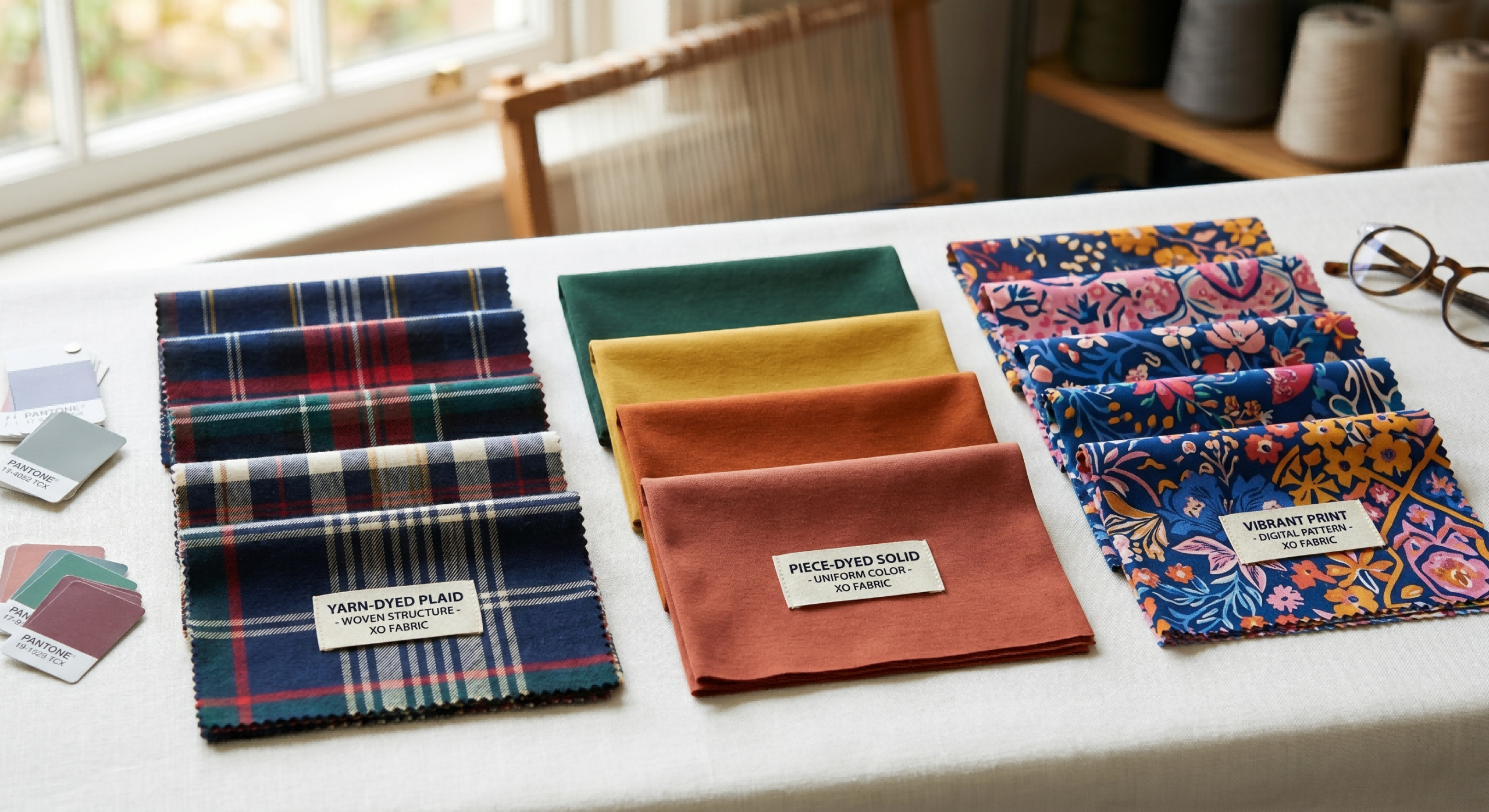
Textile manufacturing relies on three dominant color application techniques. Yarn dyeing treats the fibers before they become fabric. Piece dyeing colors the finished material. Printing deposits pigments or dyes directly onto the surface.
Each approach creates entirely different visual results. Yarn dyeing builds color into the structure itself. Piece dyeing gives you a uniform, saturated base. Printing overlays patterns, graphics, or localized color shifts.
Understanding these differences matters when you are specifying materials for production. The technique you pick will dictate shrinkage behavior, hand feel, and even how your seams press later. If you are unsure which base construction suits your pattern, checking out Understanding different fabric structures usually clears up the confusion early.
In yarn dyeing, the mill processes fibers in hank or package form before weaving or knitting. The yarns soak in dye baths, then dry and set before tension is ever applied during fabric formation.
This upfront coloring creates inherent multi-color effects. You get true heather mixes, crisp plaids, and reversible stripes because the color lives inside the yarn cross-section. Dimensional stability improves since the material shrinks and relaxes before it becomes a bolt.
Denim relies entirely on this method. So do high-end upholstery fabrics and jacquard weaves. The trade-off is straightforward. You pay more per meter. You wait longer. And you commit to heavier minimums because every colorway needs its own dedicated yarn packages.
I once watched a client try to force a complex plaid into piece dyeing just to save three days. The resulting check alignment was completely off-grain. Sometimes the premium for yarn dyeing buys you structural integrity you cannot patch later.
If you are exploring specialty weaves that benefit from deep color penetration, reading about How XO Fabric produces premium velvet through specialized processes shows how pre-colored yarns interact with pile formation.
Piece dyeing handles finished greige fabric. The mill runs the material through continuous or batch machines like jigs, winches, or jets. The dye penetrates the surface and diffuses inward under heat and chemical catalysts.
It is the default for solid colors. You order blank fabric, wait for the base to arrive, and pick colors much closer to your shipment window. Minimums drop significantly. Turnaround shrinks. Cost per meter stays predictable.
The catch is uniformity. Piece dyeing cannot create woven patterns. Batch-to-batch shade variation becomes a real risk when you order in phases. Dense constructions sometimes reject dye in the center, leaving a lighter core.
Heavier fabrics demand longer processing times. If you are working with 300 GSM fleece or 220 GSM canvas, you need to account for extra dwell time in the dye bath. Checking How fabric weight (GSM) affects dye absorption will help you adjust your production schedule accordingly.
Jet dyeing machines handle knits better than winches because they use liquid circulation instead of mechanical drag. I always specify jet for lightweight jersey to avoid edge distortion.
Printing applies color selectively. The base fabric stays untreated in blank areas. Patterns land exactly where the screen or print head directs them. You get localized color without altering the entire roll.
Rotary screen printing uses engraved metal cylinders. It requires heavy setup but drops the per-meter cost dramatically once you hit volume. Expect 8 to 12 color repeaters for complex designs. It is the workhorse for high-run fashion prints.
Digital printing changed the game for short runs. Inkjet heads lay down pigment or reactive inks directly. No screens means zero setup fees. You can order 50 meters of a photorealistic floral and hit the ground running.
Discharge printing removes existing dye and replaces it with pigment. It creates a surprisingly soft hand on dark fabrics. The palette is limited, but the texture wins over print collectors.
When designing ventilation zones for performance gear, understanding How mesh fabrics work in sportswear helps you place prints where they will not compromise airflow or print registration.
Fastness ratings tell you how a color survives stress. ISO and AATCC scales run from 1 to 5. Five means negligible change. One means rapid degradation. Most buyers need a 4 or higher for commercial garments.
Yarn dyeing usually scores 4 to 5 across wash, light, and rub tests. The dye sits deep in the filament. Piece dyeing typically hits 3 to 4 for wash and a solid 4 for light exposure. Printing varies wildly by chemistry.
Pigment prints often sit at 2 to 3 for wash fastness. Reactive prints climb to 3 or 4. Sublimation on polyester frequently reaches 4 to 5 because the dye becomes part of the polymer matrix.
I keep a faded swatch book on my desk. It reminds me that a 2.5 rating looks fine under showroom lighting but turns disastrous after ten consumer washes. Always specify your target rating in the purchase order.
Pricing shifts dramatically based on your chosen method. Yarn dyeing carries a premium of $0.80 to $2.50 over greige. You are paying for individual yarn processing, multiple dye baths, and slower throughput.
Piece dyeing runs $0.40 to $1.20 over greige. It is the most economical path for solids. Polyester dyeing stays at the low end. Cotton sits in the middle. Blends require dual chemistry, which pushes the price up.
Printing introduces setup variables. Rotary screens cost $150 to $500 per color upfront. The running cost drops to $0.60 to $1.80 per meter. Digital printing charges $2.00 to $6.00 per meter with zero setup. Sublimation lands between $1.00 and $2.50. Discharge prints run $1.50 to $3.00.
I always build a 10 percent contingency into dyeing budgets. Color matching is never linear. The mill will ask for adjustments. Your client will request a darker tone. The contingency keeps you from rewriting invoices.
Minimums dictate whether you can actually run a sample collection. Yarn dyeing demands 500 to 1000 kg per colorway. Each shade requires dedicated packages. Multi-color designs multiply that requirement.
Piece dyeing drops the barrier to 200 to 300 kg per color. Some mills in Foshan will accept 100 kg for basic neutrals. Long-term clients often negotiate lower thresholds for seasonal testing.
Printing breaks the mold. Digital runs accept 50 to 100 meters with no practical barrier. Rotary screens need 1000 to 3000 meters to justify the cylinder cost. Sublimation sits comfortably at 200 to 500 meters per design.
Consolidation saves margins. Group multiple SKUs into shared dye lots where the shades align. Use piece dyeing for bulk bases and reserve printing for accent panels. If you are still juggling batch sizes, reading Understanding MOQ strategies gives you practical frameworks for negotiation.
Timelines separate planning from panic. Yarn dyeing takes 25 to 35 days total. Dyeing runs 10 to 15 days. Weaving or knitting adds another 10 to 15 days. Finishing closes the loop in 3 to 5 days. Lab dips eat up 5 to 7 days upfront.
Piece dyeing compresses to 15 to 22 days. Greige production takes 10 to 15 days. The dye bath only needs 3 to 5 days. Finishing takes 2 to 3 days. If the mill already stocks your base fabric, you can cut total time to 10 to 15 days.
Printing timelines split by technology. Digital finishes in 5 to 10 days. Rotary requires 15 to 25 days to account for screen engraving and registration testing. Sublimation sits at 10 to 15 days.
Last year a client needed a forty-eight piece activewear line in six weeks. The factory had already cut the blanks. We only had the dye and print stage left.
We originally quoted piece dyeing for the base colors. It would have been cheapest. But the mill warned about batch variation across eight shades. We switched to digital printing for three accent panels and kept piece dyeing for the solids.
The first lab dips came back too warm. We adjusted the reactive chemistry. That cost two days. We ran the digital files through a pretreatment wash to prevent migration. That added another day.
We staged the production in overlapping waves. Greige arrived while screens were being tested. The digital printer ran continuously while the jig dyers processed the solids. We shipped on day forty-two. We lost margin on the digital surcharge. We gained a signed contract for fall.
Parallel processing beats perfection. If you are constantly chasing shipping dates, Managing lead time delays covers the scheduling tactics that actually move material forward.
Fiber composition dictates chemistry. Woven fabrics accept all three methods. Denim exclusively uses yarn dyeing with indigo. Shirting and suiting favor yarn dyeing for patterns and piece dyeing for solids.
Knit fabrics lean heavily toward piece dyeing. Jet and winch machines handle the stretch without distorting the gauge. Digital printing on knits requires light stabilization to prevent skewing during ink absorption.
Synthetic fibers like polyester demand disperse dyes at 130 degrees Celsius. Sublimation printing thrives here. The heat transfers the pigment directly into the polymer. Piece dyeing polyester remains cost-effective at scale.
Natural fibers respond to reactive chemistry. Cotton and linen achieve the highest fastness with piece dyeing and vat processes. Bamboo and Tencel absorb reactive dyes beautifully, giving rich, level shades.
Blends complicate everything. Cotton-polyester mixes require a two-step dyeing process. You apply reactive dyes first, then disperse dyes. The extra cycle adds cost and shrinkage variables. Yarn dyeing blends often simplifies the workflow.
If you are weighing fiber options, a Cotton vs polyester vs blends comparison will clarify how chemistry interacts with your base material.
Water consumption used to be the biggest environmental liability. Traditional dyeing guzzles 50 to 150 liters per kilogram of fabric. Modern Chinese mills have pushed that down to 30 to 50 liters through closed-loop recycling and low-liquor-ratio machines.
Eco-friendly dyes are gaining traction. GOTS-certified reactive dyes eliminate heavy metals. Natural dyes like indigo and madder offer marketing appeal but struggle with consistency. Digital printing cuts water waste by roughly 90 percent compared to rotary screens.
Energy reduction matters just as much. Running polyester piece dyeing at 120 degrees instead of 130 degrees saves about 15 percent in steam consumption. The mill I work with recently upgraded to heat-pump dryers. The utility bill dropped noticeably.
Wastewater treatment has become non-negotiable. Reputable facilities in the Foshan textile district now operate closed-loop systems. They achieve 80 to 95 percent water recycling. Compliance checks are stricter than ever.
If you are navigating compliance requirements, Sustainable textiles regulations in 2026 breaks down the testing thresholds you will face. You can also review XO Fabric’s sustainable practices to see how the facility structures its recycling and chemical handling.
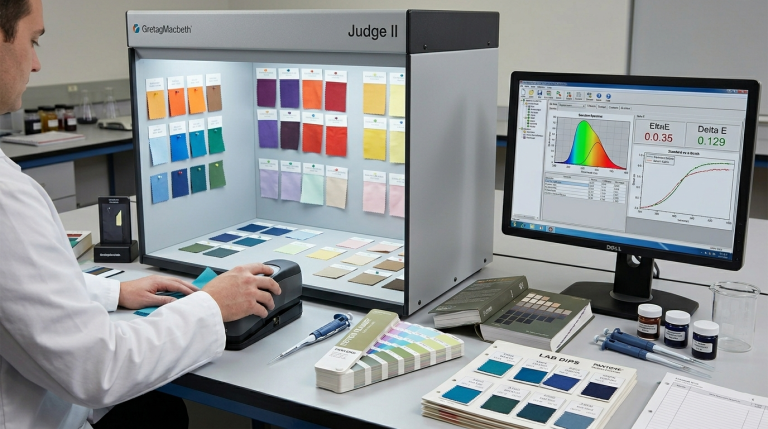
Lab dips bridge your design vision and the factory floor. The mill cuts A4 swatches and runs three to four shade variations around your target. You pick the closest match. They tweak the formula and send a final confirmation dip.
Expect five to seven days for the first round. Corrections take three to five days. Budget for one or two adjustments. Chasing perfection beyond that usually burns more margin than it saves.
Provide a physical standard. Pantone TCX or TPX swatches work best. Specify your light source. D65 standard daylight is the industry default. Define your tolerance. A delta E under 1.0 keeps production consistent.
Digital matching is replacing guesswork. Spectrophotometers measure reflectance and calculate exact dye formulas. The mill I use switched to digital matching last year. We cut lab dip rounds in half. The accuracy is noticeably tighter.
For a deeper technical breakdown, check Color matching in textile production. It covers instrumental reading, metamerism checks, and formula adjustment.
Shade variation causes the most headaches. It stems from inconsistent dye batching, temperature swings, or uneven fabric loading. Specify a maximum delta E tolerance in your contract. Request shade continuity across lots.
Dye migration bleeds color beyond intended borders. It happens when curing temperatures drop too low or drying time is cut short. Maintain proper heat settings. Allow full fixation before washing.
Metamerism makes colors shift under different lights. A navy looks perfect under fluorescent lighting but turns brownish in sunlight. Specify CMC tolerance under D65 and your secondary light source. Test swatches in both environments.
Stains and spots indicate dye aggregation or machine contamination. They appear as random dark patches or white flecks. Work with mills that follow strict cleaning protocols between color runs.
If you are building a inspection workflow, a Quality control checklist for shipments keeps your team aligned. Learning how to interpret test results through Reading fabric lab reports prevents costly misunderstandings later.
Solid colors on a tight budget almost always mean piece dyeing. It offers the lowest cost, lightest minimum, and fastest turnaround. You get predictable results for basics.
Multi-color patterns woven into the structure require yarn dyeing. Accept the higher cost and heavier minimums. Authentic heather, plaid, and jacquard designs cannot be faked with surface printing.
Complex graphics or photorealistic imagery demand digital printing. Use it for short runs and rapid prototyping. Switch to rotary screens only when you cross the volume threshold where setup costs amortize.
Sportswear with sublimation needs benefits from polyester piece dye or direct sublimation on white base fabric. The vapor transfer locks the design into the fiber without compromising stretch.
Maximum durability points back to yarn dyeing with reactive or vat chemistry. It delivers the highest fastness across every test category. If the garment will face heavy washing or UV exposure, build that requirement into your spec sheet.
If you are planning a performance line, Choosing fabrics for a sportswear collection covers how dyeing interacts with moisture management and recovery.
| Method | Cost Premium | MOQ | Lead Time | Best For | Fastness (W/L) | Patterns |
| Yarn Dyeing | $0.80-2.50/m | 500-1000 kg | 25-35 days | Woven patterns, denim | 4-5 / 4-5 | Inherent weave |
| Piece Dye (Cotton) | $0.40-1.20/m | 200-300 kg | 15-22 days | Solid basics, casual | 3-4 / 4 | Solids only |
| Piece Dye (Poly) | $0.40-1.00/m | 200-300 kg | 15-22 days | Activewear, linings | 4 / 4 | Solids only |
| Digital Printing | $2.00-6.00/m | 50-100 m | 5-10 days | Short runs, graphics | 3-4 / 4 | Photorealistic |
| Rotary Screen | $0.60-1.80/m | 1000-3000 m | 15-25 days | High volume repeats | 3-4 / 4 | Multi-color repeat |
| Sublimation | $1.00-2.50/m | 200-500 m | 10-15 days | Polyester sportswear | 4-5 / 4-5 | Full surface |
| Discharge Printing | $1.50-3.00/m | 300-800 m | 10-18 days | Soft hand on darks | 3-4 / 4 | Localized design |
Our color development team handles lab dips with three shade options per request. You typically receive them within five to seven working days. The turnaround stays tight because we keep reactive and disperse chemistry in stock.
We run both piece dyeing and yarn dyeing for specialty patterns. We also partner with a digital printing facility for short-run custom designs. You get flexibility without being locked into a single production line.
Every custom-colored fabric undergoes fastness testing before shipment. We require a minimum wash fastness of 4. Light and rub tests run through the same standard. Our internal lab uses Datacolor spectrophotometers for objective measurement.
Minimums start at 200 kg for piece dyeing. Yarn dyeing begins at 500 kg. Established clients often qualify for reduced thresholds during seasonal planning.
If you want to see how the material moves through the facility, check out Inside XO Fabric production tour. Understanding our workflow makes ordering smoother. You can also read about The XO Fabric advantage to see how we structure communication and quality control.
Piece dyeing remains the default for speed and budget. Yarn dyeing stays essential when the pattern lives in the weave. Digital printing unlocks short-run customization without the setup penalty.
Always specify your color fastness requirements upfront. It saves you from rewriting contracts and chasing faded samples. Treat the dyeing process as a structural decision, not just a cosmetic one.
Reach out to the production team when you are ready to request lab dips or develop custom colors. We can run initial swatches within a week and adjust the formula until the shade hits your target. Let’s get your collection onto the right color path from day one.