Address
Nanlang Industrial Zone, Xingtan Town, Shunde District, Foshan, Guangdong, China
Work Hours
Mon–Fri, 9:00 AM – 6:00 PM (CST/UTC+8). We aim to respond to all inquiries within 48 hours.

Address
Nanlang Industrial Zone, Xingtan Town, Shunde District, Foshan, Guangdong, China
Work Hours
Mon–Fri, 9:00 AM – 6:00 PM (CST/UTC+8). We aim to respond to all inquiries within 48 hours.

China produces over 60% of the world’s textile exports, yet most international buyers still feel like outsiders at the negotiating table. You’re staring at quotes that vary wildly for what looks like the same fabric, wondering if you’re being quoted fairly or just quoted.
New buyers often overpay by accepting the first number they hear. Or they swing too hard in the other direction, negotiating aggressively without understanding how Chinese suppliers actually build their pricing. Either way, credibility takes a hit.
Here’s why this matters: every dollar saved on fabric costs flows directly to your margin. And every relationship built on mutual respect unlocks better MOQ flexibility, priority production slots, and faster problem resolution when things inevitably go sideways.
This guide walks through the key negotiation points for fabric sourcing from Chinese suppliers, practical communication tactics that actually work, and warning signs that signal it’s time to walk away. Think of it as your field manual, with transparent sourcing practices as the benchmark.
Let’s start with the basics: FOB, CIF, DDP. These aren’t just acronyms; they’re the foundation of your total landed cost.
FOB (Free on Board) means the supplier covers production and handling to the port. You pay freight and insurance from there. CIF (Cost, Insurance, Freight) adds shipping to your destination port, typically bumping the price 15-30%. DDP (Delivered Duty Paid) sounds convenient, but the pricing is often opaque.
Always ask for a full cost breakdown, not just a unit price. I’ve seen quotes that looked great until we realized they assumed 150cm fabric width when we needed 160cm. That extra 10cm? It’s not free.
| Term | What’s Included | Buyer Responsibility |
| FOB | Production + port handling | Freight, insurance, import duties |
| CIF | FOB + freight + insurance to destination port | Import duties, customs clearance |
| DDP | Everything to your door | Nothing (but verify all costs upfront) |
Why do quoted prices vary so much between suppliers for “the same” fabric? It’s rarely just markup.
Yarn quality matters: virgin polyester vs. recycled, filament vs. spun, denier count. A 75D filament feels completely different from a 75D spun, and the price gap reflects that. Dyeing method adds complexity too. Reactive dyes for cotton cost more than disperse dyes for polyester, and matching a Pantone shade within ±0.5 DE requires extra lab work.
Fabric weight tolerance is another silent cost driver. If your spec calls for 180 GSM ±5%, a supplier quoting at 175 GSM is effectively giving you less fabric per meter. That 5g difference compounds fast over 10,000 meters.
Then there are the hidden levers: fabric width (narrower = more waste), packaging (individual poly-bags add $0.03-0.08/m), inspection level (100% inspection vs. AQL 2.5), and sample development fees that get amortized into bulk quotes.
Understanding whether your supplier quotes FOB, CIF, or DDP directly affects your total cost. And many pricing discrepancies stem from different MOQ assumptions.
MOQs aren’t arbitrary. They exist because setup costs are real. Warping a new yarn, changing knitting machine settings, or switching dye vats can cost $500-$2,000 per production run. A typical dye vat needs 300-500kg of fabric to be economically viable. Smaller runs increase the risk of shade variation between batches.
But MOQs aren’t set in stone. Here are strategies that actually work:
I once worked with a brand launching a capsule collection. They needed 8 colors of a 220 GSM French terry. The mill’s MOQ was 500kg per color. By committing to the base fabric across all 8 colors and paying a $350 color development fee, we got the MOQ down to 200kg per color. The total order stayed the same, but cash flow improved dramatically.
That said, be cautious. A supplier who immediately drops their MOQ without any negotiation might be quoting below cost, planning to recover margins later. And MOQs below 300kg for custom-dyed fabrics? The dye lot may be combined with another buyer’s order, risking shade consistency.
Our guide to MOQ strategies covers reduction tactics and how XO Fabric supports flexible ordering. Also, aligning your MOQ negotiation with your development timeline ensures you don’t commit to bulk before samples are approved.
Payment terms in Chinese textile trade follow patterns, but they’re negotiable.
T/T (Telegraphic Transfer) is most common for smaller orders: 30-50% deposit, balance against shipping documents. L/C (Letter of Credit) is recommended for orders over $10,000; the bank guarantees payment, reducing risk for both parties. DP (Documents Against Payment) lets the bank hold shipping documents until you pay, less expensive than an L/C but with less protection.
For a first order, expect 30% deposit / 70% against Bill of Lading. After 3+ successful orders, you can often negotiate to 30% deposit / 70% upon delivery or D/P at sight. For larger orders ($50,000+), consider L/C at sight for mutual protection.
Never pay 100% upfront. Reputable suppliers don’t require this. If they do, that’s a signal to pause.
Protect yourself with documentation. Always use a formal Purchase Contract, not just email confirmations. Include an inspection clause: payment is contingent on passing quality inspection. Define defect tolerance and rejection procedure in writing. For example, specify that seam slippage exceeding 6mm under 50N force (per ASTM D434) constitutes a rejectable defect.
From T/T to Letter of Credit, our guide explains every payment option and when to use each.
Language barriers are real, but the bigger gap is often cultural. In China, WeChat is the standard business communication tool. Request your supplier’s WeChat for quick updates. Use email for formal confirmations, contracts, and documentation. WhatsApp or Skype work for video calls, but schedule in advance (China is GMT+8).
Always confirm critical terms in writing, even after verbal agreements. I’ve learned this the hard way. A “yes” on WeChat doesn’t always mean “yes” in the contract.
Timing matters. Best times to contact: 9 AM – 11 AM China time (GMT+8), which is evening in Europe, early morning in US East Coast. Avoid contacting during Chinese holidays: Chinese New Year (January/February, 2-4 weeks), National Day (October 1-7). Response time: expect 2-24 hours for email; near-instant for WeChat.
Chinese business culture values relationship-building (“Guanxi”). A brief greeting and small talk before diving into business shows respect. Asking about their weekend, commenting on the weather in Foshan, or sharing a photo of your finished product using their fabric—these small gestures build trust.
Visiting the factory in person dramatically improves negotiation outcomes. Face-to-face trust matters more than any email chain. Even a short trip to meet the team, see the production floor, and share a meal can shift the dynamic from transactional to partnership.
Not every supplier is the right fit. Here’s how to spot the warning signs early.
Pricing red flags: Quotes 20-30% below the market average often mean compromised quality or hidden charges added later. A supplier who refuses to provide a cost breakdown lacks transparency. Aggressive pressure to pay 100% upfront? Walk away.
Quality and certification red flags: If a supplier can’t provide fabric lab reports or test certificates for standard properties like shrinkage (should be ≤3% for woven cotton per AATCC 135) or color fastness (≥4 for washing, ≥3-4 for rubbing), that’s a problem. Certifications that don’t match your requirements—claiming Oeko-Tex but unable to provide the certificate number for verification—are equally concerning. And if they refuse to send samples before a bulk order, always test fabric quality first.
Operational red flags: Constantly changing contact persons may indicate internal instability. Missed timelines without proactive communication suggest they’re overcommitted. Overly vague about factory location or refusing a factory tour? A legitimate supplier should welcome verification.
Here’s a quick troubleshooting checklist for red flags:
Every reputable supplier should provide a fabric lab report. Learn how to read one to verify quality claims. And verify that your supplier’s certifications are legitimate. Our guide shows you how to check.
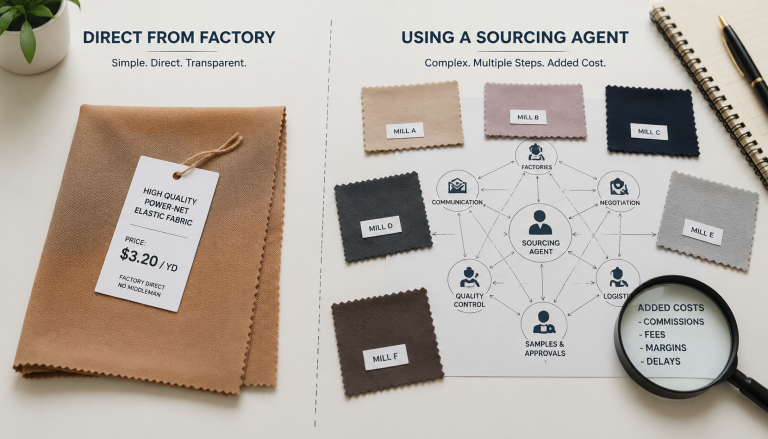
Transparency starts with pricing. Every quote includes a full cost breakdown: yarn cost, weaving/dyeing, finishing, packaging, and logistics. No hidden charges. Any additional costs are communicated and agreed before production begins.
MOQ flexibility matters for brands of all sizes. Through a 2000㎡ warehouse, initial dye lots can be shared across multiple buyers, reducing the burden on any single order. First-order test quantities are available for confirmed fabric constructions.
The focus is on long-term partnership, not one-off transactions. That means no high-pressure sales tactics. Instead, it’s about understanding your product roadmap and finding ways to support it. Annual contracts with volume commitments in exchange for stable pricing are available for committed partners.
See our Foshan facility where we manage every step of production under one roof. And if you’re ready to start a transparent conversation about your fabric needs, reach out directly.
Before negotiating:
During negotiation:
After agreement:
Negotiating with Chinese textile suppliers isn’t about winning a battle. It’s about building a bridge. The best deals aren’t the cheapest upfront; they’re the ones where both sides feel respected, informed, and set up for success.
You’ll still encounter language gaps, cultural differences, and the occasional quote that makes no sense. That’s normal. What matters is your approach: ask questions, demand transparency, and trust your instincts. If something feels off, it probably is.
And remember, fabric sourcing is iterative. Your first order is a learning opportunity. Document what works, note what doesn’t, and refine your process. Over time, those small improvements compound into real competitive advantage.
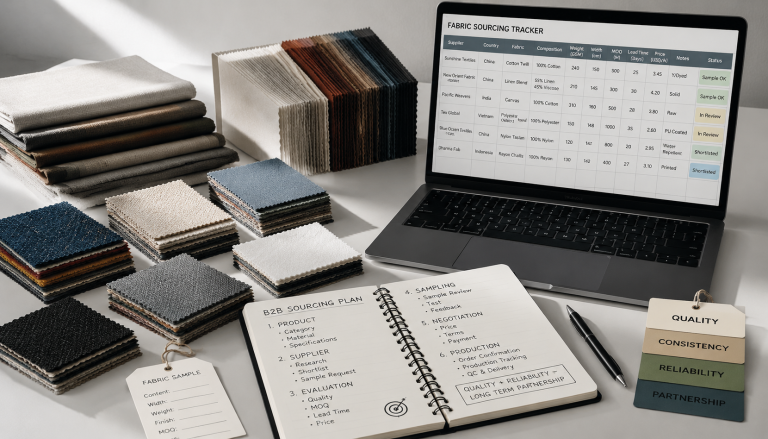
One last thing: I still keep a spreadsheet of every supplier interaction, every quote, every lesson learned. It’s messy, it’s personal, and it’s invaluable. Maybe start your own. You’ll thank yourself later.