Address
Nanlang Industrial Zone, Xingtan Town, Shunde District, Foshan, Guangdong, China
Work Hours
Mon–Fri, 9:00 AM – 6:00 PM (CST/UTC+8). We aim to respond to all inquiries within 48 hours.

Address
Nanlang Industrial Zone, Xingtan Town, Shunde District, Foshan, Guangdong, China
Work Hours
Mon–Fri, 9:00 AM – 6:00 PM (CST/UTC+8). We aim to respond to all inquiries within 48 hours.
A single gram of sweat-soaked sportswear fabric can harbor over 100,000 colony-forming units of bacteria within just 30 minutes of exercise. That bacterial bloom isn’t just gross; it’s the root cause of the persistent odor, skin irritation, and fabric degradation that drive customer complaints and returns.
Antibacterial fabrics have moved far beyond niche medical applications into mainstream sportswear, underwear, bedding, and everyday apparel. Yet the technology behind these treatments varies enormously.
Choosing the wrong antibacterial treatment means wasted money on a feature that doesn’t perform, potential regulatory non-compliance, or even skin sensitization issues for end consumers. This guide examines the four major antibacterial fabric technologies—silver-ion, bamboo charcoal, chitosan, and nano-zinc oxide—comparing their mechanisms, efficacy, durability, and ideal applications.
At a fundamental level, antibacterial treatments operate through two distinct mechanisms. Ionic release treatments shed antimicrobial ions that penetrate bacterial cell walls, disrupting metabolic processes and effectively killing the organism. This is an active defense.
In contrast, contact kill treatments rely on the treated fiber surface physically rupturing bacterial cell membranes upon direct contact, providing a more passive antimicrobial barrier.
Most textile treatments aim for broad-spectrum coverage. You’re looking for effectiveness against Gram-positive bacteria like Staphylococcus aureus, Gram-negative bacteria such as Escherichia coli and Klebsiella pneumoniae, and often some fungi like Candida albicans. It’s worth noting that not all treatments are effective against viruses.
Application methods dictate a lot of the final performance. Pad-dry-cure is the industry workhorse, where fabric passes through a chemical bath and is dried and cured. Exhaust dyeing integrates the treatment during the dyeing process. Coating or spray methods apply the finish to the surface, which is generally less durable. Fiber modification integrates the treatment during extrusion; this is the most durable option but comes at a higher cost.
There’s also a semantic distinction that matters for marketing and compliance. “Antibacterial” specifically targets bacteria, while “antimicrobial” is broader, encompassing fungi and some viruses. Most sportswear treatments fall under the antibacterial category, whereas medical textiles often require full antimicrobial coverage.
I always remind clients that moisture management is the first line of defense against odor. Bacteria thrive in damp environments, so pairing a finish with good wicking is non-negotiable. If you haven’t optimized the moisture profile of your fabric, even the strongest antibacterial treatment will struggle. Read more about moisture-wicking fabrics and odor control to understand how these functions interact.
Micro-note: I once saw a brand push a heavy coating finish on a lightweight knit; the fabric lost all its drape and the coating flaked off after three washes. Application method has to match the hand feel requirements.
| Method | Durability | Cost | Best For |
| Fiber Modification | Excellent | High | Performance/Medical |
| Pad-Dry-Cure | Good | Medium | General Sportswear |
| Coating/Spray | Low | Low | Decorative/Short-life |
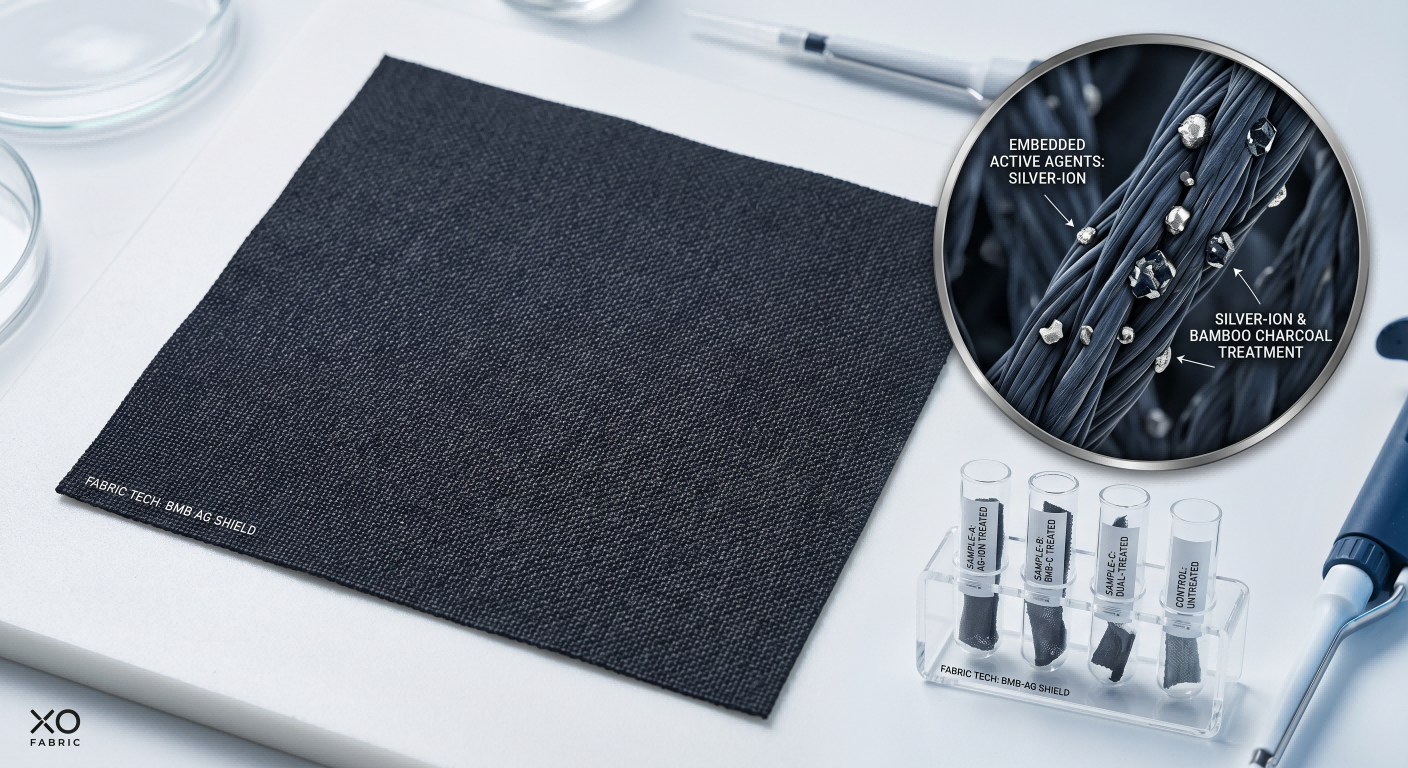
Silver ions (Ag+) bind to bacterial cell walls, disrupt membrane permeability, and penetrate the cell to interfere with DNA replication and enzyme function. The brilliance of silver is its multi-target action. Bacteria find it nearly impossible to develop resistance because the ions attack multiple biological pathways simultaneously.
In terms of efficacy, silver-ion consistently delivers a 99.9% bacterial reduction, known as a 3-log reduction, against standard test strains. It works effectively at very low concentrations, typically between 10 and 100 ppm on the fabric. This performance comes from both ionic release and contact mechanisms working in tandem.
Industrial application usually involves pad-dry-cure using silver-ion microcapsules, often based on silver-zirconium phosphate or silver chloride carriers bound to fibers with a polymer resin. For the highest performance, silver can be integrated into synthetic fibers during extrusion using a masterbatch method.
Wash durability is where silver truly shines. Standard treatments maintain 80 to 90% efficacy after 50 washes. Fiber-integrated versions push this even further, maintaining over 95% efficacy after 100 washes. This is currently the most wash-durable antibacterial technology available.
Cost-wise, expect a premium of $0.80 to $2.50 per meter for standard treatments. Fiber-integrated versions command $2.00 to $4.00 per meter. Safety is generally well-regulated; silver is GRAS by the FDA for textile use. Argyria, a skin discoloration condition, is a rare concern only at extremely high concentrations not found in textile treatments. OEKO-TEX Standard 100 Class II permits silver in textiles.
One practical tip for designers: Silver treatments are usually colorless, so they won’t alter the shade of your fabric. However, if the silver loading is extremely high, you might see a very slight yellowing on light pastels. Always check the swatch under neutral lighting.
Bamboo charcoal is produced by pyrolyzing bamboo at temperatures exceeding 800°C. The result is a highly porous structure with a massive surface area, sometimes reaching 300 m²/g. This structure adsorbs odor molecules and moisture physically. Antibacterial action comes from natural minerals like potassium and calcium released from the charcoal, along with the physical entrapment of microorganisms.
Efficacy ranges from 70 to 90% reduction against common bacteria. It’s less potent than silver-ion or zinc oxide, but for everyday applications where odor control is the primary goal rather than clinical sterilization, it’s often more than sufficient.
The real draw here is the multi-functionality. Bamboo charcoal adsorbs odors directly, absorbs moisture, and offers far-infrared emission properties. The circulation claims around far-infrared are debated, but the odor and moisture benefits are solid.
Application typically involves blending bamboo charcoal powder into polyester staple fiber during extrusion, usually at 2 to 5% content. Surface coatings are possible but less durable.
Durability tracks with the application method. Fiber-integrated versions hold 60 to 75% efficacy after 50 washes. Surface coatings degrade faster, often dropping below 50% efficacy after just 20 to 30 washes. The cost advantage is notable, with premiums ranging from $0.40 to $1.50 per meter.
There is a major design constraint you need to watch. Bamboo charcoal makes the fiber dark gray or black. You cannot produce white bamboo charcoal fabric. If your design calls for light colors, this technology is off the table unless you accept a heathered dark look.
Micro-note: I’ve noticed that bamboo charcoal blends can sometimes have a slightly gritty hand feel if the particle size isn’t controlled, so always request a swatch before approving a bulk order.
Chitosan is derived from chitin found in crustacean shells, primarily shrimp and crab. Its polycationic molecular structure is key. It interacts with the negatively charged bacterial cell membranes, causing leakage of intracellular components. This mechanism makes it particularly effective against Gram-negative bacteria and fungi, though efficacy against Gram-positive bacteria like S. aureus is more moderate, usually sitting between 60 and 75%.
Reduction rates hit 80 to 95% against E. coli and K. pneumoniae. It’s also a standout performer against fungi and yeast, which opens up interesting applications in intimate apparel or sports socks.
Application happens via pad-dry-cure from a dilute acetic acid solution. Crosslinking agents like citric acid or BTCA are often added to improve wash fastness. Chitosan works best on cellulose fibers like cotton, rayon, or bamboo because of hydrogen bonding capabilities.
Without crosslinking, durability is poor, dropping to 50 to 70% efficacy after 30 washes. With proper crosslinking, you can maintain 70 to 85% efficacy over the same period. Still, it’s generally less durable than silver-ion options.
There’s a critical consideration here: shellfish allergens. While the protein content is usually negligible, the regulatory and perception risks mean you may need allergen labeling, especially in medical or baby textile applications. The premium sits around $0.50 to $1.20 per meter.
Case Study: The Baby Brand Dilemma
A few years ago, I worked with a brand launching a line of organic cotton bibs for sensitive skin. Their initial instinct was silver-ion for durability, but their marketing team pushed back hard. They were worried parents might view silver as a “heavy metal” and fear skin absorption, despite the safety data.
We pivoted to chitosan because it felt more “natural” to the consumer base. However, chitosan has lower durability, and these bibs would be washed constantly. We ran trials comparing uncrosslinked chitosan against a version crosslinked with citric acid. The uncrosslinked version failed the 20-wash test miserably, dropping below 60% efficacy.
The crosslinked version performed well, but the citric acid changed the hand feel slightly, making the fabric a fraction stiffer. We had to do a balancing act. We optimized the citric acid concentration to just enough to pass 30 washes without ruining the softness. It required three rounds of lab dips to get the pH and crosslink density right.
The final decision was chitosan with light crosslinking. We accepted a slightly lower durability claim compared to silver but won on the “natural antibacterial” narrative. It taught me that sometimes the “best” technical spec isn’t the right commercial choice if it alienates your audience. You have to weigh the science against the story.
Zinc oxide nanoparticles, typically ranging from 20 to 100 nm in size, operate by generating reactive oxygen species (ROS) under UV light. These ROS damage bacterial cell membranes and DNA. The nanoparticles also provide a physical barrier through surface roughness that can trap and disrupt microbes.
Efficacy is impressive, often achieving 90 to 99% reduction against both Gram-positive and Gram-negative bacteria. Performance actually improves under UV exposure, making it highly effective in sunlight or indoor environments with UV components. As a bonus, zinc oxide provides UV protection equivalent to SPF 15 to 30.
Application methods include in-situ synthesis on the fabric surface, pad-dry-cure with nanoparticle dispersions, or coating with ZnO-sol-gel. It adheres well to cotton, polyester, and blends.
Durability depends heavily on the binding. With proper crosslinking agents, you can see 70 to 85% efficacy after 50 washes. Sol-gel applications tend to show the best retention.
Regulatory landscape is shifting. Zinc oxide is generally permitted under OEKO-TEX Standard 100, but there are growing concerns in the EU under REACH regarding nanoparticle release during washing. If you’re selling in European markets, keep a close watch on the latest regulations. Costs range from $0.60 to $2.00 per meter.
| Feature | Nano Zinc Oxide | Silver-Ion |
| Mechanism | ROS / Contact | Ionic / Contact |
| UV Benefit | Yes (SPF 15-30) | No |
| Efficacy | 90-99% | 99.9% |
| Durability | 70-85% (50 washes) | 80-95% (50 washes) |
You can’t manage what you don’t measure, and in antibacterial textiles, testing standards are non-negotiable. ISO 20743:2009 is the international benchmark. It outlines three methods: absorption, transfer, and printing. Results are reported as an antibacterial activity value (A value). An A value of ≥ 2.0 indicates a significant antibacterial effect, corresponding to a 99% reduction.
In the US, AATCC 100:2019 is the go-to standard. This method is quantitative. Fabric is inoculated with a known bacterial concentration, incubated for 24 hours, and then bacteria are eluted and counted. Results come out as percentage reduction. A reduction of ≥99% is classified as antibacterial, while ≥99.9% is strongly antibacterial.
For the Japanese market, you’ll need JIS L 1902:2015, which mirrors ISO 20743 and uses the same A value system. AATCC 147:2020 offers a qualitative zone of inhibition test, which is great for quick screening but doesn’t provide the quantitative data needed for serious claims.
Durability testing is equally important. Performance must be verified after wash cycles. Standard protocols test after 5, 10, 20, and 50 washes using methods like ISO 105-C06 or AATCC 61. Always demand reports that show efficacy at each wash interval, not just “new” fabric performance.
If you are reviewing test reports and see only an “A value” without the wash data, ask for the full package. Some labs will test the initial performance but skip the wash durability to save time, which leaves you guessing about real-world performance.
Wash durability is the single most important performance differentiator. A treatment that loses efficacy after 10 washes is commercially useless for sportswear or underwear, where washing happens frequently.
Ranking the technologies by durability gives a clear hierarchy. Fiber-integrated silver-ion sits at the top, followed by pad-dry-cure silver-ion. Nano zinc oxide applied via sol-gel comes next. Crosslinked chitosan follows, then fiber-integrated bamboo charcoal. Uncrosslinked chitosan and bamboo charcoal coatings are less durable, with surface-applied zinc oxide at the bottom.
Several factors influence how long a treatment lasts. Binder quality plays a huge role; silicone binders often outperform acrylics in flexibility and retention. Curing temperature and time must be precise. Fabric construction matters too; tighter weaves or knits tend to retain treatments better than loose structures. Wash conditions, including detergent type, temperature, and mechanical action, will always accelerate degradation.
Realistic expectations are key. Even the best treatments show a gradual decline. If a treatment achieves 99.9% reduction new and maintains 95% after 50 washes, that’s excellent performance. Be wary of “lifetime antibacterial” claims unless they are backed by specific, rigorous test data showing retention over a defined number of washes.
Troubleshooting Checklist: Treatment Failing Wash Test
Sweat, warmth, and friction create the perfect storm for bacterial proliferation in sportswear. Bacteria like Corynebacterium and Staphylococcus metabolize sweat components to produce volatile organic compounds, resulting in that persistent “gym odor” that survives normal washing.
For sportswear, silver-ion is the dominant choice due to its broad efficacy and superior durability. Nano zinc oxide is also popular, offering dual benefits of antibacterial action and UV protection. These two technologies cover the vast majority of performance applications.
Application strategy can impact cost. Compression garments and base layers often receive full-body treatment. For lifestyle sportswear, targeted treatment in high-sweat zones like underarm panels, back panels, or crotch linings can deliver odor control while reducing the cost premium.
Marketing claims must be precise. “Antibacterial” claims should reference specific test results, such as “99.9% reduction of S. aureus per AATCC 100, maintained after 50 washes.” Vague terms like “odor-fighting” face less scrutiny but lack credibility with informed buyers.
Antibacterial finishes are frequently combined with moisture-wicking and water-repellent treatments to create multi-functional fabrics. If you are building a technical line, understanding how these finishes interact is crucial. Sometimes DWR finishes and antibacterial treatments compete for binding sites, so sequencing matters. Check out choosing fabrics for a sportswear collection for guidance on balancing functions, and read about fabric’s role in sports performance to see how antibacterial treatments contribute to overall athlete comfort.
Micro-note: I’ve seen brands save money by only treating underarm panels, which works well, but they have to ensure the seam between treated and untreated fabric doesn’t show a visible line or hand feel difference.
Medical textiles operate in a different league. The requirements are stringent: efficacy must be ≥99.9% (3-log reduction), coverage must be broad-spectrum including fungi, and durability must withstand minimum 50 industrial washes at temperatures between 70 and 90°C.
Silver-ion, specifically fiber-integrated versions, is the dominant technology here. Nano zinc oxide is also used, particularly in wound dressings where it promotes healing and provides UV protection.
Product applications range from hospital bedding, patient gowns, and surgical scrubs to wound dressings, bandages, compression stockings, and face mask interlayers.
Regulatory compliance is complex. You may need CE marking under the EU Medical Device Regulation (MDR) or FDA 510(k) clearance for medical devices in the US. Biocompatibility testing per ISO 10993 is required for any textile contacting skin in a medical context.
Antibacterial fabrics in medical settings must also survive sterilization. This means withstanding autoclaving at 121°C, gamma irradiation, or ethylene oxide treatment without losing efficacy. Not all treatments can handle this; always verify sterilization compatibility early in development. I’ve seen silver microcapsules rupture under gamma irradiation, so fiber-integrated is safer for that route.
Prolonged skin contact, warmth, and moisture in intimate apparel create conditions ripe for bacterial and fungal growth. This can lead to odor, skin irritation, and potential infections like candidiasis.
Bamboo charcoal is often preferred here because the “natural” positioning appeals to health-conscious consumers. Chitosan is also a strong candidate due to its excellent antifungal properties. Silver-ion is used for premium or medical-grade products where maximum efficacy is required.
Skin safety is paramount. Treatments must be non-irritating, non-sensitizing, and non-cytotoxic. OEKO-TEX Standard 100 Class I, the baby-safe certification, is the gold standard for intimate apparel.
Marketing angles vary. “Natural antibacterial” resonates with eco-conscious buyers, while “clinically proven” appeals to those seeking performance and health benefits. Choose the technology that aligns with your brand’s story.
There’s a distinction that often causes confusion: antibacterial versus anti-odor. Antibacterial treatments kill or inhibit bacteria and can be tested with standards like ISO 20743 or AATCC 100.
Anti-odor approaches reduce odor, which may or may not involve killing bacteria. Methods include antibacterial action, odor adsorption using materials like activated carbon or bamboo charcoal to trap volatile compounds, or odor neutralization via chemical reactions with molecules, such as cyclodextrins.
Some technologies bridge both worlds. Silver-ion kills bacteria and their odor byproducts. Bamboo charcoal adsorbs odor molecules while also inhibiting bacterial growth.
Buyer beware: A fabric labeled “anti-odor” might not be antibacterial at all. It could simply have an odor-adsorbing coating. Always verify claims with specific test data to ensure you’re getting the performance you need.
Compliance landscape is fragmented. OEKO-TEX Standard 100 classifies textiles by risk. Class I has the strictest limits on silver, zinc, and other chemicals, making it essential for baby products. Class II covers direct skin contact, Class III no direct contact, and Class IV decorative. Your antibacterial textile must be certified to the appropriate class.
In the US, EPA registration under FIFRA is required for articles claiming public health benefits, such as killing disease-causing bacteria. This is a heavy regulatory burden. Many sportswear brands sidestep this by making “odor control” claims instead of antibacterial claims.
The EU Biocidal Products Regulation (BPR) operates similarly, requiring active substance approval for treated articles claiming antibacterial properties. In the Nordics, the SEK marking is common, based on ISO 20743 with a minimum A ≥ 2.0 after 10 washes.
Labeling requirements vary by jurisdiction. Some regions mandate specific test method citations on labels. Always check local regulations before making claims. For a broader overview, consult our fabric certifications guide.
XO Fabric offers silver-ion, bamboo charcoal, and zinc oxide antibacterial treatments across its knit and woven ranges. Treatment selection is guided by your target application, budget, and certification needs.
Every antibacterial fabric comes with third-party test reports showing performance on new fabric and after 20 and 50 washes. Reports specify the bacterial strains tested, ensuring transparency.
We also support custom development. If you need a fabric that combines antibacterial protection with moisture-wicking, water-repellency, or UV protection, we can engineer those multi-functional finishes.
Quality assurance is handled in-house. Our testing lab monitors every production lot for antibacterial efficacy, ensuring batch-to-batch consistency. You can learn more about our facilities on the inside production tour or read about our quality control process.
Cost premiums vary by technology. Silver-ion ranges from $0.80 to $4.00 per meter. Bamboo charcoal is $0.40 to $1.50. Chitosan sits at $0.50 to $1.20, and zinc oxide is $0.60 to $2.00. These figures fluctuate based on fabric base, concentration, and application method.
The ROI can be strong. Antibacterial fabrics often command a 15 to 30% retail price premium in sportswear. Customer satisfaction and repeat purchase rates improve when odor control claims are substantiated.
Antibacterial treatment is worth the investment for sportswear, medical textiles, underwear, travel clothing, and workwear where hygiene or odor control drives purchase decisions.
It may not be worth it for fashion items washed infrequently, home decor, or budget categories where the treatment premium erodes margin without clear consumer benefit.
Choosing the right technology depends on your priorities. For cost-sensitive sportswear, bamboo charcoal offers natural antibacterial and odor adsorption at the lowest cost. For premium performance, silver-ion delivers the best efficacy and durability. In medical applications, fiber-integrated silver-ion is essentially non-negotiable.
Working with a supplier who can help you balance cost and performance is valuable. See advantage as a partner for insights on cost-optimized solutions.
Silver-ion remains the most effective and durable antibacterial technology for textiles. Bamboo charcoal provides a natural, cost-effective solution for everyday odor control. Always demand specific test data, including ISO 20743 or AATCC 100 results, along with wash durability proof. Regulatory compliance with OEKO-TEX, EPA, and EU BPR is critical, as unsubstantiated claims create liability.
Contact us to request antibacterial fabric samples with test reports, or discuss custom functional fabric development for your brand.
The landscape of antibacterial textiles is evolving rapidly. Nanotechnology is advancing, regulatory scrutiny is tightening, and consumer expectations for both performance and sustainability are rising. The key to success lies in understanding the mechanics of each technology, validating claims with rigorous testing, and aligning your fabric choices with the real-world needs of your end users. Don’t just treat fabric; solve the problem.