Address
Nanlang Industrial Zone, Xingtan Town, Shunde District, Foshan, Guangdong, China
Work Hours
Mon–Fri, 9:00 AM – 6:00 PM (CST/UTC+8). We aim to respond to all inquiries within 48 hours.

Address
Nanlang Industrial Zone, Xingtan Town, Shunde District, Foshan, Guangdong, China
Work Hours
Mon–Fri, 9:00 AM – 6:00 PM (CST/UTC+8). We aim to respond to all inquiries within 48 hours.
Deadstock Fabric: Pros, Cons & When It Fits Your Production. This guide covers key properties, real-world applications, and a practical sourcing checklist for B2B buyers.
A mid-size apparel brand in Berlin ordered 12,000 metres (13,123 yd) of “deadstock” nylon from a broker in 2023. The price was 40 % below greige-goods market rate. Three weeks later, the shipment arrived with inconsistent dye-lots across 30 % of the rolls, no test reports, and a supplier who had already dissolved his company. The brand’s spring line shipped two months late.
That story sticks with me because it is not rare. It is a cautionary tale that plays out every quarter across the global textile trade. Deadstock fabric pros and cons are not abstract—they are the daily reality for sourcing managers balancing tight margins against unpredictable supply chains.
This article unpacks when deadstock fabric is a smart procurement move—and when it becomes a liability.
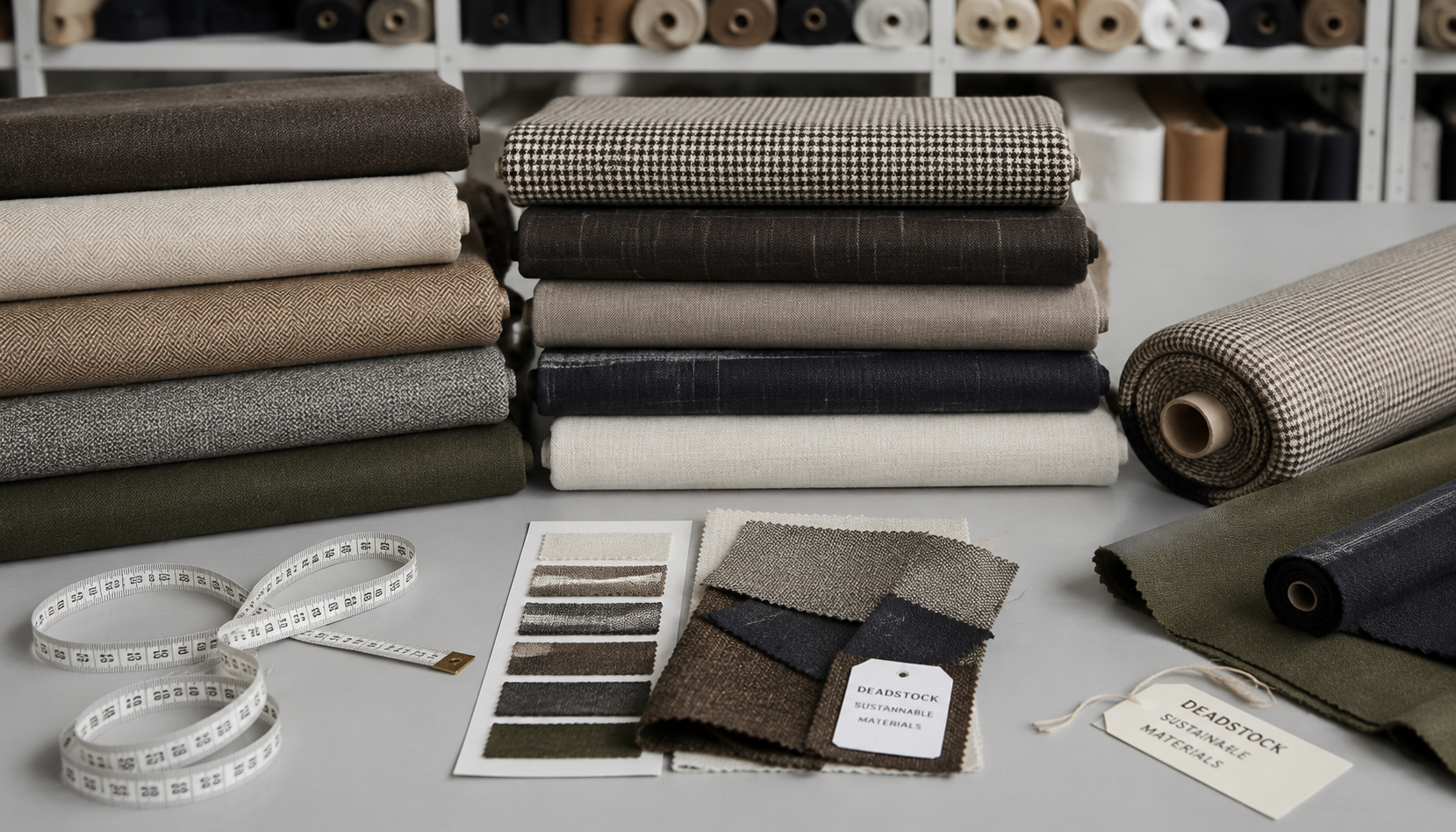
First, let us clarify what is deadstock fabric in a professional context. The term covers three distinct origin categories, and the source matters enormously for quality predictability.
Mill overruns occur when a weaving or dyeing campaign produces more fabric than the original purchase order required. These lots typically come from a single production run, which means composition, dye-lot, and finish are consistent across the entire quantity. Of the three categories, these carry the lowest quality risk.
Brand-canceled POs are fabrics originally commissioned by a brand or retailer that later canceled the order. The mill is left holding goods that were produced to a specific technical specification. Quality is usually high, but documentation may be incomplete if the original buyer retained the test reports.
Design-sample surplus includes fabric developed for sampling, trade shows, or prototype rounds. Quantities are small—often 50 to 200 metres (55 to 219 yd)—and the lots may be one-of-a-kind. Re-orderability is essentially zero.
Understanding these three origins is the first step in evaluating deadstock fabric pros and cons for your specific production needs.
The scale of textile surplus globally is staggering. According to the UNEP Sustainability and Circularity in Textiles report, an estimated 92 million tonnes of textile waste is generated annually worldwide. A meaningful portion of that figure represents pre-consumer surplus—fabric that was never cut, sewn, or sold to an end consumer.
For B2B buyers, this surplus represents a commercial opportunity: access to quality materials at significantly reduced cost. But the opportunity comes with a caveat. The deadstock market is fragmented, poorly regulated, and heavily reliant on the integrity of intermediaries.
| Origin Type | Typical Volume per Lot | Quality Consistency Risk |
|---|---|---|
| Mill Overrun | 1,000–10,000 m (1,094–10,936 yd) | Low — single production campaign |
| Brand-Canceled PO | 500–5,000 m (547–5,470 yd) | Medium — documentation may be incomplete |
| Design-Sample Surplus | 50–200 m (55–219 yd) | Variable — often untested at scale |
There is a persistent misconception in the market that deadstock implies seconds or defects. It does not. Professional mills and liquidators use a grading system—typically A, B, and C grade—to classify surplus fabric.
A-grade deadstock meets the original mill specification in full: correct composition, weight within tolerance, no visible flaws, and complete documentation. This is the category most B2B buyers should target.
B-grade may have minor cosmetic inconsistencies—slight shade variation between rolls, minor weaving faults that do not affect structural integrity, or incomplete test documentation.
C-grade is where defects genuinely appear. These lots are typically sold at deep discount to markets with lower quality requirements or for non-apparel applications like cleaning textiles or industrial use.
The question of “is deadstock good or bad” really depends on which grade you are buying and from whom. A verified mill grading its own surplus will always be more reliable than a broker who acquired the goods through three intermediaries.
The headline benefit of deadstock fabric is price. Typical discounts range from 30 % to 60 % below current greige-goods market rates. The economic logic is straightforward: the mill has already absorbed the production cost as a sunk cost. There is no R&D amortization, no custom dyeing campaign, and no minimum-order negotiation. The mill is recovering cash on goods that would otherwise sit in a warehouse depreciating.
Consider a hypothetical order of 5,000 metres (5,470 yd) of 100 % polyester microfiber, 75-Yarn Count Converter, 150 cm (59 in) wide.
| Scenario | Price per Metre (USD) |
|---|---|
| Fresh-mill greige goods (custom order) | $1.80–$2.20 |
| Deadstock lot (A-grade, verified documentation) | $0.90–$1.40 |
On a 5,000-metre order, that differential translates to $4,000–$5,000 in raw-material savings. For a small brand running a capsule collection, that is the difference between profitability and break-even. These are the core benefits of deadstock fabric that attract buyers in the first place.
The environmental argument for deadstock is genuine—up to a point. Every metre of surplus fabric diverted from landfill or incineration represents avoided waste. For brands marketing a sustainability position, deadstock sourcing offers a tangible, story-ready claim.
But here is where I get cautious. Without verified chain-of-custody documentation, the sustainability claim is unverifiable. A broker telling you “this fabric would have been thrown away” is not the same as a mill providing a documented surplus certificate with production date, lot number, and original buyer reference.
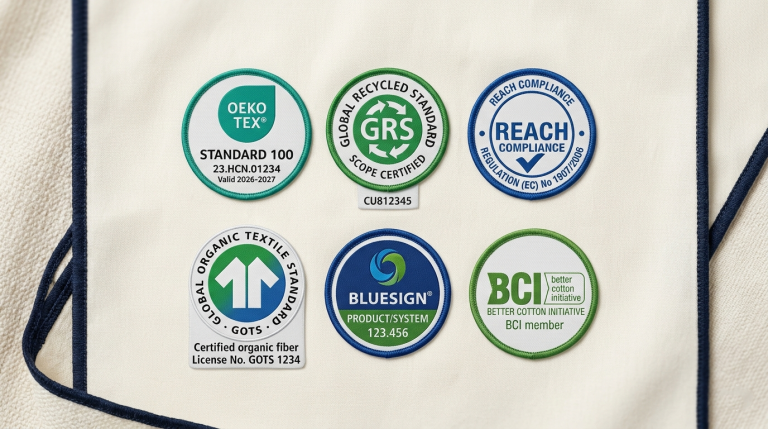
The Global Recycled Standard (GRS) 4.0 provides a certification framework for verifying chain-of-custody on surplus textiles, including deadstock. If your brand is making public sustainability claims based on deadstock sourcing, GRS certification—or at minimum, mill-level documentation—is not optional. It is the floor.
This is where the deadstock fabric pros and cons conversation gets uncomfortable. The 40 % discount on paper can evaporate—and sometimes reverse—when hidden costs surface. I have seen it happen more than once.
When these hidden costs surface mid-project, buyers often need rapid technical consultation to assess whether the lot is salvageable or should be rejected. For those moments, direct access to an experienced export and engineering team can save days of back-and-forth. If you are facing hidden-cost issues or need rapid spec clarification on deadstock lots, the technical consultation channel at XO Fabric connects you with engineers who understand both the fabric and the logistics.
A European outdoor brand needed 8,000 metres (8,749 yd) of 40-denier ripstop nylon for jacket liners. A broker offered deadstock at 45 % below current market—roughly $1.10 per metre instead of $2.00. The brand’s procurement lead saw an opportunity to hit margin targets on a mid-tier product line.
Here is where it got complicated. The brand’s R&D spec required a consistent C6 DWR (durable water-repellent) finish across the entire lot, with a minimum spray rating of 80 on the AATCC 22 test. The deadstock rolls, however, came from two different dyeing campaigns with unknown finish history. The broker could not provide finish documentation because he had acquired the goods through a liquidation auction.
The brand accepted the lot without pre-shipment testing. That was the first mistake.
On the first production run, QC testing revealed water-repellency variance ranging from 20 to 80 spray rating across rolls. Some rolls performed beautifully. Others absorbed water like kitchen towels. The inconsistency meant the brand could not use the fabric for any application where DWR was a functional requirement—which was the entire purpose of the liner.
The team then paid for third-party lab testing on 15 % of the rolls, adding approximately $0.12 per metre to the effective cost. Even after testing, they could not achieve uniform specification across the lot. The rolls from Campaign A had a different DWR chemistry than Campaign B, and re-finishing was not economically viable at this volume.
The compromise: the brand used the deadstock for non-critical internal linings—pocket bags, internal wind flaps—where DWR performance was cosmetic only and not subject to consumer-facing claims. They then sourced a fresh-mill run of 3,000 metres (3,281 yd) of 40-denier ripstop with verified C6 DWR for the outer shell panels.
Total project cost rose 18 % over the original deadstock-only plan. But the product line shipped on time, and the brand avoided a potential warranty nightmare.
This case illustrates the central tension in deadstock fabric pros and cons: you can have cost savings or spec certainty, but rarely both simultaneously. The smart move is knowing which one matters more for each component of your product.
Before you commit to a deadstock purchase, demand a documentation packet. If the seller cannot provide these documents, walk away—regardless of the price.
| Document | What It Proves | Risk If Missing | Typical Lab Cost to Re-test |
|---|---|---|---|
| Mill Test Report | Composition, weight (GSM), shrinkage rate | Unknown fiber content; potential mislabeling | $100–$200 |
| Dye-Lot Certificate | Shade consistency within the lot | Color variation across rolls; production delays | $50–$80 per shade group |
| OEKO-TEX or RSL Report | Chemical compliance for EU/US markets | Regulatory non-compliance; seizure at customs | $300–$500 |
| Country-of-Origin Declaration | Trade compliance; duty rate eligibility | Incorrect tariff classification; duty penalties | N/A — administrative |
I personally will not proceed with a deadstock lot that lacks at least the mill test report and dye-lot certificate. The OEKO-TEX report I can sometimes commission independently if the savings are large enough, but missing composition data is a deal-breaker. You cannot verify what you cannot measure.
Documentation tells you what the fabric should be. Physical inspection tells you what it actually is. I recommend a simple but rigorous protocol before committing to any deadstock lot.
Request three rolls from different pallet positions—not three rolls from the same pallet. Pallet grouping often reflects production sequence, so adjacent rolls may share the same dye-lot while rolls from different pallets reveal true lot-wide variation.
On each roll, check the following:
This is the section where I get genuinely concerned about buyer risk. Deadstock fabric from unknown mills may carry higher chemical risk than fresh production, and here is why.
When a mill produces fabric under a brand contract, the brand’s compliance requirements (typically aligned with EU REACH SVHC Candidate List, California Prop 65, or CPSIA for children’s products) drive the mill’s chemical management. The mill knows it must test and certify.
When that same mill produces overruns or when a brand cancels a PO, the compliance pressure disappears. The mill may not have tested the surplus lot at all, or may have tested it against a less stringent internal standard. The fabric is physically identical, but the compliance documentation may be absent or incomplete.
For buyers importing into the EU, this is not a theoretical risk. EU customs authorities can request RSL test reports at the border. Without one, your shipment sits in a bonded warehouse while you scramble to commission testing—a process that takes 7–14 business days and costs $300–$500 per lot.
The question of “what is the unhealthiest fabric to wear” is not really about the fabric type—it is about the chemical management process behind it. A deadstock nylon from a certified mill with full RSL testing is safer than a fresh-production cotton from an untested source.
Deadstock fabric makes strategic sense when your project fits this profile:
Equally important is knowing when deadstock is the wrong choice. Walk away if your project involves any of the following.
Regulated end-products such as children’s wear (CPSIA compliance), medical textiles (ISO 10993 biocompatibility), or PPE (EN/ISO certification). These markets require full traceability from fiber to finished product. Deadstock’s fragmented provenance makes traceability nearly impossible.
Color-critical programs requiring re-orderability. If your product line depends on a specific Pantone match that must be reproduced across multiple seasons, deadstock is a dead end. You will not be able to reorder the same shade.
Large-volume production above 10,000 metres (10,936 yd). At this scale, consistency risk compounds. A 5 % defect rate on a 500-metre order is 25 metres. On a 10,000-metre order, it is 500 metres—enough to disrupt an entire production schedule.
Markets with strict chemical documentation requirements where you cannot independently verify compliance. If the lot lacks OEKO-TEX or equivalent certification and you are not prepared to commission third-party RSL testing, the regulatory risk outweighs the cost savings.
Here is a strategy I have seen work well for brands that want the cost benefits of deadstock without the all-or-nothing risk. Use deadstock for non-critical components—linings, internal pockets, pocket bags, sample development—while sourcing fresh-mill goods for visible or performance-critical panels.
The blended cost advantage typically falls in the 15–25 % range versus sourcing everything fresh. Not as dramatic as the 40–60 % savings on a pure-deadstock approach, but with significantly lower risk and no compromise on the components that matter most.
For buyers exploring this hybrid approach, a verified stock program with graded documentation serves as a lower-risk entry point into surplus fabric sourcing. The stock-program fabrics available through XO Fabric, for example, include lot-level grading, composition verification, and GSM documentation—essentially the due diligence layer that raw deadstock typically lacks.
For buyers who decide deadstock fits their project, here is a practical six-step SOP that minimizes risk at each stage.
Payment structure matters more with deadstock than with fresh-mill orders because the recourse options are narrower. A broker who dissolves his company—as in our Berlin brand example—is not going to honor a warranty claim.
Insist on T/T with 30 % deposit and 70 % against B/L copy or inspection pass. If the order value exceeds $15,000, an L/C at sight provides additional bank-level protection. Avoid 100 % advance payment under any circumstances.
For Incoterms, FOB is generally preferable for deadstock because it gives you control over the freight forwarder and customs broker. DDP can be tempting for simplicity, but it concentrates too much control with the seller—risky when the seller is an intermediary with limited accountability.
HS code classification for surplus textile goods requires particular attention. The same fabric classified as “woven nylon, not dyed” versus “woven nylon, dyed” can attract different duty rates. Ensure your customs broker reviews the classification before shipment, not after.
It depends on three factors: order size, end-use criticality, and documentation availability. For small-to-mid orders (500–5,000 m / 547–5,470 yd) of non-critical components with verified lot documentation, deadstock can deliver genuine cost and sustainability advantages. For regulated products, color-critical programs, or large-volume production, the risk profile typically outweighs the savings. Refer to the decision matrix above for a detailed framework.
The three primary benefits are cost savings (30–60 % below greige market), sustainability positioning (verified landfill diversion with documentation), and speed-to-sample (no dyeing campaign lead time). Each benefit carries a qualification: cost savings are only real after accounting for hidden costs, sustainability claims require chain-of-custody verification, and speed advantage applies only if the deadstock lot matches your spec requirements.
Diverting fabric from landfill or incineration is genuinely positive. However, without verified chain-of-custody documentation, the environmental claim is unverifiable. A broker claiming “this would have been wasted” is not the same as a mill providing documented surplus certificates. For credible environmental claims, seek GRS-certified deadstock or, at minimum, mill-level documentation with production dates and lot references.
Only if the originating mill tested and certified the lot. Deadstock fabric pros and cons in 2022 and beyond are increasingly shaped by regulatory scrutiny—EU customs authorities now routinely request RSL test reports for textile imports. If the deadstock lot lacks a current OEKO-TEX certificate or equivalent RSL report, budget $300–$500 for third-party testing and 7–14 business days for results. Do not assume compliance—verify it.
Deadstock fabric is neither a silver bullet nor a trap. It is a procurement tool with specific strengths—cost, speed, sustainability narrative—and specific weaknesses—consistency, documentation gaps, re-orderability limits. The brands that succeed with deadstock are the ones that treat it with the same rigor they apply to any other sourcing decision: verify the documentation, inspect the goods, understand the end-use requirements, and structure the payment to protect against the inevitable surprises.
The Berlin brand that opened this article learned the hard way. But with the right vetting process, the right documentation demands, and the right expectations, deadstock can be a legitimate and profitable part of your sourcing strategy. The key is knowing when to say yes—and when to walk away.