Address
Nanlang Industrial Zone, Xingtan Town, Shunde District, Foshan, Guangdong, China
Work Hours
Mon–Fri, 9:00 AM – 6:00 PM (CST/UTC+8). We aim to respond to all inquiries within 48 hours.

Address
Nanlang Industrial Zone, Xingtan Town, Shunde District, Foshan, Guangdong, China
Work Hours
Mon–Fri, 9:00 AM – 6:00 PM (CST/UTC+8). We aim to respond to all inquiries within 48 hours.
Fabric Customs Duty When Importing to the USA: HS Codes & Rates. This guide covers key properties, real-world applications, and a practical sourcing checklist for B2B buyers.
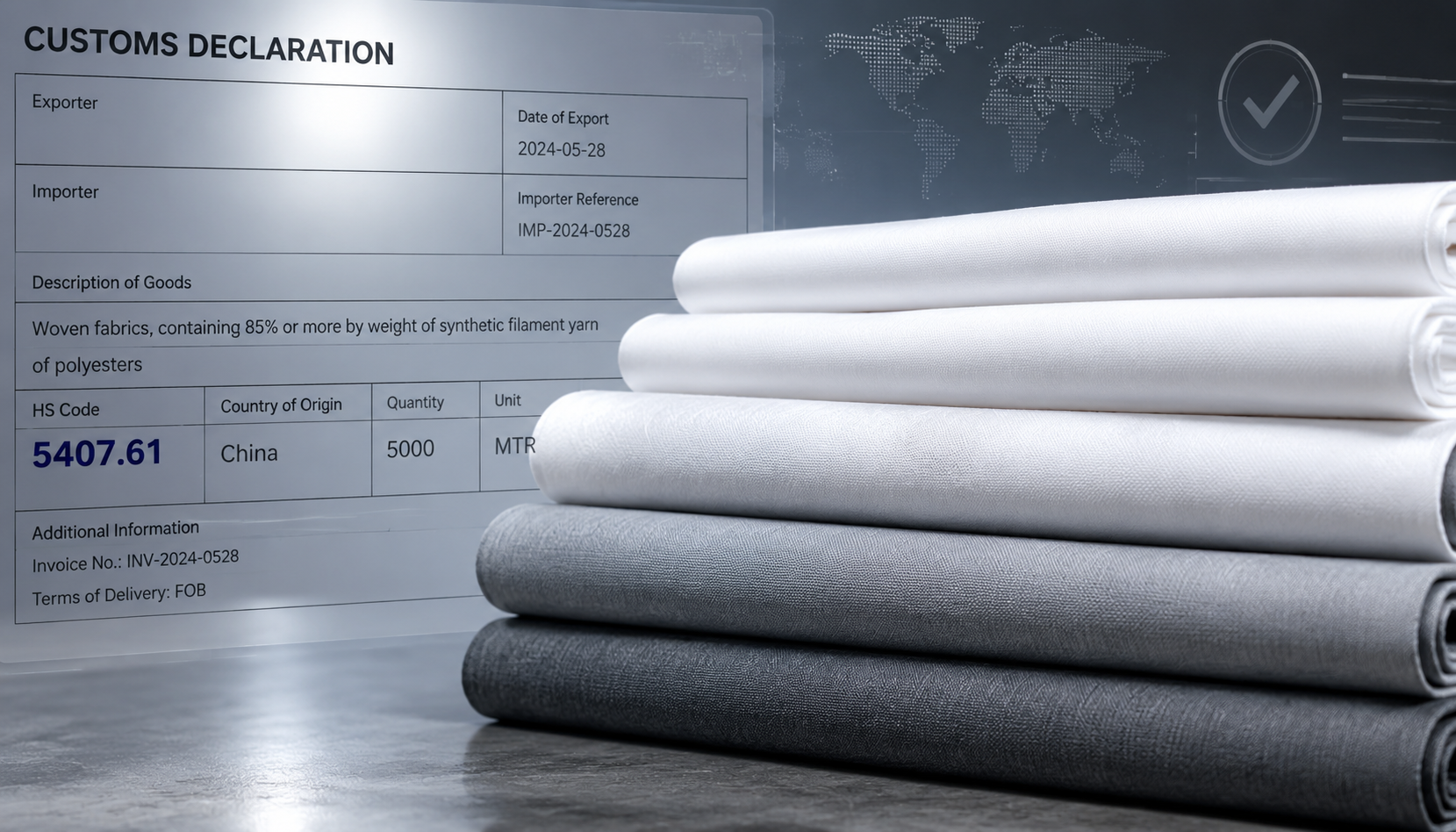
A mid-volume importer in Ohio recently paid 17.6% duty on a container of polyester-spandex power-net fabric — not because the rate was wrong, but because the broker filed under Chapter 60 (knitted fabric) instead of Chapter 59 (coated/impregnated textile). That single HS-code misclassification cost the buyer an extra $4,200 on a $38,000 shipment. This guide walks B2B textile buyers through the exact duty mechanics, classification logic, and import SOP so you never overpay at U.S. Customs again.
When fabric arrives at a U.S. port, CBP doesn’t care what you call it. They care about the Harmonized Tariff Schedule (HTS) code — an 8-digit classification system that determines your duty rate, your compliance obligations, and whether your shipment clears in 24 hours or sits in a bonded warehouse for weeks.
The HTS system works in layers. The first four digits identify the HS chapter and heading — this is the international standard, shared across 200+ countries. The next two digits are the U.S. suffix, narrowing the category. The final two digits are statistical, used for trade data tracking but still part of your official classification.
For textile buyers, three chapters dominate the landscape:
| Chapter | Covers | Typical MFN Rate |
|---|---|---|
| 59 | Coated, impregnated, or laminated textiles (PU-coated fabrics, technical textiles) | 2.7% – 7.6% |
| 60 | Knitted or crocheted fabrics (jersey, mesh, power-net, interlock) | 8% – 16% |
| 63 | Made-up textile articles (garments, home textiles, finished goods) | 7% – 20% |
The problem starts when a single fabric has characteristics that could push it into multiple chapters. A power-net elastic fabric with a polyurethane micro-coating? That’s a knit (Chapter 60) that’s also been impregnated (Chapter 59). The classification depends on whether the coating is considered “substantial” enough to change the fabric’s essential character.
The General Rules of Interpretation (GRI) govern how CBP resolves these conflicts. GRI Rule 3(b) — the “essential character” test — asks: what gives this fabric its identity? Is it the knit structure, or the coating?
For a 90/10 polyester-spandex power-net with a light PU finish, the knit construction is clearly the dominant feature. That fabric lands in Chapter 60, heading 6004.10, at around 12% MFN duty. But if you shift to 80/20 poly-spandex with a heavier coating that changes the hand-feel and moisture-management properties, CBP might argue the coating defines the product — pushing it into Chapter 59, heading 5903.20, at 7.6% MFN.
Same fabric family. Different classification. Different U.S. customs import duty rates. And when you layer Section 301 tariffs on top, those percentage-point differences add up fast on a $40,000 shipment.
Before diving into theory, let’s look at the numbers that actually matter to your purchasing budget. Here’s what B2B textile importers face across the most common fabric categories, including the Section 301 tariff layer that many landed-cost calculators still miss.
| Fabric Type | HTS Chapter | MFN Rate | + Section 301 |
|---|---|---|---|
| Polyester knit (jersey, interlock) | 6006 | 10% | 7.5% |
| Nylon mesh / power-net | 6004 / 6005 | 12% | 7.5% |
| Cotton woven (poplin, twill) | 5208 / 5209 | 7.6% – 12% | 7.5% |
| Spandex blend knit | 6004.10 | 12% | 7.5% |
| PU-coated fabric | 5903.20 | 7.6% | 7.5% |
| Flocked fabric | 5907.00 | 5.8% | 7.5% |
Look at the nylon mesh row. That 12% MFN plus 7.5% Section 301 tariff means you’re paying 19.5% effective duty on every dollar of declared value. On a $100,000 annual import volume, that’s $19,500 in duties alone — before you even touch freight, insurance, or handling fees.
Section 301 tariffs were introduced in 2018 as part of the U.S.-China trade dispute, and they’ve become a permanent feature of the textile import landscape. According to the USTR’s official tariff actions page, List 3 covers most textile products at 25%, though many items have been partially excluded, bringing the effective additional rate to 7.5% for most fabrics.
The critical detail: these tariffs stack on top of your MFN duty rate. They don’t replace it. So a fabric with a 12% MFN rate and 7.5% Section 301 tariff carries a 19.5% effective rate. That’s nearly one-fifth of your declared value going to duties — and it’s the number most first-time importers miss when building their landed-cost models.
When you look up an HTS code, you’ll see three rate columns. Most buyers only check the first one. That’s a mistake.
Column 1 (MFN) applies to World Trade Organization members and countries with Normal Trade Relations status. China, Vietnam, Bangladesh, India — all fall here. This is your baseline rate.
Column 2 applies to countries without MFN status — North Korea, Cuba, and a handful of others. If you’re sourcing from these countries (unlikely for textiles, but worth knowing), rates are significantly higher.
Special/FTA rates apply under free trade agreements. USMCA covers Mexico and Canada. CAFTA-DR covers Central American nations. If your fabric is woven in Guatemala using U.S.-origin yarn, it might qualify for reduced or zero duty under CAFTA-DR. But the rules of origin are strict — the fabric must meet specific “yarn-forward” or “fabric-forward” requirements.
Importing fabric isn’t just about paying duties. It’s a process with hard deadlines, mandatory documents, and penalties for getting it wrong. Here’s the SOP that experienced textile importers follow — and the traps that catch newcomers at every step.
Your customs broker can’t file without the right paperwork, and incomplete documents are the number-one cause of clearance delays. Here’s what you need, and why each piece matters:
The Importer Security Filing — commonly called “10+2” — is a pre-arrival data submission required by CBP. It must be filed at least 24 hours before the vessel loads at the foreign port. Miss that deadline, and you’re looking at a $5,000 penalty per violation.
New importers often assume their freight forwarder handles ISF automatically. Sometimes they do. Sometimes they don’t. The responsibility falls on the importer of record, and if there’s confusion about who’s filing what, the shipment sails without a valid ISF — and you find out when the penalty notice arrives.
Let’s look at what happens when classification goes sideways — not in theory, but in the messy reality of a mid-size activewear brand trying to get product into the country on deadline.
A Los Angeles-based startup ordered 8,000 meters (8,749 yards) of 80/20 polyester-spandex power-net elastic fabric — 135 Fabric GSM Calculator (4.0 oz/yd²), warp-knit construction with a light PU micro-coating — from a Foshan mill for its Spring 2026 sports bra line. The purchasing manager budgeted landed cost assuming a 12% duty rate under Chapter 60, heading 6004.10 (knitted stretch fabrics).
Their customs broker disagreed. The broker argued that the PU coating on the power-net surface pushed the fabric into Chapter 59, specifically HTS 5903.20 (textiles impregnated, coated, or covered), which carries a 7.6% MFN rate. Lower base rate, but the purchasing manager had built their entire cost model around Chapter 60. And the real question was: which classification would CBP accept?
Here’s where the trial-and-error got expensive.
The importer filed under 6004.10 — 12% MFN plus 7.5% Section 301 tariff, for a 19.5% effective rate. CBP issued a CF-28 (Request for Information), questioning the classification and asking for technical documentation on the coating process. The importer scrambled to provide lab reports and mill specifications.
While waiting for CBP’s response, the second shipment arrived at the Port of Long Beach. It was held pending classification resolution. Demurrage charges started accumulating at $85 per day.
After six weeks, CBP issued a binding ruling: the fabric fell under 5903.20 — 7.6% MFN plus 7.5% Section 301, for a 15.1% effective rate. The importer had to file a Post Summary Correction on the first shipment’s entry summary, and the second shipment’s demurrage bill hit $1,275.
| Cost Item | Chapter 60 (Wrong) | Chapter 59 (Ruling) |
|---|---|---|
| Duty on $38,000 shipment | $7,410 (19.5%) | $5,738 (15.1%) |
| Demurrage (port holding) | $0 | $1,275 |
| Broker / ruling fees | $0 | $850 |
| Net impact | — | -$1,672 duty saved, +$2,125 in delays |
The net result? Short-term pain: $2,125 in demurrage and broker fees. Long-term gain: $1,672 saved per shipment going forward at the lower 15.1% effective rate. The break-even came on the second shipment after the ruling.
The lesson here isn’t that Chapter 59 is “better” than Chapter 60. It’s that you must resolve classification before your first shipment sails. A binding ruling request to CBP is free. It takes 6–8 weeks. And it eliminates the guesswork that leads to CF-28s, port holds, and demurrage charges. For any fabric with coating, lamination, or finishing that could shift its HTS chapter, filing a proactive binding ruling is the single most cost-effective step in the entire import process.
You can review past CBP rulings on similar fabrics through the CBP Binding Ruling Online Search database before filing your own — it’s a useful way to see how CBP has classified comparable textiles in previous cases.
Duty rates feel fixed, but your effective tax burden isn’t. There are legitimate, fully legal strategies that can shave 15–30% off your annual textile import duty bill. The catch: most require planning before you place the order, not after the goods arrive at port.
If your supply chain includes a trading company or intermediary, you’re probably paying duty on the middleman’s price — not the factory’s. The First Sale rule lets you declare the manufacturer’s original invoice price as the customs value, provided you can prove the transaction meets CBP’s requirements: a bona fide sale, arm’s-length pricing, and clear documentation of the factory-to-intermediary-to-importer chain.
For a typical textile import with a 20–30% trading company markup, First Sale valuation can reduce your duty base by that same percentage. On a $50,000 shipment at 19.5% effective duty, that’s $1,950–$2,925 saved per shipment.
The documentation requirement is the barrier. You need the factory’s original invoice, a relationship disclosure between all parties, and proof that the intermediary didn’t alter the goods. B2B buyers evaluating direct-from-mill sourcing to eliminate middleman markups and simplify First Sale documentation can request a factory-direct quote with full production-chain transparency — useful for First Sale valuation documentation.
Getting the duty rate right is only half the equation. The other half is staying compliant — because CBP penalties for textile imports can dwarf the duties themselves.
| Risk | Consequence | Prevention |
|---|---|---|
| HS code misclassification | 3–8% duty variance; CF-28 delays | Binding ruling before first shipment |
| UFLPA violation (cotton) | Shipment seizure; import ban | Full supply-chain audit documentation |
| FTC labeling violations | Fines up to $16,000/violation | Verify fiber content + country of origin labels |
| Anti-dumping duties | Additional 10–300% duties on specific goods | Check Commerce Department AD/CVD orders |
| ISF late filing | $5,000 penalty per violation | Confirm filing responsibility before booking |
The Uyghur Forced Labor Prevention Act, enforced by CBP and detailed on CBP’s official UFLPA page, creates a “rebuttable presumption” for all goods produced in whole or in part from Xinjiang cotton. That means any fabric containing cotton is automatically presumed to involve forced labor — and the burden of proof falls entirely on the importer.
To clear a cotton or cotton-blend fabric shipment, you need a complete chain of custody: Transaction Certificates tracing the cotton from farm to spinning to weaving to dyeing. For most B2B buyers, this documentation burden makes synthetic fabrics — polyester, nylon, spandex blends — the safer sourcing choice. They sidestep UFLPA entirely.
US textile imports by country data shows a clear shift: buyers are moving cotton orders to India, Turkey, and Central America, while ramping up synthetic fabric sourcing from China, Vietnam, and Taiwan. The UFLPA didn’t create this trend, but it accelerated it significantly.
There’s no single answer — it depends on three variables. First, the HTS classification: Chapter 59 (coated fabrics) typically runs 2.7%–7.6% MFN, while Chapter 60 (knitted fabrics) ranges from 8%–16%. Second, the country of origin: Chinese fabrics face an additional 7.5% Section 301 tariff on top of MFN rates, while Vietnamese or Bangladeshi fabrics currently face MFN only. Third, any applicable FTA reductions. For a typical Chinese-origin knitted fabric, expect an effective rate of 15%–23.5%. The best way to confirm your exact rate is to file a binding ruling request with CBP before your first shipment.
Almost all commercial textile imports carry some duty obligation. The exception is the De Minimis threshold: shipments valued under $800 can enter duty-free, which is why many importers use this for sample orders and small test batches. For larger commercial shipments, FTA partner countries may offer reduced rates — Mexican-origin fabrics under USMCA, for example, can qualify for preferential treatment if they meet the agreement’s rules of origin. But “duty-free” on commercial-scale textile imports is rare.
Three methods, in order of reliability. First, use the USITC HTS Search Tool — search by chapter (59, 60, 63) or keyword to narrow down candidates. Second, consult a licensed customs broker with textile experience; a good broker will have classified hundreds of fabrics and knows where the gray areas are. Third, and most definitively, file a Binding Ruling Request with CBP. It’s free, takes 6–8 weeks, and the ruling is legally binding — meaning CBP can’t change the classification on you later. Whatever you do, don’t rely solely on the supplier’s HS code. The supplier isn’t the U.S. importer and doesn’t bear the compliance risk.
Fabric customs duty import to the USA isn’t a single number — it’s a system of interlocking variables that can swing your landed cost by thousands of dollars per shipment. Here’s what to carry forward:
For B2B buyers building long-term sourcing strategies, supply-chain transparency matters as much as duty rates. Reviewing a manufacturer’s production history, facility capabilities, and certification matrix supports the kind of due-diligence documentation that UFLPA compliance demands. Buyers can explore the manufacturer’s 20-year production history, integrated weave-dye-flock facility, and OEKO-TEX / GRS / ISO 9001 certifications to support supply-chain due-diligence documentation on the about page.
For deeper technical reference on fabric specifications, weight conversions, and sourcing terminology, the knowledge hub provides calculators and glossaries — including GSM converters, yarn count tools, and garment yardage calculators — that complement this import-duty guide and help buyers verify fabric specs before classification.
I’ve seen importers spend weeks negotiating a 2% price reduction with a mill, then lose that savings — and more — because they filed under the wrong HTS code. The customs classification process isn’t glamorous. Nobody builds a sourcing strategy around it. But it’s the single highest-leverage decision in your entire import workflow.
Get the code right before the fabric ships. Build your landed-cost model with Section 301 tariffs included. And if there’s any ambiguity about whether your power-net is a knit or a coated textile — file the binding ruling. Six weeks of patience at the front end saves months of headaches at the port.