Address
Nanlang Industrial Zone, Xingtan Town, Shunde District, Foshan, Guangdong, China
Work Hours
Mon–Fri, 9:00 AM – 6:00 PM (CST/UTC+8). We aim to respond to all inquiries within 48 hours.

Address
Nanlang Industrial Zone, Xingtan Town, Shunde District, Foshan, Guangdong, China
Work Hours
Mon–Fri, 9:00 AM – 6:00 PM (CST/UTC+8). We aim to respond to all inquiries within 48 hours.
Sustainable Fabric Options for Apparel Brands: A Practical Shortlist. This guide covers key properties, real-world applications, and a practical sourcing checklist for B2B buyers.
The EU’s Textile Strategy for 2030 is no longer a distant policy paper; it’s a procurement reality with countdown timers attached. I’ve seen mid-sized brands scramble because a key retail partner suddenly mandated 50% recycled content, and their existing supply chain couldn’t provide a single bolt of GRS-certified fabric. That panic—that scramble—is exactly what this guide is designed to prevent. For apparel brands navigating the crowded landscape of sustainable fabric options, the challenge isn’t a lack of materials, but a lack of clarity. Which certifications are genuine gatekeepers? Which are marketing fluff? And how do you verify a supplier’s claims without blowing your entire sampling budget?
Forget the consumer-facing definition of “eco-friendly.” For a B2B buyer, “sustainable fabric” is a three-legged compliance stool. If any leg is weak, the whole structure collapses under regulatory or brand scrutiny.
The first leg is raw material traceability. Can you trace the recycled polyester in your yarn back to a specific post-consumer waste stream? Is the organic cotton certified by the Global Organic Textile Standard (GOTS)? This isn’t about feel-good stories; it’s about audit trails. The second leg is production footprint. This covers water usage, chemical management (like ZDHC compliance), and carbon emissions during dyeing and finishing. The third, often overlooked, is end-of-life design. Is the fabric mono-material for easier recycling? Does it use biodegradable components? This is where future-proofing against regulations like the EU’s Ecodesign for Sustainable Products Regulation (ESPR) comes in.
Not all certifications are created equal. Some are table stakes; others are premium differentiators. Understanding this hierarchy is the first step in filtering sustainable fabric suppliers.
| Certification | Primary Focus | Audit Frequency | B2B Buyer Relevance |
|---|---|---|---|
| OEKO-TEX Standard 100 | Harmful substance testing on final product | Annual | Essential for any fabric touching skin. A non-negotiable baseline for intimates and children’s wear. |
| Global Recycled Standard (GRS) 4.0 | Recycled content verification & chain of custody | Annual + Transaction Certificate (TC) per shipment | The gold standard for recycled materials. Required by most major retailers for “recycled” claims. |
| EU REACH | Restriction of hazardous chemicals in EU market | Ongoing compliance | A legal requirement, not a voluntary certification. Non-compliance risks market access. |
| bluesign | Safe chemical management & resource productivity | Continuous system audit | A strong process-oriented certification, often preferred by outdoor performance brands. |
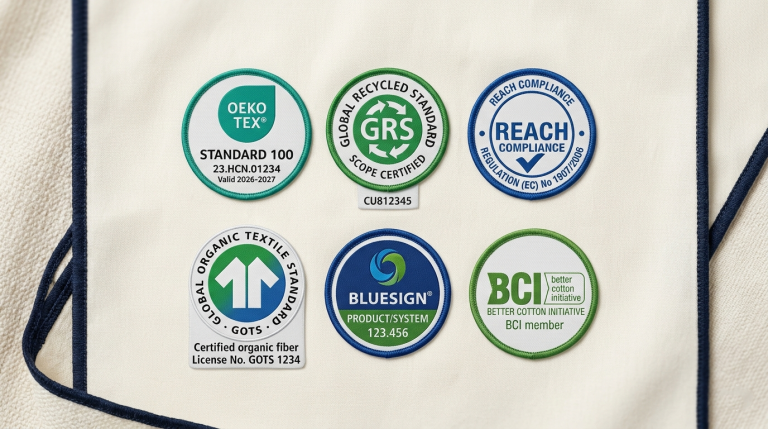
For most apparel brands building a sustainable sourcing strategy, the minimum viable combination is OEKO-TEX Standard 100 for safety and GRS 4.0 for recycled content claims. As defined by Textile Exchange’s official standard, GRS requires a minimum of 20% recycled content and mandates strict chain-of-custody documentation. According to OEKO-TEX’s framework, their Standard 100 tests for hundreds of regulated and non-regulated substances.
This is where procurement teams get burned. Terms like “eco-friendly,” “natural,” “low-impact,” or “conscious collection” have no unified, audited standard behind them. They are marketing descriptors, not compliance guarantees. A fabric can be called “natural” if it’s 95% cotton, even if that cotton was grown with intensive pesticides and processed with restricted chemicals.
The antidote is specificity. Instead of accepting “recycled polyester,” demand “GRS 4.0 certified recycled polyester with a valid Transaction Certificate for this production lot.” This shifts the conversation from vague promises to verifiable data. It’s the difference between a supplier saying “trust us” and them handing you a searchable certificate number.
The best sustainable fabric options for apparel brands aren’t chosen in a vacuum. They’re selected based on the end-use performance requirements. A fabric perfect for a structured blazer will fail spectacularly in a yoga legging. Here’s a decision matrix to guide your shortlisting.
| Application | Recommended Sustainable Fabric Family | Key Parameters | Certification Priority |
|---|---|---|---|
| Performance & Activewear | Recycled Polyester (rPET), Recycled Nylon (e.g., ECONYL) | Moisture-wicking, 4-way stretch, high abrasion resistance, 130-180 gsm (3.8-5.3 oz/yd²) | GRS 4.0 (mandatory), OEKO-TEX, bluesign |
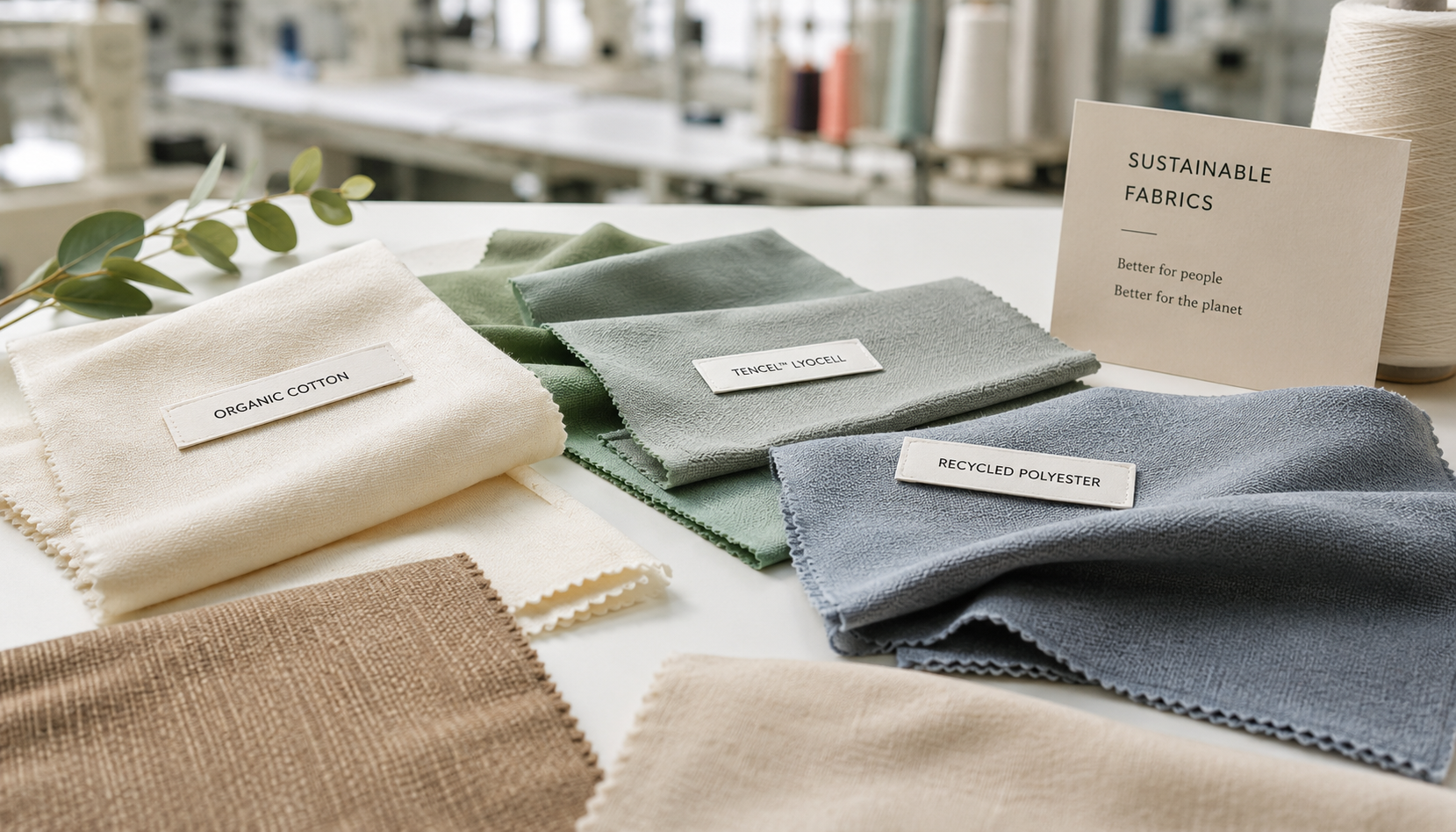
| Intimates & Loungewear | Organic Cotton, TENCEL Lyocell, Modal | Soft hand-feel, breathable, excellent drape, 120-200 gsm (3.5-5.9 oz/yd²) | OEKO-TEX Standard 100 (essential), GOTS for organic claims |
| Women’s Fashion & Menswear | Recycled Polyester Twill/Satin, Organic Cotton Poplin | Good drape, color retention, structure, 150-250 gsm (4.4-7.4 oz/yd²) | GRS 4.0, OEKO-TEX, EU REACH |
| Outerwear & Workwear | Recycled Nylon, Recycled Cotton Blends | Durability, wind/water resistance, weight, 200-400 gsm (5.9-11.8 oz/yd²) | GRS 4.0, bluesign |
For activewear, recycled polyester (rPET) and recycled nylon are the undisputed workhorses. They deliver the moisture management, quick-dry properties, and elastic recovery that performance demands. The critical factor is the quality of the recycled feedstock and the consistency of the yarn spinning. A poorly controlled rPET yarn can lead to pilling and inconsistent dye uptake.
This is where a verified sample becomes your best friend. For instance, a GRS-certified power net elastic fabric at 135 gsm (4.0 oz/yd²) with a 4-way stretch structure and ≥90% elastic recovery provides a tangible benchmark for what high-performance sustainable materials can achieve. You can examine such a technical sample, like this GRS-certified elastic power net, to assess hand-feel, stretch, and recovery before committing to a bulk order.
Here, the story shifts from performance metrics to sensory experience and safety. OEKO-TEX Standard 100 certification is non-negotiable, as it ensures the fabric is free from harmful levels of over 100 substances. TENCEL Lyocell, produced in a closed-loop process that recovers 99% of the solvent, offers a sublime drape and moisture management. Organic cotton, certified to GOTS, provides the familiar comfort consumers expect, but with a verified lower environmental impact from farm to gin.
The challenge for women sustainable fabric options in apparel brands, particularly in fashion, is achieving the same aesthetic and hand-feel as conventional luxury materials. Recycled polyester can now be engineered into convincing silk-like satins and structured twills. The key is Yarn Count Converter control and finishing. For menswear, organic cotton poplins and recycled wool blends offer structure and breathability. The best sustainable fabric options for apparel brands in this segment balance drape, colorfastness (aim for Grade 4 or higher on the ISO 105 scale), and a credible sustainability story backed by GRS certification.
Case Study: The rPET Colorfastness Hurdle
A European mid-tier activewear brand needed to switch 60% of its polyester supply to GRS-certified rPET within 12 months to meet a major retailer’s 2025 mandate. The initial quotes from GRS-certified suppliers were 18-25% higher than virgin polyester. The cheapest option failed their internal colorfastness test, scoring a Grade 3 versus their required Grade 4. Their first trial with a different supplier passed hand-feel evaluations but failed a 10-wash pilling test, scoring only Grade 2-3. After a second trial with a supplier using tighter denier control, they achieved Grade 4 colorfastness, but at a total blended cost increase of 22%. The compromise? They negotiated a 6-month price lock and reduced their SKU count from 45 to 32 to protect margins. The final fabric, delivered at 145 gsm (4.3 oz/yd²), proved that meeting stringent performance and compliance standards is possible, but rarely cheap or easy on the first try.
Trust, but verify. This old adage is the core of sustainable sourcing. The verification process shouldn’t be an afterthought; it should be built into your sourcing SOP from day one. The goal is to move from paper promises to physical proof with minimal cost and risk.
Before you even ask for a swatch, arm yourself with this document checklist. A reputable supplier will have these readily available.
Once you have a sample, investing in a few targeted lab tests is the most cost-effective way to de-risk a bulk order. Focus on these three:
These tests usually cost between $50-$150 per test per colorway and take 5-10 business days. It’s a small price for peace of mind. When you’re ready to move from research to action, you can submit your technical specifications and sampling request to get the verification process started with a supplier.
A structured sourcing SOP turns a daunting task into a manageable workflow. Here’s a streamlined process, with key decision points and pitfalls at each stage.
| SOP Step | Key Decision Point | Common Pitfall |
|---|---|---|
| 1. Define Requirements | Set non-negotiables: end-use, performance specs, target certifications, budget. | Vague briefs lead to mismatched samples and wasted time. |
| 2. Supplier Shortlist | Filter by certification, production capability, and minimum order quantity (MOQ). | Choosing solely on price without verifying certification authenticity. |
| 3. Sample & Verify | Order lab dips and physical samples; conduct in-house feel tests and lab tests. | Skipping lab tests to save time/cost, leading to bulk order failures. |
| 4. Commercial Negotiation | Agree on price, MOQ, lead time, payment terms, and quality benchmarks. | Not locking in price for a set period, exposing you to raw material volatility. |
| 5. Bulk Order & QC | Place order with clear QC inspection criteria (AQL levels). | Not having a pre-shipment inspection process. |
Sustainable fabrics often have different commercial terms than their conventional counterparts. Be prepared for typical MOQs ranging from 300-500 m (328-547 yd), though some suppliers may offer lower MOQs for in-stock items. Lead times for custom production usually fall between 10-20 working days after sample approval. The most common payment term is T/T 30/70 (30% deposit, 70% before shipment). For a deeper dive into these terms and the entire procurement lifecycle, the knowledge center offers detailed guides that can serve as an extension of this SOP.
Keep your eyes open for these warning signs:
Let’s talk numbers. Sustainable fabrics typically carry a cost premium, but it’s not always as steep as feared, and it must be weighed against risk. The table below illustrates a simplified comparison.
| Metric | Conventional Polyester (Virgin) | GRS-Certified rPET | Key Consideration |
|---|---|---|---|
| Cost (per meter) | $1.20 – $1.80 | $1.50 – $2.30 | Premium of 18-30%, but price locks can mitigate volatility. |
| Performance (e.g., wicking, stretch) | Excellent | Excellent (if well-made) | Quality varies greatly; sampling is critical. |
| Compliance Risk | High (future regulatory risk) | Low (future-proofed) | The cost of non-compliance (fines, lost orders) can dwarf the fabric premium. |
| Lead Time | Standard | Can be 10-20% longer | Due to additional verification steps in the supply chain. |
When evaluating sustainable fabric brands, the total cost of ownership includes the premium, the risk mitigation value, and the potential brand equity uplift. A 20% fabric cost increase might translate to only a 2-3% increase in final garment cost, which can be offset by marketing the verified sustainable story.
Perfection is the enemy of progress. A common and pragmatic compromise is the blended approach. A brand might target an 80% recycled / 20% conventional blend for a particular line to meet a retailer’s minimum recycled content threshold while managing cost and performance consistency. This isn’t a failure; it’s a strategic step. The plan can be to increase the recycled percentage in the next season as supply chains mature and costs decrease. The key is transparency with your end consumer about the journey.
Case Study: The REACH Compliance Squeeze
A Southeast Asian supplier serving EU high-street brands faced losing a $1.2M annual account if they couldn’t pass EU REACH SVHC screening for 12 fabric SKUs. Reformulating with REACH-compliant dyes increased costs by $0.35-$0.50 per meter, but the buyer refused any price increase. The supplier’s first attempt with “REACH-friendly” alternatives resulted in uneven dye uptake on dark navy shades. A second attempt with a different leveling agent fixed the color but added three days to the dyeing cycle. The final compromise: the supplier absorbed the $0.40/m cost increase, renegotiated the MOQ down to 300 m (328 yd) to reduce inventory risk, and accepted a 25% longer lead time for dark colors. All 12 SKUs passed on the third trial. This illustrates that compliance often requires absorbing short-term costs and adjusting operational parameters to retain key business.
A truly sustainable garment considers the entire value chain. Focusing solely on the fabric is like judging a book by its cover. There are several other critical factors that sustainable fabric suppliers and brands should address.
When conducting a factory audit or questionnaire, go beyond the production floor. Ask these questions:
A factory that can answer these confidently is more likely to be a reliable long-term partner for your sustainable sourcing goals. You can learn more about the operational standards and history of an integrated manufacturer by reviewing their company profile and facility details, which often provide insight into these broader commitments.
Typical MOQs for sustainable fabrics range from 300 to 500 meters (328 to 547 yards). This can vary based on the fabric type, construction, and whether it’s a stock item or a custom development. Many suppliers, including those with integrated production, offer smaller MOQs for sampling and initial orders to help brands test the waters.
Expect a sampling lead time of 7 to 15 working days. This timeline can be influenced by the complexity of the color (special dyes take longer), the need for specific finishes, and the supplier’s current production schedule. Always factor in shipping time for physical swatches.
Absolutely. In key performance metrics like elastic recovery, colorfastness, and abrasion resistance, high-quality sustainable fabrics from reputable suppliers are fully comparable to their conventional counterparts. The critical factor is the supplier’s process control and yarn quality. This is why the sampling and verification step is so vital.
For a robust baseline, require OEKO-TEX Standard 100 for product safety and Global Recycled Standard (GRS) 4.0 for any recycled content claims. This combination addresses both consumer safety and verifiable sustainability. For brands with more advanced goals, adding bluesign or GOTS (for organic natural fibers) can be a differentiator. You can browse a range of performance and functional knits with these certifications to see what’s available off-the-shelf.
You’ve moved from understanding the landscape to having a practical framework for evaluation. The key takeaways are: prioritize verifiable certifications over marketing terms, build a sample-and-test step into your SOP, and look at the total cost of compliance and risk, not just the per-meter price. The journey from reading about sustainable fabric options for apparel brands to actually sourcing them begins with a single, concrete action: defining your technical requirements and initiating a conversation with a potential supplier.
The most efficient way to bridge that gap is to have your specifications ready. Whether you’re looking for a specific recycled polyester knit, an organic cotton jersey, or a technical functional fabric, the process starts when you submit your detailed inquiry and technical specifications. This allows a supplier’s technical team to provide accurate feedback on feasibility, certification availability, and a realistic sampling timeline, setting you on a clear path from shortlist to purchase order.