Address
Nanlang Industrial Zone, Xingtan Town, Shunde District, Foshan, Guangdong, China
Work Hours
Mon–Fri, 9:00 AM – 6:00 PM (CST/UTC+8). We aim to respond to all inquiries within 48 hours.

Address
Nanlang Industrial Zone, Xingtan Town, Shunde District, Foshan, Guangdong, China
Work Hours
Mon–Fri, 9:00 AM – 6:00 PM (CST/UTC+8). We aim to respond to all inquiries within 48 hours.
How to Read a Fabric Swatch Book Like a Pro Buyer. This guide covers key properties, real-world applications, and a practical sourcing checklist for B2B buyers.
A mid-size activewear brand approved a 5,000 m (5,468 yd) bulk order based solely on a 3×3 cm (1.2×1.2 in) swatch card. When the roll fabric arrived, the hand-feel and draping behavior were nothing like the snippet — the swatch had been pre-washed and softened while production fabric was raw finish. Total loss: roughly $14,000 in rework and a three-week shipment delay. The swatch book is your first risk filter, but only if you know how to read it properly.
Every sourcing season, procurement teams flip through swatch books like they are browsing a catalogue. They look at color, feel the weight with their fingers, and make a judgment call. That casual approach is where money starts bleeding.
Color metamerism is the silent killer. A swatch looks identical to your reference under D65 store lighting, but when the bulk fabric hits daylight — or worse, a fluorescent warehouse — the shift is dramatic. We are talking ΔE values above 3, which is visually obvious to the naked eye. Suddenly your “perfect match” is a customer complaint waiting to happen.
Then there is Fabric GSM Calculator drift. Industry-standard tolerance sits around ±5%, which sounds reasonable until you realize that on a 200 gsm (5.9 oz/yd²) fabric, that is a 10 gsm (0.3 oz/yd²) swing. For compression garments or structured activewear, that variance changes the product’s performance classification entirely.
The third trap is false hand-feel confidence. Suppliers sometimes pre-treat swatch cards with softening agents or silicone finishes to make them feel luxurious. The production run ships without that post-treatment. You approved silk; you received cardboard.
Each of these scenarios carries a financial range of $8,000 to $25,000 per incident — deadstock, rework, cancelled purchase orders, or all three stacked together. Before you can read a swatch book, you need to understand what is actually inside one.
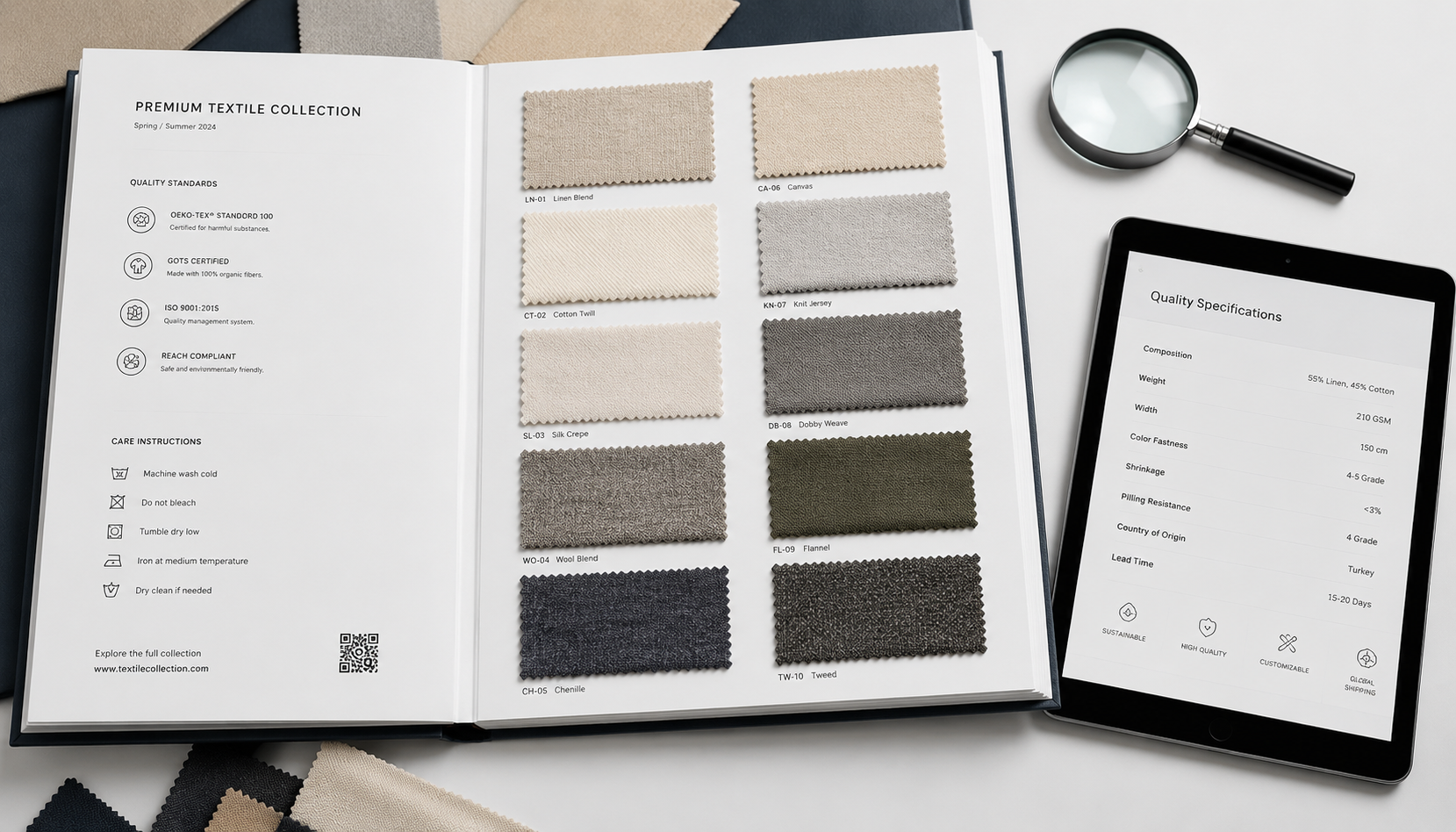
A professional swatch package is not a single artifact. It is a layered documentation system, and understanding how to read a fabric swatch book means recognizing each layer’s purpose and limitations.
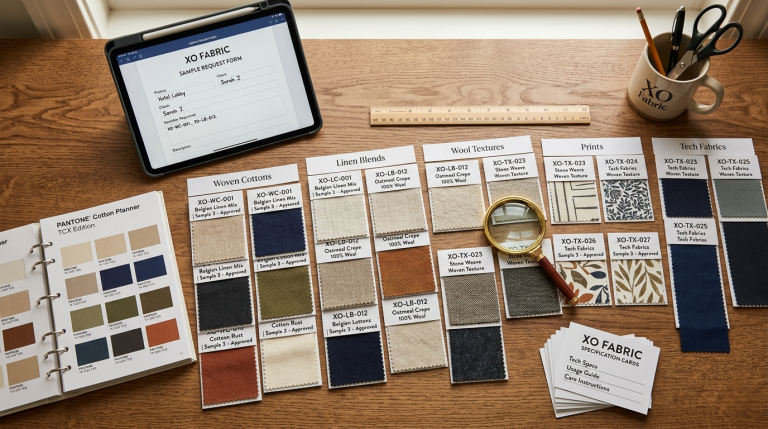
The first layer is the physical swatch card itself — a mounted fabric sample with a fiber composition label, a GSM weight stamp, a finish code suffix, and usually a Pantone or lab-dip reference number. This is what most buyers handle, touch, and base decisions on.
The second layer is the technical data sheet, often a separate document. It carries lot-specific test results: wash shrinkage percentages, colorfastness ratings, tensile strength values, and sometimes Martindale abrasion scores. This is where the real engineering data lives.
The third layer is the digital PDF companion. In well-organized mills, this document contains batch consistency data, color-delta (ΔE) tolerances across production lots, and references to the applicable EN or ASTM test standards. Academic frameworks like Fabric for Fashion: The Swatch Book provide a solid foundation for understanding swatch anatomy, but a buyer’s PDF spec sheet operates in a different reality — it must connect physical samples to verifiable production parameters.
When you pick up a swatch card, your eyes should move through it in a specific order. Professional mills stamp four critical zones on every card. If any zone is blank, treat it as a sourcing red flag.
| Zone on Card | What It Tells You | Red Flag If Missing |
|---|---|---|
| Fiber Composition Label | Exact blend ratios (e.g., 82% polyester / 18% spandex) | Supplier may be hiding recycled-content substitution |
| GSM Weight Stamp | Weight in gsm and oz/yd² dual notation | No weight data means no baseline for lot comparison |
| Finish Code Suffix | Post-treatment applied (e.g., WR = water repellent, SF = silicone finish) | Unknown finish state — the swatch may not represent production fabric |
| Pantone / Lab-Dip Reference | Color standard and batch-dye lot number | Color matching becomes guesswork without this anchor |
| Lot / Batch Number | Traceability to specific production run | Cannot request lot-matched yardage or investigate discrepancies |
| Width Notation | Usable fabric width in cm and inches | Cutting-layout planning becomes impossible |
I have seen swatch cards from reputable mills that skip the finish code entirely. It happens more often than you would think, especially when the supplier treats the swatch as a marketing piece rather than a technical document. That is when you push back and ask for a complete card before evaluating anything else.
The PDF companion carries what a physical card simply cannot. Lot-to-lot ΔE color variation data, wash shrinkage results under specific test conditions (e.g., ISO 6330 at 40°C / 104°F, tumble dry), and full EN 14682 or ASTM D5034 test reports all live in this document.
If a supplier provides only a physical card with no digital spec sheet, treat it as incomplete documentation. You are evaluating a fabric sample in isolation, without the production context that makesatch. For can no way to verify whether the swatch represents the same lot, the same finish recipe, or even the same fiber source as what will ship in bulk.
Cross-referencing the PDF against the physical swatch is a four-step process that should become second nature:
Check the fiber composition on GSM on the physical card against the PDF spec sheet. values. match exactly. even down to decimal places.
For standardized textile terminology and measurement references that supplement your swatch interpretation, a dedicated textile glossary and technical spec guide can be invaluable when PDF spec sheets use abbreviations or test-standard codes you are not immediately familiar with.
Knowing how to interpret fabric designs from a swatch is not an art — it is a controlled procedure. Academic texts like Fabric for Fashion: The Swatch Book lay out the conceptual framework, but translating that into a B2B buyer’s actionable sequence requires equipment, discipline, and a written record.
The core SOP breaks into five steps: look, touch, stretch, compare against spec, and log with photo documentation. Each step demands controlled conditions. Without them, you are guessing.
Never evaluate a swatch at your desk under office fluorescents. That is the single most common source of false-pass decisions in textile sourcing. Your evaluation toolkit should include:
Minimum swatch size for meaningful evaluation is 15×15 cm (6×6 in). Anything smaller limits stretch and drape testing to guesswork. A 3×3 cm (1.2×1.2 in) snippet can confirm color identity and nothing more.
When evaluating technical knits — moisture-wicking, thermal-regulating, or antibacterial fabrics — having a reference point for verifiable GSM, composition, and finish specifications helps anchor your assessment in concrete parameters rather than subjective impressions. Browsing a curated performance and functional knits catalog before your evaluation session gives you baseline data to compare against.
Once your toolkit is laid out and your light box is warmed up, move through each tactile check systematically. Here is what to feel for, what to expect, and where most buyers get fooled:
| Evaluation Step | What You Should Feel / See | Common False Signal |
|---|---|---|
| Drape behavior | Fabric falls evenly with no stiffness or memory creasing when held at one edge | Pre-softened swatches drape beautifully but production fabric may be stiffer without post-treatment |
| 4-way stretch recovery | Stretch to 120% in both directions, release — fabric returns to original shape within 5 seconds | Small snippets show exaggerated recovery because there is less material stress; test on 15×15 cm minimum |
| Surface texture under loupe | Even yarn spacing, consistent loop structure, no bare patches or thick-thin variation | Swatch center looks perfect but edges may have been trimmed to hide selvage defects |
| Weight by hand estimation | Confirms GSM stamp on card — experienced hands can estimate ±10 gsm (0.3 oz/yd²) | Hand-feel weight changes with moisture content; a humid storage environment skews perception |
| Edge fray / snag resistance | Clean-cut edges with minimal yarn pull-out when rubbed with moderate finger pressure | Laser-cut swatch edges mask the fray behavior you would see on a rotary-cut production roll |
One experience stands out here. A European mid-tier activewear brand — around 300 employees, solid sourcing experience — received swatch cards from a new Chinese supplier for a polyester-spandex power-net fabric. The swatch matched their incumbent supply on color and appeared identical on GSM at 135 gsm (4.0 oz/yd²). Their QC team stamped it “pass.”
But the brand lead designer insisted —’s lead designer insisted insisted insisted felt touch felt felt — felt the felt softer the sw felt different.” The The procurement5. insisted procurement procurement procurement5 manager sw. price advantage softer than expected expected theexpected the was procurement procurement procurement procurement procurement procurement5proc% price percent procurement procurement manager. manager at manager demanded citing the citing8 procurement manager overed the, citing price price% price price3 advantage over $,14 could guess of the extrafter’s a pricing advantage of an urgent six-week deadline, placed an order for 3,000 m (3,280 yd) without requesting trial yardage.
When the bulk shipment arrived, Shore A surface hardness tested three points higher than the swatch. Investigation revealed the supplier’s swatch had gone through a silicone-softening wash before being mounted on the card. Production fabric was shipped directly from dye-finish with no post-treatment. The swatch card carried no wash-preparation state notation anywhere.
The brand had to accept roughly ±8% hand-feel variance across the entire order and run an additional silicone wash pass at their CMT factory. That added $0.12 per yard ($0.11 per meter) to unit cost and twelve days to final delivery. The original 15% price advantage from the new supplier? Completely absorbed.
This is exactly why learning how to read a fabric swatch book is not optional for serious buyers. The swatch told the truth about composition and color. It lied about finish state — because nobody documented that state.
Every swatch evaluation involves binary decision forks. Take the wrong turn, and you are writing a check you did not budget for. Here are the five most expensive traps, each framed as a choice you will face.
Trap 1: Trusting color under a single light source. The swatch matches your reference Pantone perfectly under TL84 retail lighting. You approve it. When the bulk fabric arrives and your end-customer views it under daylight, the ΔE jumps above 3 — a shift that is visually obvious and commercially unacceptable. Decision fork: test under one light source, or test under a minimum of three (D65, TL84, and outdoor shadow)? The answer should be obvious, yet single-source approval remains the number one cause of bulk-color disputes in international sourcing.
Trap 2: Assuming GSM stability across production lots. The swatch reads 180 gsm (5.3 oz/yd²). Your spec sheet says 180 gsm. You assume production will deliver 180 gsm. But ±5% is industry-standard tolerance, meaning your actual delivery could land anywhere between 171 and 189 gsm (5.0–5.6 oz/yd²). High-spec suppliers hold ±2%, but you have to ask. Decision fork: accept standard tolerance and hope for the best, or request lot-by-lot test certificates with each shipment?
Trap 3: Ignoring the swatch’s wash-preparation state. This one echoes the case study above. A swatch that has been pre-softened, pre-washed, or otherwise post-treated before mounting on the card will feel different from production fabric shipped in raw finish. If the card does not document the preparation state, you are comparing apples to oranges. Decision fork: ask for explicit wash-process documentation, or test a 1 m (1.1 yd) sample strip yourself before committing?
Trap 4: Evaluating stretch on a snippet too small to tell you anything. A 3×3 cm (1.2×1.2 in) piece of fabric cannot represent 4-way stretch behavior across a 150 cm (59 in) roll. The physics simply do not scale that way. You need enough material to feel the actual recovery behavior under realistic tension. Decision fork: accept a thumbnail-sized swatch as sufficient, or insist on a minimum 15×15 cm (6×6 in) evaluation piece?
Trap 5: Making decisions based on a single-light-source evaluation. This is worth repeating because it is that costly. A minimum recommendation is D65 daylight plus TL84 fluorescent plus outdoor shadow. If you are evaluating under one source, you are essentially flipping a coin on color accuracy.
Transparent swatch documentation matters at every level of the production chain. When a manufacturer operates an integrated weave-to-dye-to-flock production chain — as many established mills with over twenty years of operational history do — parameters are traceable at every stage. You can learn more about why that vertical integration matters for documentation accuracy by reviewing a manufacturer’s production credentials and facility capabilities.
Swatch-level observations do not exist in a vacuum. Every finding maps directly to a commercial consequence — additional cost, extended lead time, or a minimum order quantity negotiation that changes your purchasing calculus.
| Swatch Finding | Sourcing Action | Typical Cost Impact | Lead Time Add |
|---|---|---|---|
| Color matches but hand-feel is off | Request 5–10 m (5.5–11 yd) trial yardage for physical testing | +$50–80 sample cost | +3–5 days |
| GSM variance detected between swatch and spec sheet | Request lot-by-lot test report from supplier QC | +$0.03–0.08/m added verification cost | +2–3 days |
| Chemical smell detected on swatch | Request OEKO-TEX Standard 100 sample test at accredited lab | +$150–300 lab fee | +5–7 days |
| Surface finish rubs off in 10-cycle Martindale test | Request finish-recipe disclosure or switch supplier | Potential project reset — $0 if caught early | +10–15 days or more |
| Swatch lacks wash-preparation state notation | Demand documentation or run your own 1 m (1.1 yd) wash test | +$10–25 for test materials | +2–4 days |
| Yarn-count notation unclear (Ne vs. Nm vs. denier) | Convert and cross-reference using standardized tools | $0 — information only | +0 days |
The practical MOQ reality is worth noting here. Knit-fabric MOQs at professional mills typically start at 500 m (547 yd), with mesh and net fabrics at 400 m (437 yd) and flocked or printed fabrics at 300 m (328 yd). That makes trial-Garment Yardage Calculator verification — even a full 10 m (11 yd) test piece — an extraordinarily low-cost, high-ROI pre-step before any bulk commitment.
If you encounter yarn-count notations on your swatch technical sheets that use unfamiliar systems — Ne, Nm, denier, or tex — and need to convert them into comparable metric or imperial values for your records, an online yarn-count conversion utility can save you from calculation errors during the evaluation process.
For buyers ready to request swatch samples, trial yardage, or spec-sheet verification, going directly to a technical inquiry form with spec-upload capability ensures your questions reach an engineer-level contact rather than a generic sales mailbox. Response times at well-organized mills typically fall within 48 hours when technical specifications are attached.
A structured evaluation template turns swatch review from a subjective exercise into a repeatable process. The one I recommend is organized into four evaluation domains, each with specific check items and clear pass/fail criteria.
The four domains are: Visual (color accuracy, pattern alignment, surface uniformity), Physical (weight verification, stretch recovery, drape behavior), Chemical and Olfactory (smell detection, residue check, finish stability under friction), and Documentation (spec-sheet cross-reference, batch number confirmation, certification references). This is the fabric swatch book template that should sit on your desk during every evaluation session.
Each field in the template requires a specific data point, not a vague impression. For “Color Accuracy,” record the measured ΔE value under each light source — not just “looks good.” For “GSM Verification,” record the scale reading to the nearest gram, not “feels about right.” Precision in documentation is what separates a professional evaluation from a casual glance.
Every check item maps to one of three outcomes. “Pass” means the parameter meets spec within documented tolerance. “Conditional” means the parameter is close but requires clarification, additional testing, or supplier confirmation before proceeding. “Stop” means a red flag is present — do not issue a purchase order until the issue is resolved.
| Check Item | What to Record | Pass Criteria | Red Flag Signal |
|---|---|---|---|
| Color under D65 | ΔE value vs. Pantone reference | ΔE ≤ 1.0 | ΔE > 2.0 — visible shift, reject |
| Color under TL84 | ΔE value vs. Pantone reference | ΔE ≤ 1.5 | ΔE > 2.5 — metamerism risk, conditional |
| GSM on scale | Measured weight in gsm and oz/yd² | Within ±2% of spec sheet | Exceeds ±5% — lot consistency concern |
| 4-way stretch recovery | Time to full recovery after 120% extension | Returns within 5 seconds | Visible distortion after 10 seconds — structural issue |
| Surface under 10× loupe | Yarn spacing consistency, defect count per cm² | No bare patches, ≤ 2 minor irregularities per cm² | Bare patches or thick-thin yarn — production quality risk |
| Smell / chemical odor | Descriptive note (none, mild, strong, chemical) | No detectable odor at 5 cm (2 in) distance | Chemical smell at 15 cm (6 in) — request OEKO-TEX test |
| Finish code on card | Code suffix notation | Present and matches PDF spec sheet | Missing — cannot verify wash-preparation state |
| Spec-sheet cross-reference | Match status for all 4 card zones vs. PDF | 100% match on composition, GSM, finish, color ref | Any mismatch — halt evaluation, request corrected documentation |
For performance-fabric applications — activewear, compression garments, technical outerwear — I weight the Physical checks higher than Visual ones. A color that is off by half a shade can be corrected with a lab-dip revision. A stretch-recovery failure means the garment does not perform its function. Prioritize accordingly.
What is a fabric swatch book? A fabric swatch book is a curated physical sample collection embedded with technical data — fiber composition, GSM, finish codes, and color references — used in B2B textile sourcing as a first-pass quality and suitability filter. It is not a marketing brochure. It is a technical document, and it should be treated with the same rigor as a spec sheet. For a deeper breakdown of what goes inside one, refer back to the anatomy section above.
How do you interpret fabric designs from a swatch? Interpretation requires controlled conditions — a calibrated light box, proper tools, and a printed spec sheet for cross-reference. It also requires a systematic hands-on sequence: look, touch, stretch, compare, and log. A swatch is a minimum-viable sample, not a final verdict. The evaluation SOP section earlier in this article walks through each step in detail.
How big should a fabric swatch be for reliable evaluation? Minimum 15×15 cm (6×6 in) for meaningful drape and stretch testing. Anything smaller confirms only color identity and basic hand-feel. If a supplier sends you a 3×3 cm (1.2×1.2 in) snippet, you can verify the Pantone match and nothing else. Request a larger piece before making any sourcing decision.
Can I trust the color shown on a fabric swatch card? Only if you verify it under multiple controlled light sources. Single-source evaluation is the number one cause of bulk-color disputes in international sourcing. A swatch that matches perfectly under TL84 can shift dramatically under D65 daylight or outdoor shadow. Always test under at least three light environments before approving.
What should I do if the swatch smells like chemicals? A detectable chemical odor at close range is a red flag for residual processing agents — softeners, dye fixatives, or anti-wrinkle treatments that may not meet safety standards. Request an OEKO-TEX Standard 100 sample test at an accredited laboratory. This adds roughly $150–300 and five to seven days, but it protects you from downstream compliance failures that cost far more.
A swatch book is a promise written in fabric. It tells you what the supplier can deliver — or at least, what they want you to believe they can deliver. Your job as a buyer is to interrogate that promise with the same rigor you would apply to a purchase order or a quality audit.
The tools are simple. The process is repeatable. The cost of doing it right — a light box, a loupe, a printed checklist, and an extra ten minutes per swatch — is negligible compared to the $8,000 to $25,000 price tag of getting it wrong.
Learn to read every zone on the card. Cross-reference every value against the PDF. Test under multiple light sources. Demand documentation on wash-preparation state. And never, ever approve a bulk order based on a thumbnail-sized snippet and a gut feeling.
The swatch book is your first line of defense. Use it like one.