Address
Nanlang Industrial Zone, Xingtan Town, Shunde District, Foshan, Guangdong, China
Work Hours
Mon–Fri, 9:00 AM – 6:00 PM (CST/UTC+8). We aim to respond to all inquiries within 48 hours.

Address
Nanlang Industrial Zone, Xingtan Town, Shunde District, Foshan, Guangdong, China
Work Hours
Mon–Fri, 9:00 AM – 6:00 PM (CST/UTC+8). We aim to respond to all inquiries within 48 hours.
Velvet vs Velour Fabric: What's the Difference for Upholstery & Apparel. This guide covers key properties, real-world applications, and a practical sourcing checklist for B2B buyers.
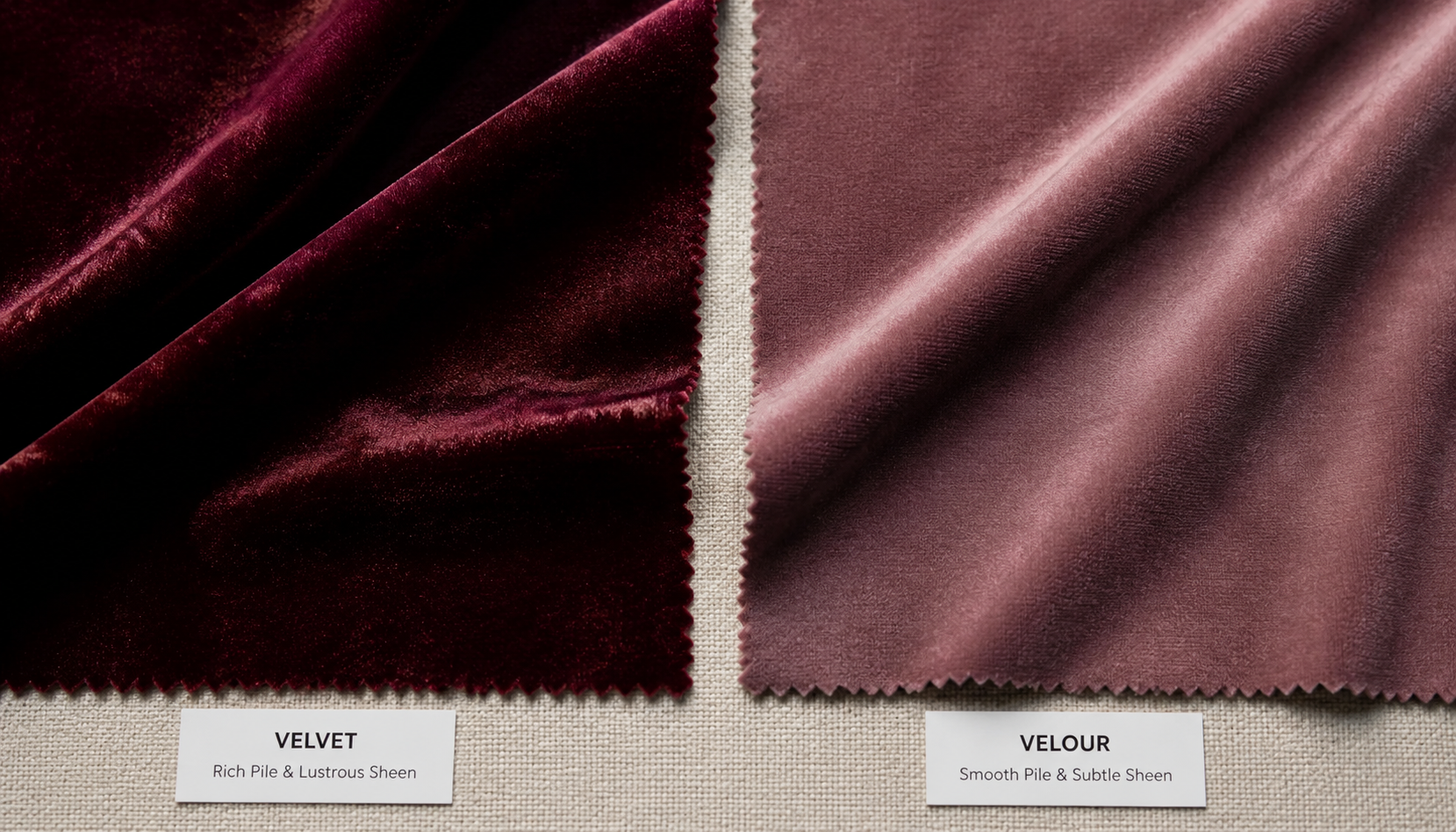
You receive a sample swatch labeled “velvet” from a new supplier. In the showroom, under warm lighting, it looks rich enough. But when your technical team runs the first wash cycle, the seams crack. Or maybe the drape is stiff where your design called for fluidity. That moment—when the fabric on paper doesn’t match the fabric in your hand—is where the real cost of confusing velvet and velour begins. This isn’t a semantic debate; it’s a procurement risk that can derail timelines, blow budgets, and compromise final product quality.
Let’s cut through the marketing haze. The core of the velvet vs velour fabric question isn’t about which sounds more luxurious. It’s about construction. These are two fundamentally different textiles, built on different looms, behaving in different ways under stress, and serving different end markets.
Velvet is, at its heart, a woven fabric. Its signature dense, upright pile is created on a loom using a technique called double-cloth weaving. Picture two layers of fabric being woven simultaneously, face-to-face, with an extra set of warp yarns connecting them. A blade then slices through these connecting yarns, separating the two layers and leaving the cut ends standing upright as the pile.
This process is what gives true velvet its characteristic depth and light-catching ability. The pile height, density, and yarn quality are everything. Traditional velvet uses silk or cotton for the warp pile, but modern production has expanded the fiber palette significantly.
The key takeaway is that velvet’s identity is tied to its woven, cut-pile origin. This gives it inherent stability but very little inherent stretch.
Now, velour. This is where many buyers get tripped up. Velour is not a woven fabric. It is fundamentally a knit fabric—typically a weft-knit or warp-knit base—that has a pile surface created through shearing, brushing, or, in many modern technical applications, electrostatic flocking.
This knit foundation is the critical difference. It gives velour inherent stretch and recovery that velvet simply doesn’t have. A quality velour will stretch comfortably and return to shape, making it ideal for form-fitting garments or upholstery that needs to conform to curves. The common misconception that velour is “just cheap velvet” ignores this engineered performance aspect. For a concrete example of a modern, factory-produced knit-base velour with a flocked pile finish, you can examine the velour flocked fabric specifications, which detail composition, weight ranges, and standard widths.
The pile on velour is also generally shorter and denser than on many velvets, contributing to a different kind of tactile experience—often described as “plush” or “soft” rather than “lustrous.” This distinction in hand-feel is a major factor in the velvet vs velour fabric clothing debate.
Talking about definitions is one thing. Seeing the parameters side-by-side is what helps a buyer make a decision. Let’s break down the tangible differences that matter on a spec sheet and in a product’s performance.
The table below distills the core technical divergences. This is the data you need to have in front of you when reviewing a supplier’s quotation or tech pack.
| Parameter | Velvet (Woven) | Velour (Knit) | Procurement Implication |
|---|---|---|---|
| Base Structure | Woven (cut warp pile) | Knit (weft/warp knit) | Velour offers inherent stretch; velvet requires spandex blends for stretch. |
| Pile Formation | Cut-pile from woven structure | Sheared, brushed, or flocked | Flocking allows precise pile height/density control. |
| Stretch Behavior | Minimal (0-5%) unless blended | High (15-30%+) typical | Critical for pattern grading and fit in apparel. |
| Typical Weight Range | 180–350 gsm (5.3–10.3 oz/yd²) | 150–280 gsm (4.4–8.3 oz/yd²) | Heavier weight often correlates with perceived luxury and durability. |
| Common Width | 54″ / 137 cm | 58-60″ / 147-152 cm | Wider goods can reduce cutting waste for large panels. |
| Cost at Scale (5,000 m / 5,468 yd) | Higher (complex weaving) | Lower (efficient knit+flock) | Velour often wins on cost for equivalent visual quality at volume. |
Beyond the spec sheet, how do these fabrics behave in the real world? The performance trade-offs directly dictate which fabric belongs in which product category.
Drape and Hand Feel: Velvet, especially silk or viscose blends, has a fluid, luxurious drape that falls in soft folds. Velour, due to its knit base, has a more substantial, “cozy” drape that clings slightly. For a flowing evening gown, velvet is the classic choice. For a fitted hoodie or track pants, velour’s stretch and recovery are superior.
Abrasion Resistance: This is a key metric for upholstery and high-wear apparel. A quality polyester velvet can achieve 30,000+ Martindale cycles (the industry-standard abrasion test, ISO 12947). Velour performance varies more widely; a flocked knit designed for upholstery can also reach high cycle counts, but a lightweight brushed velour for loungewear may be rated for less intensive use.
Care Requirements: Traditional velvet is often labeled “dry-clean only,” especially if it contains silk or viscose. Modern polyester velvet and most velours are frequently machine-washable, a major advantage for the activewear and loungewear market. This is a crucial point in the stretch velvet vs velour discussion—both can offer stretch, but their care labels might differ.
Visual Profile: Velvet’s cut pile catches light directionally, creating a rich sheen and shadow. Velour’s pile, whether flocked or sheared, tends to have a more uniform, matte-to-satin appearance. This affects how colors read under different lighting—a vital consideration for retail presentation.
Here’s a question that haunts procurement managers: “Why does this velvet look so cheap?” The answer is almost always in the technical shortcuts taken during production. A low-cost polyester velvet isn’t inherently bad, but if it’s made with poor yarns and inadequate finishing, it will look and feel lifeless.
The perception of luxury in velvet is a direct function of its construction quality. When buyers complain about a cheap appearance, they’re usually reacting to one or more of these technical failures:
Velour has its own failure modes. A brushed velour with an inconsistent knit tension can develop bald spots or pilling. A flocked velour with poor adhesive application will shed its pile. The lesson is the same for both: you get what you specify. Vague terms like “velvet-feel” in a tech pack are an open invitation for a supplier to choose the cheapest construction method that barely meets the letter of the request.
This isn’t theoretical. A mid-range European loungewear brand learned this lesson the expensive way while sourcing 5,000 meters (5,468 yards) of fabric for a winter capsule collection. Their design brief called for a “velvet-feel” fabric that was soft, luxurious, and machine-washable for a line of premium joggers and hoodies.
Their tech pack specified “velvet.” The first supplier quoted a beautiful, lustrous polyester velvet at a competitive price. A sample swatch looked perfect under studio lights. The brand placed an initial order for 1,200 meters (1,312 yards).
The problem emerged during pre-production testing. The woven velvet, when sewn into garment seams and subjected to the brand’s standard industrial wash protocol (3 cycles at 40°C / 104°F), showed catastrophic seam cracking. The non-stretch fabric couldn’t handle the mechanical stress of washing and tumbling. The fabric was beautiful, but it was functionally wrong for the end-use.
Panicking, the brand’s sourcing team pivoted. They found a brushed polyester knit that passed wash and stretch tests. But when the first production run arrived, the design team was disappointed. The fabric lacked the visual depth and density of the original velvet sample. It looked, in their words, “like a cheap tracksuit.”
This is where the trial-and-error cost them time and money. The conflict was clear: the visual brief pointed to velvet, but the functional requirements (stretch, washability) demanded a knit construction. The resolution came when a technical consultant suggested specifying a flocked knit velour instead of relying on vague “velvet-feel” language.
The final compromise was a polyester-spandex flocked velour, weighing 220 gsm (6.5 oz/yd²). It offered 4-way stretch and passed 10,000 Martindale abrasion cycles. To meet the pilling test standard (ISO 12945-2), they accepted a slightly lower pile height of 2.0 mm (0.08 in) versus their desired 2.5 mm (0.10 in). The visual result was a dense, soft surface that captured the luxury feel they wanted, with the performance their product demanded. This is a classic example of why understanding the broader flocked fabric category can unlock solutions that a narrow focus on traditional velvet cannot.
It’s worth noting that brand perception plays a role here too. Some buyers, thinking of iconic velour tracksuits from brands like Juicy Couture, might initially associate velour with a dated, early-2000s aesthetic. But modern flocked velours are technically advanced materials, far removed from those nostalgic references. The perception is outdated; the material is not.
So, what is better, velour or velvet? The answer is always: “For what application?” Using a structured decision matrix removes the guesswork and aligns your fabric choice with your product’s technical and commercial requirements.
Use this table as a starting point for your internal sourcing discussions. It maps common end-uses to the recommended fabric type and the primary reason for that recommendation.
| End-Use Application | Recommended Fabric | Key Reason | Stretch Required? |
|---|---|---|---|
| Formal Upholstery (Sofas, Armchairs) | Velvet (Polyester/Cotton) | Superior abrasion resistance, formal drape, and light-catching depth. | No |
| Casual Upholstery (Accent Chairs, Ottomans) | Velour (Flocked Knit) | Conforms to curves, easier to clean, often more cost-effective at volume. | Yes (for fitted covers) |
| Eveningwear & Formal Apparel | Velvet (Viscose/Silk/Polyester) | Luxurious drape and sheen for tailored silhouettes. | No (or minimal) |
| Activewear, Loungewear, Dancewear | Velour (Knit) | 4-way stretch, moisture management, machine-washability. | Yes |
| Automotive Interiors | Velour (Heavy-duty Knit) | Conforms to complex shapes, durable, easy to maintain. | Yes |
| Theatrical Costumes & Dance | Velour (Knit) or Stretch Velvet (Knit-blend) | Movement freedom, stage-light performance, durability for quick changes. | Yes |
At industrial scale, cost differentials become significant. For a production run of 500 meters (547 yards), the price gap between a quality polyester velvet and a flocked velour might be modest. But at 5,000 meters (5,468 yards), the velour’s more efficient production process (knitting + flocking vs. complex double-cloth weaving) typically yields a lower per-meter cost for an equivalent visual quality.
Minimum order quantities (MOQs) also differ. Woven velvet mills often have higher MOQs due to loom setup times. Flocked velour manufacturers, especially those with integrated production, can offer more flexible MOQs—sometimes as low as 300 meters (328 yards) for stock goods. This makes velour a more accessible option for smaller brands or for testing new product lines without a massive upfront commitment.
Whether you choose velvet or velour, a rigorous sourcing process is non-negotiable. Don’t rely on a single swatch and a PDF spec sheet. Follow this checklist to de-risk your procurement.
Starting this process is straightforward. You can begin by reaching out to a verified manufacturer to request spec sheets, test reports, and pre-production samples through their contact page. A responsive supplier will have this documentation ready and will work with you to meet your specific testing requirements.
From a B2B procurement perspective, neither is universally “better.” It’s a classic case of trade-offs. Velvet excels in visual luxury, formal applications, and scenarios where drape and sheen are paramount. Velour wins on stretch, washability, and cost-efficiency for high-volume casual, performance, or automotive goods. Refer to the decision matrix above to align the fabric with your product’s specific needs.
Absolutely not. While the early-2000s velour tracksuit trend may have peaked, the fabric itself is a modern staple. It remains a core material in the athleisure, loungewear, and automotive interior markets. Furthermore, innovation continues—modern flocked-knit velours made with GRS-certified recycled polyester are gaining significant traction in sustainable fashion sourcing circles. The material has evolved far beyond its pop-culture moment.
Honesty is important here. Compared to premium woven velvet, velour can have a lower pile density, which may affect its perceived luxury in some high-end contexts. In high-traffic upholstery applications, a lighter-weight velour may be susceptible to pile crush over time. There’s also the perception issue—some buyers still associate it with fast fashion. These disadvantages can be mitigated by specifying higher Fabric GSM Calculator weights (250+ gsm / 7.4+ oz/yd²) and requesting crush-resistance test data from your supplier.
This is a common point of confusion. Velvet is a woven cut-pile fabric, prized for its sheen and formal elegance. Velour is a knit-based pile fabric, valued for its stretch and soft, plush feel. True suede is a split leather product. However, in the textile world, “suede” almost always refers to microsuede—a synthetic, woven fabric (often polyester microfiber) designed to mimic the look and feel of leather suede. Microsuede is rugged and durable, often used for upholstery and accessories, but it is a distinct product from velour. Don’t confuse the three when writing your tech packs.
The velvet vs velour fabric decision is ultimately a decision about priorities. Are you prioritizing the visual drama of light and shadow, the fluid drape of a woven textile, and a formal end-use? Then velvet is your path, but you must specify it rigorously to avoid the “cheap” look that comes from poor construction. Are you prioritizing stretch recovery, machine-washability, cost efficiency at scale, and a plush, comfortable hand? Then velour is your engineered solution.
The most expensive mistake in textile sourcing isn’t choosing the “wrong” fabric—it’s choosing the wrong fabric for the job because you didn’t understand the technical difference. Specify with precision. Test with your own protocols. And let the end-use, not the label, drive your decision.