Address
Nanlang Industrial Zone, Xingtan Town, Shunde District, Foshan, Guangdong, China
Work Hours
Mon–Fri, 9:00 AM – 6:00 PM (CST/UTC+8). We aim to respond to all inquiries within 48 hours.

Address
Nanlang Industrial Zone, Xingtan Town, Shunde District, Foshan, Guangdong, China
Work Hours
Mon–Fri, 9:00 AM – 6:00 PM (CST/UTC+8). We aim to respond to all inquiries within 48 hours.
rPET Recycled Fabric for Apparel: Sourcing, Certs & Limits. This guide covers key properties, real-world applications, and a practical sourcing checklist for B2B buyers.
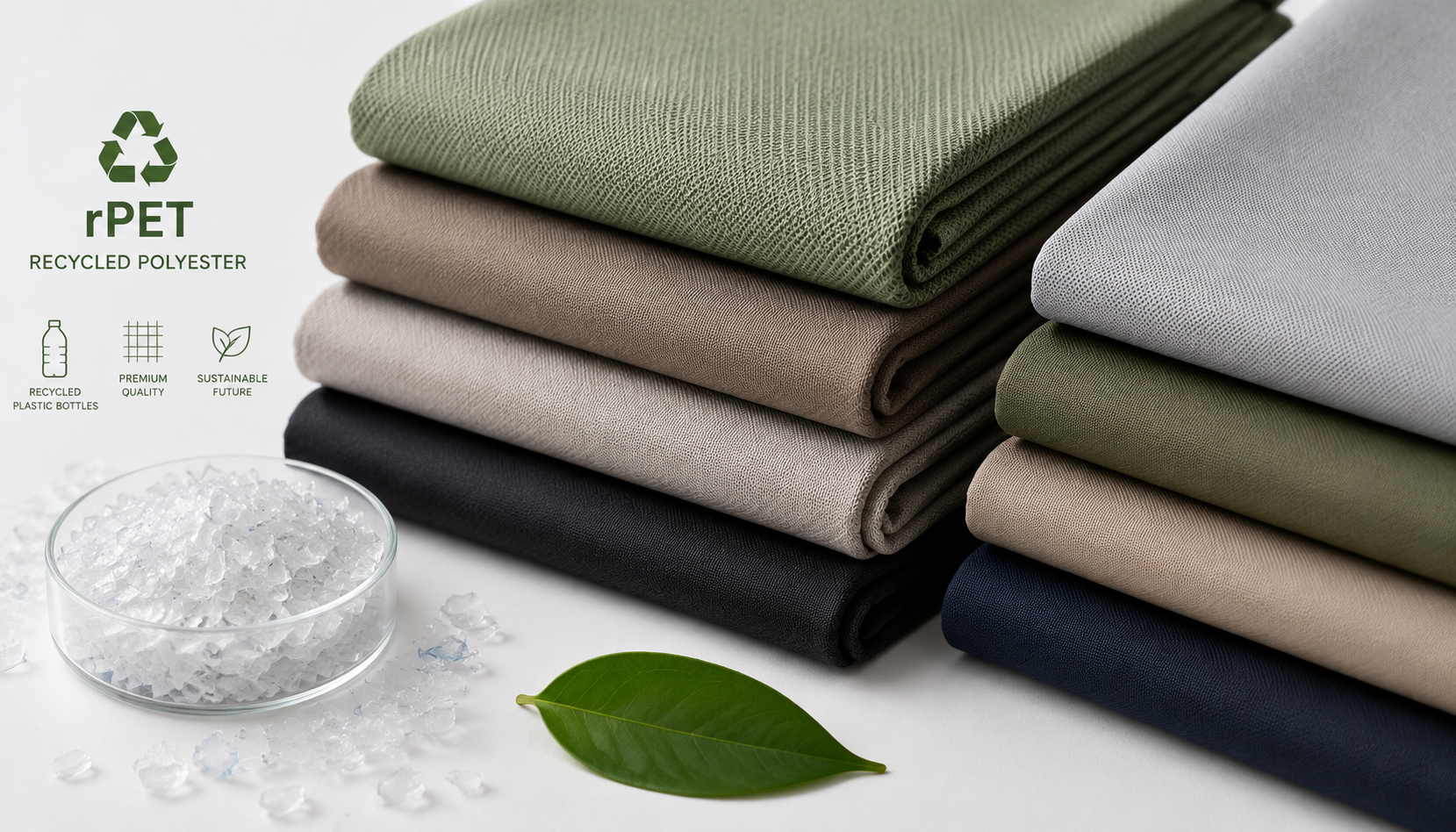
A mid-sized European activewear brand ordered 8,000 m (8,749 yd) of what its supplier labeled “recycled polyester interlock” — then watched the entire lot get rejected after a third-party DNA tracer test, commissioned by the end retailer in Hamburg, detected zero post-consumer PET content. The financial damage exceeded €14,000, and the product launch slipped six weeks. Scenarios like this one are disturbingly common in rPET fabric sourcing, and they almost always stem from the same few breakdown points in certification, chain-of-custody documentation, and buyer assumptions. What follows is a field-level technical guide for procurement teams navigating the rPET recycled fabric apparel supply chain — from molecular behavior in recycled polyester fibers to a step-by-step sourcing SOP that actually works.
Walk into any textile trade show and you will find booths advertising “100% recycled polyester” on signage the size of a truck. The phrase sounds definitive. It is not. Many buyers treat “recycled polyester” and “rPET” as interchangeable terms, but they describe fundamentally different material streams with different performance ceilings, different certification requirements, and very different price points.
The recycled polyester fabric meaning most sourcing professionals carry around is dangerously broad. Strictly speaking, rPET refers to polyester fiber manufactured from post-consumer polyethylene terephthalate — plastic drink bottles that were actually used, collected, and reprocessed. “Recycled polyester,” by contrast, can include post-industrial waste (factory floor trimmings, off-spec yarn), industrial PET scrap, or even mechanically reprocessed virgin-production rejects. These are not equivalent feedstocks.
The reason it matters comes down to traceability and performance equivalence. Post-consumer PET has endured UV exposure, mechanical stress, and thermal fluctuations during its service life as a bottle. Each recycling pass degrades the polymer chains slightly, reducing the intrinsic viscosity (IV) that governs fiber tenacity and processability. Post-industrial scrap, on the other hand, has near-virgin IV values because it never left a climate-controlled factory. Globally, roughly 55 percent of PET bottles are collected for recycling, but only a fraction of that volume reaches textile-grade fiber production — the rest becomes packaging, sheet, or strapping.
Here is where sourcing teams get burned. When a supplier says “recycled,” they may be technically accurate while omitting the single most critical qualifier: was the source material post-consumer or post-industrial? The two categories carry different weight under RPET Fabric certification schemes and different implications for ESG reporting.
The takeaway is straightforward: do not buy a sustainability claim. Buy a document trail.
Mechanical recycling remains the dominant route for converting post-consumer PET bottles into textile-grade rPET fiber, accounting for over 90 percent of current rPET Fabric production volume. Understanding each processing step helps procurement teams know where quality can degrade — and where their inspection dollars matter most.
A well-run rPET fabric supplier will have optimized each of these steps with dedicated process parameters specifically for recycled content, rather than running rPET through the same settings used for virgin material. That distinction shows up immediately in QC data.
| Production Stage | Typical Loss Rate / Key Metric | Quality Control Focus |
|---|---|---|
| Flake Sorting | 8–12% material rejection (non-PET, colored flakes in clear stream) | Near-infrared sorting accuracy; impurity % |
| Washing & Drying | Moisture must drop below 20 ppm before extrusion | Residual adhesive/contamination test |
| Melt Extrusion | IV value target: ≥ 0.58 dL/g for apparel-grade fiber | Rheological testing; thermal degradation control |
| Spinning & Drawing | Fiber tenacity: 4.0–5.5 g/d (slightly below virgin range of 5.0–7.0 g/d) | Denier consistency; filament count uniformity |
| Weaving / Knitting | Hairiness increase vs. virgin: 8–15%; breakage increase: 8–15% | Machine speed reduction; tension calibration |
| Dyeing & Finishing | Color-batch consistency risk: 8–12% higher standard deviation in ΔE | Dye-lot matching; repeat-order continuity |
The delta in that last row — dye-batch consistency — deserves particular attention. It is the single most frequent quality complaint from buyers who have run multiple production orders with recycled polyester. We will come back to it.
No procurement decision should be driven by enthusiasm or guilt. It should be driven by data, tradeoffs, and end-use requirements. Here is the honest side-by-side — the kind of comparison table most supplier brochures skip.
| Parameter | rPET | Virgin Polyester | Sourcing Decision Signal |
|---|---|---|---|
| Breaking Tenacity | 4.0–5.5 g/d | 5.0–7.0 g/d | For high-stress applications (climbing gear, industrial webbing), virgin remains safer |
| Dye-Batch Uniformity | Higher ΔE variance (8–12%) | Tight ΔE control | Analytic single-tone collections; solid-color menswear — extra lab-dip cycles needed |
| UV Resistance | Slightly lower — faster degradation under prolonged UV | Baseline acceptable | Outdoor/sportswear with long sun exposure may require UV-stabilizer additives |
| Moisture Wicking | Comparable (depends on cross-section) | Comparable | Neutral — performance depends on filament geometry, not polymer origin |
| Carbon Footprint | ~1.5 tonnes CO₂e less per tonne vs. virgin PET | Baseline: ~5.0 t CO₂e/tonne | ESG reporting leverage; strongest commercial differentiator for rPET |
| Cost Baseline | 15–30% premium over virgin (certified) | Baseline — commodity pricing | Premium narrows at scale; premium widens when GRS/RCS is required |
| Certification Viability | GRS, RCS, SCS verified — commercially essential | Standard ISO/OEKO-TEX | rPET without certification is essentially unsellable to branded retail |
I have omitted one column that most comparison articles include — “softness” — because in blind hand-feel panels for apparel weights, neither I nor most textile engineers I trust can reliably distinguish 150 Fabric GSM Calculator (4.4 oz/yd²) rPET jersey from its virgin equivalent. The differences are real but they live in the engineering specs, not in the consumer’s hand.
This is one of the most-asked questions from product designers new to RPET Fabric. The short answer: no more or less waterproof than virgin polyester with the same construction and finish. Water resistance is a function of weave/knit density, membrane lamination if applied, and DWR (durable water repellent) chemical finish — not of polymer origin. A tightly woven 70-denier rPET shell fabric with a PU membrane laminated at 10,000 mm water column will outperform a loosely woven virgin polyester at 1,000 mm every single time. The fiber source is irrelevant to hydrostatic performance once you control for fabric structure and finish chemistry.
Where rPET recycled fabric apparel does show a measurable weakness is colorfastness over repeated laundering. Internal testing data from multiple mills shows that rPET fabrics typically retain a 4–4.5 rating on the grey scale (ISO 105-C06 multi-fiber adjacent staining test) after 50 wash cycles, while comparable virgin polyester holds at 4.5–5. The practical impact: after 50 home washes, a mid-tone navy rPET T-shirt will develop slightly more pilling-adjacent color shift than its virgin polyester twin. Whether end consumers notice this is debatable. Whether a brand’s QC team should build a testing buffer for it is not.
The carbon story is real and quantifiable. Every tonne of rPET fiber avoids approximately 1.5 tonnes of CO₂e relative to virgin PET production, and that number has been independently verified across lifecycle assessment studies. For brands selling into the EU market — where regulatory pressure on textile sustainability is accelerating — this is not a nice-to-have but a compliance fleet. The carbon saving becomes a line item in ESG disclosures and, increasingly, in retailer onboarding scorecards.
There is also a consumer-facing brand story that converts at retail. Post-purchase surveys from multiple European retail partners consistently show that verified recycled-content hang tags rank in the top three purchase motivators for conscious shoppers, behind only price and fit. But note the word “verified” — an unverifiable claim does the opposite of building trust when scrutinized. Certification is the bridge.
The certification landscape for recycled textiles looks simple from the outside and grows complicated the moment you start reading scope certificates. Here is the map I wish someone had drawn for me eight years ago.
| Certification | Core Guarantee | Chain-of-Custody Scope | Verification Difficulty for Buyers |
|---|---|---|---|
| GRS (Global Recycled Standard) | Minimum 20% recycled content; chemical, environmental & social compliance | Full — from recycler to final product; Transaction Certificates (TC) per shipment | Moderate — TC must match PO details; scope-certificate validity must be confirmed annually |
| RCS (Recycled Claim Standard) | Minimum 5% recycled content; chain-of-custody only (no chemical/social criteria) | Full — same tracking as GRS but narrower scope | Low — easier to obtain but weaker as a market differentiator |
| OEKO-TEX Standard 100 | Harmful-substance testing (formaldehyde, heavy metals, pesticides, etc.) | Product-level only — does not verify recycled content | Low — lab-test certificate is per-fabric-variant; easy to request and verify |
| EU Ecolabel | Full lifecycle environmental criteria (energy, water, chemicals, durability) | Facility-level audit; covers production processes | High — fewer textile mills certified; scopes vary widely |
| SCS Recycled Content | Third-party verified recycled-content percentage | Product-level verification | Moderate — recognized in North American market; less brand pull in EU |
The critical distinction most buyers miss is between GRS and RCS. Both are administered by Textile Exchange, and both deploy a Transaction Certificate system that tracks recycled content through each supply-chain step. But GRS — officially Global Recycled Standard 4.0, as defined at Textile Exchange’s standards page — extends its audit scope to chemical restrictions, environmental management, and social/labor criteria. RCS verifies only the chain-of-custody and minimum content threshold. Most major EU and US retailers now mandate GRS for recycled-content claims on hang tags. If a supplier offers only RCS certification, that is a signal worth interrogating.
OEKO-TEX Standard 100 complements this picture by testing for harmful substances at the finished-fabric level. It does not verify recycled content, so it cannot substitute for GRS — but it adds a safety layer that most consumer-facing brands require regardless of fiber origin. Think of GRS as the “recycled” guarantee and OEKO-TEX as the “safe to wear” guarantee. You need both.
And the regulatory horizon is not getting friendlier for uncertified recycled-content claims. The European Commission’s EU Strategy for Sustainable and Circular Textiles, published as part of the broader European Green Deal framework, lays out a 2030 roadmap that will accelerate mandatory recycled-content disclosure, digital product passports, and eco-design requirements. For brands sourcing rPET Fabric supplier packages today, aligning with GRS and OEKO-TEX is not forward-thinking — it is the minimum entry ticket for five-year market access.
A UK-based athleisure brand needed 10,000 m (10,936 yd) of 150 gsm (4.4 oz/yd²) rPET interlock jersey for a Spring/Summer capsule collection. Their target retail price was €38 per unit. Two suppliers quoted: a non-certified mill at $2.35/m and a GRS-certified mill at $2.95/m — a 25.5 percent premium that pushed unit cost uncomfortably close to the brand’s absolute margin ceiling. The buyer chose the cheaper supplier based on a verbal assurance of “recycled content” and a self-declared material composition sheet showing “100% recycled polyester.”
The first 10,000 m run sailed through the brand’s internal QC — correct weight, acceptable hand-feel, clean cut edges. The fabric shipped to Hamburg. Upon arrival, the European retail partner — prompted by new guidelines under the upcoming EU textile passport framework — commissioned a third-party DNA tracer test on the delivered rolls. The result: zero detectable post-consumer PET content. Every filament tested was consistent with virgin PET polymer. The entire lot was rejected and quarantined.
The brand scrambled. They switched to the GRS-certified mill, absorbed the 25.5 percent higher fabric cost, and renegotiated the retail price upward by €2.90 per unit — from €38 to €40.90. To justify the price increase to buyers, they added a verified GRS logo hang tag with a scannable QR code linking to recycled-content documentation. The collection launched five weeks late.
The outcome surprised everyone. It achieved 91 percent sell-through in the first five weeks, comfortably above the brand’s 72 percent target. In a post-launch consumer survey, the verified GRS hang tag appeared in the top three stated purchase motivators. The premium fabric cost that nearly killed the project became the feature that sold it out.
This trial-and-error case is not remarkable because the brand got unlucky. It is remarkable because the decision to select a low-cost, uncertified supplier over a documented, audited one is the single most common procurement mistake in the rPET space — and it is entirely predictable and preventable.
After two decades in textile sourcing — and after witnessing more than a few incidents like the one above — I have landed on a five-step standard operating procedure for rPET procurement that consistently reduces risk without adding more than a few business days to the timeline. It is not glamorous, but it works.
| Risk Category | Red-Flag Indicator | Consequence if Ignored | Mitigation |
|---|---|---|---|
| Recycled-content fraud | No valid GRS TC; self-declared MCS only | Lot rejection; retailer penalty; brand damage | Require GRS TC per shipment; commission DNA tracer test on first bulk run |
| Certification expiry | Scope certificate expired or under suspension | TCs not issued; shipment held at port | Verify certificate status on Textile Exchange public database before PO |
| Dye-batch inconsistency | No lab-dip approval process; large ΔE variance between rolls | Retailers reject color-garment matching; returns spike | Mandatory lab-dip; production lot matching to approved swatch with ΔE ≤ 1.0 tolerance |
| Lead-time slippage | rPET flake supply affected by seasonal collection cycles | Capsule collection delayed; missed retail window | Buffer 2–3 weeks vs. standard virgin-polyester lead time; secure flake supply commitments early |
| Physical performance shortfall | Tenacity < 3.8 g/d; excessive yarn breakage on knit trials | Defective fabric; high cutting-room waste | Specify minimum tenacity in technical spec; test sample lot against it before bulk |
For procurement teams evaluating whether a rPET Fabric supplier operates with the vertical integration needed to maintain chain-of-custody integrity, it is worth considering suppliers that control multiple production stages under one roof — from yarn sourcing through weaving, dyeing, and finishing. A factory that has operated an integrated production line since 2005, maintaining a 2,000 m² (21,528 ft²) ready-stock warehouse alongside its full-scale knitting, dyeing, and flocking capabilities, can demonstrate the kind of end-to-end traceability that reduces rPET chain-of-custody breaks, as detailed in the company’s facility and capability profile. This vertical integration model is particularly relevant for men’s athleisure and technical sportswear applications where mid-production handoffs between separate subcontractors frequently introduce documentation gaps.
If you are beginning a new rPET sourcing project — or if this article has prompted a reassessment of your current supply chain’s risk exposure — you can submit your technical specification sheet and design drawings directly through the supplier’s inquiry form. Within one business day, a technical engineer will provide a feasibility assessment and customized quotation for your rPET fabric requirements.
From a B2B sourcing perspective, rPET is polyester fiber produced from post-consumer PET plastic bottles through either mechanical recycling (sorting → washing → melting → spinning) or chemical recycling (depolymerization → re-polymerization). Its physical properties are broadly comparable to virgin polyester, though documented limitations exist in dye-lot consistency and UV resistance. The key distinction: “rPET” specifically implies post-consumer feedstock verified by the Global Recycled Standard or an equivalent chain-of-custody scheme. Without that verification, the term is marketing language rather than a technical specification.
The honest list is not long, but each item has weight. Repeated thermal processing during recycling degrades molecular chain length (IV value), which slightly reduces fiber tenacity — typically by 10–20 percent versus virgin PET at equivalent Yarn Count Converter. Dye-batch color consistency across production runs shows roughly 8–12 percent higher ΔE variance compared to virgin polyester, meaning more lab-dip iterations and tighter incoming inspection. Supply of post-consumer bottle flake fluctuates seasonally and regionally, which can impact pricing and lead-time predictability. And the certification overhead — GRS audit fees, Transaction Certificate issuance, mass-balance recordkeeping — adds cost that gets passed along the chain.
Yes — when the material is certified under recognized standards. OEKO-TEX Standard 100 tests finished fabrics for over 100 harmful substances (formaldehyde, heavy metals, banned azo dyes, organotin compounds, and more), and certified rPET meets the same safety thresholds as virgin polyester. The EU REACH regulation provides an additional chemical-safety framework for all textiles sold in the European market. The safety risk in rPET does not come from the polymer backbone itself — PET is chemically inert at body temperature. The risk comes from untraceable supply chains where unknown additives, improper washing processes during flake preparation, or cross-contamination from non-PET waste streams cannot be ruled out. Certification is the mechanism that closes that gap. No certification, no safety assurance — regardless of whether the fiber is recycled or virgin.
This question reaches beyond the rPET discussion, but it deserves an answer. The health risk in any textile — recycled or not — is not determined by the fiber source material. It is determined by what happens during dyeing, printing, and finishing. Cheap, uncertified fabrics (across all fiber types) can contain excessive levels of heavy-metal-based azo dyes, formaldehyde cross-linking agents used in “anti-wrinkle” finishes, and per- and polyfluoroalkyl substances (PFAS) applied as water-repellent treatments. The danger is not “recycled” versus “virgin.” It is “tested” versus “untested.” Any fabric that has not been verified against OEKO-TEX, REACH, or equivalent chemical-safety standards carries risk — regardless of how many sustainability adjectives appear on the label.
In that context, a properly certified RPET Fabric falls comfortably within the safe zone. The polymer itself is the same polyethylene terephthalate that has been used in food-grade beverage bottles for decades. What matters is whether the end fabric was produced and tested under audited conditions with documented chemical management — and that is a function of supplier qualification, not fiber chemistry.
In normal apparel-use conditions — say, a T-shirt worn and washed twice a week — the durability difference between certified rPET and virgin polyester is negligible for the garment’s functional lifespan. Both polymers resist microbial degradation, maintain structural integrity through hundreds of wash cycles, and retain most of their physical properties well beyond the point at which the garment is discarded for style reasons rather than material failure. The marginal tenacity reduction in mechanically recycled PET does not meaningfully translate into premature failure in apparel weights (typically 80–200 gsm, or 2.4–5.9 oz/yd²). Where the gap matters is in technical and industrial textiles under sustained mechanical load — and even there, the difference is a percentage, not a category.
rPET recycled fabric apparel is not a niche anymore — it is a procurement category entering its mainstream phase, with all the complexity that entails. The brands that will succeed in this space are not the ones chasing the lowest unit cost or the most aggressive sustainability claims. They are the ones building sourcing processes that treat recycling claims the same way they treat any other technical specification: demanding documentation, verifying independently, and accepting that a verification step that costs $200 per order can prevent a $14,000 (or $140,000) catastrophe downstream.
The supply chain is there. The certification frameworks are mature. The consumer demand is documented. What remains is the operational discipline to connect those three pillars through proper process — one RFQ, one Transaction Certificate, one lab-dip at a time.