Address
Nanlang Industrial Zone, Xingtan Town, Shunde District, Foshan, Guangdong, China
Work Hours
Mon–Fri, 9:00 AM – 6:00 PM (CST/UTC+8). We aim to respond to all inquiries within 48 hours.

Address
Nanlang Industrial Zone, Xingtan Town, Shunde District, Foshan, Guangdong, China
Work Hours
Mon–Fri, 9:00 AM – 6:00 PM (CST/UTC+8). We aim to respond to all inquiries within 48 hours.
Bonded vs Coated Fabric: Key Differences Buyers Should Know. This guide covers key properties, real-world applications, and a practical sourcing checklist for B2B buyers.
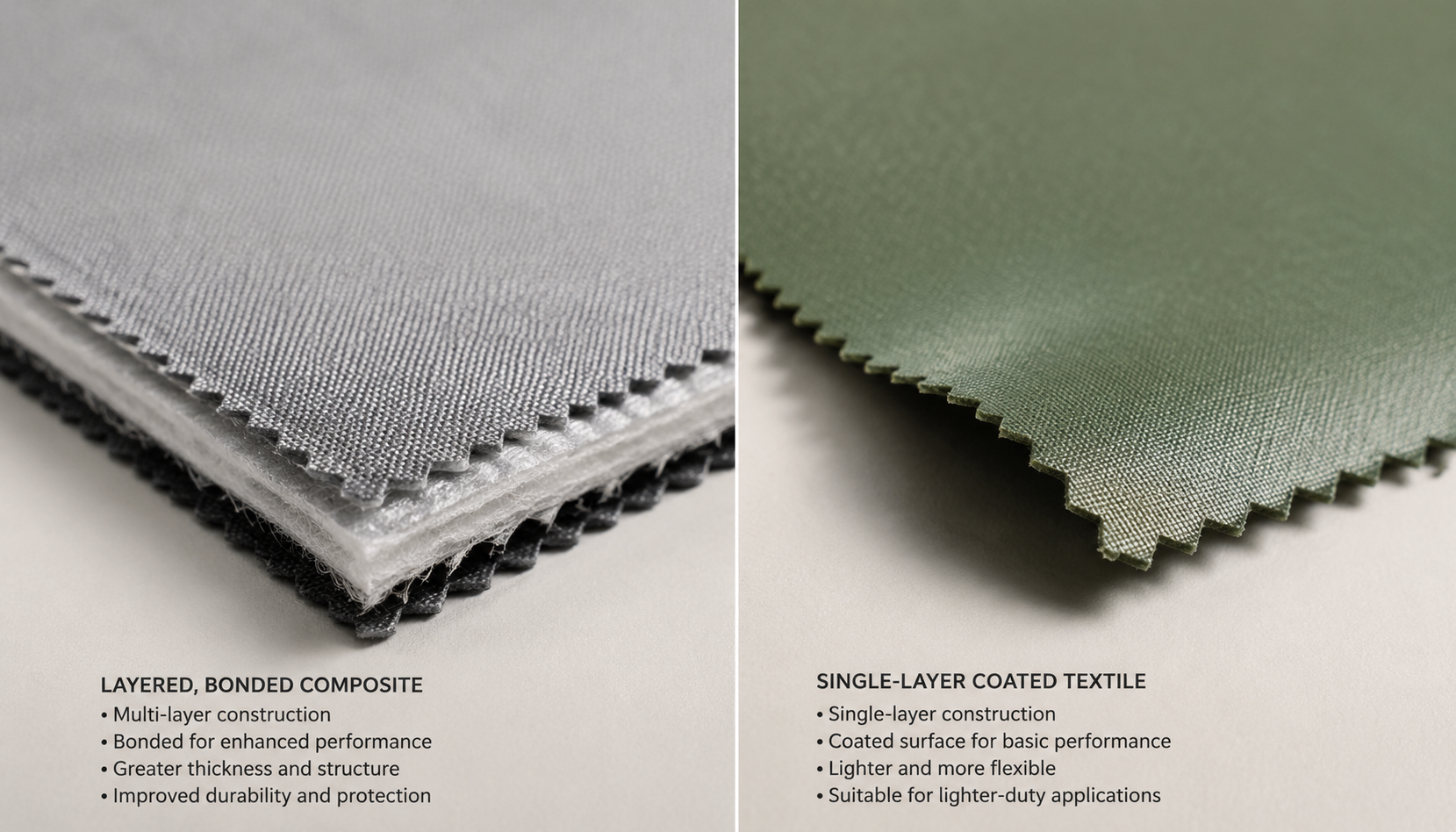
A European outdoor brand once rejected a 5,000 m (16,400 ft) shipment of “bonded” jackets because the fabric delaminated after three washes—their supplier had actually shipped a coated nylon. That single-word mix-up cost them €12,000 in rework and a six-week launch delay. For B2B textile buyers, understanding the real bonded vs coated fabric difference isn’t academic—it’s the line between on-time delivery and a full-blown supply-chain headache.
Before you can choose between these two fabrication methods, you need to know exactly what each one is. They look similar on a sample card. In the hand, a novice buyer might not feel the difference at all. But under the microscope—and in the field—the structural gap between them drives everything downstream.
The simplest bonded fabric meaning is this: two or more textile layers fused into a single composite through heat, pressure, or adhesive. Think of it as a sandwich—the face fabric, a functional membrane, and a lining, all locked together.
The lamination process typically runs through a nip roller system. Adhesive film (either dot-pattern or full-surface) is laid between layers, then heat-activated at 130–160°C (266–320°F) depending on the adhesive chemistry—TPU-based adhesives sit at the higher end, while EVA-based films activate lower. Roller pressure ranges from 2–5 bar (29–73 psi), enough to consolidate the layers without crushing the membrane’s micro-pores.
Dots versus full-surface bonding matters more than most buyers realize. Dot bonding preserves drape and breathability at the cost of slightly lower peel strength. Full-surface bonding locks everything tight but can make the hand feel stiffer—sometimes uncomfortably so for next-to-skin applications.
A real-world example of high-quality lamination-grade composite textiles can be found in the factory’s specialty finishes and custom bonded product line, which documents spec sheets for three-layer laminates with published MVTR and hydrostatic head values. That kind of transparency turns a vague marketing claim into data you can actually verify.
Where bonding fuses layers, coating deposits chemistry onto the face. That’s the core coated fabric definition: a base textile with a polymer layer applied to one or both surfaces—usually through knife-over-roll, transfer coating, or direct gravure methods.
Common coatings include polyurethane (PU), PVC, silicone, and acrylic, each with typical application thicknesses of 15–50 µm. PU coatings dominate apparel and soft goods. PVC owns industrial applications. Silicone is niche but growing in heat-resistant and medical contexts.
Critically, a coated fabric remains a single structural unit. There is no adhesive interface to fail, no membrane to puncture separately. The polymer chemically bonds to the textile surface—or, in the case of PVC, mechanically grips the weave structure. You lose some flexibility in engineering performance, but you gain simplicity in the supply chain and often in care instructions.
Here’s the bonded vs coated fabric difference clothing buyers really need to internalize: bonded equals multi-layer composite held by adhesive or heat; coated equals a single substrate with a surface-applied polymer. That cascade of consequences—from breathability to seam strength to wash temperature tolerance to price per linear meter—stems from nothing more than this structural fork. Everything else is detail. Important detail, sure, but detail.
If the structural explanation above was the “why,” this section is the “so what.” Let’s translate those manufacturing distinctions into numbers that actually affect purchasing decisions.
| Property | Bonded Fabric | Coated Fabric |
|---|---|---|
| Layer Structure | Multi-layer (2–4 layers), adhesive-bonded | Single substrate + surface polymer |
| Typical Weight Range | 100–200 gsm (3.0–5.9 oz/yd²) | 80–350 gsm (2.4–10.3 oz/yd²) |
| Breathability (MVTR) | 5,000–20,000 g/m²/24h | 500–5,000 g/m²/24h |
| Water Resistance | 10,000–20,000 mm H₂O | 2,000–30,000 mm H₂O |
| Seam Strength | 30–50 N/5 cm | 20–40 N/5 cm |
| Typical Price Delta | +20–40% vs coated equivalent | Baseline cost reference |
| Common Failure Mode | Delamination at adhesive interface | Surface cracking, hydrolysis (PU), plasticizer migration (PVC) |
Every row in that table maps to a procurement risk. Low MVTR on a coated fabric? Expect warranty claims once the product hits an activewear market. High seam strength on a multi-layer bonded laminate? That often adds 8–12% to CMT cost because the sewing team needs heavier needles and slower stitch speeds.
A quick fabric selection guide shortcut for B2B textile sourcing: if your end-use demands simultaneously exceeding 10,000 mm H₂O and 8,000 g/m²/24h MVTR, bonded is almost certainly your path. If waterproofing above 20,000 mm is the priority and breathability is secondary—or if the product will be welded rather than sewn—coated likely wins.
For a full range of lamination options with published technical specifications that you can cross-reference against these thresholds, check the factory’s knit base fabrics and bonded product category page. Verifiable data beats marketing copy every time.
Understanding the manufacturing workflow helps you anticipate what can go wrong—and which questions to ask during supplier qualification. The process shapes the product more than any spec sheet can convey.
The bonding process follows a tightly sequenced workflow. Each step introduces a potential failure point if QC is slack.
QC checkpoints are non-negotiable. Peel strength testing per EN ISO 2411 should target ≥10 N/25 mm for apparel-grade laminates and ≥15 N/25 mm for workwear. Visual delamination inspection under standardized lighting catches defects that numbers miss.
The coating process is conceptually simpler but demands equal process discipline.
This is where theory meets warranty returns. Bonded fabrics fail via delamination—the adhesive interface literally peels apart. Repeated flex cycles stress the bond; 50,000+ Martindale cycles can dislodge a poorly bonded membrane even if peel strength tested fine out of the gate.
Coated fabrics fail differently. PU coatings are susceptible to hydrolysis—moisture and heat break down the polymer chains, turning a once-flexible coating into a sticky, crumbling mess. PVC coatings suffer plasticizer migration over time, especially at elevated temperatures, causing the surface to stiffen and eventually crack. Understanding these failure signatures helps you specify the right test protocols before you commit to bulk.
Technology doesn’t live in a lab. It lives in specific products, specific climates, specific failure modes. Let’s map each fabric type to the applications where it genuinely earns its keep.
Bonded laminates dominate wherever multi-parameter performance is non-negotiable. The five big categories are:
Coated fabrics own the volume-driven, performance-secondary segments. Here’s where they show up:
Neither technology has a clean monopoly. In the middle ground—mid-range rain jackets, softshell garments, certain upholstery lines—both bonded and coated solutions can deliver acceptable results. In those overlap zones, the decision often hinges on non-technical factors: minimum order quantities, lead time, end-market positioning, and cost ceiling.
I personally lean toward bonded solutions for garments where the wearer will sweat, and coated solutions for anything that sits still or gets folded repeatedly in non-perforating applications. But that’s a preference born of seeing enough delamination claims—not a hard rule.
If your next project sits in this gray area and you’re not sure which direction to go, the factory’s technical team offers application-specific consultations. You can reach out through the contact page, send your tech pack or spec sheet, and get a data-backed recommendation within 24 business hours. Sometimes a 15-minute call with a process engineer saves you from chasing the wrong substrate for six weeks.
Rather than leaving you with a pile of data and no decision path, here’s a four-step framework that transforms the bonded vs coated fabric difference into a sourcing action plan.
List your non-negotiable performance specs before you talk to any supplier. Get these numbers from your product development team, not from the mill’s sales rep. The essentials:
If you don’t have these numbers locked in, stop here and go get them. Speculating on fabrics without confirmed end-use requirements is how that European brand ended up with 16,400 feet of the wrong material.
Use this shortcut to narrow the field quickly. These are starting points, not rigid algorithms:
Outside these ranges, you’re in the overlap zone. Make your decision based on trade-offs rather than defaults.
This is the step most buyers skip—and the one that causes the most expensive surprises. A mediocre bonded fabric from an under-equipped lamination line will underperform a good coated fabric from a supplier with rigorous QC. In textile procurement, capability beats chemistry.
Evaluate your supplier on four criteria:
Never commit to bulk on swatches alone. Request full-width samples—minimum 3 m (10 ft)—and run your own in-house and third-party testing. Key test standards to demand:
A reliable supplier provides test reports with every sample shipment. If they hand you fabric and a handshake—nothing else—walk away.
You can request full-width samples with accompanying test reports directly through the factory’s sample request process, which ships 1–3 m (3.3–9.8 ft) lengths per color within 5–7 business days. The fee is credited against your first bulk order.
Frameworks are helpful, but checklists catch what frameworks overlook. Print this out. Pin it above your desk. Or just bookmark the page.
Several warning signs should pause your sourcing process immediately:
The case of a Middle Eastern workwear distributor underscores why these checks matter. The distributor sourced 20,000 m (65,600 ft) of so-called “bonded” FR fabric for oil and gas coveralls—from a new supplier offering 15% below the incumbent’s pricing. When the fabric arrived, peel strength tested at 6 N/25 mm against a spec requirement of ≥12 N/25 mm per EN ISO 2411. The adhesive had degraded because the fabric spent three weeks in a humid, non-climate-controlled container during transit—something their QC process never accounted for because they skipped step two on the checklist above.
The supplier offered a 5% credit note. The distributor engaged their original supplier for an emergency re-order, but the 28-day lead time collided with a 14-day project deadline. The compromise: they accepted the credit, used the substandard fabric for non-critical internal linings where peel strength was less consequential, expedited 8,000 m (26,200 ft) from the incumbent at standard pricing. Total project cost increased 12%. The project shipped 10 days late. An expensive lesson that a checklist—and a humid-clause in the purchase contract—could have prevented.
Bonded fabric is a multi-layer composite—face, membrane, lining—held together by adhesive and heat. Coated fabric is a single textile substrate with a polymer layer applied directly to its surface. For clothing, this structural difference is the reason bonded fabrics typically offer superior breathability (MVTR of 5,000–20,000 g/m²/24h versus 500–5,000 for coated), while coated fabrics win on simplicity, lower cost, and easier sealing or welding applications.
Most bonded fabrics are rated for 30–40°C (86–104°F) wash cycles. Higher temperatures risk softening the adhesive interface, causing delamination over repeated washes. Some high-performance TPU-bonded constructions can tolerate 60°C (140°F)—but never assume. Always confirm the care specifications with your supplier’s technical data sheet, and validate with EN ISO 6330 wash testing before committing to care label instructions.
Bonded fabrics generally cost 20–40% more than their coated equivalents. That premium reflects the additional adhesive film, the membrane layer, the longer processing time, and more stringent QC. PVC-coated fabrics are typically the most cost-effective option for industrial applications—sometimes 50% cheaper than equivalent-weight bonded laminates. The cost question, though, should never be answered in isolation. A cheaper fabric that causes warranty returns is the most expensive option of all.
Key certifications include OEKO-TEX Standard 100 for chemical safety (any classification from Class I for infant to Class IV for decorative), bluesign for sustainable chemistry practices, and EU REACH compliance for restricted substance control. The Global Recycled Standard (GRS) is increasingly requested for recycled content verification. Requirements vary by end-market—EU and North American channels have the strictest certification expectations. When evaluating a supplier’s certification portfolio, verify that their certificates cover the specific product lines you’re ordering, not just the company in general. A factory accredited to OEKO-TEX for its plain polyester does not automatically carry that accreditation for its bonded laminates.
It’s worth noting that the factory behind this guide has built a 20-year track record of integrated production across weave, coating, and lamination lines, with a certification portfolio spanning OEKO-TEX Standard 100, GRS 4.0, ISO 9001:2015, and bluesign system partnership—details that can be explored further on the company’s about page, which includes a virtual factory tour and equipment inventory.
The bonded vs coated fabric difference is not a contest with a universal winner. It is a set of trade-offs—breathability against cost, durability against simplicity, performance ceiling against supply chain flexibility—and the right answer depends entirely on what you are building, who will use it, and how much margin you have to absorb a wrong turn.
I have sat in enough sourcing meetings to know that the temptation is always to pick the cheaper option and hope the spec holds. Sometimes it does. More often, the failure shows up six months later in a warranty pile or a brand-damaging review. The few extra dollars per meter for a properly engineered bonded laminate—or the discipline to specify a coated fabric for an application that genuinely does not need lamination—pays for itself many times over in avoided headaches.
Ask questions. Demand test reports. Sample extensively. And when you are staring at two fabric options that both look right on paper, remember that the difference between them is not just chemistry—it is structure. Get that part right, and everything downstream gets easier.