Address
Nanlang Industrial Zone, Xingtan Town, Shunde District, Foshan, Guangdong, China
Work Hours
Mon–Fri, 9:00 AM – 6:00 PM (CST/UTC+8). We aim to respond to all inquiries within 48 hours.

Address
Nanlang Industrial Zone, Xingtan Town, Shunde District, Foshan, Guangdong, China
Work Hours
Mon–Fri, 9:00 AM – 6:00 PM (CST/UTC+8). We aim to respond to all inquiries within 48 hours.
OEKO-TEX vs GRS Certification: What B2B Buyers Actually Need. This guide covers key properties, real-world applications, and a practical sourcing checklist for B2B buyers.
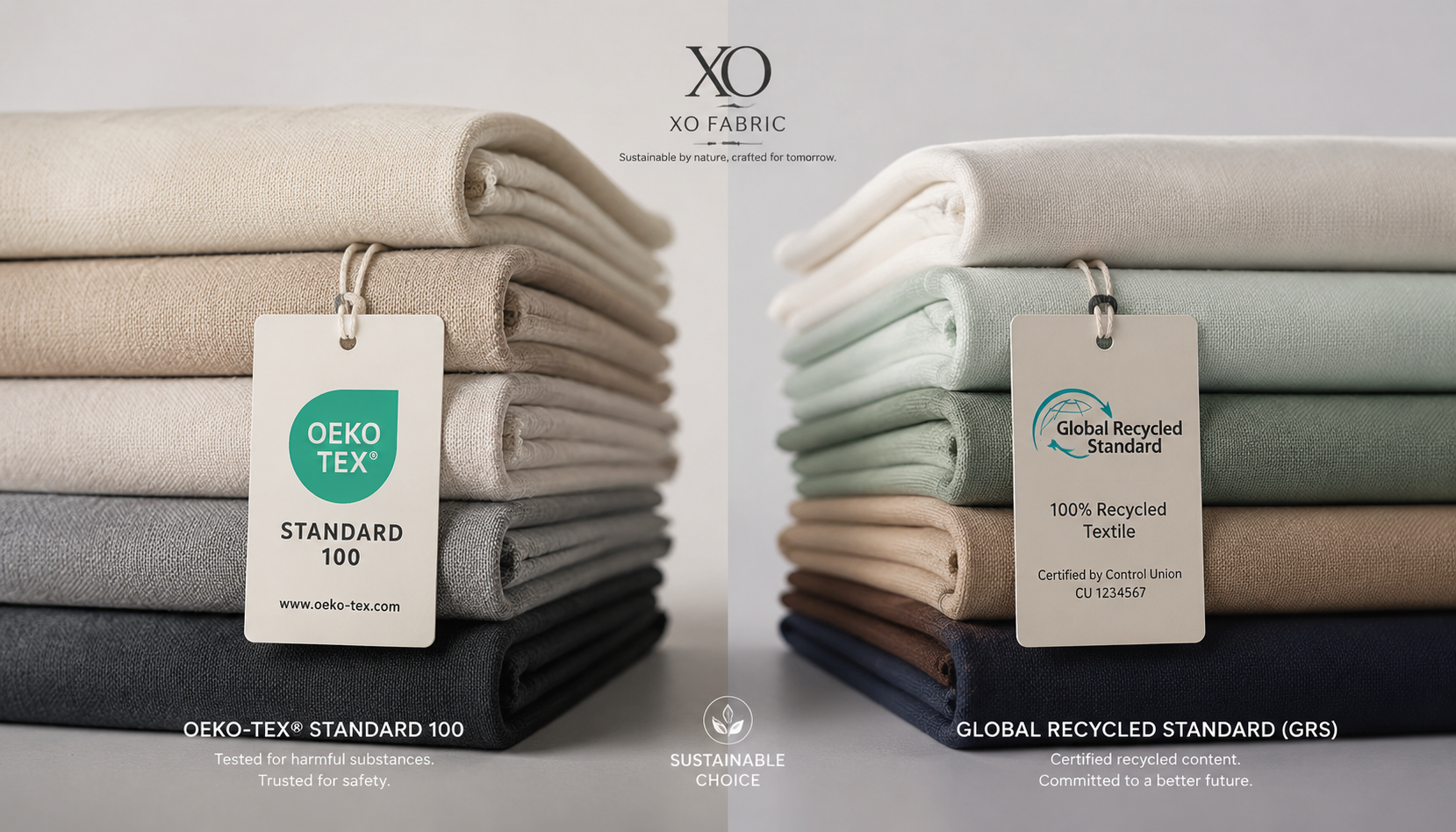
A European outdoor brand’s quality team once rejected an entire shipment of recycled polyester fleece — not because the fabric failed safety tests, but because the supplier’s OEKO-TEX Standard 100 certificate was being presented as proof of “sustainable sourcing.” It wasn’t. The certificate proved the finished product was free of harmful residues. It said absolutely nothing about whether the yarn inside contained a single gram of recycled material. That distinction — seemingly obvious to certification specialists — costs procurement teams real money every quarter, and it’s the reason this comparison exists.
At first glance, both certifications appear in conversations about “responsible textiles.” Both logos appear on hangtags. Both involve third-party testing bodies. But their foundational logic could not be more different.
OEKO-TEX Standard 100, managed by the OEKO-TEX Association in Zurich, is essentially a chemical safety net applied to finished textile products. It asks one question: does this product contain harmful substances above safe thresholds? It does not ask where the fiber came from, how the factory treats its workers, or whether any recycled content is involved. According to OEKO-TEX’s official Standard 100 documentation, the testing program covers more than 350 individual substances — a number that updates annually as new chemicals of concern emerge.
GRS (Global Recycled Standard), administered by Textile Exchange, takes a completely different angle. It’s a chain-of-custody certification that verifies recycled material content and traces it through every step of the supply chain — from the recycling facility to the final product. The GRS 4.0 standard also layers in social and environmental requirements, referencing ILO conventions and wastewater management benchmarks. But its core job is answering: how much of this product is actually recycled, and can you prove it?
| Certification | Managing Body | Certification Object | Core Testing Dimension |
|---|---|---|---|
| OEKO-TEX Standard 100 | OEKO-TEX Association (Switzerland) | Finished textile product | Chemical residue screening (350+ substances) |
| GRS (Global Recycled Standard) | Textile Exchange (USA) | Recycled material supply chain | Recycled content percentage + chain-of-custody traceability |
The Standard 100 program operates on a product-level basis, not a factory-level one. Each fabric SKU, each colorway, each production batch can — and often does — carry its own certificate. The testing scope includes formaldehyde, heavy metals (lead, cadmium, mercury, chromium VI), phthalates, PFAS compounds, alkylphenol ethoxylates (APEO), and a long list of regulated and non-regulated substances that OEKO-TEX proactively screens.
The classification system matters for procurement decisions. Standard 100 divides products into four classes: Class I for infant articles (the strictest limits), Class II for direct skin contact, Class III for products without direct skin contact, and Class IV for decorative materials. If you’re sourcing baby blankets, the allowable formaldehyde limit drops to 16 mg/kg (16 ppm), compared to 75 mg/kg (75 ppm) for Class III products. That difference alone can determine whether your fabric passes or fails — something I’ve seen trip up sourcing teams more than once.
GRS works backward from a percentage threshold. A product must contain at least 20% verified recycled material to earn GRS certification and carry the “GRS” label. At 50% or above, the product qualifies to display the GRS logo on marketing materials and hangtags. The numbers aren’t arbitrary — they were set to create a meaningful entry point while allowing for blended materials that dominate commercial production. A typical recycled polyester jersey might contain 60% post-consumer recycled PET fiber and 40% conventional polyester; under GRS, that product would qualify for the logo tier.
What makes GRS operationally intensive compared to OEKO-Yarn Count Converter is the Transaction Certificate (TC) system. Every shipment between GRS-certified entities must carry a TC that documents the weight, composition, and batch-level provenance of the recycled material. If a spinner’s GRS-certified yarn gets blended with a non-GRS yarn at the knitting stage — even by accident — the resulting fabric cannot receive a valid TC. This chain-of-custody requirement is where most supply chains break down, and it’s why GRS compliance costs more to maintain than a simple product-level test.
Definitions are useful, but procurement managers don’t buy definitions. They buy outcomes that match specifications, market requirements, and brand expectations. This section distills the two certifications into decision-relevant dimensions — the kind of comparison you’d pin to a sourcing team’s wall.
| Comparison Dimension | OEKO-TEX Standard 100 | GRS | Procurement Impact |
|---|---|---|---|
| Certification Goal | Verify chemical safety of finished product | Verify recycled content and supply chain traceability | Determines which brand claims you can legally make |
| Testing Object | Finished product (per SKU/colorway) | Supply chain (per entity + per shipment) | Affects which suppliers in your chain need certification |
| Validity Period | 12 months from issue | Annual audit + per-shipment TCs | Renewal planning matters for long-reorder programs |
| Renewal Cost | Lower (product-level testing fees) | Higher (multi-site audits + TC issuance fees) | Directly affects per-meter cost at lower volumes |
| Social Compliance | Not covered | ILO conventions referenced | GRS partially overlaps with SMETA/SA8000 audits |
| Transaction Certificate Required | No | Yes, per inter-entity shipment | Requires supplier coordination and documentation discipline |
| Impact on End-Product Labeling | Standard 100 label by product class | GRS label/logo by recycled content tier | Determines hangtag claims available for marketing |
| Typical Buyer Need | EU REACH compliance, CPSIA (US), brand safety spec | Recycled content claims, EPR reporting, EU textile strategy readiness | Aligns with different regulatory and commercial drivers |
Let’s talk numbers, because this is where procurement teams make real budgeting decisions. OEKO-TEX Standard 100 testing for a single fabric product typically runs in the range of USD 400–800 (depending on the number of colorways and substance categories needed), with results in 2–4 weeks. Annual renewal involves re-testing, which costs less than the initial certification since the test scope often narrows to substances flagged as “of continued interest.”
GRS is a different financial equation. Initial certification for a single manufacturing site can range from USD 2,000–5,000 when you factor in the audit fee, registration, and first year of Transaction Certificate issuance. And critically, every supplier in the chain — spinner, knitter, dyer, garment maker — needs their own GRS certification or at minimum a Letter of Approval. For a supply chain with 4–5 entities, the total GRS compliance cost can easily reach USD 15,000–25,000 annually. The audit timeline also runs longer: plan for 6–10 weeks from application to first TC issuance, compared to OEKO-TEX’s comparatively streamlined 2–4 week path.
One nuance that doesn’t appear in any official cost sheet: the hidden cost of GRS non-conformance. A single broken chain-of-custody link — say, a yarn broker who cannot produce a valid TC — can stall an entire shipment. I’ve seen this delay orders by 3 weeks while the affected batch was re-sourced and re-tested. With OEKO-TEX, the risk profile is simpler: pass the lab test or don’t. The accounting is cleaner.
Every procurement meeting I’ve sat in where OEKO-TEX and GRS come up, GOTS is not far behind. The three certifications form a triangle that confuses even experienced buyers, largely because they overlap just enough to create the illusion of interchangeability.
GOTS (Global Organic Textile Standard) is the most comprehensive — and the most demanding — of the three. It requires certified organic natural fiber content (≥70% for the “made with organic” label, ≥95% for the “organic” label), covers the entire processing chain from field to finished product, mandates strict chemical inputs criteria (essentially an enhanced version of what OEKO-TEX tests for, embedded within the supply chain audit), and includes non-negotiable social compliance requirements based on ILO core conventions. If OEKO-TEX asks “is the product safe?” and GRS asks “is the recycled content real?”, GOTS asks both of those questions plus “is the organic claim genuine, and were decent labor practices followed?”
| Certification | Core Concern | Raw Material Requirement | Social Compliance Requirement |
|---|---|---|---|
| OEKO-TEX Standard 100 | Product safety (chemical) | None — applicable to any fiber type | Not included |
| GRS | Recycled content verification + traceability | ≥20% certified recycled material | ILO conventions referenced; basic requirements |
| GOTS | Organic integrity + full-chain compliance | ≥70% certified organic natural fiber (label grade: ≥95%) | Mandatory; based on ILO core conventions; annual social audit |
The critical takeaway for B2B sourcing: OEKO-TEX + GRS ≠ GOTS. Stack OEKO-TEX and GRS on the same product, and you’ll have chemical safety verified and recycled content traced — but you will not have organic fiber compliance, full-chain chemical input restrictions beyond the finished product, or the mandatory social audit. GOTS is not a composite of other certifications; it is its own integrated system with its own audit bodies, its own scope, and its own accreditation structure. If a brand specification calls for GOTS, no combination of OEKO-TEX and GRS will satisfy it.
I’ve watched too many procurement teams default to “get all the certifications” as a risk-mitigation strategy. It’s understandable — nobody wants to be the one who missed a compliance requirement. But over-certifying is its own risk: increased cost, longer lead times, and supplier fatigue (a dyeworks that has to manage six different certification audits per year starts making mistakes). The smarter move is a structured needs assessment before the first RFQ goes out.
Here’s a three-step framework that’s kept our sourcing teams out of trouble:
There are real-world scenarios where dual certification is not just nice-to-have but commercially essential. The clearest example: recycled polyester fabric destined for the European infant product market. In this case, you need OEKO-TEX Standard 100 Class I (chemical safety for the strictest baby-product limits) and GRS (to substantiate the recycled content claim that commands a 10–15% price premium). Neither certification alone covers the full commercial requirement.
When stacking, sequence matters. Prioritize OEKO-TEX testing first — it’s faster, cheaper, and gives you immediate product safety confirmation while the GRS chain-of-custody work is being built through the supply chain. If OEKO-TEX reveals a problem (a trace of a restricted substance above the Class I threshold), you can address it before investing in GRS audit costs. I’ve seen teams do it the other way — lead with GRS, then discover a chemical compliance issue that requires reformulating the dyestuff, effectively wasting the first GRS audit cycle.
Additional cost impact: dual certification adds approximately 8–12% to the per-meter cost of the finished fabric, primarily driven by GRS’s multi-site audit requirements. On a 10,000-meter order of recycled polyester jersey, that translates to USD 0.15–0.30 per yard — meaningful when you’re buying at volume, but justified if the end product commands a sustainability premium in the target market.
Case in point: a mid-sized Scandinavian outdoor brand approached one of our partner suppliers about sourcing a recycled fleece fabric for their children’s collection. The initial brief said “certified sustainable fabric” — no specific certifications named. The procurement team pursued OEKO-TEX Standard 100 first, assuming chemical compliance was the priority. Certificate in hand, they submitted samples to the brand, who immediately responded: “Where’s the recycled proof?”
Round two: the team initiated GRS certification. But the yarn spinner — a separate entity from the weaver — wasn’t GRS-certified and had blended GRS-origin fiber with conventional stock in shared storage bins. The Transaction Certificate application was rejected: chain of custody broken at the yarn stage. Three weeks lost while the spinner reorganized storage, applied for GRS letter of approval, and reissued compliant yarn.
The compromise: the supplier accepted a dual-certification workflow as standard for this brand relationship. They built a dedicated GRS-compliant yarn storage zone — roughly 150 m² (1,615 ft²) of marked, separated warehouse space — adding about 8% to procurement costs. Lead time stretched from 45 days to 60 days (approximately 2 months). But the resulting product now carries both the OEKO-TEX Class I label and the GRS logo, giving the brand’s marketing team exactly the claims they needed. The pain was real. The outcome was commercially right.
Knowing which certifications you need is step one. Knowing whether the certificates your supplier actually handed you are legitimate and current is step two — and the step where most procurement failures happen. Here are seven red flags that should trigger immediate follow-up:
For OEKO-TEX, it’s genuinely quick: go to the Label Check page, enter the certificate number and product type, and confirm the certificate is active with a scope matching your ordered product. For GRS, ask your supplier for their Certificate Scope (which lists what they are certified to produce) and verify their certification body is listed on the Textile Exchange website. If the supplier is claiming a Transaction Certificate for a specific order, request the PDF — it will show the issuing CB, the certificate holder, material type, weight, and the sending/receiving entities. Match these against your purchase order and your supply chain map. It really does take about 60 seconds once the documents are in front of you. The hard part — as always — is getting the documents.
A quick micro-note from practice: a fabric trader once showed me an OEKO-TEX certificate for “100% polyester woven fabric” to cover a product that was actually a polyester-spandex blend (92/8%). Technically, the spandex content disqualified the certificate’s applicability to that specific product. The trader wasn’t trying to defraud anyone — they simply didn’t understand the distinction between OEKO-TEX covering the polyester component versus covering the finished blended product. But a market inspector or brand auditor wouldn’t care about intent. The certificate didn’t match the SKU. Period.
Here’s the direct answer to a question that surfaces constantly in procurement discussions: no single textile certification is “better” than OEKO-TEX Standard 100 in absolute terms. The question itself reveals a category error — it assumes certifications exist on a single vertical axis of quality, when they actually occupy different horizontal lanes of concern. Asking “what’s better than OEKO-TEX?” is like asking “what’s better than a fire extinguisher?” It depends on whether you’re fighting a fire, a flood, or a gas leak.
The evaluation should instead be built on three dimensions:
In certain scenarios, GRS delivers more commercial value than OEKO-TEX. For a recycled nylon supply chain serving European sportswear brands, GRS certification is the gating factor — without it, the “recycled” claim cannot be substantiated, and the product loses its competitive positioning. In other scenarios, OEKO-TEX is the non-negotiable: infant products, anything touching broken skin, and products destined for the most sensitive end uses where regulatory scrutiny is highest. There is no universal hierarchy. There is only fit.
Better depends on what you’re optimizing for. If your priority is recycled content verification and supply chain traceability, GRS addresses that directly. If your brand requires certified organic fiber with full-chain social and environmental compliance, GOTS is the relevant standard — and its requirements significantly exceed both OEKO-TEX and GRS in scope. For chemical safety alone on a finished product, OEKO-TEX Standard 100 remains the most widely recognized benchmark globally. The best move is to communicate your specific product type, target market, and brand requirements to a manufacturer experienced with multiple certification systems.
GRS verifies that a product contains a minimum of 20% recycled material, with full supply chain traceability through Transaction Certificates. It does not require organic fiber. GOTS requires ≥70% certified organic natural fiber (or ≥95% for the “organic” label grade), mandates strict chemical input restrictions throughout the processing chain, and includes enforceable social compliance audits. GOTS is substantially more demanding and more expensive to achieve and maintain.
No — these are fundamentally different certifications. OEKO-TEX Standard 100 is a product-level chemical safety test applied to the finished textile, regardless of fiber origin. GOTS is a full-chain certification covering organic fiber integrity, chemical inputs, environmental management, and social compliance from spinning through final packaging. An OEKO-TEX certificate tells you nothing about organic content; a GOTS certificate inherently includes chemical safety verification (and much more). They are not interchangeable.
Absolutely, and it’s increasingly common in European-facing product lines where recycled content claims must be substantiated alongside formal chemical safety verification. The two certifications operate independently — OEKO-TEX tests the product; GRS audits the supply chain — so they complement rather than conflict with each other. The key operational consideration is that their audit and renewal cycles don’t synchronize automatically, so planning buffer time around overlapping administrative windows is wise. For further guidance on how these apply to your specific fabric program, don’t hesitate to contact the factory’s technical team for a certification mapping based on your product specifications and target market.
Certification in the textile industry is not a checklist you complete once and file away. It’s an ongoing operational commitment — one that touches raw material purchasing, production scheduling, documentation discipline, and ultimately your ability to make credible claims in front of end consumers and regulators. The OEKO-TEX versus GRS question isn’t really “which one is better.” It’s “which one solves the problem my order, my market, and my customer actually have.” Make that determination before the first PO goes out, and you’ll save yourself weeks of rework, thousands in re-certification fees, and at least one awkward conversation with a brand buyer about why the certificate doesn’t say what the hangtag claims.
Since 2005, the factory behind this resource has maintained certifications including OEKO-TEX Standard 100, GRS 4.0, ISO 9001, and EU REACH compliance — not because any single certification is the answer, but because different customers face different regulatory and commercial realities. If you’re mapping your own certification strategy and want a technical perspective grounded in real production experience, you can always submit an inquiry with your product specs for a tailored recommendation and optional sample development.