Address
Nanlang Industrial Zone, Xingtan Town, Shunde District, Foshan, Guangdong, China
Work Hours
Mon–Fri, 9:00 AM – 6:00 PM (CST/UTC+8). We aim to respond to all inquiries within 48 hours.

Address
Nanlang Industrial Zone, Xingtan Town, Shunde District, Foshan, Guangdong, China
Work Hours
Mon–Fri, 9:00 AM – 6:00 PM (CST/UTC+8). We aim to respond to all inquiries within 48 hours.
Interlock Knit Fabric: Properties, Seasonality & Best Uses. This guide covers key properties, real-world applications, and a practical sourcing checklist for B2B buyers.
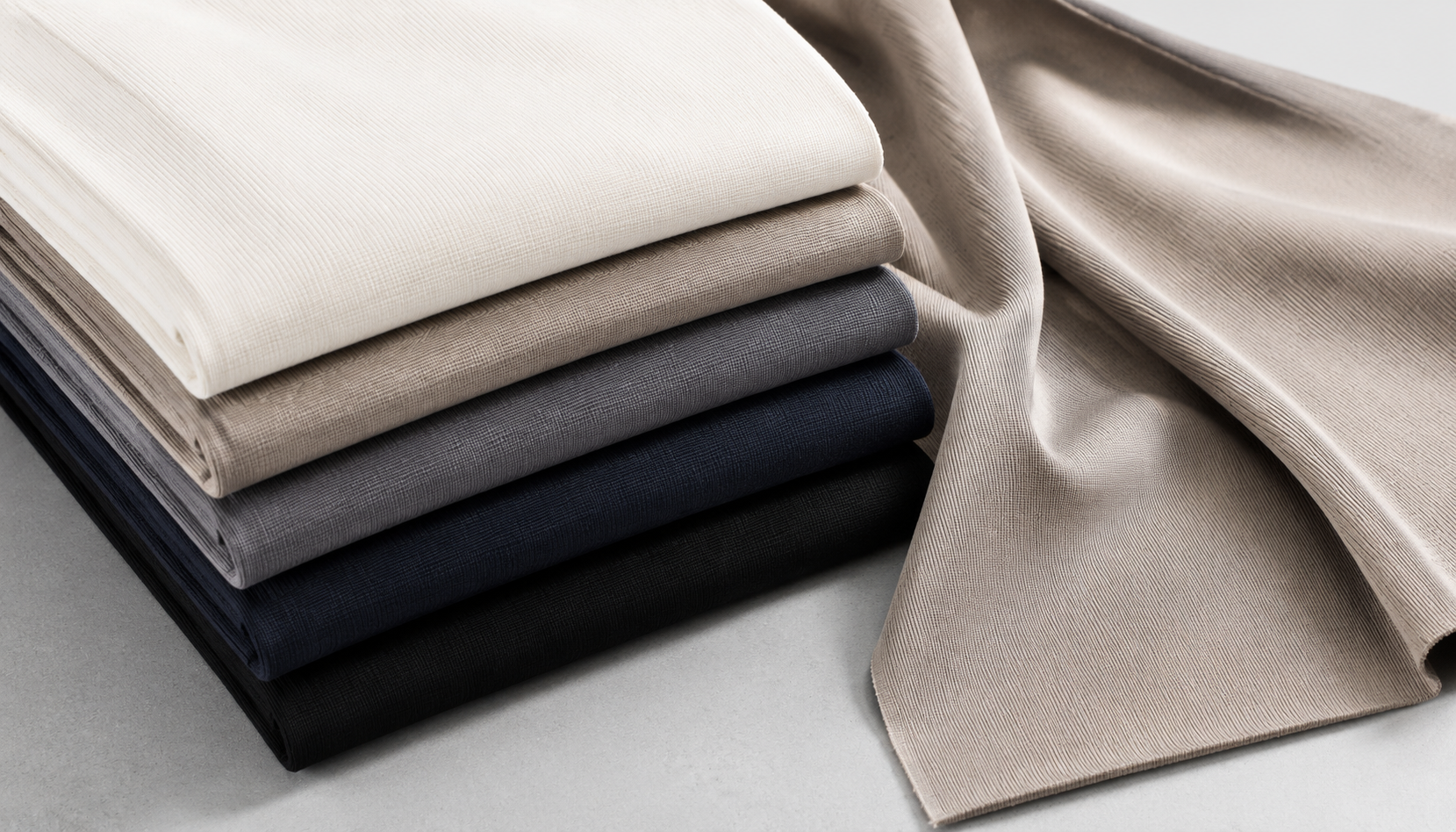
A Southeast Asian brand recently placed their first order for baby bodysuits, specifying “interlock” on the purchase order. What arrived was a single jersey fabric with a brushed inner face—a common supplier shortcut. The result? Severe transparency issues under stretch, a full container rejection, and a six-month delay to market. The painful lesson: knowing the difference between fabric constructions isn’t academic—it’s the line between profit and a write-off.
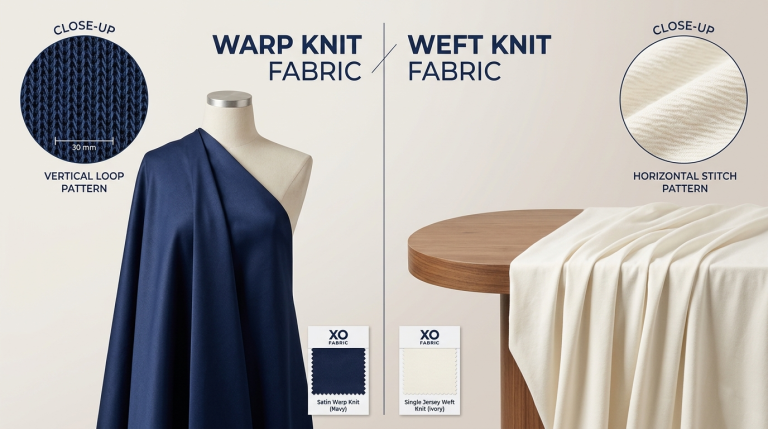
Let’s start with the classification tree, because this is where most sourcing confusion begins. In the world of knits, the hierarchy flows: knit → weft knit → double knit → interlock. Interlock is a specific subset of double-knit fabrics where two sets of needles—arranged on a dial and a cylinder—synchronize to form interlocking loops on both faces simultaneously.
The result is a fabric where both sides look identical: vertical wale lines, smooth surface, no float stitches visible. This is fundamentally different from single jersey (one face shows knit stitches, the other purl) or 1×1 rib (alternating knit-and-purl wales that create visible vertical ridges on both sides, but with a different hand-feel).
For B2B buyers, this distinction matters enormously. The double-faced, interlocked structure gives interlock its signature traits: no curling at the edges, a firm yet soft hand, and approximately 1.5 to 2 times the thickness of a comparable single jersey. These properties make it a go-to for applications where surface smoothness, opacity, and dimensional stability are non-negotiable—think infant wear, medical textiles, and premium underwear.
Understanding where interlock sits within the broader weft knit family helps you navigate supplier catalogs more intelligently, especially when comparing across pique, jersey, and rib constructions. If you want to explore the full range of weft-knit options available from the factory, you can browse the weft knit fabrics category to see how interlock fits alongside its cousins.
On a double-knit circular machine, the dial (horizontal needle bed) and the cylinder (vertical needle bed) work in alternating sequence. In each feed, the yarn first forms a loop on the front needle, then on the back needle, creating a true interlock where the loops from each face nest inside each other. This is not a two-layer fabric stitched together—it’s a single, unified structure.
The needle configuration matters. A 2+2 setup (two needles on dial, two on cylinder per cam system) produces a slightly looser, more flexible hand, while a 1+1 configuration yields a denser, crisper fabric. Most commercial interlock uses 2+2 for apparel applications and 1+1 for technical or industrial uses.
Here’s why this matters for sourcing: you cannot “simulate” interlock through post-finishing. A single jersey cannot be napped, brushed, or laminated to achieve interlock’s properties. The performance is structural, not chemical. This is a common misconception among buyers who try to substitute cheaper constructions.
| Fabric Type | Needle Configuration | Face/Back Consistency | Edge Curling |
|---|---|---|---|
| Interlock | Dial + Cylinder, synchronized | Identical on both sides | None |
| Single Jersey | Single cylinder only | Different (knit vs purl) | Significant curl on all four edges |
| 1×1 Rib | Dial + Cylinder, alternating | Similar ridged texture, but different hand | Minimal curl, but elastic recoil at edges |
For a deeper dive into how these structures compare across the full spectrum of knit base fabrics, the knit base fabrics overview provides a comprehensive reference.
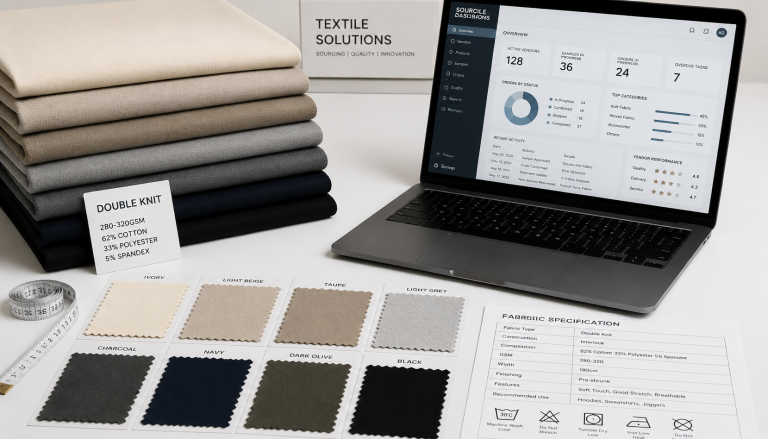
Typical interlock specifications run from 160 to 310 gsm (4.7 to 9.1 oz/yd²), with common widths of 150–180 cm (59–71″). Material compositions span 100% cotton, CVC (chiefly cotton), TC (chiefly polyester), and 100% polyester or recycled polyester blends. The structural density means interlock absorbs dye deeply and evenly, which is why it’s favored for solid-color applications where uniformity is critical.
B2B buyers frequently request an “interlock knit fabric properties PDF” from their suppliers. The problem is that most spec sheets list numbers without explaining what those numbers mean for your finished product. Let’s break down the parameters that actually impact your sourcing decisions.
| Parameter | Typical Range (Metric + Imperial) | Test Standard | Sourcing Implication |
|---|---|---|---|
| Weight (GSM) | 160–310 gsm (4.7–9.1 oz/yd²) | ASTM D3776 | Drives cost, drape, and season suitability |
| Thickness | 0.5–1.2 mm (0.02–0.05 in) | ASTM D1777 | Affects layering strategy and pattern grading |
| Horizontal Stretch | 20–45% | ASTM D2594 | Critical for pattern width allowances |
| Vertical Stretch | 5–15% | ASTM D2594 | Less give—garment length is more stable |
| Air Permeability | 80–150 cfm (ft³/min·ft²) | ASTM D737 | Lower than single jersey at same weight—warmer |
| Pilling Resistance | Grade 3–4 (out of 5) | ASTM D4970 | Cotton interlock pills faster than polyester |
| Formaldehyde Limit | ≤ 16 mg/kg (Class I infant) | OEKO-TEX Standard 100 | Non-negotiable for infant and skin-contact products |
| Colorfastness (Wash) | ≥ Grade 4 (change), ≥ Grade 3–4 (staining) | ISO 105-C06 | Below this = returns and brand damage |
When converting between metric and imperial weight units for your spec sheets—say, comparing a 220 gsm interlock against a 6.5 oz/yd² sample from a US buyer’s request—the GSM calculator tool eliminates manual conversion errors and keeps your documentation consistent across markets.
Stretch asymmetry. Interlock’s horizontal stretch (20–45%) far exceeds its vertical stretch (5–15%). This means your pattern grading must account for width ease differently than length ease. I’ve seen factories cut interlock garments on-grain assuming symmetrical stretch, only to find the body fits fine but the length is uncomfortably short after washing.
Thermal performance. At roughly 1.5× the thickness of single jersey, interlock traps more air and provides meaningful insulation. This makes it excellent for autumn/winter base layers and mid-layers, but potentially too warm for summer single-wear applications in tropical climates.
Is all interlock cotton? No. While 100% cotton and CVC interlocks dominate the market, 100% polyester interlock—especially recycled polyester variants—is growing rapidly in the activewear segment. The hand-feel and moisture management profile are completely different, so specifying “interlock” without specifying composition is a recipe for receiving the wrong fabric.
There is no universally “best” knit structure. The right choice depends entirely on your product’s end-use requirements. Here’s a decision matrix that cuts through the marketing noise.
| Evaluation Dimension | Interlock | Single Jersey | 1×1 Rib |
|---|---|---|---|
| Surface Smoothness | Excellent—flat, uniform face | Good on face side, purl on back | Ridged texture on both sides |
| Edge Curling | None | Severe on all edges | Minimal, but elastic recoil |
| Face/Back Consistency | Identical | Different | Similar but textured |
| Relative Cost Index | 1.3–1.5× (highest) | 1.0× (baseline) | 1.1–1.2× |
| Best Season | Autumn/Winter, transitional | Spring/Summer | Year-round (depends on weight) |
| Sewing Difficulty | Moderate—stable but thick | Easy—thin and pliable | Moderate—elastic recovery complicates feeding |
| Strongest Application | Infant wear, medical, premium underwear | T-shirts, casual tops, layering | Cuffs, neckbands, fitted silhouettes |
When comparing fabric quotes from different suppliers, you’ll often encounter yarn count specifications in different systems—English (Ne), metric (Nm), tex, or denier. This creates real confusion when trying to compare apples to apples. The yarn count converter handles these conversions instantly, so you can standardize your comparison basis before making sourcing decisions.
One property alone—”interlock doesn’t curl”—has driven entire product categories to switch away from single jersey. For baby clothing brands, eliminating the need for serged or heat-cut edges means fewer production steps, lower per-unit finishing costs, and zero risk of heat-damage marks on delicate fabrics. For medical textiles, the clean edge reduces lint generation during cutting and assembly. It’s a structural advantage that no amount of post-processing on single jersey can replicate.
Thin interlock (≤180 gsm / 5.3 oz/yd²) in 100% cotton can work for loose-fitting summer T-shirts, particularly in relaxed silhouettes where airflow isn’t restricted by tight construction. But compared to the same weight in single jersey, interlock will feel noticeably warmer. The double-layer structure simply traps more air. If your product line targets hot, humid climates, interlock is probably not your first choice for summer basics.
This is where interlock truly shines. At 280–310 gsm (8.2–9.1 oz/yd²), cotton or CVC interlock provides substantial warmth without the bulk of fleece or the pilling tendency of brushed fabrics. There’s growing industry discussion about using heavyweight interlock as a cost-effective alternative to brushed-back fabrics in mid-layer winter garments—the surface stays smooth and clean, the cost is lower, and there’s no pile to shed or pill over time.
Interlock is a construction method, not a material. The reason this question has such high search volume is that the vast majority of commercial interlock—probably 70% or more of global production—is indeed 100% cotton or CVC. But 100% polyester interlock, Tencel interlock, and modal/cotton interlock are all growing segments. Each material brings a different performance profile: polyester for moisture-wicking activewear, Tencel for sustainable luxury basics, modal for enhanced drape in loungewear. Always specify both construction and composition on your purchase orders.
The factory’s integrated production line—established since 2005 with weaving, dyeing, and flocking capabilities under one roof—supports this full range of material options, which you can explore further on the about page.
A Middle East baby brand was sourcing 180 gsm cotton interlock for infant bodysuits, needing OEKO-TEX Standard 100 Class I certification. The interlock quote came in 35% higher than single jersey. The procurement team pushed to explore alternatives.
First attempt: single jersey at 180 gsm. Failed opacity QC under stretch—the fabric became semi-transparent when pulled, which is unacceptable for infant garments. Second attempt: increased single jersey weight to 220 gsm. Opacity improved, but the hand-feel became stiff and rough against infant skin in wear trials. Third attempt: switched to 1×1 rib. Opacity and hand-feel were acceptable, but edge curling during cutting caused a 22% increase in sewing defects and significantly slower production throughput.
The final compromise: 180 gsm CVC interlock (65/35 cotton-polyester blend). This passed OEKO-TEX Class I and the opacity QC. The per-unit cost was 11% lower than pure cotton interlock (saving approximately $0.30 per unit), though the brand had to adjust their “100% cotton” marketing claim. The lesson: interlock’s structural advantages aren’t just nice-to-have—they’re often the only viable path for certain product requirements.
For brands facing similar sourcing decisions, the technical engineering team is available to review your specifications and provide feasibility assessments. You can submit your technical spec sheets through the contact form, with a commitment to a one-on-one response from a dedicated technical engineer within 24 hours.
Q: Does interlock knit curl?
No. The double-faced, interlocked loop structure physically prevents edge curling. This is one of interlock’s most celebrated structural advantages and a primary reason it replaces single jersey + serging in infant and medical products. Only under extreme, sustained overstretching or in cases of needle-drop defects will you see minor edge waviness—but this is a quality issue, not an inherent property.
Q: Does interlock fabric fray?
The raw cut edge will eventually unravel along the wale direction, but at a significantly slower rate than woven fabrics. In industrial cutting, using ultrasonic blades or die-cutting dramatically reduces edge fraying. For most garment applications, the cut edge is enclosed in seams before fraying becomes visible.
Q: What is interlock fabric good for overall?
Interlock’s triple advantage—high surface smoothness, identical face/back appearance, and zero edge curling—makes it the structural choice of record for infant wear, medical textiles, and premium underwear. Where opacity, dimensional stability, and clean finishing are requirements rather than preferences, interlock consistently outperforms alternatives. It costs more per meter, but the downstream savings in finishing, defect reduction, and customer satisfaction typically justify the premium.
From confirming the right GSM and composition to verifying wash stability and sealing your first production run, the path from spec sheet to finished garment is full of technical traps that can derail timelines and budgets. If you’re evaluating interlock for an upcoming collection, the most efficient next step is to submit your technical specifications and design files for a professional feasibility review—our technical engineers commit to a one-on-one response within 24 hours via the contact page.