Address
Nanlang Industrial Zone, Xingtan Town, Shunde District, Foshan, Guangdong, China
Work Hours
Mon–Fri, 9:00 AM – 6:00 PM (CST/UTC+8). We aim to respond to all inquiries within 48 hours.

Address
Nanlang Industrial Zone, Xingtan Town, Shunde District, Foshan, Guangdong, China
Work Hours
Mon–Fri, 9:00 AM – 6:00 PM (CST/UTC+8). We aim to respond to all inquiries within 48 hours.
Spacer Knit Fabric Applications in Apparel, Footwear & Automotive. This guide covers key properties, real-world applications, and a practical sourcing checklist for B2B buyers.
A European sportswear brand recently recalled an entire production run of cycling jerseys after the spacer knit fabric in the back panels lost over 30% of its loft within five wash cycles. The procurement team had specified the correct thickness and weight, but they never asked for compression recovery data after laundering—a single test report that could have saved them six figures and a damaged reputation.
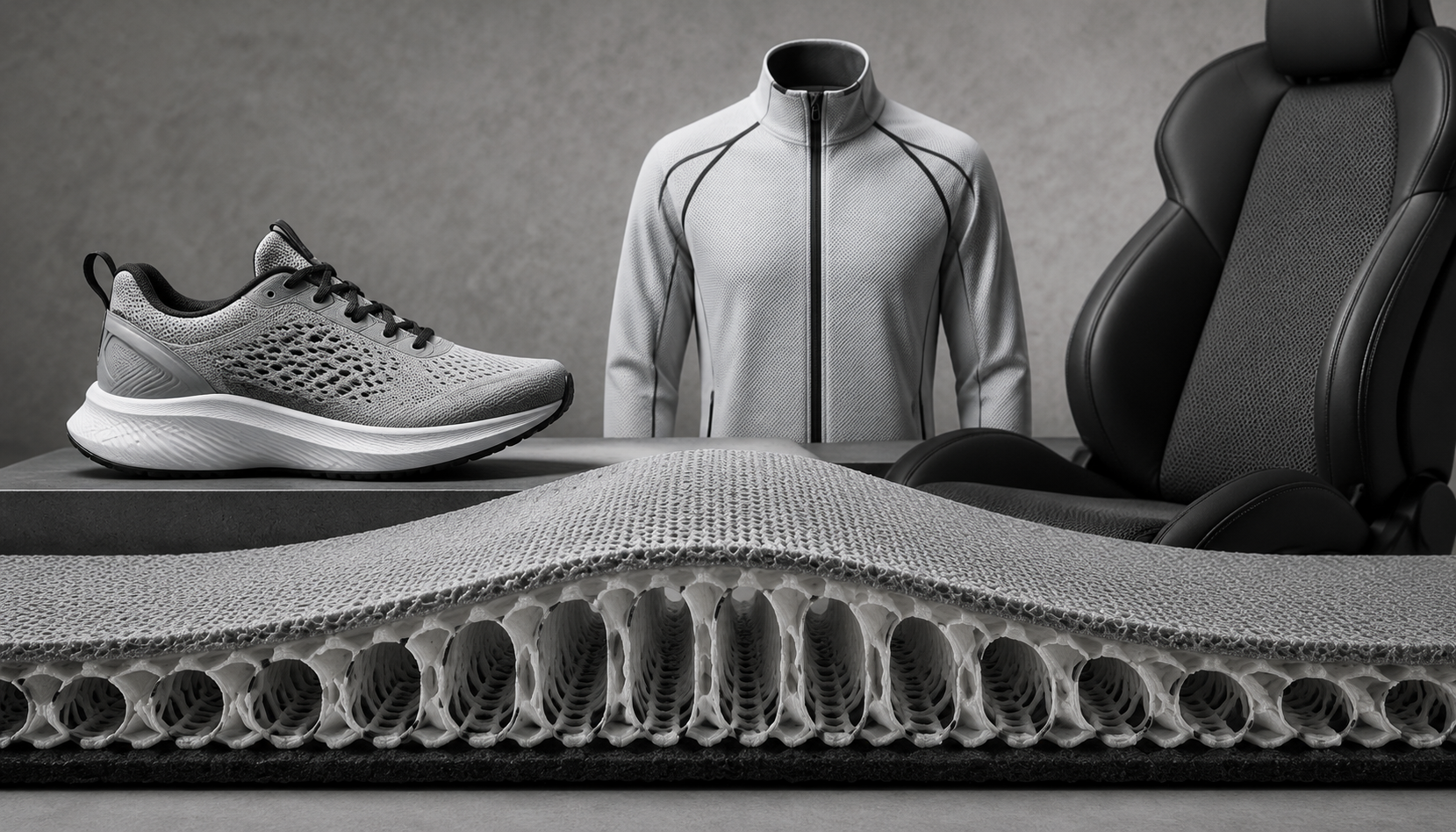
Spacer knit fabric, sometimes marketed as 3D air mesh, is a three-dimensional textile engineered to create a breathable cushioning layer between two outer surfaces. If you have ever looked at the tongue of a high-end running shoe or the back panel of a cycling jersey, you have likely seen spacer fabric in action. Its defining characteristic is the open, lattice-like middle layer that allows air and moisture to pass through while maintaining structural integrity under compression.
Think of spacer knit fabric as a textile sandwich. The top layer, often called the face fabric, provides the visible surface—it can be smooth, textured, or patterned depending on the end use. The bottom layer, or back fabric, may be designed for skin contact, adhesion to other materials, or structural reinforcement. Between them lies the spacer layer: a grid of monofilament yarns, typically polyester, that act as tiny columns holding the two faces apart. These monofilaments, usually between 0.10 mm and 0.20 mm (0.004 to 0.008 in) in diameter, create consistent air channels throughout the material. This is not just a fabric; it is a miniature engineered structure.
The monofilament density, yarn diameter, and knitting gauge (commonly E18, E22, or E28) determine the fabric’s final thickness, which can range from 2 mm to 12 mm (0.08 to 0.47 in). A tighter gauge with finer monofilaments yields a denser, more supportive structure, while a looser gauge produces a softer, more breathable result. For buyers, understanding this architecture is the first step toward specifying the right spacer knit fabric applications for their products.
Standard double-knit fabrics are two layers of knitted material joined together, but they lack the engineered air channel in the middle. This makes them denser, heavier per unit of thickness, and significantly less breathable. A typical double-knit might achieve an air permeability of 10–30 CFM (Cubic Feet per Minute), while a spacer knit fabric routinely delivers 80–200 CFM when tested according to ASTM D737. That is an order-of-magnitude difference in airflow, and it translates directly into wearer comfort, moisture management, and thermal regulation.
| Property | Standard Double-Knit | Spacer Knit Fabric |
|---|---|---|
| Air Permeability (ASTM D737) | 10–30 CFM | 80–200 CFM |
| Typical Thickness | 1–3 mm (0.04–0.12 in) | 2–12 mm (0.08–0.47 in) |
| Weight-to-Thickness Efficiency | Moderate | High (lighter per mm of loft) |
| Compression Recovery | 60–75% | >90% (after 50 washes) |
For any product where breathability, cushioning, or weight reduction is a priority, spacer knit fabric applications are almost always the superior technical choice. The trade-off is cost—spacer fabrics are more expensive to produce—but the performance gap is substantial enough that most technical buyers consider it a justified investment.
When evaluating spacer knit fabric applications, procurement teams often focus on thickness and weight. Those are important, but they are surface-level metrics. The real decision-making happens at the intersection of six core performance parameters, each of which defines the boundaries of what the fabric can and cannot do in a finished product.
| Parameter | Test Standard | Typical Range | Application Implication |
|---|---|---|---|
| Air Permeability | ASTM D737 | 80–200 CFM | Defines suitability for activewear, footwear, and automotive seating |
| Compression Recovery | ASTM D3574 | >90% after 50 washes | Determines lifespan in cushioning applications (seats, insoles) |
| Moisture Wicking Rate | AATCC 195 | Grade 4–5 | Critical for sportswear and medical garments |
| Weight (GSM) | ASTM D3776 | 200–600 gsm (5.9–17.7 oz/yd²) | Impacts garment drape, shipping cost, and end-use weight targets |
| Thickness | ASTM D1777 | 2–12 mm (0.08–0.47 in) | Determines cushioning level and design envelope |
| Abrasion Resistance | Martindale | 20,000–50,000 cycles | Essential for automotive and footwear durability requirements |
CFM measures the volume of air that passes through one square foot of fabric per minute under a standardized pressure differential. For spacer knit fabric, values between 80 and 200 CFM are typical, depending on monofilament diameter, gauge, and face yarn density. Traditional polyurethane foam, by contrast, rarely exceeds 20 CFM. This makes spacer fabric the go-to spacer fabric material for any application where heat and moisture buildup is a concern—from cycling jerseys to automotive seat covers. I have seen designers specify 150 CFM spacer fabric for summer cycling bibs, only to find that their pattern’s seam placement blocked airflow in key zones. Breathability is a system property, not just a fabric property.
Compression recovery, tested per ASTM D3574, measures how well a fabric returns to its original thickness after being compressed. For spacer knit fabrics used in cushioning applications, you want a recovery rate above 90% after repeated compression cycles—and critically, after repeated washing. A fabric that recovers beautifully in its delivered state but collapses after 10 washes is a liability. This is the parameter that separates a viable product from a warranty claim, and it is the one most frequently overlooked in initial sourcing conversations.
The open lattice structure of spacer knit fabric creates capillary pathways that wick moisture away from the skin and allow it to evaporate rapidly. When tested to AATCC 195, high-performance spacer fabrics achieve Grade 4 or 5 ratings, meaning they transport moisture efficiently and dry faster than most conventional knits. This is not just a comfort feature—it is a safety feature in medical and workwear applications where prolonged skin moisture can lead to irritation, infection, or thermal stress.
One of the most compelling spacer knit fabric applications is in lightweight cushioning. A 6 mm (0.24 in) spacer fabric might weigh only 350 Fabric GSM Calculator (10.3 oz/yd²), while a comparable foam laminate of the same thickness could weigh 500 gsm (14.7 oz/yd²) or more. That 30% weight saving matters enormously in performance footwear, aerospace interiors, and any application where every gram counts. The trade-off is that thinner spacer fabrics (under 3 mm) offer limited cushioning, so there is a practical floor to how light you can go without sacrificing function.
Spacer fabric clothing has moved well beyond niche technical applications. Today, it appears in everything from high-impact sports bras to post-surgical compression garments, and each application demands a different set of fabric parameters. The key is to match the spacer knit construction to the specific biomechanical and comfort requirements of the garment.
| Application | Thickness | Weight | Key Property |
|---|---|---|---|
| Sports Bra | 3–5 mm (0.12–0.20 in) | 250–350 gsm (7.4–10.3 oz/yd²) | Compression recovery, moisture wicking |
| Cycling Jersey Back Panel | 4–6 mm (0.16–0.24 in) | 200–300 gsm (5.9–8.8 oz/yd²) | Air permeability (>150 CFM), quick-dry |
| Medical Compression Garment | 2–4 mm (0.08–0.16 in) | 300–400 gsm (8.8–11.8 oz/yd²) | Uniform pressure distribution, breathability |
| Workwear Impact Pad | 6–10 mm (0.24–0.39 in) | 400–600 gsm (11.8–17.7 oz/yd²) | Energy absorption, FR compatibility |
| Outerwear Liner | 3–5 mm (0.12–0.20 in) | 200–350 gsm (5.9–10.3 oz/yd²) | Thermal insulation, lightweight |
In the spacer fabric bra category, the material’s ability to provide structured support without rigid components is a genuine innovation. A 4 mm (0.16 in) spacer knit with 92% polyester and 8% spandex can deliver enough compression to support high-impact movement while maintaining breathability that traditional foam-lined bras simply cannot match. The typical specification sits around 280–350 gsm (8.3–10.3 oz/yd²), with a compression recovery above 90% after 50 wash cycles. For cycling jerseys, the back panel is where spacer knit fabric applications really shine—the open structure channels air across the spine, reducing core temperature during sustained effort. One thing I have noticed is that many brands underestimate the importance of face yarn selection; a brushed face yarn feels softer but can trap lint and reduce airflow over time.
In medical textiles, spacer knit fabric applications address two critical needs: pressure distribution and skin health. Post-surgical compression garments made from spacer fabric deliver more uniform pressure than traditional elastic bandages because the three-dimensional structure resists localized compression points. The breathability also reduces the risk of moisture-related skin breakdown, which is a genuine clinical concern for patients wearing compression garments for extended periods. The typical specification here is a thinner construction—2 to 4 mm (0.08 to 0.16 in)—with a higher GSM (300–400 gsm / 8.8–11.8 oz/yd²) to achieve the necessary compression modulus without excessive bulk.
Spacer fabric used in workwear typically serves as an impact-absorbing or insulating layer. In high-visibility vests and protective jackets, a 6–8 mm (0.24–0.31 in) spacer knit can replace foam padding while offering superior breathability. The challenge here is compatibility with flame-retardant (FR) finishes—some FR chemistries can stiffen the monofilament spacer layer, reducing compression recovery by 5–10%. When FR compliance is required, it is essential to test the finished fabric (not just the base cloth) to FMVSS 302 or the relevant regional standard before committing to production.
Outside of apparel, spacer knit fabric applications demand higher durability thresholds and more complex integration with other materials. Footwear and automotive interiors push spacer fabrics to their mechanical limits, and the sourcing process is correspondingly more rigorous.
In performance footwear, spacer knit fabric applications are centered on three zones: the insole, the upper, and the collar. For insoles, a 5–8 mm (0.20–0.31 in) spacer with high compression recovery (>92%) provides cushioning that does not bottom out over the life of the shoe. For uppers, thinner spacer fabrics (3–4 mm / 0.12–0.16 in) with high CFM ratings (150+) keep the foot cool during activity. Collar padding uses spacer fabric for its soft, non-abrasive feel against the Achilles tendon. The specification challenge in footwear is abrasion resistance—shoe uppers routinely see Martindale testing above 30,000 cycles, which requires careful face yarn selection.
Automotive spacer knit fabric applications are governed by a different set of constraints: flame resistance, fogging resistance, and long-term compression set. A seat cover material must maintain its loft after 100,000 compression cycles—equivalent to years of daily use. Headliner applications prioritize weight reduction and acoustic absorption. All automotive textiles must comply with FMVSS 302 flammability requirements, and many OEMs impose additional proprietary standards for odor, fogging, and UV resistance.
A Tier-1 automotive supplier in Germany recently needed a breathable seat cover material for a premium electric vehicle program. The goal was to replace a traditional PU foam laminate, reducing weight by 15% while keeping compression set below 10% after 100,000 cycles. Spacer knit fabric was the obvious candidate—it met breathability and weight targets easily. But the first samples failed the OEM’s abrasion test at just 18,000 Martindale cycles, well below the 25,000-cycle threshold.
The supplier faced a difficult choice. They could accept the heavier foam laminate and abandon the weight target, or they could invest in developing a higher-denier face yarn. They chose the latter, but it was not straightforward. The first trial with 50-denier face yarn failed abrasion at 18,000 cycles. The second trial with 75-denier passed abrasion but pushed the fabric thickness to 6.8 mm (0.27 in), exceeding the 6 mm (0.24 in) design envelope. The third trial—75-denier face yarn with a tighter knitting gauge—finally achieved 35,000 Martindale cycles at 5.2 mm (0.20 in) thickness. The compromise was a 22% cost increase and a 0.8 mm (0.03 in) thickness reduction versus the original specification. The material passed all OEM tests, but the six-month qualification process delayed the vehicle launch by one production milestone. It was a success, but a costly one that reinforced the importance of specifying abrasion resistance from the very first sample request.
Sourcing spacer knit fabric is not like sourcing a commodity textile. The three-dimensional construction introduces variables that flat fabrics do not have—monofilament quality, knitting gauge consistency, post-finishing compression behavior—and these variables are difficult to assess from a spec sheet alone. A structured evaluation process is essential.
Before placing any order, procurement teams should insist on the following test reports: compression recovery per ASTM D3574, air permeability per ASTM D737, abrasion resistance per Martindale, colorfastness per ISO 105, and chemical compliance per OEKO-TEX Standard 100 or REACH. For automotive applications, add FMVSS 302 flammability and OEM-specific fogging tests. These are not optional—they are the minimum due diligence for any B2B spacer knit fabric applications procurement.
A standard sample validation workflow for spacer knit fabric follows five stages. First, you submit your technical requirements (thickness, weight, color, finish) and receive a quotation with lead time. Second, the supplier ships an A-sample—typically 1–3 yards (0.9–2.7 m)—within 5–10 business days. Third, you conduct lab testing on the A-sample, which takes 2–3 weeks depending on the number of tests. Fourth, if the A-sample passes, you request a B-sample in production-representative Garment Yardage Calculator for wear testing or pilot production. Fifth, you confirm the B-sample and place the production order. The entire cycle, from initial inquiry to production-ready approval, typically takes 6–10 weeks for a standard spacer knit and 12–16 weeks for a custom development.
If you are ready to begin the evaluation process, you can request free sample yardage through the factory’s sample request portal, which supports a three-step workflow: select your product specifications, submit the form with your shipping details, and receive a confirmation with estimated delivery—typically 5–7 business days for international courier. For more complex custom requirements, the same contact page allows you to upload tech packs, spec sheets, or CAD files and connect directly with a technical engineer who can advise on construction options.
Even experienced procurement teams make predictable mistakes when sourcing spacer knit fabric. The most expensive errors tend to involve parameters that are not visible in a delivered sample but emerge during washing, wear testing, or end-use evaluation. Understanding these pitfalls upfront can save months of rework and significant cost.
This is the single most common failure mode in spacer knit fabric applications, and it is entirely preventable. Many procurement teams evaluate compression recovery on the as-received sample, which almost always performs well. The critical test is compression recovery after repeated laundering—20, 50, or even 100 wash cycles. A spacer knit that starts at 95% recovery but drops to 60% after 10 washes will produce a visibly deflated, uneven product within the first season of use. Always request post-wash compression data, and if the supplier cannot provide it, test it yourself before committing to production.
It is tempting to equate higher GSM with better quality, but in spacer knit fabric, weight is a poor proxy for performance. Two fabrics at 400 gsm (11.8 oz/yd²) can behave completely differently depending on monofilament diameter, knitting gauge, and face yarn construction. A 400 gsm spacer with 0.12 mm (0.005 in) monofilaments and a loose gauge will feel soft and compressible but may lack structural support. The same weight with 0.18 mm (0.007 in) monofilaments and a tight gauge will feel firmer and recover better under load. Evaluate the spacer fabric material on its construction parameters, not just its weight.
A mid-tier European sportswear brand learned this the hard way when they launched a new sports bra line using spacer fabric sourced from a low-cost supplier. The fabric passed initial fit samples beautifully—soft, supportive, breathable. But they had not requested wash compression set data. After just five wash cycles, compression recovery dropped from 92% to 61%, and the bras lost their structural support. Customer complaints mounted, and the return rate hit 15% on the first production run.
The brand tested three alternative suppliers. The first two provided fabrics with similar compression set failures—they had sourced from the same upstream monofilament supplier. The third supplier, who controlled their entire production chain from knitting to finishing, achieved 88% compression recovery after 20 washes. The switch cost 18% more per unit and extended lead times from four to six weeks, but the return rate dropped below 2% and the brand recovered its reputation over two seasons. The lesson: integrated manufacturing capability is not a marketing talking point—it is a quality assurance mechanism.
Spacer knit fabric applications span sportswear (sports bras, cycling jerseys), footwear (insoles, uppers, collar padding), automotive interiors (seat covers, headliners), medical garments (compression wear, orthopedic supports), and workwear (impact padding, insulation). The common thread is its unique combination of breathability, cushioning, and lightweight construction—properties that flat knits and foams cannot simultaneously deliver.
Spacer knit fabric typically ranges from 2 mm to 12 mm (0.08 to 0.47 in) in thickness, depending on monofilament length and knitting parameters. Thinner constructions (2–4 mm / 0.08–0.16 in) are used in apparel liners and medical garments. Mid-range (4–8 mm / 0.16–0.31 in) is common in sportswear and footwear. Thicker constructions (8–12 mm / 0.31–0.47 in) are reserved for heavy-duty cushioning in automotive seating and protective equipment.
Yes, extremely. When tested to ASTM D737, spacer knit fabrics typically achieve air permeability ratings of 80–200 CFM. Traditional polyurethane foam, by comparison, rarely exceeds 20 CFM. The open lattice structure of the spacer layer creates continuous air channels through the fabric, making it one of the most breathable cushioning materials available in technical textiles.
Single-composition spacer fabrics—those made from 100% polyester (PET)—are mechanically recyclable and can qualify for GRS (Global Recycled Standard) certification if the input material meets recycled content thresholds. Blended spacer fabrics (e.g., polyester-spandex) are more difficult to recycle because the elastane component complicates mechanical reprocessing. If end-of-life recyclability is a priority for your product line, specify a mono-material construction from the outset.
Spacer knit fabric is not a commodity—it is an engineered material system where every variable, from monofilament diameter to post-wash compression recovery, directly impacts the performance and marketability of your finished product. The brands and suppliers who succeed with spacer fabric applications are those who treat specification as a rigorous, data-driven process rather than a checkbox exercise. If you are exploring spacer knit fabric for a new product development program, the most productive next step is to evaluate a physical sample against your specific performance requirements. You can browse the full range of spacer knit constructions, including detailed specification matrices for weight, thickness, composition, and available finishes, on the performance functional knits product page.