Address
Nanlang Industrial Zone, Xingtan Town, Shunde District, Foshan, Guangdong, China
Work Hours
Mon–Fri, 9:00 AM – 6:00 PM (CST/UTC+8). We aim to respond to all inquiries within 48 hours.

Address
Nanlang Industrial Zone, Xingtan Town, Shunde District, Foshan, Guangdong, China
Work Hours
Mon–Fri, 9:00 AM – 6:00 PM (CST/UTC+8). We aim to respond to all inquiries within 48 hours.

Sourcing knit fabrics overseas usually means guessing whether the next shipment will actually match the swatch you approved. I’ve seen too many production schedules derail over inconsistent GSM weights or stubborn pilling that only shows up after cutting.
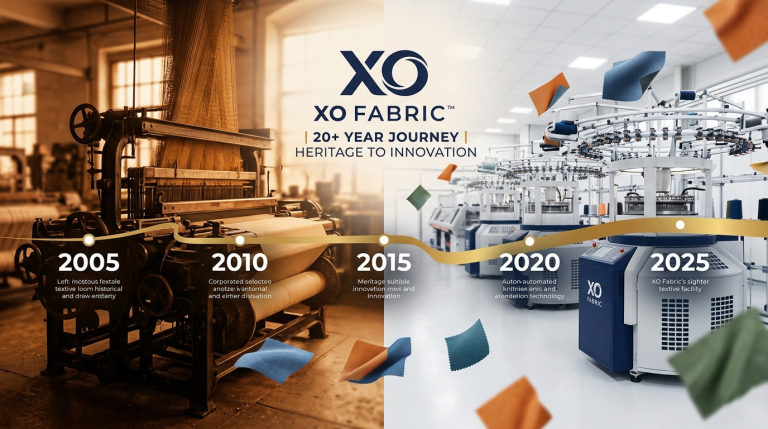
Building a textile supply chain takes more than just buying machines. It requires understanding how yarn behaves under tension before it even hits the knitting bed. When we started in 2005 as a small specialized workshop, we focused entirely on mastering knit base fabrics. There was no room for shortcuts back then. Every bolt had to pass manual inspection before leaving the floor.
Over two decades, that approach scaled into a 20,000+㎡ production facility. We didn’t just add square footage. We added institutional knowledge. Our technical team includes over fifty specialists who have spent more than ten years navigating shifting market demands. Sustainability compliance, performance wear engineering, and fast fashion speed all require different knitting tensions and finishing parameters.
When you work with a mill that has survived multiple supply chain shocks, you notice the difference in consistency. We have maintained stable operations without major disruptions for over twenty years. That kind of longevity isn’t an accident. It comes from strict adherence to international standards like OEKO-TEX, REACH, and ISO 9001.
| Year | Milestone | Production Impact |
| 2005 | Workshop founding | Manual quality checks, small batch focus |
| 2012 | First major export contract | Standardized dyeing protocols for EU markets |
| 2018 | Facility expansion to 10,000㎡ | Automated moisture control in finishing lines |
| 2024 | 500+ global brand partnerships | Predictable lead times across 30+ countries |
I always tell new buyers that experience shows up in the details. It’s the difference between a fabric that curls at the seam allowance and one that lays flat on the cutting table. Our twenty-plus years of expertise covers high-demand categories like Performance and Functional Knits, trusted by global sportswear brands who need predictable stretch recovery. You can feel that stability when you run your hand along a properly tensioned interlock knit.
We also track how construction choices affect garment performance long term. A standard jersey might look fine off the roll, but without proper heat setting, it will distort after three wash cycles. We built our reputation by catching those structural weaknesses before they reached your sample room.
Most textile mills outsource dyeing or finishing to save overhead. That model creates hidden delays and quality gaps. When you strip away the middlemen, you gain complete control over the material from raw yarn to finished roll. Our facility handles knitting, dyeing, finishing, flocking, and final inspection all under one roof.
This vertical integration changes how you plan production. You don’t have to chase subcontractors for updates. The same team that knits the base fabric oversees the dye lot consistency. We maintain a 2,000㎡ warehouse with over five hundred stock-ready fabrics. For standard items, we can move from yarn sourcing to finished delivery in seven to fifteen days.
I’ve worked with brands that tried to piece together finishes from separate vendors. The color shift between batches was brutal. By keeping everything in-house, we eliminate that variable. Our integrated finishing line delivers custom solutions like our Water Resistant Coating Finish, with full quality control from start to finish. You get uniform membrane thickness and reliable breathability without the guesswork.
Cost control is another direct benefit. Vertical integration typically shaves ten to fifteen percent off pricing compared to fragmented supply chains. Lead times for custom orders run about thirty percent faster than the industry average. When you need urgent replenishment, we can reallocate machine time without negotiating with third parties.
Traceability matters more than ever. Every batch includes documented fiber origin, dye lot numbers, and finishing parameters. If a seam slippage issue arises later, we can trace it back to the exact needle gauge and tension settings used during knitting. That level of transparency is impossible when production jumps between facilities.
Quality control isn’t just about catching defects. It’s about preventing them through systematic monitoring. Our QC department employs over fifty technicians who work across every production stage. We run a three-stage inspection process that covers raw material intake, in-process monitoring, and final goods evaluation.
During incoming inspection, we test yarn evenness and moisture content. Moisture variance over four percent can throw off dye uptake and cause shading issues later. In-process checks monitor stitch density and tension consistency. Finished goods go through rigorous testing for colorfastness, shrinkage, pilling resistance, tensile strength, and chemical compliance.
| Test Type | Standard | Acceptance Threshold |
| Colorfastness to Washing | ISO 105-C06 | Grade 4-5 minimum |
| Dimensional Stability | AATCC 135 | ±3% shrinkage tolerance |
| Pilling Resistance | ASTM D4970 | Grade 4 or higher |
| Tensile Strength | ASTM D5034 | Matches construction specs |
We maintain a ninety-nine point two percent first-pass quality rate for bulk orders. That metric comes from strict adherence to OEKO-TEX Standard 100 and REACH chemical compliance. Our ISO 9001:2015 certification isn’t just paperwork. It dictates how we document deviations and adjust machine settings before they compound.
I keep a simple rule for fabric troubleshooting: if shrinkage exceeds three percent, check the heat-setting temperature first. We run mechanical conditioning at 130°C to 140°C for twelve minutes to lock in dimensions. Skipping that step or rushing the cooling phase will cause unpredictable distortion during garment pressing.
Our quality guarantees are straightforward. We provide free replacement for any quality-defective bulk orders. Pre-shipment inspection reports accompany every container. Color matching stays within a ΔE ≤ 1.0 tolerance, which is industry leading. All our Flocked Printed Fabrics undergo rigorous 3-stage QC to ensure consistent pile height, adhesion, and color accuracy. You’ll notice the difference when the flocking doesn’t lift during steam finishing.
Small brands often get locked out of quality mills because of rigid minimum order quantities. We structured our MOQ policy to support growth without penalizing early-stage production runs. Standard knit base fabrics require a 500m minimum. Flocked printed fabrics sit at 300m. Custom-developed performance fabrics need 1000m due to specialized yarn sourcing and testing cycles.
Customization doesn’t mean endless options. It means targeted adjustments that solve actual garment problems. Our lab dip service turns around custom color matches in three to five days. We adjust GSM, width, and stretch percentages based on your pattern engineering needs. You can request specific finishes like antibacterial treatment, UV protection, or enhanced moisture wicking.
I’ve seen designers order fifty different lab dips because they couldn’t visualize how a color would behave under different lighting. We recommend testing dips against your actual garment trims and packaging. The perceived hue shifts dramatically depending on contrast materials. It’s a small step that saves massive revision cycles later.
Private labeling and custom packaging are standard. We match your branding requirements without adding hidden fees. Our Performance and Functional Knits are available with low MOQs, perfect for emerging activewear and sportswear brands testing new market segments.
When negotiating fabric specs, always weigh stretch recovery against hand feel. A tighter knit gauge improves recovery but reduces drape. We help clients find that middle ground by running tension tests on 1×1 rib versus 2×2 interlock before committing to bulk. The right compromise keeps seams intact without making the garment feel rigid.
Real partnerships reveal themselves under pressure. I want to share a few examples where fabric engineering directly impacted brand outcomes. These aren’t polished marketing summaries. They’re snapshots of actual problem-solving on the production floor.
A European sportswear brand approached us with persistent return rates caused by uneven stretch recovery in leggings. The initial solution tried increasing spandex content to eighteen percent. That boosted elasticity but destroyed the fabric’s opacity. We spent two weeks testing different yarn blending ratios. The compromise landed on an eighty-five percent polyester and fifteen percent spandex construction with a modified stitch structure. It reduced returns by forty percent and earned a two-year exclusive supply agreement.
Another case involved a US loungewear startup needing just eight hundred meters across three French terry variants for their first collection. Most mills would have quoted a massive setup fee. We adjusted our scheduling to batch the dye runs with existing production. That flexibility let them launch. Eighteen months later, they were pulling ten thousand meters monthly. We scaled the process alongside them.
An Asian retailer needed seven-day turnaround for stock fabric restocks. We prioritized warehouse allocation for repeat orders, hitting ninety-nine percent on-time delivery for three years straight.
Decision-making in textile sourcing rarely follows a straight line. You have to balance cost, performance, and timeline constraints. I always advise buyers to request physical test garments before approving bulk specs. Digital renders hide seam puckering and tension flaws. Wearing the sample reveals the truth.
Join hundreds of global brands that have grown with us. Contact XO Fabric to start your partnership. We treat every client relationship as a long-term engineering project rather than a transactional exchange.
Getting started doesn’t require complex negotiations or lengthy contracts. We streamline the onboarding process so you can focus on design and production planning. First, browse our product catalog or share your specific fabric requirements. Our technical team will match your needs to the right construction type and finishing parameters.
Next, request samples for physical evaluation. We ship lab dips and physical swatches quickly so you can test drape, stretch, and hand feel. Once you approve the sample, we provide a custom quote with exact lead times and MOQ details. After bulk production begins, you receive regular updates and tracking information. Delivery arrives on schedule with complete documentation.
I prefer keeping initial conversations focused on practical needs. Tell us your target garment type, expected wash cycles, and pressing methods. That information lets us recommend the right needle gauge and heat-setting protocol from day one. It prevents costly mistakes down the line.
Take the first step toward a stress-free textile supply chain. Contact our team to discuss your fabric needs. We measure success by how smoothly your production runs, not just by the meters we ship.
Building a reliable textile partnership takes patience, clear communication, and mutual respect for technical constraints. The mill prioritizes long-term relationships over quick turnover. When you understand how construction choices affect garment performance, you make better decisions upfront. You avoid the frustration of inconsistent batches and production delays.
Whether you are launching a small capsule collection or scaling to enterprise volume, the same principles apply. Verify shrinkage parameters. Confirm dye lot consistency. Test seams under real pressing conditions. These habits protect your brand reputation.
Ready to move forward? Contact XO Fabric to request samples and discover why hundreds of global brands trust us as their reliable fabric manufacturer partner. Let’s engineer your next collection together.