Address
Nanlang Industrial Zone, Xingtan Town, Shunde District, Foshan, Guangdong, China
Work Hours
Mon–Fri, 9:00 AM – 6:00 PM (CST/UTC+8). We aim to respond to all inquiries within 48 hours.

Address
Nanlang Industrial Zone, Xingtan Town, Shunde District, Foshan, Guangdong, China
Work Hours
Mon–Fri, 9:00 AM – 6:00 PM (CST/UTC+8). We aim to respond to all inquiries within 48 hours.
Importing fabric from overseas is a cost-effective way to source high-quality materials for your apparel line, but hidden logistics costs often blow budgets for new importers.
Most brands only budget for the fabric’s unit price. They completely forget to account for Incoterms, freight fees, import duties, and auxiliary charges like customs broker fees or port handling.
Unexpected logistics costs can erase profit margins. They delay production timelines or force you to raise product prices and lose customers.
I’ve seen seasoned makers panic when a cheap bolt turns into a logistical nightmare. The fix usually comes down to tracking the full chain upfront. This guide breaks down every component of shipping fabric import costs. We’ll explain key Incoterms, compare shipping options, walk through landed cost calculations, and share actionable tips to reduce expenses. You’ll also see how a dedicated partner handles the heavy lifting so you can focus on cutting and sewing.
Incoterms (International Commercial Terms) are standardized rules defining buyer and seller responsibilities for shipping, insurance, and import costs.
Published by the International Chamber of Commerce and updated every decade, the current version is Incoterms 2020. These terms aren’t just paperwork. They dictate who pays when a container sits idle at a port or who covers damage during transit.
Getting this wrong causes costly disputes. I’ve spent hours untangling emails because a supplier assumed FOB covered inland trucking. It never does. Always clarify the exact transfer point before signing.
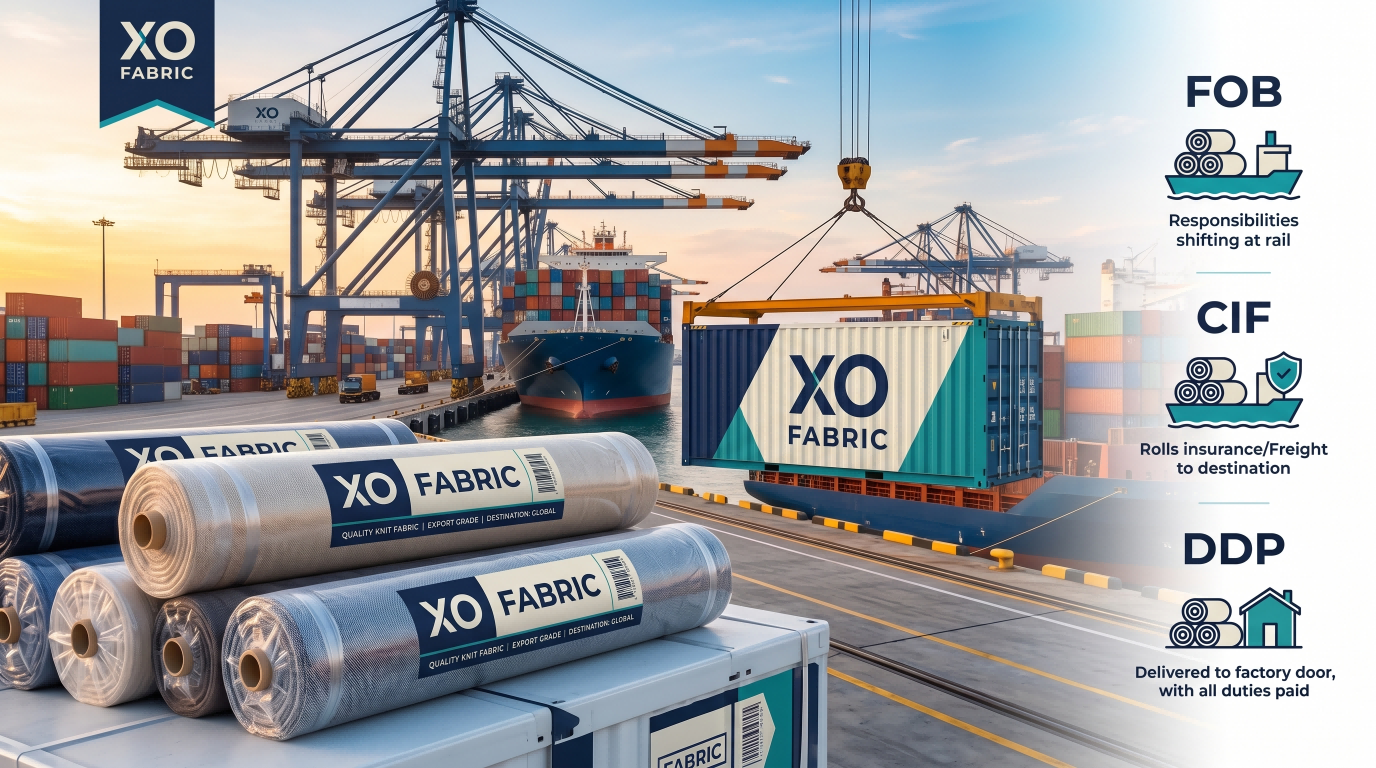
Under FOB, the seller delivers the fabric to the departure port and clears export customs. You, as the buyer, pay for sea or air freight, insurance, import duties, and local delivery.
This works well if you already have a trusted freight forwarder. You handle the risk once the cargo crosses the ship’s rail. You control routing, scheduling, and carrier selection.
I prefer FOB for established brands running consistent monthly volumes. The per-kg savings compound quickly when you negotiate direct carrier rates.
With CIF, the seller covers freight and insurance to the destination port plus export clearance. You step in to pay import duties, customs broker fees, and local delivery.
It lowers your upfront risk, but suppliers sometimes pad the shipping rates since you aren’t comparing quotes. I once took a CIF quote that looked tidy until hidden demurrage fees hit.
Always ask for the base rate breakdown. If the mill won’t share carrier invoices, walk away. Transparency matters more than convenience when freight prices fluctuate weekly.
DDP puts everything on the seller. Freight, insurance, import duties, taxes, and door-to-door delivery are all included. It costs more upfront, but it eliminates logistics headaches.
New importers or brands prioritizing predictable cash flow usually prefer this. You can review the full policy at XO Fabric Terms and Conditions before locking in your first shipment.
Picking an Incoterm is less about saving money and more about managing your bandwidth. If your team is small, DDP buys you time. If you scale rapidly, FOB eventually wins on volume discounts. Just remember that Incoterms don’t override local tax laws. They just split the operational burden.
The physical transport method sets your baseline cost and timeline. Each route trades speed for budget. Fabric weight, roll diameter, and humidity sensitivity all influence which lane makes sense.
Sea freight remains the cheapest option for bulk rolls. Full container loads (FCL) run roughly $0.50 to $2 per kg, while less than container loads (LCL) sit between $1 and $3 per kg.
Lead times stretch from 20 to 40 days. A transpacific run from China to the US West Coast takes about 25 days, while Europe averages 35. I usually recommend sea for orders over 500kg.
The fabric sits stable in temperature-controlled containers. This prevents humidity shifts that ruin knit recovery. Just pack tightly to maximize cubic meters. Woven denims at 12 oz GSM pack denser than light poplin, so calculate volumetric weight carefully.
Air freight jumps 3 to 7 times higher, landing between $3 and $8 per kg. Transit shrinks to 3 to 7 days. It makes sense for urgent mid-size runs between 100 and 500kg.
You’ll sacrifice budget for speed, and bulky woven fabrics often hit dimensional weight penalties. I’ve seen teams pay a premium for air when sea plus a safety stock buffer would have covered them.
Only rush if production is genuinely stalled. Air also lacks the humidity buffering of sea containers. Lightweight synthetics can develop static cling or micro-tears if packed too tightly in cargo holds.
DHL, FedEx, and UPS charge $8 to $15 per kg, but deliver in 2 to 5 days door-to-door. No minimums apply, and customs clearance usually bakes into the fee.
This is strictly for samples, test bolts, or urgent under-50kg orders. You can order fabric swatches via express shipping to test quality before placing bulk orders through XO Fabric Product Categories.
Express handles fragile packaging well, but never ship heavy denim or technical laminates this way. The weight thresholds kill the margins. I keep a dedicated sample kit for this exact reason.
| Method | Cost/kg | Lead Time | Best For |
| Sea (FCL/LCL) | $0.50–$3 | 20–40 days | Bulk production, 500kg+ |
| Air Freight | $3–$8 | 3–7 days | Urgent mid-size, 100–500kg |
| Express Courier | $8–$15 | 2–5 days | Samples, under 50kg |
Unit price means little until the fabric hits your loading dock. Landed cost captures every fee from the factory floor to your cutting table. The formula looks simple on paper.
Total Landed Cost equals fabric product cost plus shipping, insurance, import duties, tariffs, customs broker fees, port handling, and local delivery. In practice, importers consistently miss the hidden line items.
Customs exam fees run $200 to $500. Port storage charges $50 per day if your trucker isn’t ready. Currency conversion adds another 1 to 2 percent. I keep a running spreadsheet that updates weekly because freight markets shift faster than yarn prices.
Let’s walk through a concrete scenario. You order 500 yards of organic cotton jersey from a Chinese mill. The quoted fabric cost is $3 per yard, totaling $1500.
You ship via LCL sea freight at $400. Insurance runs $50. The US import duty for HTS code 5208.32.10 sits at 5 percent of the fabric value, adding $75.
Your customs broker charges $150 for documentation and filing. Port handling adds $100, and local drayage to your warehouse costs $75.
Add it up: $1500 plus $400 plus $50 plus $75 plus $150 plus $100 plus $75 equals $2350. Divide by 500 yards, and your true cost per yard is $4.70.
That $1.70 gap between quote and reality is where margins live or die. If you want an accurate landed cost estimate for your next order, you can Request Shipping Quote directly from the logistics desk.
I recall working with a startup that budgeted strictly at $3.50 per yard. They ignored broker fees and assumed CIF covered everything. When the shipment arrived, unexpected port storage and a classification audit pushed their cost to $5.10.
They had to cancel the second cut to stay solvent. Always build a 10 to 15 percent buffer into your landed cost model. Freight isn’t static. Neither is compliance.
Tracking shrinkage percentages also ties into shipping delays. If cotton arrives late during a humid summer, it expands. You might need to reorder trims to match the adjusted yardage. Logistics decisions ripple into pattern grading.
Tariffs change the math dramatically depending on where your warehouse sits. Base rates vary by fiber content, weave structure, and finished weight. Always verify the Harmonized System (HS) or Harmonized Tariff Schedule (HTS) code before shipping.
A single digit error can trigger a customs hold or reclassification penalties. I cross-check every mill declaration against official government databases. Paperwork accuracy saves weeks of idle inventory.
Section 301 tariffs layer 7.5 to 25 percent additional duty on top of the base 3 to 10 percent rate for Chinese textiles. Cotton fabrics fall under Chapter 52, while man-made fibers sit in Chapter 55.
Specialty weaves and technical knits often map to Chapter 58. I always cross-check the mill’s HTS suggestion against USITC databases. Misclassification is the fastest way to trigger a CBP audit.
Keep commercial invoices aligned with packing lists. Any discrepancy in roll widths or GSM ratings invites a manual inspection. Delays cost more than the original duty rate.
EU base duties range from 3 to 12 percent based on fabric type. You also face 21 percent VAT, though member states adjust it (Germany runs 19 percent, France 20 percent).
Trade agreements have softened additional levies on Chinese textiles, but customs documentation must match EU formatting exactly. EORI numbers are mandatory for clearance.
Batch your shipments if you run multiple EU warehouses. Consolidating duties into a single EU entry reduces administrative friction significantly.
Post-Brexit, duties sit between 0 and 12 percent plus a flat 20 percent VAT. Preferential rates apply if the fabric originates from CPTPP countries, but rules of origin require strict mill certificates.
UK customs has grown stricter on informal declarations, so paper trails matter more than ever. I recommend using a UK-based broker familiar with textile classification nuances.
Canada applies 0 to 5 percent duty under USMCA frameworks, with GST or HST applying instead of VAT. Australia runs 0 to 5 percent under CPTPP alongside a 10 percent GST.
Both markets prioritize digital submissions. I recommend batching your paperwork and validating commercial invoices early. Customs won’t wait for your last-minute edits.
Freight margins tighten when you stop reacting and start planning. The goal isn’t to cheap out on transport. It’s to align logistics with your production calendar.
Combine multiple small orders into a single full container. You’ll typically save 30 to 50 percent compared to LCL fragmentation. Mapping three to six months of production ahead eliminates panic surcharges.
I usually align dye lots with sea freight windows so inventory arrives just as the factory line ramps up. Bulk consolidation also reduces the carbon footprint per garment.
Negotiate FOB if your freight forwarder offers better routing than the mill’s preferred carrier. Switch to DDP when you need fixed, all-in pricing for investor reporting or tight cash flow cycles.
Skip CIF unless the supplier provides transparent, unmarked freight breakdowns. Hidden markups erode the perceived savings instantly. I always request carrier rate sheets before committing.
Rates surge 20 to 50 percent before Chinese New Year in January and February. Q4 holiday demand from October to December pushes another wave. Booking slots in March through May or July through September locks in baseline pricing.
Port congestion also eases during these windows. I schedule bulk dye runs during these calm periods. The mill gets smoother scheduling, and you get predictable transit times.
General freight forwarders often mishandle roll fabrics. They stack them incorrectly, ignore humidity controls, or misfile HTS codes, which triggers inspections.
Logistics providers who actually understand textile weight limits, shrinkage tolerances, and seam slippage risks avoid those costly mistakes. The mill I work with has an in-house team that negotiates preferred rates with major carriers, which keeps volumetric pricing honest.
Logistics should support your design process, not derail it. That’s why the supplier built flexibility into every shipping tier. You can choose FOB, CIF, or DDP depending on your internal bandwidth and budget constraints.
Every invoice breaks down freight, duties, and handling separately. No surprise line items buried in the footer. Clear pricing means accurate margin forecasting.
The team has moved fabric to over 50 countries for more than a decade. They handle export declarations, import paperwork, and carrier coordination without requiring you to juggle multiple email threads.
Preferred agreements with Maersk, COSCO, DHL, and FedEx keep base rates competitive. When a shipment runs behind, you get proactive updates, not radio silence. I appreciate that transparency during tight sample approvals.
If you want true hassle-free shipping, the DDP option drops the fabric directly at your warehouse. All duties, taxes, and clearance steps are pre-paid and processed.
Real-time tracking updates live inside the client portal, so your production manager can schedule cutting without guessing. The on-time rate for DDP runs near 99 percent because the routing is locked before the container rolls out.
Want to explore what’s ready to ship? You can Browse Fabric Collections to see the full knit and woven lineup. Ready to map out your next run? Contact XO Fabric and the logistics desk will draft a custom quote tailored to your timeline.
Shipping fabric import costs aren’t just a line item. They’re a strategic lever that dictates cash flow, production pacing, and ultimately, whether your margin survives the runway.
You don’t need to become a freight expert overnight. You just need to track the full chain, pick the right Incoterm for your current stage, and build realistic buffers into your cost model.
I’ve found that the brands who treat logistics as a design constraint rather than an afterthought scale much faster. They avoid the panic shipments, they respect the lead times, and they keep their factories running smoothly. Take your time mapping the route. The savings compound quietly, and your production schedule will thank you.