Address
Nanlang Industrial Zone, Xingtan Town, Shunde District, Foshan, Guangdong, China
Work Hours
Mon–Fri, 9:00 AM – 6:00 PM (CST/UTC+8). We aim to respond to all inquiries within 48 hours.

Address
Nanlang Industrial Zone, Xingtan Town, Shunde District, Foshan, Guangdong, China
Work Hours
Mon–Fri, 9:00 AM – 6:00 PM (CST/UTC+8). We aim to respond to all inquiries within 48 hours.
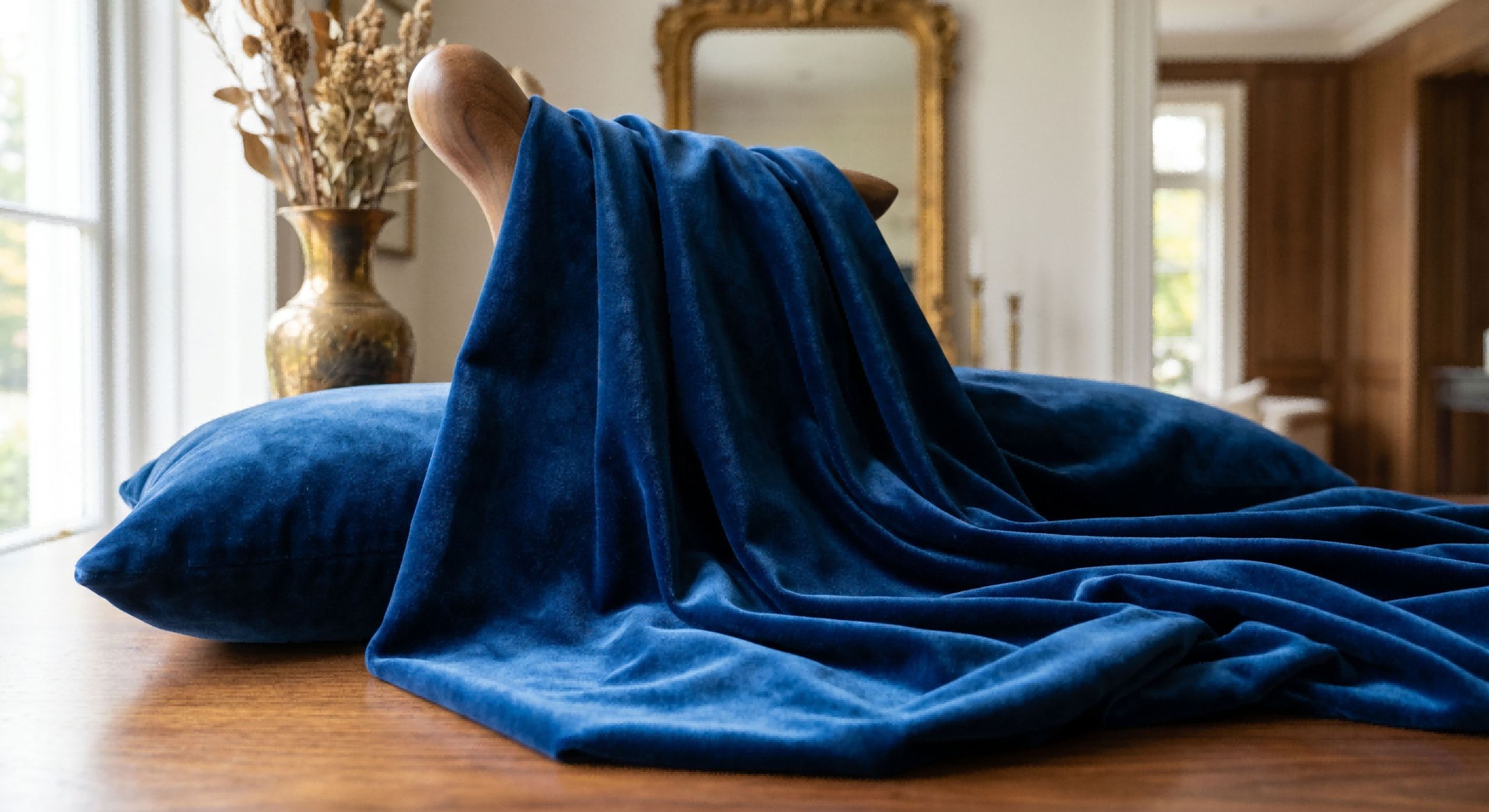
High-F velvet has quietly taken over the premium apparel market, showing up in luxury tracksuits and high-end loungewear that somehow never pill or lose their drape. Yet, when you ask a technical designer what actually makes it different, the answer usually stalls at “it just feels softer.” The “F” in High-F isn’t marketing fluff; it stands for filament count. A standard yarn might pack 72 filaments, but High-F velvet pushes that to 100F, 120F, or even 144F within the same denier. That structural shift changes everything downstream—from how the base fabric knits to how the flock fibers anchor. If you’ve ever struggled with uneven pile or brittle flock shedding after three wash cycles, the problem usually traces back to how those early manufacturing steps were handled. Understanding the actual production flow helps you spot quality shortcuts before they ruin a garment line.
The terminology around velvet can get messy fast. When spec sheets list 100D/144F, the first number is denier (linear density), and the second is the filament count. Think of it like a rope: you can twist together twenty thick strands, or one hundred hair-thin strands, to get roughly the same thickness. The hundred-strand version will always drape smoother and reflect light more evenly. High-F velvet specifically targets that higher filament threshold, usually sitting at 100D/144F or 150D/144F. Compared to a standard 72F yarn, you’re essentially doubling the individual fibers in the exact same cross-section.
That extra density translates to a significantly softer hand feel and far less surface friction. Filament cross-sections matter here too; round filaments give you that classic deep luster, while trilobal shapes scatter light for a more muted, pearl-like finish. I’ve seen brands try to cut costs by dropping to 72F or 96F, only to deal with customer complaints about that familiar “sawtooth” feel on the inside of a jacket.
The higher filament count doesn’t just change aesthetics; it changes how the fabric breathes and moves against skin. That’s why it’s become the default for premium sportswear, evening wear, and luxury home textiles. It handles repeated flexing at the knees and elbows without breaking down, which is a nightmare with lower-filament alternatives.
That’s where specialized mills actually separate themselves. We’ve spent over two decades refining this specific construction, keeping knitting, dyeing, and flocking under one roof. When you control the entire chain, you can adjust tension parameters on the fly instead of passing quality notes between three different factories. Our High-F Shiny Velvet (100D/144F) line showcases exactly how that filament density performs in a finished garment, while our broader Flocked and Printed Fabrics category covers applications where texture meets structure.
Yarn isn’t just fed into a machine and hoped for the best. The incoming stage dictates roughly sixty percent of your final fabric behavior. We start by locking in denier and filament count, but the real work happens in the pre-treatment phase. High-filament yarns are notoriously sensitive to mechanical stress. If the tension drops even slightly during unwinding, individual filaments can stretch out of alignment, creating weak points that will snap during warp knitting.
We condition the yarn in a climate-controlled environment to stabilize moisture regain, which keeps the fibers pliable without making them tacky. I usually run a quick tensile strength test on three different spools from any new batch. If the variance exceeds five percent, I hold the shipment. Uniformity isn’t just a checkbox; it prevents those annoying “ghost lines” that show up later as faint streaks in the flock pile.
We also monitor filament shape integrity. Trilobal or hollow-core yarns need gentler handling than standard round filaments. Before the yarn ever touches a knitting needle, it passes through a static elimination bar and a gentle crepe roller. This removes surface oils and ensures every strand feeds at the exact same speed. When sourcing for a technical client, we’ll sometimes blend a small percentage of modified polyester to boost abrasion resistance without sacrificing drape. The High-F Shiny Velvet base relies on this exact preparation method to maintain its structural integrity before the flocking stage even begins.
Warp knitting is non-negotiable for high-end velvet bases. Unlike weft knitting, which builds row by row like a traditional sweater, warp knitting runs vertically with each needle interlacing its own thread. The result is a fabric that doesn’t run or ladder, holds its width under tension, and produces a remarkably flat surface. That flatness is critical because flocking relies on consistent adhesive penetration. If the base has a loose, bouncy structure, the flock fibers will sink unevenly, leaving patchy spots after curing.
We target a specific stitch density, usually measuring between 3.2mm and 3.8mm in stitch length, depending on the desired GSM. A tighter knit gives you a heavier hand and better dimensional stability, but if you go too tight, the adhesive can’t penetrate deep enough to anchor the flock properly. It’s a constant balancing act. Our technicians monitor loop formation in real-time, using laser scanners to detect broken filaments before they propagate into skipped stitches. Tension across the full width is kept within a two-gram variance. Even a three-gram shift will cause the fabric to skew, which becomes glaringly obvious once the pile is sheared.
I once worked with a client who wanted an ultra-lightweight track pant at 180 GSM but demanded heavy-duty flock adhesion. We had to compromise on stitch length and introduce a subtle cross-knit reinforcement on the edges to prevent seam slippage during construction. It wasn’t perfect, but it taught me that base fabric architecture always dictates flocking limits. Our Warp Knit Fabrics collection explores how different loop structures behave under various finishing treatments. We operate over fifty warp knitting machines in-house, which allows us to tweak the stitch geometry on the fly rather than waiting weeks for a contracted mill to adjust their settings.
Piece dyeing is the standard for synthetic velvet bases, and for good reason. It allows the fabric to relax completely before absorbing color, resulting in deeper saturation and more uniform coverage. We use disperse dyes that migrate into the polyester matrix at high temperatures, typically between 128°C and 132°C. The dye bath is carefully controlled to prevent “crocheting,” where color pools on the surface instead of penetrating the core. After dyeing, the fabric moves through a heat-setting frame. This step locks the molecular structure in place, reducing residual shrinkage to under three percent. Without it, your garments will distort the first time they hit a dryer.
Finishing treatments come next. We apply a silicone-based softener to improve hand feel, but we keep the concentration low. Too much softener creates a slippery surface that repels flocking adhesives. The base needs to be clean, slightly absorbent, and dimensionally stable. We run Delta E checks on every batch, keeping color variance under 1.5 units against the master standard. If it drifts, it gets redyed.
Let’s talk about a real production decision we made recently. A heritage brand wanted a deep, matte burgundy for a winter collection but needed the fabric to pass AATCC 61 wash tests without bleeding. Disperse dyes for dark shades naturally carry a higher risk of surface crocheting, which leads to bleeding. We tested three different dye bath chemistries. The first batch was perfectly deep but failed wash fastness. The second passed testing but looked noticeably lighter in natural light. We compromised by adjusting the exhaust cycle to extend dye penetration time by twenty minutes, then added a mild after-treatment to seal the surface. It cost us an extra twelve hours in the dyeing schedule, but the final fabric held up through fifteen wash cycles with zero color transfer. That’s the kind of trial-and-error that only happens when you control the dye house directly. For deeper insights into batch consistency, check our guides on Color Matching and Dyeing Methods.
This is where the magic actually happens. Electrostatic flocking sounds like science fiction, but the mechanics are surprisingly straightforward. First, a precise layer of adhesive is applied to the base fabric using doctor blades or roller coaters. The amount matters: too thin and the flock won’t anchor; too thick and the fabric turns cardboard-stiff. Immediately after coating, the fabric passes through a high-voltage field, usually running between 50 and 100 kV. Meanwhile, flock fibers are cut to exact lengths and dropped from a hopper above. The electrostatic field ionizes the fibers, aligning them vertically like soldiers at attention before they slam into the wet adhesive. The voltage gradient must remain perfectly parallel to the fabric surface; any tilt will cause fibers to lay sideways, ruining the pile density.
Flock fiber choice dictates the final character. Nylon flock gives you exceptional softness and resilience but costs more. Viscose is economical and absorbs dyes beautifully, but it lacks the wash durability of synthetics. Fiber length is the next variable. A 1.0mm cut feels dense and carpet-like, while 1.5mm to 2.0mm mimics traditional velvet pile. Longer fibers look dramatic but require heavier adhesive loads, which can compromise drape. We typically adjust the adhesive penetration rate to match the fiber length. If the glue soaks too deep, it stiffens the base. If it stays too shallow, the pile sheds during wear.
We run multiple flocking lines calibrated for different pile heights, and our proprietary adhesive blends are specifically formulated to maintain elasticity after repeated washing. You can see how tight control over voltage and adhesive ratio plays out in our Pearl Grain Flocked Fabric, where the pattern requires absolute precision. If you want something with more movement and drama, the Long Hair Flocked Velvet demonstrates how longer fibers behave when anchored correctly.
Once the fibers hit the adhesive, they’re just sitting there loosely. They need to lock in permanently. The fabric moves straight into a continuous heat-curing oven, typically set between 160°C and 170°C. Temperature control is critical here. Under-curing leaves the adhesive tacky, which causes pile shedding in the wash. Over-curing burns the flock tips, giving them a dull, brittle appearance. We usually run a ten-minute dwell time, depending on the oven length and fabric speed. The heat triggers cross-linking in the acrylic polymer, bonding the fibers into the base matrix.
After curing, the pile often looks flattened or slightly matted from the high-voltage impact. We run the fabric through a soft brushing machine to lift the fibers back to their natural height. If the client specifies a uniform velvet look, we pass it through a precision shearing unit that trims the pile to an exact height, usually within a 0.1mm tolerance. Special finishes can be applied at this stage, too. A fluorocarbon treatment adds water repellency, while a silicone finish boosts hand softness. We always test wash fastness and abrasion resistance before releasing a batch. A simple cross-hatch rub test tells you immediately if the adhesion will hold up during garment construction.
I’ve learned to trust my hands over instruments at this stage. A perfectly cured batch should feel resilient, not stiff, and the pile should spring back instantly when pressed. Our rigorous post-flocking inspection ensures only perfect fabric reaches our customers. You can read more about how we structure those final checks in Quality Control. Once a roll passes visual and physical testing, it’s wound on rigid tubes to prevent edge crushing, wrapped in breathable film, and shipped out.
When you source textiles through multiple vendors, you’re essentially playing telephone with your quality standards. A knitting mill might produce a perfect base, but if the dyeing house over-tensions the fabric, the flocking line will struggle with uneven penetration. We’ve eliminated that friction by keeping every step under one roof. Knitting, dyeing, and flocking happen within the same facility, usually within a ten-day window. That integration cuts lead times in half and gives us a single point of accountability. If a batch runs off-spec, we don’t have to wait for a third-party report; we adjust the next machine immediately.
Customization isn’t just about picking a color swatch. We work directly with your technical pack to adjust filament counts, pile heights, and adhesive weights to match your garment’s intended use. Need a 0.8mm pile for a lightweight lounge set? We can dial it in. Want a custom geometric pattern using digital masking? Our flocking lines handle it. We maintain a strict quality assurance protocol with over fifty technicians inspecting at every transition point. Every batch undergoes wash fastness testing per AATCC standards, plus abrasion and anti-pilling checks.
We also keep a 2,000-square-meter warehouse stocked with baseline specifications, which means we can ship prototype quantities quickly while your bulk order is in production. Our minimum order quantity sits at a manageable 300 meters for flocked fabrics, making it feasible for emerging labels to test the market without overcommitting. Browse our complete collection at All Products, or Request Samples to feel the difference in hand and structure before placing a bulk order.
High-F velvet manufacturing isn’t just about stacking steps; it’s about precision at every transition. From selecting high-filament yarn and controlling warp knit tension to balancing electrostatic voltage and adhesive viscosity, each decision compounds. That 144F specification isn’t just a number on a spec sheet—it’s what gives the fabric its signature drape, luster, and durability. When every stage is managed in-house, those variables stop being guesswork and become controlled parameters. If you’re looking to elevate your next apparel line with velvet that actually performs, reach out to our technical team. We can walk you through the exact specs needed for your garments and send swatches that match your vision. Contact XO Fabric to start the conversation and get your samples ordered.