Address
Nanlang Industrial Zone, Xingtan Town, Shunde District, Foshan, Guangdong, China
Work Hours
Mon–Fri, 9:00 AM – 6:00 PM (CST/UTC+8). We aim to respond to all inquiries within 48 hours.

Address
Nanlang Industrial Zone, Xingtan Town, Shunde District, Foshan, Guangdong, China
Work Hours
Mon–Fri, 9:00 AM – 6:00 PM (CST/UTC+8). We aim to respond to all inquiries within 48 hours.
The fashion industry churns out 92 million tons of textile waste every year. When you’re on the factory floor watching offcuts get baled up, those numbers feel less like statistics and more like a personal failing.
Circular fashion offers a way to break that “take-make-dispose” cycle. But it’s not just about swapping virgin polyester for rPET and calling it a day. Real circularity requires rethinking everything from fiber selection to end-of-life recovery.
I recall a sample meeting last month where a designer asked if their recycled poly-cotton blend qualified as circular. It doesn’t. That moment highlights the gap between intent and reality in the industry today.
With the EU’s 2026 textile strategy mandating circular practices and consumers demanding transparency, brands are feeling the pressure. Brands that adapt early won’t just avoid penalties; they’ll secure a competitive edge in a market shifting toward regenerative models.
This guide dives into what circular fashion looks like in production, compares linear and circular models, breaks down recycling technologies, and explores how we’re helping brands build closed-loop systems.
Most of us learned the traditional model in design school. You extract virgin raw materials, manufacture the garment, sell it, and eventually, it ends up in a landfill. That’s the linear model, and it’s fundamentally broken.
Right now, roughly 87% of all fiber input used for clothing is incinerated or dumped. We’re wasting resources at an industrial scale. The environmental cost is massive, accounting for about 10% of global greenhouse gas emissions.
Linear production also strains water resources. Cotton cultivation alone can consume up to 10,000 liters of water per kilogram of fiber. Add in chemical pollution and microfiber shedding, and the footprint grows exponentially.
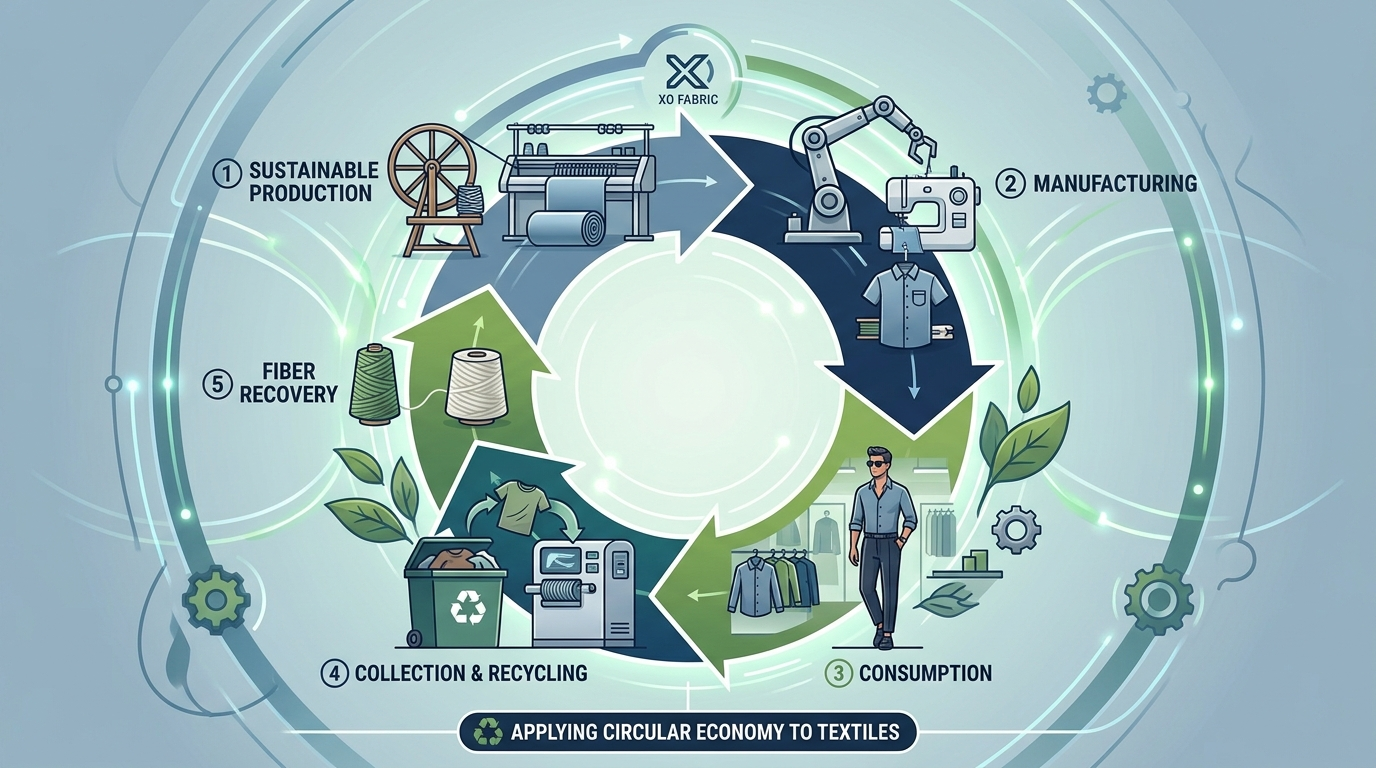
Circular fashion flips this script. It’s not just recycling; it’s a closed-loop system built on three core principles:
In practice, this creates three loops. The inner loop focuses on reuse, repair, and resale. The middle loop handles recycling and upcycling. The outer loop pushes for regeneration of natural fibers, bringing us back to the source.
When I look at the side-by-side comparison, the differences are stark. Linear fashion relies heavily on virgin materials and produces massive end-of-life waste. It’s a volume-driven business model where more is always better.
Circular fashion prioritizes recycled or renewable inputs. Waste is eliminated by design. Brands adopt service-based models like rental, resale, or take-back programs. The carbon footprint per garment can be up to 3x lower in circular models compared to linear ones.
Transitioning requires a mindset shift. You stop thinking about selling units and start thinking about retaining value. It changes how you forecast production and manage inventory.
Talking about circularity without discussing recycling tech is like talking about fashion without patterns. The technology dictates what we can actually do with waste.
Mechanical recycling is the most common method today. You take post-consumer or industrial textiles, shred them down to fibers, and re-spin them into new yarn. It works well for 100% monomaterial textiles like pure cotton or pure wool.
However, there’s a catch. Mechanical recycling shortens fiber length with each cycle. This degrades quality over time. When working with mechanically recycled cotton, you might see a GSM variance of ±3% compared to virgin. It’s minor but noticeable in tight tolerances.
Plus, it can’t separate blended fibers. If you have a poly-cotton mix, mechanical recycling struggles to pull those apart cleanly. The output is often a low-quality staple fiber suitable only for filling or insulation.
Chemical recycling is changing the game. This process breaks down fibers to the molecular level using solvents or chemicals. You can then re-polymerize them into new, virgin-quality fibers.
This is a game-changer for blended fabrics and synthetics like polyester and nylon. You get high-quality output that can be recycled multiple times without losing integrity. We’re also seeing enzymatic recycling emerge for cellulose fibers, using biology to reduce chemical load.
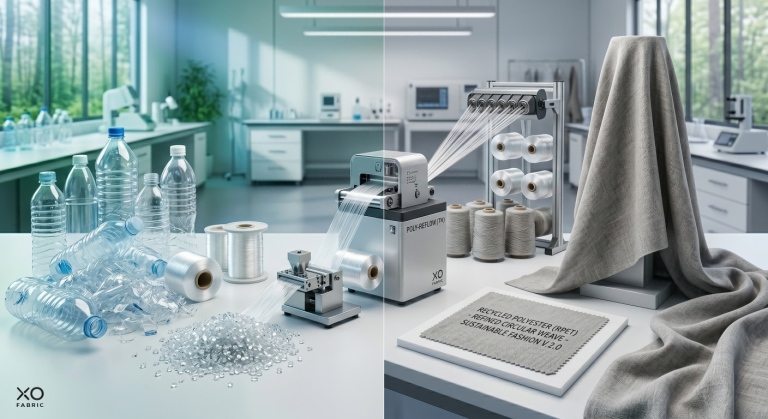
At the mill, we’ve been integrating these technologies for years. We use rPET as a base material for many of our performance knits. It’s not just about using recycled plastic bottles; it’s about partnering with verified facilities to close the loop on post-industrial waste.
Dyeing plays a huge role here too. Our Piece Dyeing Service (Custom Colors) uses low-impact chemistry that consumes 30% less water than traditional batch dyeing. This efficiency is critical when scaling circular textile production.
For brands looking to build activewear lines with a closed-loop mindset, exploring our Performance Functional Knits gives you access to rPET-based fabrics designed for durability and recyclability.
| Issue | Cause | Solution |
| GSM Variance | Fiber length inconsistency in mechanical recycling | Adjust needle size by half a point; allow ±3% tolerance in spec sheets |
| Shrinkage Increase | Fiber stress from shredding process | Use steam finishing at lower temps; stabilize with light resin finish |
| Color Depth | Recycled fibers absorb dye differently | Opt for piece dyeing; run test batches before full production |
Brands are moving beyond marketing campaigns and building actual infrastructure for circularity. The most visible shift is in take-back and resale programs.
Companies like Patagonia with Worn Wear, H&M with Garment Collecting, and Levi’s with SecondHand are leading the charge. They accept used garments and then resell, upcycle, or recycle them based on condition.
These programs extend garment life by 2-3x on average. They also build customer loyalty and reduce the brand’s waste footprint. It’s a win-win when executed well.
As a manufacturer, I see the design decisions that make or break recyclability. Monomaterial design is key. Using a single fiber type makes it infinitely easier to recycle at the end of life.
Modular design is another trend. Garments with replaceable parts, like patches or detachable liners, extend the life of the piece. We also advise clients to avoid permanent trims like bonded zippers or mixed-blend buttons that hinder the recycling process.
Some designers resist this, arguing that aesthetics suffer. But I’ve found that clean, minimalist designs often work better for modular construction. It forces you to focus on fabric quality and construction integrity.
The business side is evolving too. Rental platforms like Rent the Runway and HURR are gaining traction. Subscription services such as Nuuly and Le Tote are normalizing access over ownership.
Made-to-order production is also reducing overproduction waste. Brands only manufacture what’s sold, eliminating the dead stock that usually ends up in landfills.
A client approached us wanting to launch a circular line. They started with a poly-cotton jersey for hand feel. We ran the numbers and showed them the recycling bottleneck. They resisted, worried about performance.
We did trials with rPET knits. The color depth was an issue. We switched to piece dyeing to solve it. They also had to redesign trims to remove bonded elements. The result was a monomaterial tee that holds up to 50 washes.
It took six months longer than planned, and they had to scrap three design rounds. But the circular integrity is solid. They’re now sourcing our Performance Functional Knits for their take-back program.
Circular fashion sounds perfect in theory, but the execution is messy. There are significant hurdles that brands and manufacturers must navigate.
Separating blended fibers remains a technical nightmare at industrial scale. You can’t just recycle a poly-cotton blend easily. Mechanical recycling degrades fiber quality, limiting the number of times you can loop the material.
Global recycling infrastructure is also fragmented. There’s no standardized sorting system. What works in Europe might not work in Asia. This lack of consistency slows down adoption.
Money is always a factor. Recycled materials often cost 15-20% more than virgin alternatives. Brands have to absorb that cost or pass it to consumers, who aren’t always willing to pay up.
High upfront investment is required to transition to circular models. And consumer participation in take-back programs is still low, averaging around 12% globally. You need volume to make circular systems economical.
Supply chains are complex. Traceability is difficult when fibers pass through multiple countries and processors. Regulations vary wildly between the EU, US, and Asia.
Greenwashing is a real risk. Brands making unsubstantiated claims can damage trust. Verification and transparency are essential. We need to move beyond vague promises to audited data.
The landscape is shifting fast. New technologies and regulations are pushing the industry toward a more circular future.
Digital Product Passports (DPP) are becoming mandatory in the EU by 2026. These passports provide full traceability for textiles. You’ll be able to scan a garment and see its entire history.
AI-driven automated sorting is improving efficiency in recycling facilities. We’re also seeing bio-based fibers like mycelium, algae, and pineapple leaf fiber emerge as alternatives to synthetics.
I think DPPs will solve the data gap. Recycling facilities need to know exactly what they’re dealing with. Without fiber composition data, sorting remains a guess.
The EU Strategy for Sustainable Textiles mandates 30% recycled content and brand take-back programs by 2026. US states like California and New York are banning textile waste from landfills by 2027.
Extended Producer Responsibility (EPR) is rolling out globally. Brands will be held accountable for the end-of-life of their products. This shifts the cost of waste back to the producer.
Consumers are voting with their wallets. 60% of Gen Z consumers are willing to pay 15-20% more for certified sustainable fashion. The resale market is expected to hit $350B by 2030.
There’s a clear shift from fast fashion to slow, circular fashion. People want longer-lasting garments. They value quality and durability over quantity.
Sustainability isn’t just a buzzword here. It’s woven into our operations. We’ve been refining our processes for over 20 years to reduce impact without sacrificing quality.
Currently, 40% of our knit fabrics use recycled or renewable fibers. This includes rPET and organic cotton. We use FSC-certified recyclable packaging for all shipments.
Our supply chain is third-party audited. We ensure there’s no forced labor and no environmental violations. Transparency is non-negotiable for us.
We keep dyeing and finishing in-house to minimize transportation emissions. Our dyeing facility has a water recycling system that reduces water use by 40%.
Every bit of post-industrial waste is shredded and recycled into low-grade yarn for non-apparel use. Nothing goes to landfill. We also use our Water-Resistant Coating Finish which is PFC-free, making it safe for circular recycling processes.
We want to make circularity accessible. We offer a low MOQ of 500m for recycled fabric orders, the same as virgin materials. This removes the barrier for smaller brands.
We provide custom rPET fabric development and free technical consultations. We help brands design for recyclability and ensure they meet circular compliance standards.
Browse our full range of Performance Functional Knits to see our sustainable options in action.
Circular fashion is no longer a niche trend. It’s a necessary transformation to reduce waste, lower environmental impact, and meet regulatory demands. While challenges remain, the shift is accelerating.
Technologies are improving, and brands are committing to closed-loop systems. The question isn’t if you’ll adopt circular practices, but when.
At our mill, we’re here to support that journey. From recycled materials to low-impact finishes, we provide the resources you need.
Ready to transition to circular fashion? Contact our team to request samples of our recycled and sustainable knit fabrics.