Address
Nanlang Industrial Zone, Xingtan Town, Shunde District, Foshan, Guangdong, China
Work Hours
Mon–Fri, 9:00 AM – 6:00 PM (CST/UTC+8). We aim to respond to all inquiries within 48 hours.

Address
Nanlang Industrial Zone, Xingtan Town, Shunde District, Foshan, Guangdong, China
Work Hours
Mon–Fri, 9:00 AM – 6:00 PM (CST/UTC+8). We aim to respond to all inquiries within 48 hours.
Power Mesh vs Standard Mesh: Choosing the Right Knit for Activewear. This guide covers key properties, real-world applications, and a practical sourcing checklist for B2B buyers.
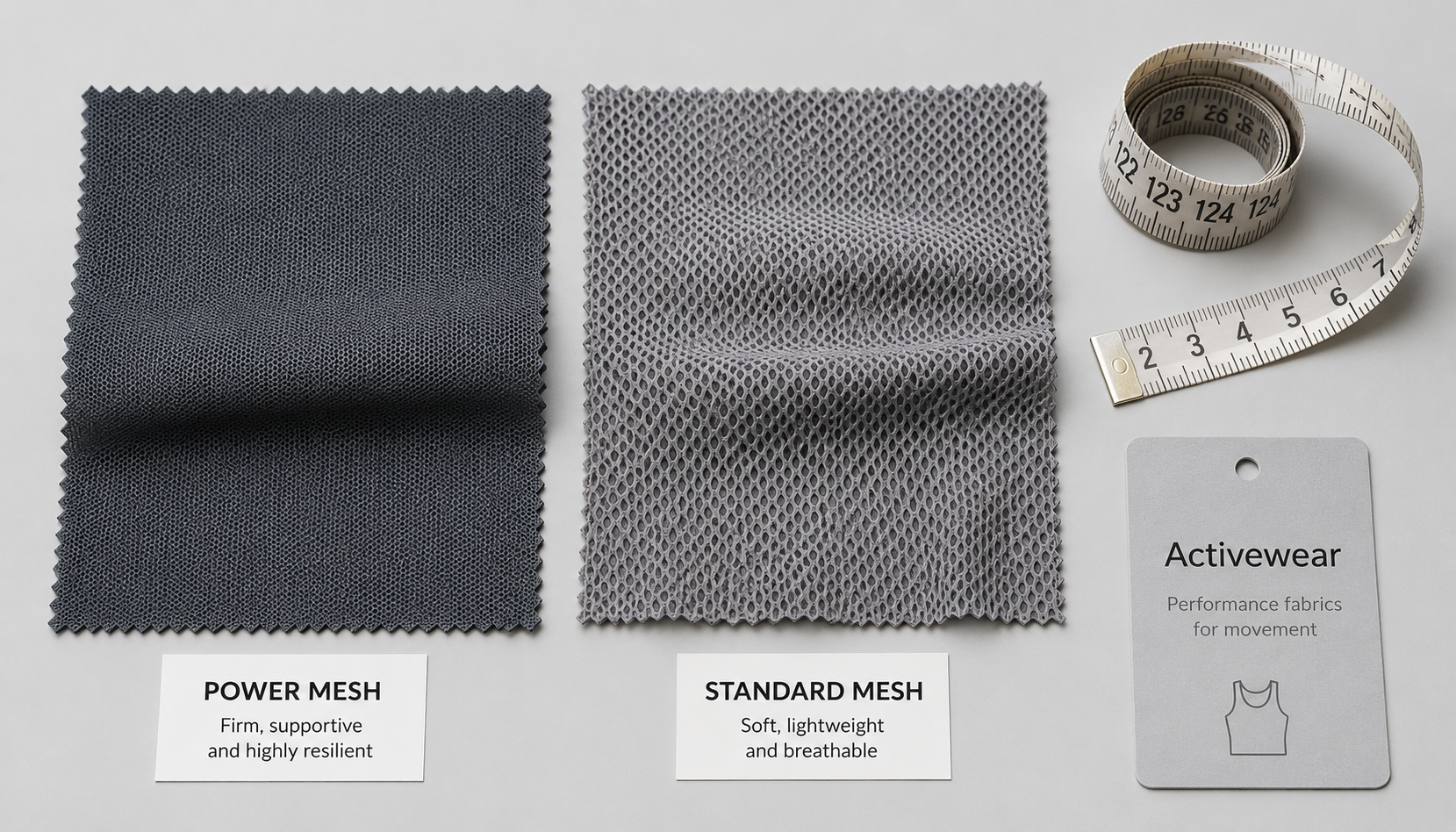
An activewear brand in Berlin recently returned an entire 3,000-meter production run because the sourcing team specified “power mesh” on the tech pack, but the mill shipped standard tulle—visually similar, yet with only 15% stretch instead of the required 40%. That single miscommunication cost the buyer €8,400 in freight, rework, and delayed launch. For B2B teams, understanding the exact technical boundary between power mesh and standard mesh is not academic—it is the difference between hitting your ship date and burning margin.
Let’s start with the basics, because the confusion usually begins at the definition stage. When a designer writes “mesh” on a tech pack, they might mean anything from a stiff tulle to a four-way stretch performance knit. The industry doesn’t help—terms overlap, and mills use them loosely.
Power mesh is a warp-knit fabric, almost always produced on a tricot machine. The key differentiator is the yarn: nylon or polyester filament yarns wrapped around an elastane (spandex) core. That elastane content—typically 10–25% of the blend—is what gives power mesh its signature 30–50% four-way stretch with strong recovery.
The construction uses an open-hole geometry, which is why it breathes well despite being a performance fabric. You’ll find it in weights ranging from 60–150 gsm (1.8–4.4 oz/yd²), with lighter variants for sports bras and heavier ones for shapewear panels. If you want to see a concrete example with documented specs, the jacquard mesh knit fabric page lists full stretch-recovery data that illustrates exactly what “power mesh” means in production terms.
One thing worth noting: “power mesh” and “powernet” get used interchangeably in lingerie sourcing, but they’re not identical. Powernet typically refers to heavier Yarn Count Converter variants—40–70 denier, with higher compression—used in shapewear and medical supports. Power mesh is lighter and more breathable. The power mesh vs powernet distinction matters when you’re specifying for activewear versus compression garments.
Standard mesh is a much broader family. It can be warp-knit or weft-knit, may or may not contain elastane, and its stretch range typically sits between 0–20%. Without elastane, standard mesh has minimal recovery—it stretches once and stays stretched.
The subtypes are worth knowing. Tulle is the stiff, hexagonal-net construction you see in ballet costumes and wedding veils. Honeycomb mesh has a larger, more uniform hole pattern. Birdseye mesh uses a tighter, diamond-shaped knit. Each serves different purposes, but none of them deliver the compression or rebound that activewear demands.
This is where the power mesh vs tulle comparison becomes critical. A buyer who orders “mesh” and gets tulle will receive a fabric that looks vaguely similar in photos but behaves completely differently on a body in motion. Tulle has essentially zero recovery. Power mesh snaps back.
The fastest way to align your sourcing team is a side-by-side comparison. Here’s what matters when you’re choosing between these two fabric families.
| Parameter | Power Mesh | Standard Mesh |
|---|---|---|
| Construction | Warp-knit tricot | Warp-knit, weft-knit, or raschel |
| Elastane Content | 10–25% | 0–10% |
| Stretch % | 30–50% four-way | 0–20% (often one-way only) |
| Recovery | ≥90% after 50 washes | 50–70% (degrades rapidly) |
| Typical Weight | 60–150 gsm (1.8–4.4 oz/yd²) | 30–100 gsm (0.9–3.0 oz/yd²) |
| Common Applications | Sports bras, compression leggings, shapewear | Linings, overlays, ventilation panels |
| Price Tier | Mid-to-high | Low-to-mid |
| Sewing Difficulty | Moderate (requires stretch techniques) | Easy to moderate |
At the machine level, the difference is significant. Power mesh runs on tricot warp-knitting machines at finer gauges—typically 28–40 gauge—which produces a smoother hand-feel against skin. The yarn denier is carefully controlled: lighter deniers (20–40) for breathable activewear, heavier deniers (50–70) for compression applications.
Standard mesh often uses raschel or weft-knit machines with coarser gauges. The loop structure is looser, the hole geometry less precise. That’s fine for a decorative overlay on a casual tank, but it won’t hold up under the mechanical stress of a high-impact sports bra.
Here’s a practical mapping. If you’re designing a power mesh bra for running or CrossFit, you need that 30–50% stretch with recovery that doesn’t quit after a few washes. Power mesh is the only viable option. For a power mesh shirt—say, a lightweight training tee with mesh ventilation panels—the same fabric works, though you’d lean toward the lighter end of the weight spectrum.
Standard mesh earns its place in non-structural roles. A lining inside a casual jacket. A decorative panel on a dance costume. A ventilation zone on the back of a cycling jersey where compression isn’t the goal. The Power Mesh vs stretch Mesh conversation really comes down to one question: does this panel need to hold the body, or just cover it?
Spec sheets tell one story. Production tells another. Here’s what happened when a mid-size UK activewear brand put both fabrics through real-world testing.
The brand needed a breathable yet supportive side panel for a new sports bra line targeting high-impact use—running, CrossFit, that sort of thing. The design required ≥35% stretch with ≥90% recovery after 50 wash cycles. Non-negotiable specs from the product team.
The sourcing team tested two options: a 90 Fabric GSM Calculator (2.7 oz/yd²) power mesh at $3.20/m and a 70 gsm (2.1 oz/yd²) standard mesh at $1.80/m. Option B was 44% cheaper. The finance team loved it.
First trial: they went with the standard mesh to save cost. After just 3 wash cycles in internal QA, recovery dropped to 60%. The panels sagged visibly. The product failed the brand’s “bounce test”—their internal protocol where a fit model jogs on a treadmill for 10 minutes while evaluators watch for excessive movement. It was a clear fail.
Second attempt: the team tried to salvage the standard mesh by adding a separate elastic binding along the seams. That added $0.40/m in trim cost and created bulk at the seam lines—exactly where a sports bra needs to lie flat. The design team rejected it immediately.
The compromise: switch to power mesh (90 gsm) for all structural panels and retain standard mesh only for non-load-bearing ventilation zones on the back. Unit cost rose 18%, but the product passed all QA benchmarks and launched on schedule. The team accepted the higher BOM cost as a necessary trade-off to avoid a £12,000 recall risk.
The lesson here is straightforward. How strong is power mesh? Strong enough to survive 50+ wash cycles at ≥90% recovery—something standard mesh simply cannot deliver under compression loads. When the product spec demands performance, the fabric choice isn’t really a choice at all.
Let’s make this actionable. Here’s a decision matrix that maps product types to fabric recommendations based on stretch requirements and end-use conditions.
| Product Type | Required Stretch % | Recommended Fabric | Rationale |
|---|---|---|---|
| Sports bra (high-impact) | 35–50% | Power mesh | Compression, recovery, breathability all required |
| Compression legging panels | 30–45% | Power mesh | Must hold shape through repeated stretching |
| Casual tank overlay | 5–15% | Standard mesh | Decorative, no structural load |
| Shapewear bodysuit | 40–50% | Heavy power mesh / powernet | Maximum compression and recovery needed |
| Dancewear costume | 10–20% | Standard mesh (tulle) | Aesthetic priority, minimal stretch acceptable |
There are clear triggers. If your garment requires compression—if it’s body-hugging, if it’s designed for high-impact sport, if it will be worn directly against skin and needs OEKO-TEX certification—specify power mesh. The higher elastane content drives cost, but it delivers performance that standard mesh cannot replicate.
Power mesh also makes sense when you need consistent recovery across the garment’s lifecycle. A power mesh bra that maintains its shape after 50 washes is a fundamentally different product than one that sags after 10. Your customer reviews will reflect that difference within months of launch.
Standard mesh wins in three scenarios. First, linings—where the fabric sits against the body but doesn’t need to compress. Second, decorative overlays—where visual texture matters more than mechanical performance. Third, cost-sensitive fast fashion—where the garment’s intended lifespan is shorter and the stretch demands are minimal.
Standard mesh also tends to have broader color availability and lower MOQ from stock, which matters when you’re sampling across multiple colorways for a seasonal collection. For buyers exploring these lighter constructions, the mesh and net knit fabrics category covers tulle, honeycomb, and birdseye variants alongside power mesh options.
After years of watching procurement teams make the same mistakes, I’ve distilled the verification process down to eight steps. Skip any of these at your own risk.
I’ve seen these three mistakes cost brands real money. First, confusing “mesh” with “power mesh” on tech packs—use specific terminology, include elastane percentage, and attach a reference swatch number. Second, skipping wash-test validation—what looks great on arrival may recover poorly after the first laundry cycle. Third, accepting stock certificates without verifying lot-specific reports—certifications cover the production system, not necessarily the exact roll you’re receiving.
For buyers ready to move from research to sampling, the factory’s technical team can provide spec sheets and sample cuts directly through the contact page. A dedicated engineer typically responds within 48 business hours with a feasibility assessment and quotation.
Power mesh is a warp-knit tricot fabric made from nylon or polyester filament yarns with an elastane (spandex) core. It delivers 30–50% four-way stretch with strong recovery, making it the go-to choice for activewear, sports bras, and shapewear where compression and breathability are both required. If you’re asking “what is a power mesh” in the simplest terms: it’s the stretchy, breathable knit that holds things in place without feeling like a wetsuit.
It’s not hard, but it does require technique. Power mesh’s stretch means you need ballpoint needles (to avoid cutting the yarn), reduced presser-foot pressure, and ideally a walking foot or serger. Standard mesh is easier to handle because it doesn’t shift under the needle—but it’s less forgiving when it comes to seam puckering. My preference: always do a 30 cm (12 in) test sew before committing to production. The settings that work for cotton will destroy power mesh.
Typical power mesh withstands 15–25 N/cm (3.4–5.6 lbf/in) in the warp direction. Standard mesh sits at 8–12 N/cm (1.8–2.7 lbf/in). That difference matters enormously in activewear, where seams and panels experience repeated tensile loading during movement. The higher tensile strength of power mesh is directly tied to its elastane content and tricot construction—it’s engineered to stretch and return without fatiguing.
Power net (powernet) is a subset of the power mesh family—heavier denier, typically 40–70 denier, with higher compression. It’s used in shapewear, medical compression garments, and structured lingerie where maximum hold is needed. Power mesh is lighter (20–40 denier), more breathable, and better suited for activewear where comfort during movement matters as much as support. Think of powernet as the heavy-duty option and power mesh as the athletic option.
The activewear market is growing at 8–10% CAGR globally, and with that growth comes increasing pressure on sourcing teams to get fabric specifications right the first time. Power mesh for performance-driven, body-conforming applications where stretch recovery is non-negotiable. Standard mesh for cost-efficient, decorative, or low-stress functional uses. The decision logic isn’t complicated—but it does require specificity at the tech-pack stage.
One thing I’ve learned over the years: the cheapest fabric is rarely the cheapest decision. That Berlin brand’s €8,400 return could have been avoided with a single swatch request and a 10-cycle wash test. For teams building their next activewear collection, the knowledge hub offers additional fabric selection guides and technical deep-dives. And for a factory that’s been doing integrated weave-to-dye production since 2005—established credentials, full certification matrix—specifying the right mesh variant at the tech-pack stage is where good products begin.