Address
Nanlang Industrial Zone, Xingtan Town, Shunde District, Foshan, Guangdong, China
Work Hours
Mon–Fri, 9:00 AM – 6:00 PM (CST/UTC+8). We aim to respond to all inquiries within 48 hours.

Address
Nanlang Industrial Zone, Xingtan Town, Shunde District, Foshan, Guangdong, China
Work Hours
Mon–Fri, 9:00 AM – 6:00 PM (CST/UTC+8). We aim to respond to all inquiries within 48 hours.
Tech Fleece vs Traditional Fleece: What B2B Buyers Need to Know. This guide covers key properties, real-world applications, and a practical sourcing checklist for B2B buyers.
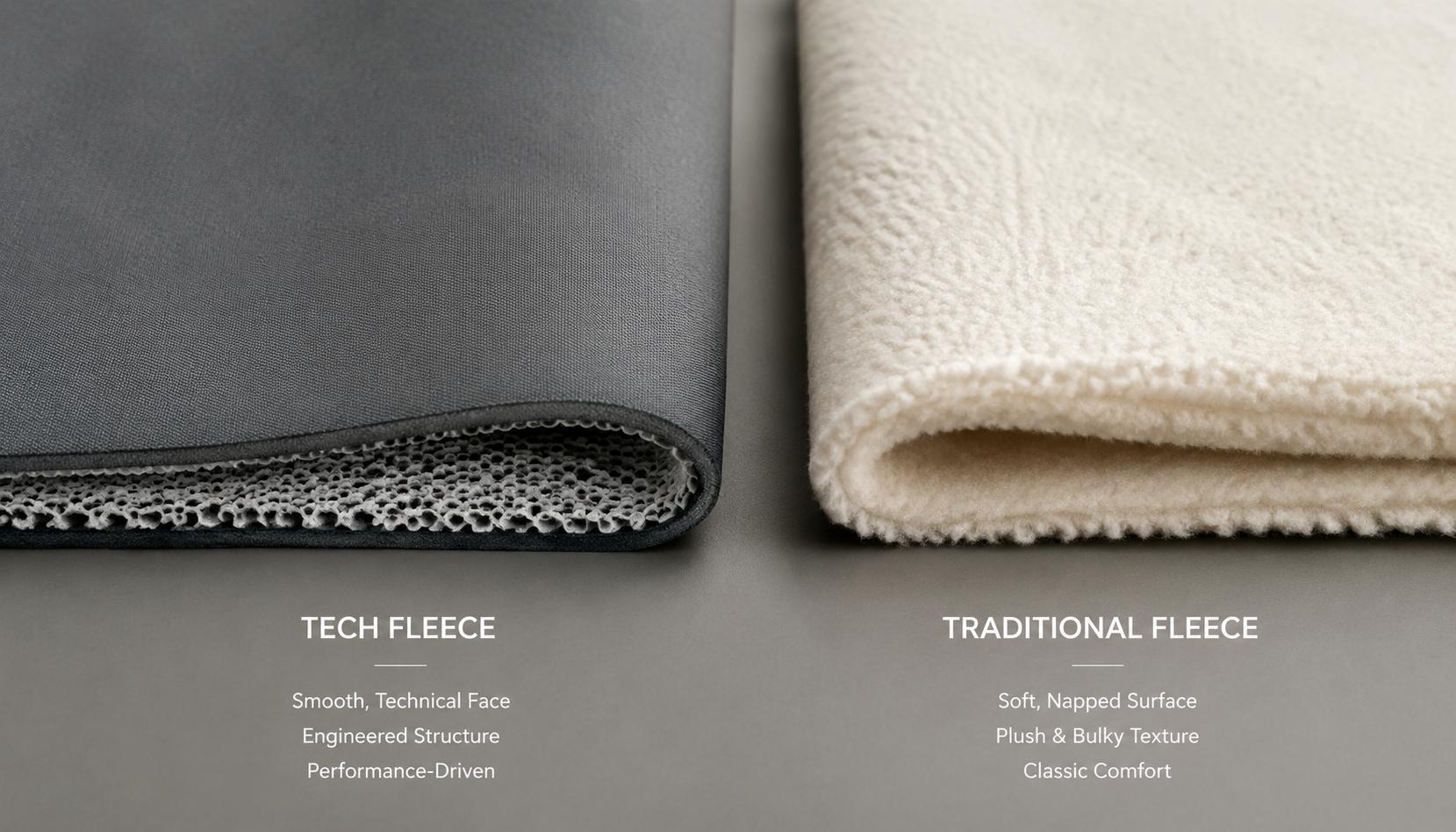
A mid-volume outerwear brand once returned an entire 12,000-unit fleece jacket order because the supplier swapped a grid-backed tech fleece for standard polar fleece—shaving $0.45 per metre but adding 180 g (6.3 oz) per garment and doubling dry-time. The gap between “tech fleece” and “traditional fleece” is real, measurable, and costly when a buyer treats the two as interchangeable.
Let’s start with the basics, because the terminology gets thrown around loosely in sourcing meetings. Traditional fleece is the stuff most people picture when they hear the word “fleece”: a polyester polar fleece fabric, typically knitted on a circular machine, then heavily brushed or sheared on one or both faces to create that familiar soft, napped surface. GSM ranges for standard polar fleece usually sit between 100 and 300 gsm (3.0 to 8.9 oz/yd²), though the bulk of commercial orders I’ve seen cluster around the 200–280 gsm (5.9–8.3 oz/yd²) sweet spot for midweight jackets and blankets.
Tech fleece, by contrast, is an engineered knit structure designed from the ground up to optimize specific performance metrics—usually warmth-to-weight ratio, moisture transport, or breathability. Instead of relying on a brushed surface for loft, tech fleece uses deliberately constructed knit geometries: grids, waffles, lofted synthetic piles, or hybrid face-back combinations. The result is a fabric that feels lighter, dries faster, and packs down smaller than its traditional counterpart at a comparable thermal rating.
In the field, you’ll hear a few specific names repeated:
Why does the distinction matter for B2B spec sheets? Because if you write “fleece” on a purchase order without specifying the construction, the factory will default to the cheapest, most familiar option—traditional polar fleece. And that default can blow up your performance specs, your costing, and your timeline all at once.
For a deeper dive into the engineering principles behind these constructions, the knowledge hub offers technical articles on fleece knitting and testing standards that go well beyond what we can cover here.
A European private-label brand came to us requesting 8,000 hoodies. Their spec sheet said “fleece.” That’s it. The factory defaulted to 280 Fabric GSM Calculator standard polar fleece—cheap, available from stock, and perfectly reasonable if nobody reads the performance fine print.
The brand’s cost target was ≤ $4.20 FOB per metre. Their performance spec required ≤ 350 g (12.3 oz) garment weight and ≤ 60-minute dry time. The first sample in 280 gsm polar fleece hit cost beautifully but weighed 520 g (18.3 oz) and took 140 minutes to dry in lab testing. Switching to 200 gsm polar reduced weight to 410 g (14.5 oz) but still failed dry-time by 40 minutes.
The compromise: we moved to a 180 gsm grid-back tech fleece at $4.85 per metre. The brand accepted a $0.65/m premium—and that premium saved them from a full order rejection, a relabelling nightmare, and about $38,000 in rework costs. The lesson? Specifying “fleece” without specifying structure is a gamble.
The popularity of Nike’s Tech Fleece line has done more to shape consumer expectations than any fabric trade show in the last decade. When end-customers say “tech fleece,” they often mean that specific midweight, smooth-face, lofted-interior hand feel. For B2B buyers, understanding what’s happening at the fiber and knit level helps you translate those consumer expectations into mill-ready specifications.
Traditional fleece uses a straightforward cut-and-brush or knit-and-brush process. The fabric is knitted on a circular machine, then mechanically brushed to raise fibers and create loft. It’s a subtractive process—you’re creating texture after the knit is formed.
Tech fleece, on the other hand, builds performance into the knit structure itself. A grid fleece, for example, features raised channels or grids on the back face that are integral to the knitting, not added later. This means the loft and air-trapping geometry are consistent across the roll and don’t degrade with washing the way brushed surfaces can.
Fiber options have expanded significantly. Both traditional and tech fleeces now commonly use recycled polyester (rPET), and some tech constructions blend in nylon (typically 15–30%) for abrasion resistance or use bio-based synthetics for sustainability positioning. GSM ranges tell the story clearly:
| Parameter | Traditional Fleece | Tech Fleece |
|---|---|---|
| Typical GSM | 200–380 gsm (5.9–11.2 oz/yd²) | 100–250 gsm (3.0–7.4 oz/yd²) |
| Construction | Circular knit, brushed face | Engineered knit (grid, waffle, lofted) |
| Warmth-to-weight | Moderate | High |
| Dry time | 90–180 min | 30–75 min |
| Packability | Low | Medium–High |
I’ll be honest: I still have a soft spot for a well-made 280 gsm polar fleece in a casual zip-up. There’s a plushness to it that most tech fleeces can’t replicate. But for performance applications, the numbers don’t lie.
When we talk about men tech fleece vs traditional fleece in a B2B context, we’re really talking about end-use alignment. Here’s a quick breakdown:
End-use mapping looks like this: traditional fleece dominates budget casualwear, throw blankets, and pet beds—applications where cost-per-square-metre trumps performance. Tech fleece takes the lead in performance mid-layers, athleisure hoodies, travel gear, and any product where the brand story revolves around innovation. The Nike Tech Fleece phenomenon has made consumers—especially in men’s streetwear—expect that smooth-face, lofted-interior hand feel even at mid-tier price points.
Octa fleece deserves a special mention here. Its eight-lobed hollow-core fiber creates air pockets that deliver exceptional loft at weights as low as 100–130 gsm (3.0–3.8 oz/yd²). It’s not cheap, and it’s not easy to source at scale outside Japan, but for brands targeting the ultralight segment, it’s a genuine differentiator.
This is where the tech fleece vs traditional fleece conversation gets uncomfortable, because the performance advantages of tech fleece come with real sourcing friction.
Price per metre: Traditional polar fleece in the 200–280 gsm range typically sits at $2.50–$4.00 FOB for orders of 1,000+ metres, depending on fiber content and finishing. Tech fleece constructions—grid, lofted, or hybrid—run $4.00–$7.50 FOB for comparable volumes. That’s a 40–90% premium, and it’s driven by more complex knit programming, specialty yarns, and lower production speeds.
The tech fleece vs traditional fleece’s cost gap narrows somewhat at higher volumes, but it never disappears entirely. The knit structure is simply more complex.
Here’s a practical sourcing timeline comparison:
One factor that can compress lead times for tech fleece is integrated production capability. When a manufacturer controls the full chain—yarn preparation, knitting, dyeing, and finishing—under one roof, they eliminate the handoff delays that plague fragmented supply chains. An integrated line can shave 5–8 business days off a custom tech fleece order compared to a mill that outsources dyeing.
If you’re exploring a tech fleece construction for the first time, I’d recommend starting with a feasibility conversation before committing to sampling. The contact form at the factory supports specification-sheet uploads, and their technical team typically responds within 48 hours with a feasibility assessment and sample quote for specific tech-fleece constructions.
I’ve seen too many sourcing decisions driven by either cost-only thinking or performance-only thinking. Neither works in isolation. Here’s a framework I use when advising brands on the tech fleece vs traditional fleece question:
| Decision Factor | Choose Traditional Fleece | Choose Tech Fleece | Consider Hybrid |
|---|---|---|---|
| End-use | Budget casualwear, blankets, pet products | Performance mid-layers, athleisure, travel gear | Outerwear with mixed-panel design |
| Performance priority | Softness, bulk warmth | Warmth-to-weight, dry time, packability | Targeted zones: tech at core, fleece at extremities |
| Budget per metre | ≤ $4.00 FOB | ≥ $4.00 FOB | $3.50–$5.50 FOB (blended) |
| MOQ flexibility | Low (300 m / 328 yd OK) | Medium–High (500+ m / 547+ yd) | Medium (400–600 m / 437–656 yd) |
Scenario A: You’re producing 15,000 units of a basic zip-up hoodie for a fast-fashion retailer. Price point at retail is $29.99. Traditional 240 gsm polar fleece at $3.20/m is your friend. Don’t over-engineer it.
Scenario B: You’re building a brand-differentiated mid-layer for an outdoor brand at $89 retail. Customers expect lightweight, quick-dry, packable. A 180 gsm grid-back tech fleece at $5.50/m is the right call, and the premium disappears in the retail margin.
Scenario C: You want the “tech” story but can’t stomach the full premium. Use tech fleece for the body panels (where performance matters most) and traditional fleece for the hood lining or pocket bags. This hybrid approach can save 15–20% on fabric cost while preserving the key performance claims.
One critical piece of advice: never make this decision on spec sheets alone. Request hand-feel swatches. Run wash tests. Feel the drape. I’ve seen fabrics that look identical on paper deliver completely different consumer experiences.
You can explore available tech-fleece and engineered knit constructions—including grid, lofted, and hybrid options—through the performance functional knits category, which is set up for sample requests.
Whether you land on tech fleece or traditional fleece, the quality verification process is non-negotiable. Here’s what I’d put on every buyer’s checklist:
Ask for third-party test reports from recognized labs—SGS, Bureau Veritas, or Intertek. In-house reports from the mill are useful for development-stage screening but shouldn’t be your sole acceptance criterion for bulk orders.
Certifications matter, too. OEKO-TEX Standard 100, GRS 4.0, and ISO 9001 are baseline expectations for any serious B2B supplier. EU REACH compliance is non-negotiable if you’re selling into European markets.
The manufacturer we work with, established in 2005, maintains an integrated weave-to-dye-to-flock production line and holds all four of those certifications. You can review their full credentials and certification matrix on their about page, which I’d recommend checking before any first-time order.
If you’re sourcing Alpha Direct fleece—the exposed-loft Polartec construction—add abrasion testing to your checklist. Because there’s no liner fabric protecting the lofted fibers, Martindale abrasion performance is critical. Expect lower baseline scores (1,500–2,500 cycles) compared to lined constructions, and design your garment care labels accordingly.
Not necessarily in absolute terms. A 300 gsm traditional polar fleece will be warmer than a 150 gsm tech fleece in static conditions. The advantage of tech fleece is warmth-to-weight ratio—it delivers comparable warmth at significantly lower weight. For active use (hiking, running, cycling), tech fleece also performs better because its breathability prevents the clammy buildup that traditional fleece is notorious for.
Yes, especially when made from recycled polyester (rPET) to begin with. Many tech fleece constructions now use GRS-certified recycled content, and the mono-material composition (100% polyester) makes them compatible with mechanical recycling streams. This is an area where Octa fleece and similar hollow-core constructions are making real progress.
For engineered tech fleece constructions—custom knit structures, proprietary blends, or non-stock colours—expect a minimum of 500 m (547 yd). Some mills will go lower for development samples, but production MOQs typically start at 500 m. Stock colours in standard grid fleece may be available at 300 m (328 yd) from certain suppliers.
Grid fleece is generally superior for layering systems. Its open-grid back face allows moisture vapor to pass through to the next layer, preventing the “wet sandwich” effect. Brushed fleece traps more air (warmer in static conditions) but holds moisture against the skin. For shell-layer compatibility, grid fleece wins. For standalone casual wear in dry cold, brushed fleece is perfectly fine.
The tech fleece vs traditional fleece question isn’t about one being “better” than the other. It’s about alignment—between your end-use, your performance specs, your budget, and your brand story. Traditional fleece still dominates by volume and probably always will. Tech fleece is growing because consumer expectations are shifting, especially in men’s athleisure and outdoor crossover categories.
My honest take: if you’re even asking the question, you’re probably leaning toward tech fleece for a reason. The key is specifying it correctly, sourcing it from a supplier with the technical infrastructure to execute it consistently, and testing it rigorously before committing to bulk. A $0.65/m premium on fabric is nothing compared to a 12,000-unit return.