Address
Nanlang Industrial Zone, Xingtan Town, Shunde District, Foshan, Guangdong, China
Work Hours
Mon–Fri, 9:00 AM – 6:00 PM (CST/UTC+8). We aim to respond to all inquiries within 48 hours.

Address
Nanlang Industrial Zone, Xingtan Town, Shunde District, Foshan, Guangdong, China
Work Hours
Mon–Fri, 9:00 AM – 6:00 PM (CST/UTC+8). We aim to respond to all inquiries within 48 hours.
GOTS vs OEKO-TEX: Organic Textile Certifications Compared. This guide covers key properties, real-world applications, and a practical sourcing checklist for B2B buyers.
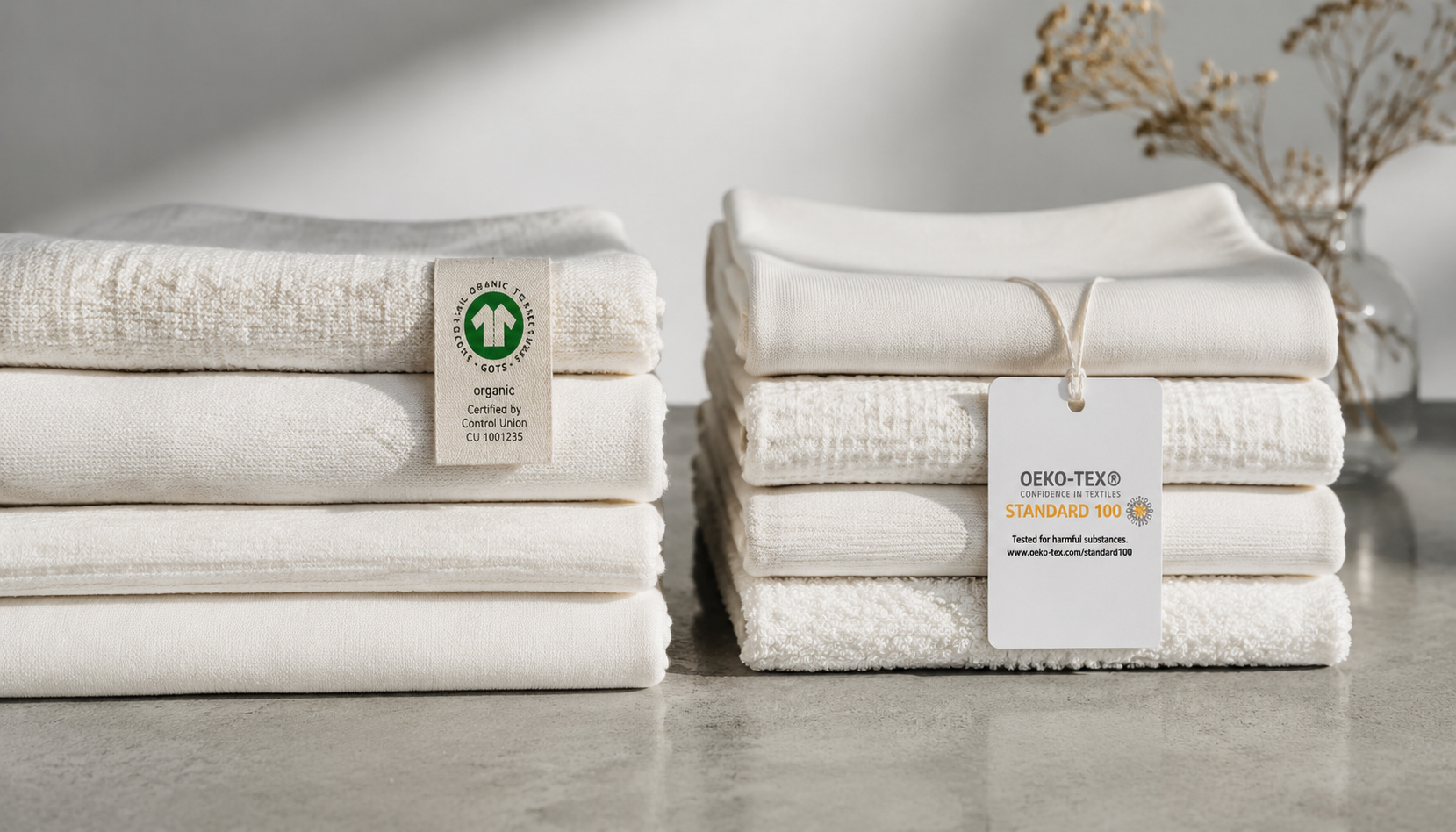
A German home-textile importer recently rejected an entire 40 ft (12.2 m) container of “organic” duvet covers because her retail chain demanded GOTS certification on the hang-tag—but the supplier had only tested to OEKO-TEX Standard 100. The two logos looked similar, the fabrics felt identical, yet the shipment was legally uninsurable as “organic.” One certification gap cost the buyer roughly €11,400 in demurrage, relabelling, and expedited resampling.
The names sound interchangeable. They are not. GOTS and OEKO-TEX operate under completely different philosophies, managed by separate international bodies, and they answer fundamentally different questions about your textile supply chain.
Understanding this distinction is the first step in avoiding costly procurement errors. One certification traces the entire life of a fiber. The other evaluates the chemical safety of the finished product on the shelf. Confusing them can derail a product launch, void marketing claims, and trigger expensive rework.
The Global Organic Textile Standard (GOTS) is a chain-of-custody certification. It is jointly managed by organizations including the International Association Natural Textile Industry (IVN), the Organic Trade Association (OTA), and the Japan Organic Cotton Association (JOCA). Its core logic is traceability.
GOTS doesn’t just test a swatch. It audits every link in the production chain—from the organic farm where the cotton was grown, through the spinning mill, the weaving or knitting facility, the dyehouse, and finally to the cut-and-sew factory that applies the hang-tag. Each facility in that chain must hold its own GOTS scope certificate.
This is why GOTS is the gold standard for brands marketing organic claims. It’s a system-level certification, not a single-product badge.
OEKO-TEX Standard 100, administered by the OEKO-TEX Association, takes a different approach. It focuses exclusively on the final product. The certification asks one question: “Is this specific item, as it exists right now, free from harmful levels of regulated substances?”
The testing covers a broad range of chemicals—formaldehyde, pesticides, heavy metals, allergenic dyes, and pH levels, among others. The standard classifies products into four categories based on skin contact intensity:
Certification is granted per product or per product line, and it requires annual renewal with surveillance testing. Crucially, OEKO-TEX Standard 100 does not verify fiber origin, organic status, or production processes. A polyester fabric made from petroleum-derived feedstock can absolutely be OEKO-TEX certified.
GOTS answers “Is it organic?” OEKO-TEX answers “Is it safe?” These are complementary questions, but they are not the same question.
Let’s put them in a direct comparison. This table distills the core differences into a quick-reference format for procurement teams.
| Dimension | GOTS | OEKO-TEX Standard 100 | Both Certified Scenario |
|---|---|---|---|
| Certification Target | Entire supply chain (farm to finished product) | Final finished product only | Product meets both organic traceability and chemical safety claims |
| Organic Fiber Requirement | ≥95% for “organic”; ≥70% for “made with organic” | None. No fiber-origin requirement. | Product must meet GOTS fiber thresholds independently |
| Chemical Control Scope | Broad RSL + process chemicals; banned substance lists for inputs | Final-product RSL only; no input-chemical control | GOTS RSL is generally stricter; OEKO-TEX testing adds independent verification |
| Supply Chain Audit Depth | Every production unit audited; chain-of-custody documentation | Sample-based lab testing of finished goods | Dual audit burden on manufacturer |
| Typical Cost Range | €3,000–€15,000+ (varies by factory size, country, number of sites) | €500–€3,000 (per product line, based on testing scope) | Combined costs are additive, not discounted |
| Validity & Renewal | 1 year; annual renewal audit required | 1 year; annual surveillance testing | Two separate renewal cycles to manage |
Keep in mind that these cost figures are indicative ranges. A large integrated mill in China will pay differently than a small garment workshop in Portugal. The key takeaway is structural: GOTS certification involves significantly more time, documentation, and cost because it audits the entire production ecosystem.
This is the most consequential difference for manufacturers. Consider a multi-process product like a flocked nonwoven fabric. The production chain might involve: needle-punching a polyester nonwoven base, applying an acrylic adhesive via rotary screen, electrostatically flocking nylon fibers onto the adhesive layer, curing at 160°C (320°F), and finally applying a softener finish.
Under GOTS, every chemical input in that chain—the adhesive, the softener, even the lubricant on the needle loom—must come from a supplier whose product is listed on the GOTS approved inputs database. The flocking adhesive itself would need to be reformulated if it contains substances on the GOTS restricted list, such as APEO-based surfactants.
Under OEKO-TEX Standard 100, the lab simply tests the final flocked fabric for residual formaldehyde, extractable heavy metals, and other regulated substances. If the finished product passes, it’s certified. The adhesive chemistry is irrelevant unless it leaves detectable residues above threshold limits.
This distinction is why some manufacturers can achieve OEKO-TEX certification in weeks but need months for GOTS. The supply chain documentation alone can be staggering.
For procurement managers, certification timelines directly impact order planning. Here’s a simplified three-step timeline comparison:
When a buyer demands both OEKO-TEX and GOTS certified products, the manufacturer’s compliance costs stack. Those costs don’t disappear—they surface in the FOB price, typically as a 3–8% uplift depending on order volume and existing certification infrastructure. Smart buyers factor this into sourcing budgets from day one.
Here’s where the abstract standards meet the textile swatch on your desk. The question “Which certification do I need?” is inseparable from “What fiber am I using?”
Natural fibers have a clear home in the GOTS ecosystem. Organic cotton, organic linen (flax), organic hemp, organic wool, and organic silk can all be GOTS certified—provided the agricultural source holds a recognized organic farming certification, such as USDA NOP or compliance with EU Organic Regulation 2018/848.
Synthetic fibers tell a different story. Polyester, nylon (including Nylon 6.6), and acrylic are derived from petrochemical feedstocks. There is no “organic” designation for petroleum. These fibers cannot obtain GOTS certification. Their natural certification pathway is OEKO-TEX Standard 100, which evaluates chemical safety regardless of fiber origin.
| Fiber Type | Recommended Certification | Key Threshold | Typical Products |
|---|---|---|---|
| Organic Cotton | GOTS (primary) | ≥95% organic fiber for “organic” label | Baby garments, bed linens, T-shirts |
| Conventional Cotton | OEKO-TEX S100 | No organic requirement; chemical safety only | Mass-market apparel, home textiles |
| Polyester / Nylon | OEKO-TEX S100 | No organic pathway exists for synthetics | Activewear, outdoor fabrics, nonwovens |
| Organic Cotton + Polyester Blend | GOTS (if ≥70% organic) + OEKO-TEX optional | Organic content must meet minimum percentage | Blended knits, performance casualwear |
| Organic Wool / Silk | GOTS | Animal welfare + organic farm certification | Premium knitwear, luxury scarves |
For blends, the situation gets nuanced. A fabric that is 65% organic cotton and 35% recycled polyester cannot carry a GOTS “made with organic” label (which requires ≥70%). It could, however, carry OEKO-TEX Standard 100 certification for chemical safety. Some brands pursue both certifications on different product lines within the same collection—a pragmatic approach that matches each product to its strongest viable claim.
Products with complex, multi-layer constructions present the most interesting certification challenges. Take a flocked-on-nonwoven-base material as an example. This type of product typically involves a nonwoven substrate (often polyester or a polyester-viscose blend), an adhesive layer, and electrostatically applied flock fibers.
Under GOTS, if any component in that stack is intended for an organic claim, the adhesive must be sourced from the GOTS approved inputs list. Historically, many industrial flocking adhesives relied on APEO (alkylphenol ethoxylate) surfactants—substances explicitly banned under GOTS 5.0 Appendix 2. Reformulating to a water-based polyurethane system can achieve compliance, but it often introduces performance trade-offs.
In one documented production trial, switching from an APEO-containing acrylic adhesive to a GOTS-compliant water-based PU system resulted in a measurable decrease in flock adhesion—from a Martindale abrasion rating of 4.5 to 4.0. The manufacturer compensated by optimizing the curing temperature to 160°C (320°F) and extending dwell time by 15 seconds, recovering most of the lost performance. But the R&D cycle added three weeks to the development timeline.
OEKO-TEX Standard 100, by contrast, would simply test the finished flocked fabric. If residual APEO levels in the final product are below the detection threshold, the product passes—even if APEO was used in processing. This is precisely why OEKO-TEX and GOTS certified claims address different dimensions of product integrity, and why they cannot be treated as interchangeable.
A mid-size European importer specializing in private-label baby textiles placed a order for 12,000 pieces of baby rompers. The fabric was a 200 Fabric GSM Calculator (5.9 oz/yd²) organic cotton knit. The purchase order specified “OEKO-TEX certified” on the supplier requirements sheet. The Chinese factory confirmed OEKO-TEX Standard 100 Class I certification and production commenced.
Three weeks before shipment, the importer’s retail client—a major German department store chain—announced a new “Organic Baby” shelf campaign. The marketing team mandated GOTS hang-tag certification on every product in the program. Suddenly, the OEKO-TEX label that everyone had relied on was insufficient.
The importer scrambled through three failed approaches before finding a workable compromise.
The resolution was a painful compromise. The importer split the order: 8,000 pieces were re-sourced from a secondary GOTS-certified mill. This factory was smaller, less automated, and quoted an 18% higher per-unit cost. The importer accepted the margin erosion because the retail shelf placement represented approximately €85,000 in seasonal revenue—far outweighing the cost increase.
The remaining 4,000 pieces stayed with the original OEKO-TEX-only supplier. These were rebranded under a separate “Dermatologically Tested” line with no organic claim. The shipment was split across two delivery windows, adding six weeks of logistics complexity.
The lesson for any B2B buyer sourcing GOTS and OEKO-TEX certified baby clothes—or any certified product—is blunt: certification name ≠ certification content. At the purchase order stage, you must verify exactly which standard is referenced, which claims it supports, and whether your supplier’s existing certificates actually cover your specific product configuration.
The case above illustrates what happens when certification selection is an afterthought. Let’s build a systematic framework so it becomes a first-thought.
| Product Type | End Market | Recommended Certification Path | Key Decision Factor |
|---|---|---|---|
| Organic cotton baby clothing | EU / North America retail | GOTS (mandatory for organic claims) | Retailer shelf requirements; organic marketing claims |
| Synthetic activewear | Global e-commerce | OEKO-TEX Standard 100 Class I–II | No organic claim possible; chemical safety is the sellable credential |
| Indoor upholstery fabric | Contract / hospitality | OEKO-TEX S100 Class IV (or GOTS if organic line) | Fire-retardant treatments may complicate GOTS chemical compliance |
| Organic cotton bed sheets | Premium retail / DTC | GOTS + OEKO-TEX dual certification | Maximum marketing claim coverage; dual-label consumer trust |
| Industrial nonwoven fabric | B2B supply (automotive, filtration) | OEKO-TEX or none (client-dependent) | End-use application determines whether certification adds value |
This framework is a starting point, not a prescription. The right answer always depends on your specific buyer’s requirements, your target market’s regulatory environment, and your supply chain’s existing certification infrastructure.
Mistake 1: Treating OEKO-TEX as an “organic” certification. It is not. OEKO-TEX Standard 100 certifies chemical safety. A product can be OEKO-TEX certified and contain zero organic content. Using the OEKO-TEX label to support an organic marketing claim is misleading and, in some jurisdictions, legally actionable.
Mistake 2: Assuming certification is a one-time event. Both GOTS and OEKO-TEX require annual renewal. GOTS mandates a full surveillance audit. OEKO-TEX requires periodic re-testing. A certificate issued in 2024 expires in 2025. If your supplier’s certificate lapses between order placement and shipment, your product is uncertified.
Mistake 3: Ignoring the scope of coverage on a single certificate. A manufacturer may hold a GOTS scope certificate covering 50 SKUs. Your specific SKU—perhaps a new colorway or a slightly modified construction—might not be listed. Always request the Scope Certificate and cross-reference your exact product specifications against the certified product list.
Certification fraud is more common than most buyers realize. In a 2023 industry survey, nearly 15% of textile certificates submitted to European importers contained discrepancies—ranging from expired dates to entirely fabricated document numbers. A robust verification protocol is not optional; it’s essential risk management.
Certain supplier behaviors should trigger immediate caution:
When evaluating a manufacturer’s true certification capabilities, look for integrated production facilities where the entire chain—from weaving to dyeing to finishing—operates under one roof. A factory that has maintained certifications since its establishment demonstrates institutional commitment, not just a one-time compliance exercise. For instance, you can review a manufacturer’s certification matrix and production line documentation to verify their long-term compliance history and operational depth, which serves as stronger evidence than a freshly obtained certificate from a newly registered entity.
An integrated manufacturer with a shorter, self-contained supply chain inherently faces fewer traceability gaps during GOTS audits, because fewer external suppliers need independent certification.
No, and this is one of the most persistent misconceptions in the industry. GOTS applies to all natural organic fibers—not just cotton. Certified organic linen (flax), organic hemp, organic wool, and organic silk all fall within the GOTS scope, provided the agricultural source holds a recognized organic farming certification such as USDA NOP or compliance with EU Organic Regulation 2018/848.
Synthetic fibers like polyester and nylon cannot receive GOTS certification because there is no “organic” agricultural origin for petrochemical-derived materials. For blended fabrics, the organic fiber content must be ≥70% to qualify for the “made with organic materials” label. If you’re exploring natural fiber options for GOTS compliance, you can browse available cotton and natural fabric product lines to understand the range of certified substrates currently on the market.
Absolutely. The two certifications are complementary, not mutually exclusive. A GOTS-certified product automatically meets—and in most cases exceeds—the chemical safety thresholds defined by OEKO-TEX Standard 100, because GOTS maintains a more restrictive restricted substances list. However, to legally display the OEKO-TEX label, the manufacturer must independently submit samples to an OEKO-TEX institute and receive a separate certificate.
Why bother with both? Consumer perception. Some end-users recognize the OEKO-TEX mark more readily than the GOTS logo. Others specifically seek organic claims associated with GOTS. Carrying both labels maximizes trust signals across different buyer personas. For brands targeting markets where GOTS and OEKO-TEX certified products command premium shelf positioning, the dual-certification investment often pays for itself through higher sell-through rates.
OEKO-TEX Standard 100 initial testing typically takes 2–4 weeks from sample submission to certificate issuance. Costs range from approximately €500 to €3,000 per product line, depending on the testing scope and the number of colorways or variants submitted.
GOTS initial certification is a substantially longer process: 2–6 months from application to certificate issuance. The timeline depends heavily on supply chain complexity—a single vertically integrated mill will move faster than a brand sourcing from five separate tier-2 suppliers across three countries. Costs range from €3,000 to over €15,000, factoring in application fees, audit fees (which scale with the number of production sites), and any corrective action costs.
The critical planning implication: don’t wait until the purchase order is confirmed to start the certification process. Build certification timelines into your new supplier development calendar. If your product launch requires GOTS certification, begin supplier qualification at least six months before your target ship date.
If you have specific questions about certification feasibility for a particular fabric construction, or need guidance on which standard applies to your product specifications, you can submit your technical requirements through the contact and inquiry page. That form supports direct attachment of specification sheets and design files, with a commitment to engineer-level response within 24 hours on business days.
The textile certification landscape rewards specificity. Vague purchase order language like “must be certified” or “needs organic approval” creates ambiguity that ultimately costs money, time, and shelf space. The most effective procurement teams treat certification selection as a technical specification—defined as precisely as fabric weight, color fastness, or tensile strength.
Know which standard your end customer actually requires. Know whether your fiber composition qualifies. Know whether your supplier’s certificate covers your exact SKU. And verify everything through the official database before the container is loaded.
The two certifications will continue to coexist because they serve genuinely different purposes. The importer who understands that distinction—and builds it into every sourcing decision—avoids the €11,400 lesson that opened this article.