Address
Nanlang Industrial Zone, Xingtan Town, Shunde District, Foshan, Guangdong, China
Work Hours
Mon–Fri, 9:00 AM – 6:00 PM (CST/UTC+8). We aim to respond to all inquiries within 48 hours.

Address
Nanlang Industrial Zone, Xingtan Town, Shunde District, Foshan, Guangdong, China
Work Hours
Mon–Fri, 9:00 AM – 6:00 PM (CST/UTC+8). We aim to respond to all inquiries within 48 hours.
4-Way Stretch Knit Fabric for Sportswear: Properties & Selection. This guide covers key properties, real-world applications, and a practical sourcing checklist for B2B buyers.
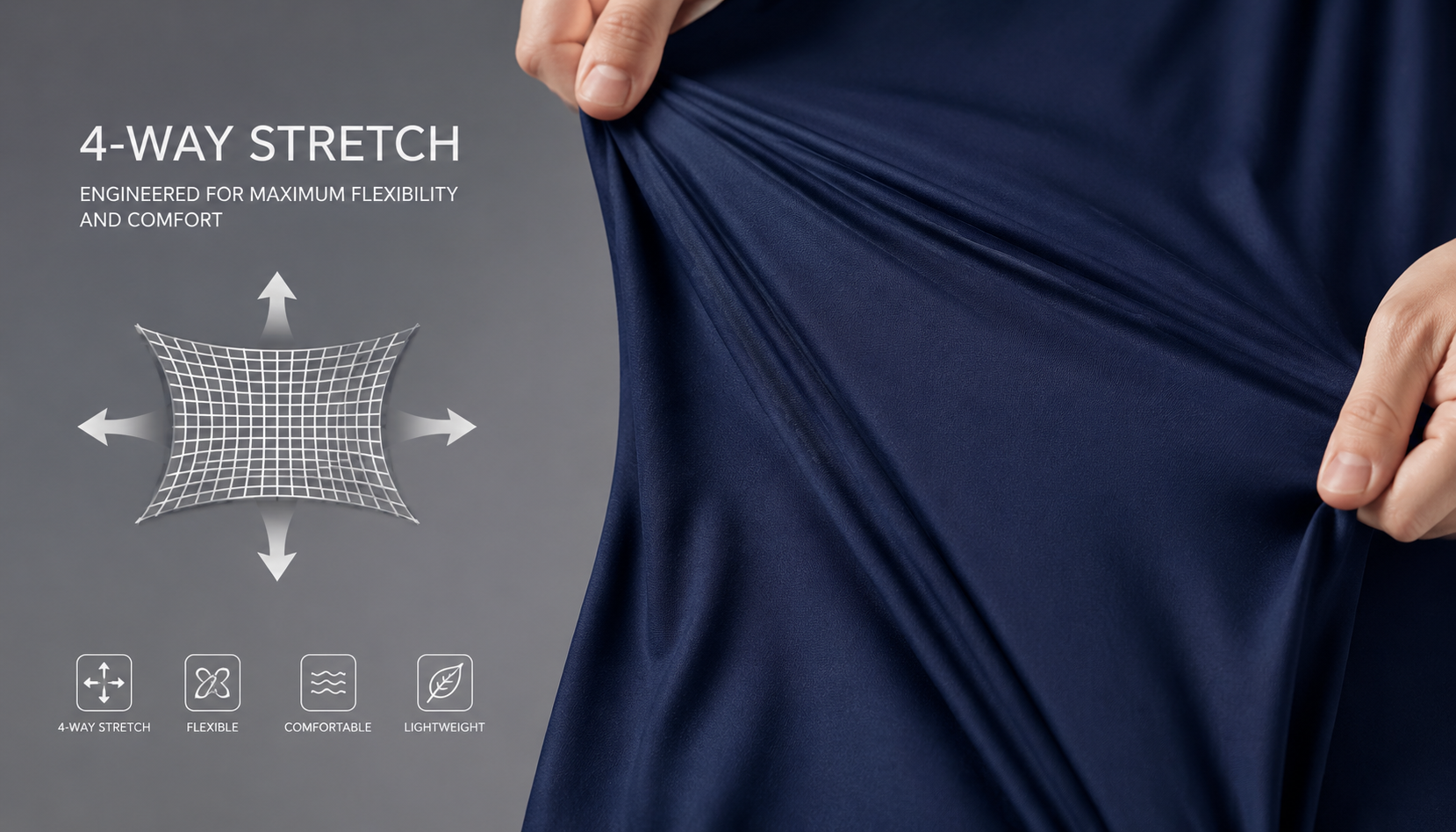
It’s a familiar story in the sourcing department: a European sportswear brand receives their first bulk shipment of 4-way stretch knit fabric for sportswear, and the initial hand-feel is perfect. But after three washes, the recovery rate plummets to 82%, and the garments “bag out” at the knees and elbows. The 30% return rate that follows is a brutal lesson: true four-way performance isn’t a marketing buzzword—it’s a set of precise, measurable engineering parameters. This guide cuts through the noise to give you the technical framework for sourcing it right the first time.
At its core, 4-way stretch knit fabric is a textile engineered to elongate and recover along both the warp (lengthwise) and weft (crosswise) directions. This is fundamentally different from 2-way stretch, which typically only offers significant stretch across the weft. The magic lies in the knit structure and the integration of elastomeric fibers like Spandex (Lycra).
The distinction starts on the knitting machine. A standard weft knit, like a single jersey, creates loops that interlock horizontally. While you can add Spandex to the weft yarns for crosswise stretch, the vertical (warp) direction remains relatively stable. True 4-way stretch is most reliably achieved through warp knitting (e.g., tricot, simplex) or specialized weft knit constructions (like interlock with inlaid Spandex in both directions). In warp knitting, the yarns run vertically, and the fabric is built by interlocking loops in a zigzag pattern across the width, inherently providing multi-directional elasticity.
| Characteristic | 2-Way Stretch Knit | 4-Way Stretch Knit |
|---|---|---|
| Primary Stretch Direction | Weft (crosswise) only | Both warp and weft |
| Common Construction | Weft knit (single jersey) with weft-inserted Spandex | Warp knit (tricot) or double-bar weft knit with bi-directional Spandex |
| Typical Elongation | 30-50% in weft, <15% in warp | 100-200%+ in both directions |
| Best For | T-shirts, casual wear with mild comfort stretch | High-intensity sportswear, compression garments, swimwear |
Think about the biomechanics of a sprinter or a weightlifter. The fabric must accommodate extreme knee flexion, hip rotation, and shoulder extension—movements that stress the material in multiple directions simultaneously. A 2-way stretch fabric will resist elongation along the warp, creating a feeling of restriction and potentially impeding performance. For 4 way stretch fabric for sportswear, the requirement is absolute: the material must move with the body, not against it, through a full range of motion and return to its original shape instantly. This is where a high-performance, multi-directional knit becomes non-negotiable.
This level of engineered elasticity is a hallmark of modern performance functional knits, which are designed from the fiber up to meet the exacting demands of athletic movement.
For a B2B buyer, the spec sheet is your bible. But knowing which numbers matter—and what the real-world thresholds are—is what separates a good supplier from a great one. Here are the five non-negotiable performance metrics.
This is the most critical and often misunderstood metric. Elongation is how far the fabric stretches; recovery is how well it snaps back. According to the ASTM D2594 standard for stretch testing, you should demand data from a 5-cycle test. A top-tier 4-way stretch knit sports fabric should show an elongation of at least 150% in both directions. More importantly, the recovery rate after 5 cycles must be ≥95%. Anything below 90% will lead to permanent deformation—what we call “bagging out”—after just a few wears and washes. I always tell buyers to ask for the recovery data specifically; a supplier who only quotes elongation is hiding the more important number.
Compression isn’t just about tightness; it’s a calibrated gradient of pressure measured in millimeters of mercury (mmHg). The application dictates the spec.
The compression level is a direct function of the fabric’s modulus (stiffness) and the garment’s pattern tension. A poorly chosen fabric will either feel constrictive or offer no support at all.
A fabric can be stretchy and supportive, but if it traps sweat, it’s useless for high-intensity sport. The key test here is AATCC 195, which evaluates liquid moisture management properties. Look for a Grade 4 or higher rating, indicating excellent wicking and drying speed. However, there’s a trade-off. A tighter knit (higher gauge) often provides better compression and durability but can reduce breathability. The best fabrics, like those using advanced micro-channel fibers, manage to wick moisture rapidly without sacrificing structural integrity. For a deep dive into engineered solutions, our moisture-wicking fabrics category explores these technical constructions in detail.
Repeated stretching, washing, and exposure to UV light and chlorine (for swimwear) are brutal tests. Dimensional stability refers to resistance to shrinkage and growth after laundering. A quality 4-way stretch fabric should have a shrinkage rate of less than 3% in both directions after 5 washes. Colorfastness, tested to standards like ISO 105, must be rated 4 or above (on a 1-5 scale) for washing, perspiration, and light to prevent fading and bleeding. A fabric that loses its color or its shape is a direct hit to your brand’s reputation.
The “what” (fiber composition) and the “how” (knit construction) are equally important. A Nylon/Spandex blend on a warp knit machine is a completely different product from a Polyester/Spandex on a weft knit machine, even if the percentages are similar.
This is the premium performance route. Nylon 6.6, in particular, offers superior abrasion resistance (Martindale test ≥40,000 cycles), a soft, luxurious hand-feel, and excellent elastic recovery. The blend with Spandex (typically 18-25%) creates a fabric that is both tough and exceptionally resilient. The downside is cost—expect to pay a 20-30% premium over polyester equivalents—and a slightly slower drying time. It’s the go-to for high-end compression wear, dancewear, and swimwear where feel and longevity are paramount.
Polyester is the workhorse of the performance textile world. It’s inherently hydrophobic, meaning it wicks moisture and dries incredibly fast (often in under 30 minutes). It also takes UV-resistant finishes exceptionally well, easily achieving UPF 50+ ratings. When blended with Spandex, it creates a highly functional, cost-effective 4-way stretch fabric. The trade-offs are a slightly less luxurious feel compared to nylon and a higher propensity for static cling in dry environments. This is the most common choice for sublimation-printed sportswear, training tights, and team uniforms.
The demand for natural-feel, sustainable options has pushed Cotton/Spandex blends into the performance conversation, especially in yoga, athleisure, and low-intensity training. The comfort and breathability are unmatched. However, cotton is hydrophilic—it absorbs moisture but dries slowly, which is a major drawback for high-sweat activities. Controlling shrinkage (which can be 5-7% without pre-treatment) and maintaining recovery after repeated washing are significant engineering challenges. This niche is growing, but it requires very specific sourcing and testing protocols.
| Material Blend | Key Advantage | Primary Limitation | Typical Cost Index |
|---|---|---|---|
| Nylon 6.6 / Spandex | Superior abrasion resistance, soft hand-feel, high recovery | Higher cost, slower dry time | 1.3x |
| Polyester / Spandex | Excellent moisture wicking, fast dry, cost-effective, good for printing | Less luxurious feel, static potential | 1.0x (Baseline) |
| Cotton / Spandex | Natural comfort, breathability, sustainable appeal | Poor moisture management, shrinkage risk, lower recovery | 1.1x |
Two fabrics with identical fiber content can perform worlds apart based on how they are knitted. This is where your technical due diligence pays off.
As touched on earlier, warp knits (like tricot or simplex) are inherently stable and offer excellent run-resistance, making them ideal for compression garments and swimwear where durability in chlorine is key. Weft knits (like interlock or jersey) can be engineered for 4-way stretch by inlaying Spandex in both directions, but they are more prone to snagging and can have more variable stretch properties. The choice depends on the end-use: warp knits for high-stress, abrasion-prone applications; weft knits for softer hand-feel and more complex textures.
Gauge (G) refers to the number of needles per inch (2.54 cm) on the knitting machine. A higher gauge (e.g., 28G to 40G) produces a finer, denser fabric with a smoother surface. This is crucial for compression uniformity and a premium aesthetic. However, an extremely high gauge can slightly reduce the fabric’s overall elongation potential because the loops are smaller and tighter. For most high-performance sportswear, a gauge in the 28G-36G range strikes the best balance between surface quality, compression, and stretch.
The versatility of a well-engineered 4-way stretch knit is remarkable. Its application extends far beyond the gym, into specialized verticals with their own demanding specifications.
Here, the fabric is an athlete’s second skin in a hostile environment. Chlorine resistance is the first gate—a minimum of 200 hours of exposure without significant degradation is standard for competition suits. Low water absorption (≤5% weight gain) is critical to prevent drag. Finally, surface treatments for fluid dynamics (like a subtle ribbed texture) can shave milliseconds off race times. The 4-Way Stretch fabric for swimwear must be a warp knit construction to handle the constant stress of starts, turns, and the hydrodynamic pressures of racing.
For stage and dance, the priorities shift. Drape and movement are everything. The fabric must flow and billow with choreography, requiring a specific balance of weight and stretch. Color saturation must be intense under stage lighting, and the fabric must be silent—no squeaking or rustling sounds during movement. A 4 Way Stretch Fabric for dress applications often uses a slightly heavier, matte-finish nylon/spandex blend to achieve this dramatic effect.
This is where sportswear technology meets clinical application. Medical compression garments use precisely graduated compression—tighter at the extremities and gradually decreasing pressure upward—to improve venous return and reduce swelling. The same principles of calibrated pressure and multi-directional stretch used in high-end sportswear are directly applicable to post-surgical recovery and lymphedema management, creating a fascinating crossover market.
Armed with technical knowledge, you need a structured process to vet suppliers and mitigate risk. This checklist is your first line of defense against costly mistakes.
When you request a quote, demand these seven data points. If a supplier can’t provide them, walk away.
| # | Parameter | Test Standard | Minimum Threshold for Sportswear |
|---|---|---|---|
| 1 | Composition | – | Accurate % of fibers (e.g., 78% Nylon 6.6 / 22% Spandex) |
| 2 | Weight (GSM / oz/yd²) | ASTM D3776 | 180-280 gsm (5.3-8.3 oz/yd²) for most applications |
| 3 | Width | – | 150-160 cm (59-63 in) standard tubular or open width |
| 4 | Elongation (%) | ASTM D2594 | ≥150% in both warp and weft directions |
| 5 | Recovery (%) | ASTM D2594 (5-cycle) | ≥95% after 5 cycles |
| 6 | Colorfastness (Washing) | ISO 105-C06 | Rating ≥4 (on a 1-5 scale) |
| 7 | Dimensional Stability (Shrinkage) | AATCC 135 | ≤3% in both directions after 5 washes |
A three-stage evaluation is non-negotiable for a new supplier or a new fabric development.
Even experienced buyers get burned. Watch for these red flags:
A mid-size German running brand learned this the hard way. They sourced a 4 way stretch Polyester Spandex fabric for a spring collection, targeting a 12-week window. The sample passed hand-feel tests, but they omitted requesting the critical ASTM D2594 recovery data after 5 washes. The spec sheet only listed “150% stretch.” When 3,000 m (3,281 yd) of bulk fabric arrived, their QC found the recovery rate had dropped to 82% after washing—far below the 95% industry threshold. The fabric bagged out at stress points after minimal wear. The result: 40% of the order had to be re-cut at significant cost, and the launch was delayed three weeks. The compromise was a 30% credit from the supplier and a switch to a verified Nylon 6.6/Spandex blend for the replacement, accepting a 15% higher unit cost for guaranteed performance. It’s a classic case of trial-and-error where the cost of not testing was far higher than the cost of the fabric itself.
For brands looking to start a conversation with a supplier that can provide full technical documentation and support this evaluation process, the first step is often reaching out through a dedicated contact channel for a feasibility assessment and quote.
Certifications are trust anchors, but you need to know what they actually certify. They don’t all mean the same thing.
This is perhaps the most misunderstood certification. OEKO-TEX Standard 100 is a safety certification for harmful substances, not a quality or performance certification. It tests for a long list of regulated and non-regulated chemicals that could be harmful to human health. For sportswear, you want a product certified to Class I (for babies) or Class II (for direct skin contact). It’s a crucial baseline for safety, but it tells you nothing about the fabric’s stretch, durability, or moisture management.
These are the performance standards. ISO 13934-1 (strip method) and ASTM D2594 (for stretch fabrics) are the primary methods for measuring tensile strength and elongation/recovery. The key difference is in the sample preparation and testing jig. A robust supplier should be able to provide data from both standards, giving you a complete picture of the fabric’s mechanical behavior under stress. Always ask for the test report, not just the number.
Chemical compliance is a legal necessity. The EU’s REACH regulation and the US’s CPSIA have different restricted substance lists (RSL). If you’re selling in both markets, your fabric must comply with the stricter of the two standards for any given chemical. A supplier with integrated, certified production lines—like one that has held OEKO-TEX and REACH compliance since its establishment in 2005—can significantly simplify your compliance burden and reduce risk.
The “green premium” is real, but so is the cost of poor performance and reputational damage. Sustainable sourcing is a strategic decision, not just a line item.
Opting for a 4 way stretch fabric Cotton blend for its natural appeal might seem sustainable, but if it leads to higher shrinkage, faster wear-out, and customer returns, the net environmental and financial cost could be negative. Conversely, investing in a durable, high-performance Nylon/Spandex fabric that lasts twice as long can be the more sustainable choice over the product’s lifecycle. Certifications like the Global Recycled Standard (GRS) for recycled polyester or nylon typically add 5-10% to the fabric cost. The question for brands is: will your end consumer pay a premium for that story? Increasingly, the answer is yes, but it requires careful marketing.
A true cost analysis must look beyond the fabric price per meter. Consider the total cost of ownership:
A slightly more expensive fabric with verified, consistent performance is almost always the cheaper choice in the long run.
It is a textile engineered for maximum multi-directional elasticity, typically composed of synthetic fibers like Nylon or Polyester blended with Spandex (15-25%). It is designed to elongate significantly (≥150%) and recover fully (≥95%) in both the warp and weft directions, providing unrestricted movement and muscle support during high-intensity athletic activities.
2-way stretch fabric primarily elongates and recovers in one direction (usually the weft or crosswise direction), while 4-way stretch fabric is engineered to perform equally in both the warp (lengthwise) and weft directions, offering true multi-directional freedom of movement essential for dynamic sports.
There is no single “best” composition; it depends entirely on the application. Nylon/Spandex blends (e.g., 78/22) offer superior abrasion resistance and hand-feel, making them ideal for compression wear and swimwear. Polyester/Spandex blends excel in moisture management and cost-effectiveness, perfect for sublimated training gear and team uniforms. The best choice is defined by the sport’s specific demands.
Minimum Order Quantities vary by supplier and product type. For stock items, MOQs can be as low as 500 m (547 yd) per color. For custom dyeing or development, expect 1,000-3,000 m (1,094-3,281 yd) minimums. Building a relationship with a supplier that offers a knowledge base and technical support can help navigate these terms and find solutions that fit your project scale.
Selecting the right 4-way stretch knit fabric is a technical decision with profound commercial consequences. It requires moving beyond marketing claims to demand verifiable data, understanding the trade-offs between different material constructions, and implementing a rigorous evaluation process. The fabric is the foundation of your product’s performance promise. Get it right, and you build a brand synonymous with quality and trust. Get it wrong, and you’re managing returns instead of building equity. Invest the time upfront in technical due diligence—it’s the most cost-effective step in your entire supply chain.