Address
Nanlang Industrial Zone, Xingtan Town, Shunde District, Foshan, Guangdong, China
Work Hours
Mon–Fri, 9:00 AM – 6:00 PM (CST/UTC+8). We aim to respond to all inquiries within 48 hours.

Address
Nanlang Industrial Zone, Xingtan Town, Shunde District, Foshan, Guangdong, China
Work Hours
Mon–Fri, 9:00 AM – 6:00 PM (CST/UTC+8). We aim to respond to all inquiries within 48 hours.
Circular Knit vs Warp Knit: Structure, Stretch & Applications. This guide covers key properties, real-world applications, and a practical sourcing checklist for B2B buyers.
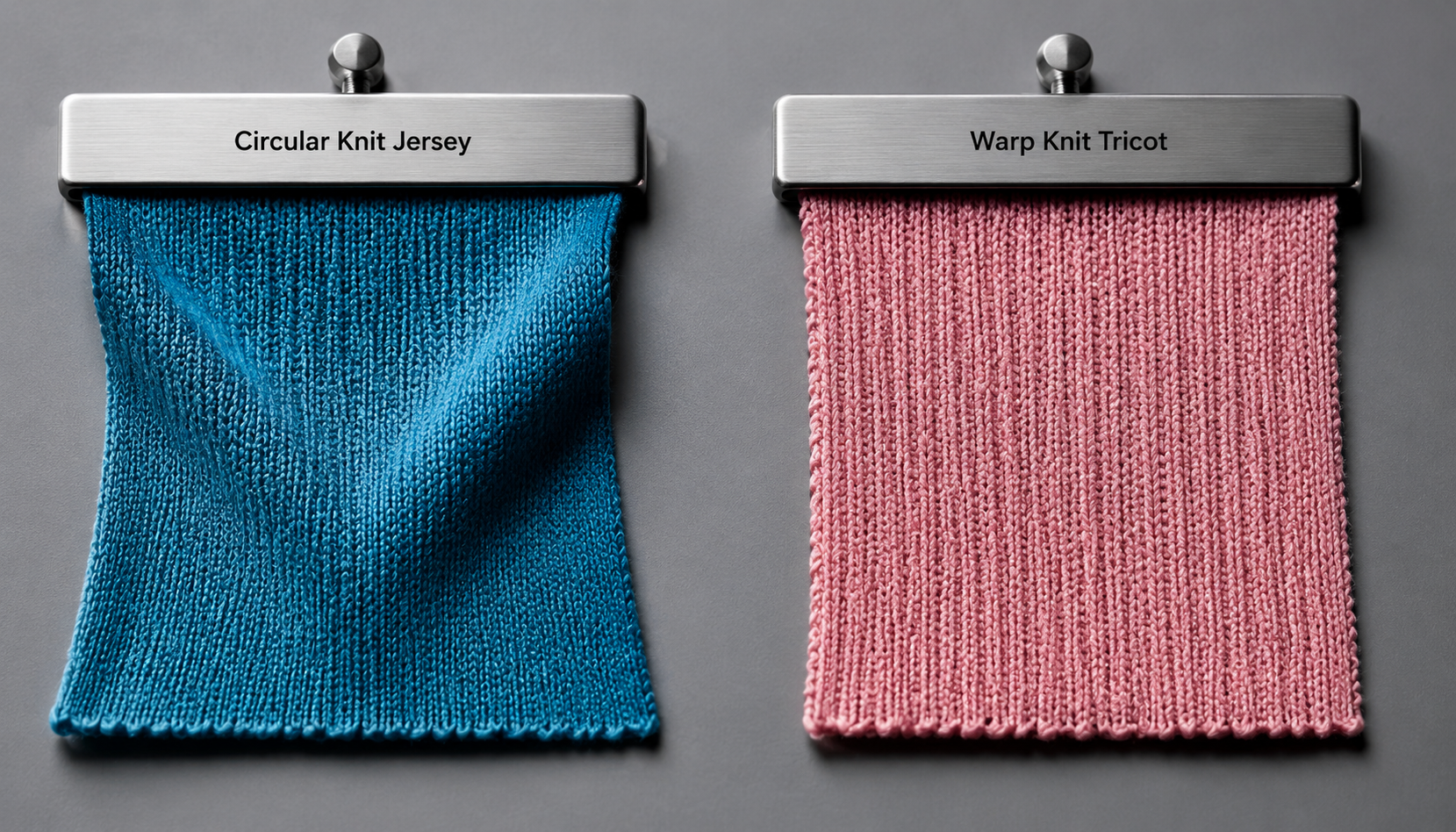
A mid-volume activewear brand once specified circular-knit lining for a run of 12,000 compression jackets. Three weeks later, every cut panel curled so badly the sewing line added 22 seconds of edge-pressing per piece — erasing the USD 0.18/yd (USD 0.20/m) they had “saved” at sourcing. Understanding the structural split between circular knit and warp knit is not an academic exercise; it is a margin decision.
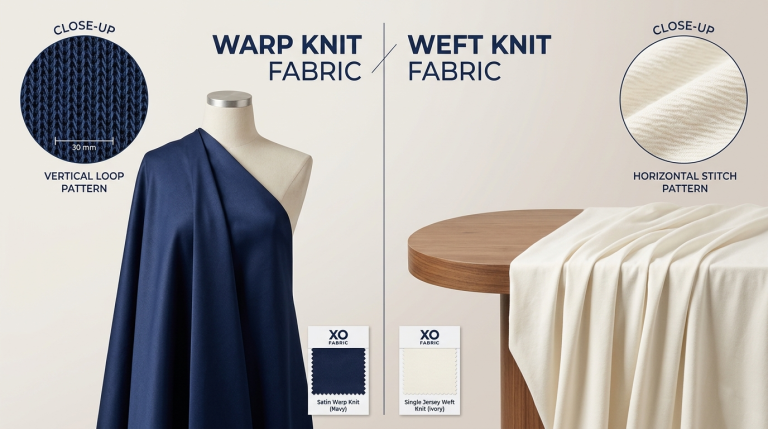
Before you can compare properties or price, you have to understand the machinery. The fundamental difference between these two families comes down to how the yarn reaches the needles. In circular knitting, a single yarn spirals around a cylinder. In warp knitting, dozens of yarns travel in parallel, feeding simultaneously across the needle bed.
That mechanical split sounds simple. But it creates a cascade of downstream differences — in stretch, stability, edge behavior, and ultimately, cost-per-finished-garment. If you only look at the fabric swatch, you might miss it. The yarn path is where the story begins.
A circular-knitting machine uses a cylinder-and-dial needle arrangement. The cylinder — typically 30 in (76 cm) in diameter for body-size garments — holds latch needles in a vertical ring. A single yarn feeder rotates around the cylinder, laying yarn into each needle hook in sequence. As the needles rise and fall, they form interlocking loops in a continuous tube.
The entire fabric panel comes from one unbroken yarn path. That is why circular knit vs flat knit discussions often center on the same core point: the fabric is inherently extensible in the widthwise (course) direction because the loops can compress and expand freely. It also means the edges have no structural reason to stay flat — the loops at the selvedge are unbalanced, which is why cut panels curl.
Warp-knitting machines work on a completely different principle. Multiple yarn beams let off dozens of yarns simultaneously, each guided by individual guide bars that swing and shog across latch needles (or compound needles) arranged in a straight or curved bed. Every course is formed by multiple yarns working together, not a single weft yarn looping around.
The two main machine families — tricot and raschel — handle different fabric weights and structures. Tricot machines run at very high speeds for fine-gauge fabrics, while raschel machines accommodate heavier yarns and more complex structures like nets and pile fabrics. In both cases, each loop is secured by yarns running in both the wale and course directions, which is why warp-knit structures are inherently more stable than their weft-knit counterparts.
According to ISO 8388, the international standard for classifying knitted fabrics, these two construction families — weft knits and warp knits — are distinguished precisely by this yarn-feed geometry. It is not a marketing distinction. It is a structural one.
Now that we have the mechanical foundation, let us look at what actually shows up on the spec sheet and on the cutting table. This is where procurement decisions get made — or should get made.
Under ASTM D2594 test conditions — the standard method for measuring stretch properties of knit fabrics — the numbers diverge sharply. A typical single-jersey circular knit offers 40–60% stretch in the widthwise (course) direction but less than 10% lengthwise (wale). Recovery after five cycles? Often below 85%, meaning the fabric does not fully snap back.
Warp-knit fabrics, by contrast, average 15–25% biaxial stretch — meaning meaningful stretch in both directions — with recovery rates above 90% after five cycles. That is the core procurement trade-off: raw elastic freedom versus predictable dimensional control. If your product needs to stretch aggressively and snap back hard (think compression sportswear), you might still choose circular knit. But if your panels need to hold shape through washing and wear, warp knit is the safer bet.
For readers who want to dig deeper into the textile-engineering theory behind these numbers — stitch geometry, loop length ratios, and finishing effects on recovery — the knowledge hub offers supplementary articles on knit construction and finishing processes.
| Property | Circular Knit | Warp Knit | Procurement Implication |
|---|---|---|---|
| Widthwise stretch | 40–60% | 15–25% | Circular gives more raw stretch; warp gives controlled stretch |
| Lengthwise stretch | <10% | 15–25% | Warp knit offers true biaxial performance |
| Edge curl tendency | High (unbalanced loops) | Minimal to zero | Circular knit adds pressing labor cost downstream |
| Snag resistance | Moderate | High | Warp knit survives industrial handling better |
| Typical cost range | USD 1.20–2.80/m | USD 1.80–4.50/m | Per-meter price favors circular; total cost may not |
| Common end-uses | T-shirts, casualwear, underwear | Automotive, lingerie, technical textiles | Match technique to performance requirement |
Why does circular knit curl at the edges? The loops at the selvedge have no opposing tension to keep them flat. The face loops pull one way; the back loops pull the other. The result is a natural tendency to roll toward the face side. Warp-knit fabrics avoid this because each loop is interlocked with yarns running in both the wale and course directions — the structure is balanced.
For a B2B buyer running a cut-and-sew (CMT) operation, this is not a minor nuisance. Edge curl propagates through the production line in a predictable sequence:
That labor cost — USD 0.05–0.12 per piece in edge-pressing or binding operations — is invisible on the fabric quotation. But it shows up clearly on the sewing-floor efficiency report.
Theory is useful. But procurement decisions are made on the factory floor, not in a textbook. Let me walk through a real scenario where the circular knit vs warp knit choice played out with actual dollars and production minutes at stake.
A European athleisure brand needed a smooth satin-faced lining for 12,000 compression jackets. The lining had to feed cleanly through automated CMT sewing lines running at 700+ pieces per day. Stable cut panels were non-negotiable.
The sourcing team quoted two options. A circular-knit satin-look lining came in at 12% lower per-meter cost. A warp-knit satin alternative — specifically a two-sided warp knit satin with satin-look surface on both faces — was priced at a 15–20% premium with a 500 m (547 yd) MOQ.
The team chose the cheaper circular knit for the first production trial. Within a week, the problems surfaced. Width variation across rolls hit ±8 cm (±3.1 in), causing pattern-nesting inefficiencies. More critically, the edge curl was aggressive enough that the sewing line added a manual pressing step — 22 seconds per piece.
A 300 m (328 yd) sample order of the warp-knit satin was then tested. Width tolerance improved to ±0.8 cm (±0.3 in), and the edges lay flat off the cutting table. But the initial hand feel was stiffer than the circular-knit version. The finishing team addressed this with a softener bath at 40°C (104°F) for 20 minutes, which brought the drape in line with the designer’s specification.
The compromise? The brand accepted the 15–20% fabric cost premium and the 500 m MOQ. The net saving after eliminating edge-pressing labor and reducing width-waste cutting loss from 6% to 1.5% came to approximately USD 0.09 per finished piece. Over 12,000 units, that was USD 1,080 saved — not on the fabric line, but on the production floor where it actually mattered.
I find this kind of case study more instructive than any property table. The numbers on the spec sheet were real. But the decision required understanding how those numbers translated into seconds, waste percentages, and operator frustration on a live sewing line.
| End-Use Category | Recommended Technique | Key Reason | Example Product |
|---|---|---|---|
| T-shirts / casualwear | Circular knit | Low cost, seamless tube, natural stretch | Single-jersey crew neck |
| Lingerie / elastics | Warp knit | Controlled stretch, clean edges | Power-net bra band |
| Automotive seat covers | Warp knit | Dimensional stability under sustained load | Raschel seat fabric |
| Sportswear base layers | Circular knit | Body-hugging stretch, seamless construction | Compression running top |
| Technical filtration mesh | Warp knit | Controlled porosity, warp-stable geometry | Industrial polyester mesh |
For buyers exploring warp-knit options beyond the single satin product referenced in the case study, the full warp-knit fabrics catalog at the manufacturer’s site lists the complete range of available constructions and specifications.
Circular knitting has real limits that become deal-breakers in certain applications. The cylinder diameter caps out at roughly 60 in (152 cm), which constrains maximum fabric width. For industrial textiles requiring wide-width goods — automotive, medical, filtration — this is a hard stop.
Warp-stable composites present another ceiling. When a knit fabric will be laminated to a film or foam substrate, dimensional stability during the lamination process is critical. Circular knit’s tendency to relax and shift widthwise under heat and pressure makes it a poor candidate. Weft knit fabric examples in laminated industrial settings are rare precisely because of this instability under sustained load.
Controlled porosity is a third constraint. Warp-knit structures allow engineers to design specific mesh openings with predictable geometry. Circular knit’s loop density varies with stretch, making consistent porosity nearly impossible to guarantee across a production run.
You have read the technical comparison. You have seen the case study. Now let us turn this into a procurement workflow — something you can actually use when evaluating a Request for Quotation.
I have seen procurement teams make the same errors repeatedly. Here are the most costly ones:
Beyond the obvious fabric price, three non-obvious costs affect your total cost of ownership:
First, width waste. Variable circular-knit goods typically produce 3–8% cutting waste versus 0.5–2% for warp knit. That difference compounds across thousands of meters. Second, finishing requirements. Circular knit often needs a softener or heat-setting pass to control curl and improve hand feel, adding USD 0.03–0.08/m. Third, inspection time. Warp-knit rolls run more uniform, reducing QC minutes per 100 m (109 yd) and lowering your incoming inspection labor cost.
We started this article with a margin-erasure story — a brand that lost USD 0.18/yd by ignoring structural differences. This final section is your defense against repeating that mistake. Treat it as a pre-flight checklist before you commit to a knit-fabric order.
Spec sheets are necessary but not sufficient. Real-world batch variability in circular-knit goods is significantly higher than in warp-knit goods, because the single-yarn-feed mechanism is more sensitive to tension fluctuations, yarn lot changes, and machine wear. Warp-knit machines, with their multi-beam feeding and tighter gauge control, produce more consistent output roll-to-roll.
My recommendation: always request a pre-production sample from the actual production run — the same machine, the same yarn lot, the same finishing parameters. Test it against the spec tolerance window. If the supplier cannot or will not provide this, consider it a red flag.
Baseline process-control assurance comes from certifications. Look for OEKO-TEX Standard 100 for product safety compliance and ISO 9001 for quality management systems. These do not guarantee fabric performance, but they confirm that the manufacturer has documented processes in place — which is the minimum threshold for a serious B2B relationship.
Pro tip: Before committing to a trial order, ask the supplier for a QC video walkthrough of the actual production line — not a promotional factory tour video, but a real-time clip of the specific machine and process that will produce your fabric. A supplier confident in their process will provide this without hesitation.
When you are ready to request a technical spec sheet, arrange a sample order, or discuss specifications for your next project, the engineering team at the contact page accepts spec-sheet and tech-pack uploads and guarantees a 48-hour response for sampling or quotation requests.
The three principal warp-knit constructions are tricot, raschel, and milanese. Tricot machines run at very high speeds on fine-gauge latch or compound needles, producing smooth, lightweight fabrics used primarily in lingerie linings and sportswear inner layers. Raschel machines handle heavier yarns and more complex guide-bar motions, producing everything from structural nets and lace to pile fabrics and automotive textiles. Milanese — the least common of the three — uses two sets of yarn beams moving in opposite directions to produce ultra-fine, diagonal-rib fabrics traditionally used in hosiery and glove-grade goods.
These advantages are exactly what the compression-jacket case study demonstrated: the warp-knit satin’s zero-curl edges and tight width tolerance translated directly into measurable production-floor savings.
Circular knitting remains the dominant choice for mass-market apparel, and for good reason. Per-meter machine and fabric costs are lower for high-volume garments. The seamless tube construction is ideal for T-shirts and bodywear, eliminating side seams entirely. The hand feel of a well-finished single-jersey is hard to beat — natural stretch without elastane, a soft drape, and excellent breathability. Modern electronic circular machines also offer faster pattern-change flexibility, making short-run colorway variations more economical.
The decision issue arises only when dimensional control and cut-panel stability are non-negotiable — which, for many technical and performance applications, they are.
For deeper technical reading on knit construction theory, finishing processes, and fabric-engineering guides, the knowledge hub offers a library of supplementary articles that go well beyond the scope of this comparison.
The right knit structure is a margin-level B2B decision. It is measured in waste percentages, sewing-floor minutes, QC reject rates, and customer return rates — not just a per-meter price line on a quotation. Whether you choose circular knit or warp knit, choose it with your eyes open to the total cost of ownership. And if you want to test the difference hands-on, request a comparative sample kit or discuss your specifications directly with the engineering team through the contact form, where you can upload your spec sheet and expect a 48-hour response.