Address
Nanlang Industrial Zone, Xingtan Town, Shunde District, Foshan, Guangdong, China
Work Hours
Mon–Fri, 9:00 AM – 6:00 PM (CST/UTC+8). We aim to respond to all inquiries within 48 hours.

Address
Nanlang Industrial Zone, Xingtan Town, Shunde District, Foshan, Guangdong, China
Work Hours
Mon–Fri, 9:00 AM – 6:00 PM (CST/UTC+8). We aim to respond to all inquiries within 48 hours.
Private Label Fabric Manufacturing: How It Works & What to Expect. This guide covers key properties, real-world applications, and a practical sourcing checklist for B2B buyers.
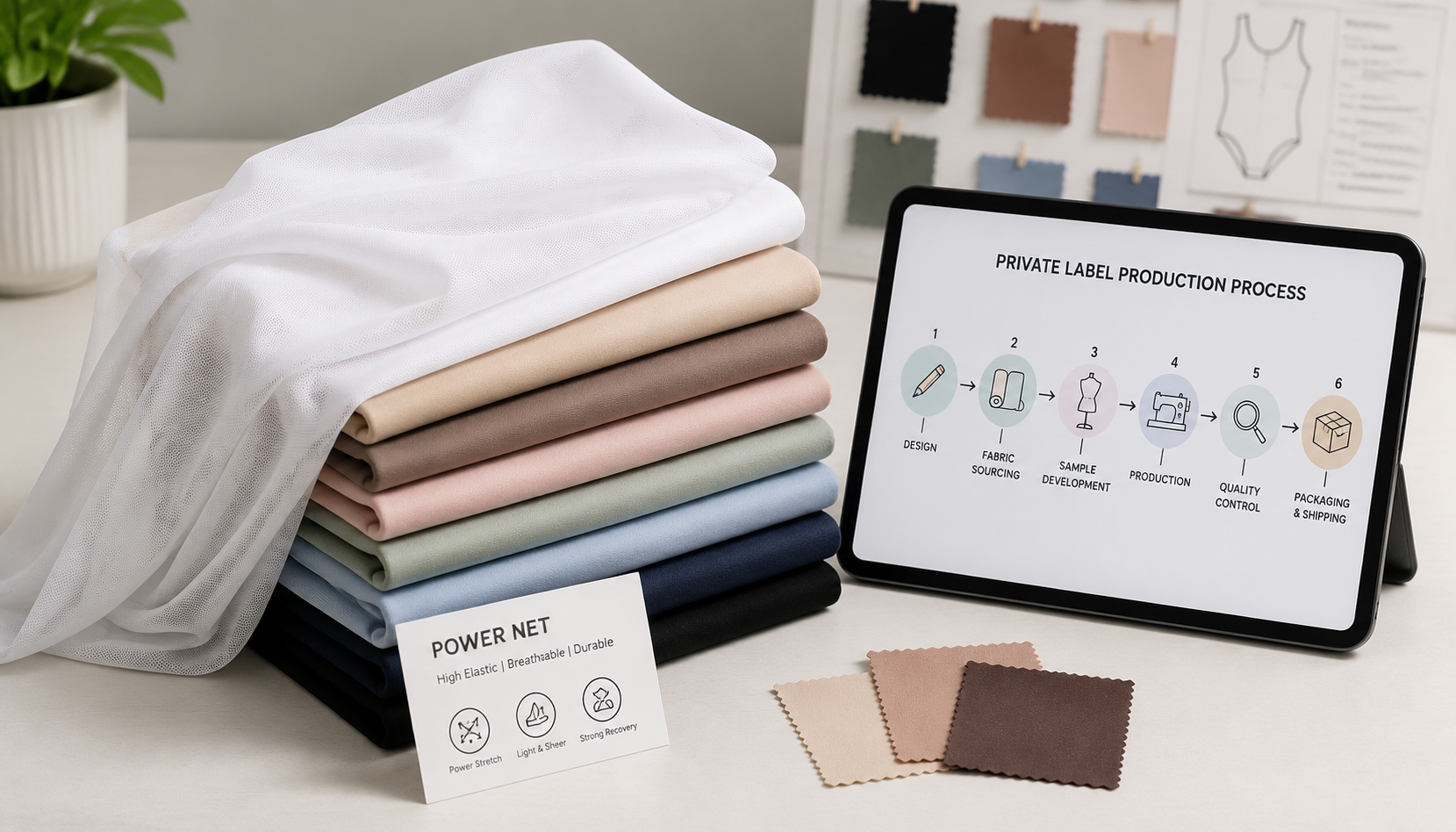
Imagine spending six months developing a new activewear collection, only to discover your fabric supplier used the same material as three of your direct competitors. That exact scenario plays out more often than most brand owners care to admit. Private label fabric manufacturing — when done right — eliminates that risk entirely, but the process involves far more decisions and technical nuance than slapping a custom label on a stock roll.
The term gets thrown around loosely in sourcing meetings. Some buyers hear “private label” and think it means ordering a batch of off-the-shelf fabric with their brand name stitched into the selvage. Others assume it requires reinventing textile engineering from scratch. Neither picture is accurate.
Working with a private label fabric manufacturer means you’re defining the product specifications — the fiber blend, the knit or weave construction, the finishing treatments — and the factory produces to your exact requirements. You own the spec. The fabric doesn’t exist on someone else’s shelf first.
This distinction matters more than most people realize. When you own the specification, you control the performance characteristics, the hand-feel, the color palette, and ultimately the identity of your end product. It’s the difference between choosing from a menu and writing your own recipe.
Not every project needs full customization. Understanding where your order falls on this spectrum saves both budget and headaches. Some brands start with stock fabrics for their first launch, then transition to semi-custom or full private label as volume justifies the investment. That’s honestly a smart ramp-up strategy I’ve seen work repeatedly.
| 模式 | 定制深度 | 典型起订量 | 交期范围 |
|---|---|---|---|
| Stock (现货) | 仅染色/印花 | 500 m (547 yd) | 3–5 天 |
| Semi-Custom | 结构+后整理 | 1,000 m (1,094 yd) | 15–25 天 |
| Full Private Label | 全链定制 | 3,000 m (3,281 yd) | 30–45 天 |
Stock fabrics work perfectly for market testing or capsule collections where speed trumps exclusivity. Semi-custom gives you structural tweaks — say, adjusting the power net knit density for better compression — without the full development timeline. Full private label is your path when brand differentiation is non-negotiable.
These three terms get conflated constantly, and the confusion leads to mismatched expectations. White label means a generic product that multiple brands can purchase and rebrand — no customization beyond the hang tag. Contract manufacturing means you supply the raw materials (or a detailed bill of materials) and the factory fabricates to your instructions.
Private label sits in between. The factory handles the full supply chain — sourcing yarns, running the looms, applying finishes — but everything is built to your unique specification. You’re not just a tenant; you’re the architect. For any serious private label clothing brand looking to build long-term market position, this model offers the best balance of control and convenience.
Here’s the part most guides gloss over — the actual sequence of events once you decide to move forward. I’ve watched enough projects succeed and stumble to know that understanding the workflow upfront prevents 80% of the pain later.
That looks straightforward on paper. In practice, steps two and three are where most timelines balloon. Getting a sample that perfectly matches your vision might take one round or five — it depends entirely on how specific your requirements are and how well you communicated them upfront.
A vague email saying “I need something stretchy and matte black” will get you a quote — but probably not the quote you want. A proper tech pack compresses the back-and-forth dramatically.
At minimum, your specification should cover fiber composition, target weight (in both metric and imperial units), finished width, colorfastness requirements, stretch and recovery percentages, any regulatory compliance needs (like OEKO-TEX or EU REACH), and the intended end use. The more context you give the technical team, the better their recommendations will be.
| Tech Pack 要素 | 示例参数 |
|---|---|
| 成分 (Composition) | 85% Nylon 6.6 / 15% Spandex |
| 克重 (Weight) | 180 gsm (5.3 oz/yd²) |
| 幅宽 (Width) | 58/60″ (147–152 cm) |
| 色牢度 (Colorfastness) | ≥4 级 (ISO 105-C06) |
If you’re sourcing from a factory with integrated production — where weaving, dyeing, and finishing all happen under one roof — the tech pack review stage becomes significantly more collaborative. The engineers can suggest construction modifications that improve performance while reducing cost, because they understand the full process chain rather than just their own station.
Lab dips typically cost USD 30–80 per color, and development samples run USD 50–200 per style depending on construction complexity. Timeline? Expect 7–10 business days for initial samples, though technically demanding fabrics with specialty finishes can stretch to 15 days or more.
The most common failure point? Misaligned color expectations. Your Pantone reference looks one way on a screen, another on cotton, and completely different on nylon power net. Physical lab-dip approval under standardized light boxes is non-negotiable. Don’t cut this corner. I’ve seen entire production runs rejected over color disputes that could have been resolved with a proper D65 light assessment at the sampling stage.
This is where the real craftsmanship lives. Two fabrics can share the same fiber composition and perform completely differently based on how they’re constructed and finished. Understanding the interplay between these variables is what separates a competent private label clothing manufacturer from a basic cut-and-sew operation.
I personally find that buyers who come to the table with even a rough understanding of construction options get dramatically better outcomes from their private label fabric manufacturer. You don’t need to be a textile engineer. But knowing that a power net knit gives you different compression characteristics than a jersey knit — that basic fluency changes the conversation entirely.
| 应用场景 | 推荐纤维 | 核心优势 | 典型克重范围 |
|---|---|---|---|
| 运动服饰 (Activewear) | Nylon 6.6 + Spandex | 耐磨、弹性好 | 130–220 gsm (3.8–6.5 oz/yd²) |
| 户外面料 (Outdoor Gear) | Polyester + PU涂层 | 防水、速干 | 80–150 gsm (2.4–4.4 oz/yd²) |
| 内衣面料 (Intimates) | Cotton + Modal | 亲肤、透气 | 150–200 gsm (4.4–5.9 oz/yd²) |
| 医疗纺织 (Medical) | Polyester + Antimicrobial | 抗菌、低致敏 | 100–160 gsm (2.9–4.7 oz/yd²) |
Notice how the weight ranges overlap across categories — that’s intentional. A 180 Fabric GSM Calculator (5.3 oz/yd²) nylon/spandex power net could serve activewear shapewear, dance costumes, or post-surgical compression garments. The application context, not just the spec sheet, determines whether a fabric is fit for purpose.
Power net knit structures, for instance, deliver targeted compression with consistent recovery — which is why they dominate activewear and shapewear categories. The open-mesh architecture allows airflow while maintaining structural integrity under tension. Contrast that with a plain weave cotton, which offers excellent drape and breathability but minimal stretch without elastane supplementation.
A tricot knit will give you a smooth, lustrous face suitable for linings and lingerie, while a raschel construction creates the textured, dimensional surface you see in decorative home textiles. The point? Your construction choice isn’t cosmetic — it fundamentally determines what the fabric can and cannot do in the hands of the end user.
Here’s the core argument: private label fabric manufacturing delivers advantages that stock fabric simply cannot replicate, across three critical dimensions — brand differentiation, supply chain control, and total cost optimization over time.
Let me walk through each one honestly, including the trade-offs.
When you source stock fabric, you’re competing on design and marketing alone. Your competitors can — and will — source the same material. Private label eliminates this vulnerability. By defining your own fiber blend, construction, and finish, you create a proprietary textile identity that can’t be duplicated off a catalog.
This matters enormously in crowded categories like activewear. Two leggings brands might both claim “moisture-wicking four-way stretch,” but if one owns a proprietary 85/15 Nylon/Spandex power net specification with a specific micro-mesh architecture and custom dye lot, the product in hand tells a different story. That’s the kind of differentiation that builds customer loyalty.
Stock availability fluctuates. During raw material shortages — and we’ve all lived through plenty of those — buyers who rely on inventory availability get squeezed first. Private label agreements, especially with a vertically integrated factory that has operated since 2005 with dedicated warehouse capacity, offer more predictable capacity allocation and raw material security.
The trade-off is minimum commitment. Full private label orders typically start at 3,000 m (3,281 yd) per colorway, which demands stronger cash flow and demand forecasting. But for brands shipping consistent volume, the per-meter cost advantage usually favors private label by 8–15% compared to equivalent stock fabrics sourced at spot pricing.
Private label isn’t exclusive to fashion — though that’s where most people’s minds go first. The model applies wherever technical textile performance creates competitive advantage. Here are the sectors driving the strongest demand.
A European activewear brand approached their manufacturer with a brief for a high-stretch, moisture-wicking fabric intended for a premium yoga line. The target specs: 180 gsm (5.3 oz/yd²), colorfastness ≥4 on the grey scale, 90% minimum stretch recovery after 50 wash cycles, and a retail-compatible unit cost.
The first proposal used 100% Nylon 6.6 — excellent performance, but the raw material cost pushed the landed price 30% above budget. The engineering team pivoted to an 80/20 polyester/spandex blend to hit the cost target. It worked on paper. In the lab, the colorfastness test returned only Grade 3 — a full grade below the requirement. The polyester fibers weren’t accepting the reactive dye system as uniformly as nylon would.
Third attempt: an 85/15 Nylon 6.6/Spandex power net construction. This blend hit all the performance benchmarks — colorfastness at Grade 4+, elastic recovery at 95% after 50 wash cycles — while landing only 15% above the polyester budget. The brand accepted the cost premium because the alternative was a product that couldn’t pass quality certification.
The result? Final defect rate dropped from 8% to 4.8% in production, returns fell by a third within the first selling season, and the brand built their entire product line around that specification. The trial-and-error process took three rounds of sampling over four weeks — but the investment in getting the spec right saved months of downstream quality issues.
Finding the right wholesale private label fabric manufacturer is less about hunting for the lowest price and more about evaluating capability fit. Here’s the framework I’d recommend — borrowed from the evaluation process serious procurement teams actually use, not the wish list that marketing departments write.
| 评估维度 | 关键问题 |
|---|---|
| 生产能力 | 是否具备织造、印染、后整理一体化产线? |
| 质量认证 | 是否通过 ISO 9001、OEKO-TEX Standard 100? |
| 样品政策 | 样品起订量是多少?打样周期多长? |
| 交期保障 | 淡旺季交期差异多大?是否有应急预案? |
| 支付条款 | 支持哪些支付方式?是否有信用证选项? |
| 物流能力 | 距离最近港口多远?支持哪些贸易术语(FOB/CIF/EXW)? |
| 沟通效率 | 是否有专属技术工程师对接?响应时间多长? |
| 案例参考 | 是否有同行业成功案例可供参考? |
That last question — case references — deserves extra weight. A factory’s portfolio tells you more than any certification audit. If they’ve successfully supplied the best private label fabric manufacturer partners in your specific segment, the path from concept to production will be dramatically smoother.
Color drift between sample and production is the single most common complaint in private label sourcing. The fix: insist on pre-production bulk lab dips approved under controlled lighting conditions, and specify acceptance tolerances in your purchase agreement — typically ΔE ≤ 1.0 for solid colors.
Lead time slippage ranks second. Build a 10–15% buffer into your planning calendar, especially for orders shipping between June and September when factories across the textile belt are at peak capacity. Communicate your hard deadlines early and in writing.
Quality inconsistency across shipments is the third pain point. The solution isn’t more inspection — it’s better specification documentation. When the factory has crystal-clear parameters and approved submission samples sealed in their QC lab, variation decreases measurably. Precision in the brief prevents improvisation on the floor.
It depends on where you sit on the customization spectrum. Stock fabrics start at approximately 500 m (547 yd), with some suppliers allowing 100 m (109 yd) minimums per colorway within a consolidated order. Semi-custom orders typically require 1,000 m (1,094 yd) per style. Full private label development — where the factory creates fabric to your unique specification — generally starts at 3,000 m (3,281 yd) per colorway. These minimums exist because yarn mills, dyehouses, and finishing lines all have minimum run thresholds for cost-effective production.
A typical timeline runs 30–45 days from finalized specification to ex-factory delivery. Sampling takes 7–10 business days, bulk production 15–25 days (extending to 25–35 during peak season), and quality inspection plus packing adds another 3–5 days. Specialized finishing — think multi-layer lamination, specialty coatings, or custom print development — can extend the full cycle to 60 days or beyond. Factor in ocean transit times of 20–30 days to European or North American ports, and a realistic door-to-door timeline is 8–12 weeks.
The foundational certifications every buyer should verify are ISO 9001 for quality management systems and OEKO-TEX Standard 100 for harmful substance testing. Beyond those, context matters: GRS (Global Recycled Standard) is increasingly required by European buyers sourcing recycled-content fabrics, while EU REACH compliance is legally mandatory for any fabric entering the European market. For medical or children’s products, additional sector-specific certifications apply. Always request the actual certificate copies and confirm their validity period — a reputable manufacturer will have these readily available rather than treating the request as unusual.
Absolutely, but manage your expectations around MOQs and upfront costs. Many factories offer bridge programs where you can start with stock fabric customization (custom dyeing on existing constructions) at 500 m (547 yd) minimums, then graduate to semi-custom or full private label as your volume grows. The key is communicating your growth trajectory to the factory — they’re more willing to offer flexible terms to brands showing genuine development potential. I’ve also seen semi-custom approaches work well: taking an existing construction and modifying just the finish or color range, which reduces development cost while still giving you a differentiated product.
The terms overlap in practice, but there’s a meaningful distinction. OEM (Original Equipment Manufacturer) typically implies the buyer provides complete technical specifications and the factory executes to those specs with minimal creative input. Private label manufacturing often involves more collaboration — the buyer defines the performance requirements and aesthetic intent, but the factory’s technical team contributes material recommendations and construction solutions. Think of OEM as “build exactly this” and private label as “build something that achieves these results.” For most brand owners, the private label model offers a better balance of control and engineering expertise.
Private label fabric manufacturing isn’t a simple purchasing transaction — it’s a technical partnership that shapes the foundation of your product line. The decisions you make at the specification stage ripple through every garment that ships under your brand name. That’s both the opportunity and the responsibility.
The brands that succeed in this space share a few traits: they come to the table with clear performance requirements rather than vague inspiration boards, they invest time in sampling approvals rather than rushing to production, and they treat their factory relationship as a collaborative asset rather than a commodity service.
If you’re evaluating your first private label project or looking to switch suppliers after a disappointing experience, it’s worth having a direct conversation with a technical team that understands both the engineering and the commercial realities. The factory’s engineers can assess your tech pack for feasibility, suggest material optimizations you may not have considered, and provide honest timelines that account for real-world production conditions. You can reach out through the factory’s contact page to request a specification review and customized quotation — that first technical dialogue often reveals more about a supplier’s capability than any marketing presentation ever will.