Address
Nanlang Industrial Zone, Xingtan Town, Shunde District, Foshan, Guangdong, China
Work Hours
Mon–Fri, 9:00 AM – 6:00 PM (CST/UTC+8). We aim to respond to all inquiries within 48 hours.

Address
Nanlang Industrial Zone, Xingtan Town, Shunde District, Foshan, Guangdong, China
Work Hours
Mon–Fri, 9:00 AM – 6:00 PM (CST/UTC+8). We aim to respond to all inquiries within 48 hours.
Brushed Knit Fabric for Winter Apparel: Warmth, Types & Care. This guide covers key properties, real-world applications, and a practical sourcing checklist for B2B buyers.
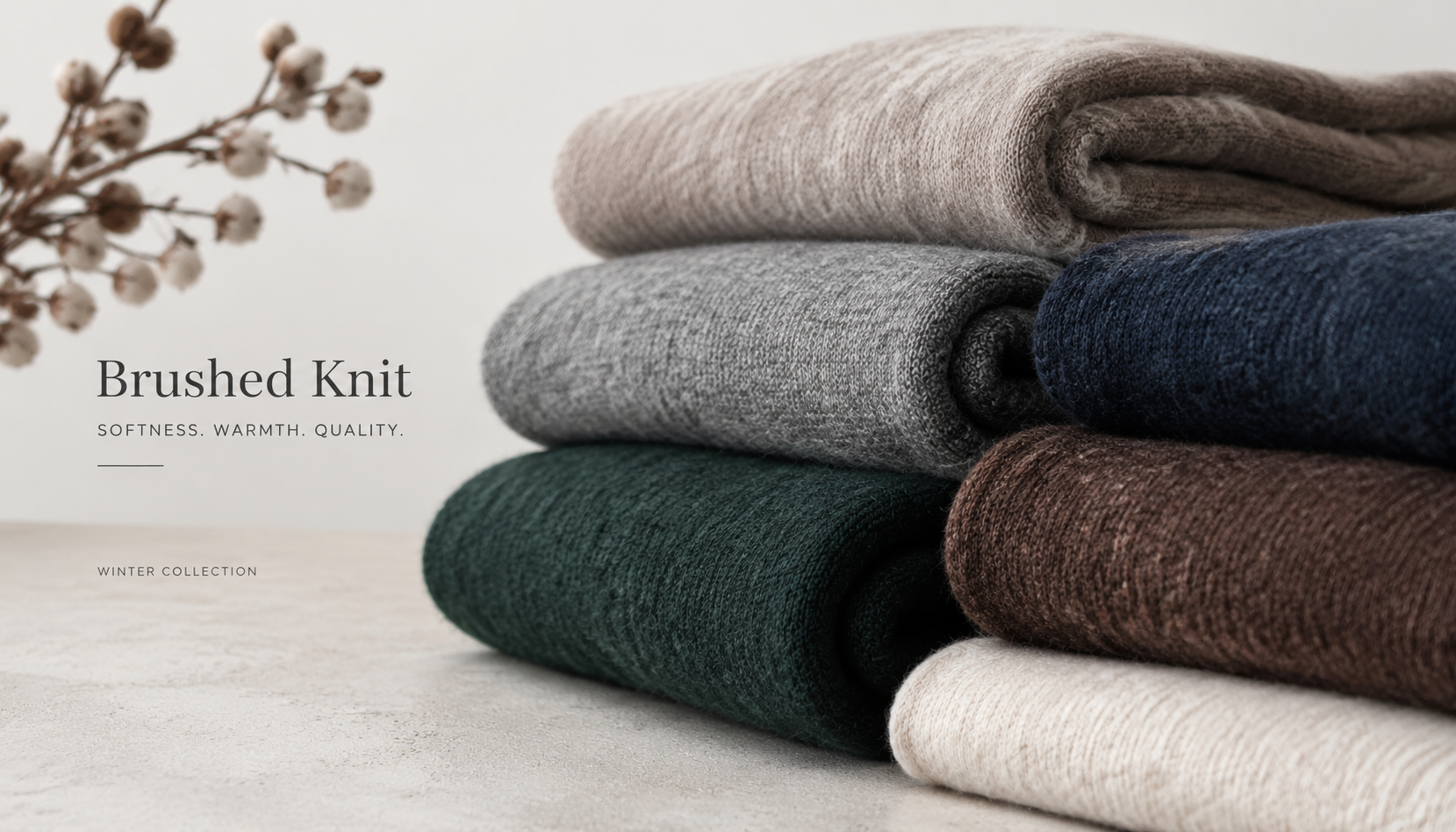
A European mid-tier brand returned a 12,000-piece fleece order last winter because the brushed interior pilled into visible clumps after just three wash cycles—costing the supplier nearly $18,000 in chargebacks. The root cause wasn’t the fiber itself, but a mismatch between the brushing machine gauge and the knit structure. This guide breaks down the technical anatomy of brushed knits so B2B buyers can specify the right construction for warmth without sacrificing durability.
At its core, brushing is a mechanical finishing process, not a fabric type. Think of it as controlled chaos on a microscopic level. High-speed rotating rollers, studded with fine wire points or card clothing, physically agitate the surface of a base knit fabric. These wires snag and pull fiber ends from the yarn structure, lifting them to create a soft, fuzzy pile layer. This is the “brush” or “nap” you feel.
The process is more nuanced than just “turning on the machine.” Key variables include the wire type (fine vs. coarse), roller speed, fabric tension, and the number of passes the fabric makes through the machine. A single pass might create a subtle peach-skin effect, while multiple passes can generate a deep, lofty pile akin to fleece. The direction of brushing—against the knit’s technical back—is also critical for achieving uniform loft.
The machinery lineup for a professional brushing operation typically includes:
This process is what transforms a flat, smooth jersey or rib into a thermal insulator. It’s why you’ll see terms like “double brushed knit fabric” in specs—meaning both the face and back of the fabric have been treated, creating a plush, all-over softness common in premium loungewear and base layers.
Taking the same base cloth—say, a 1×1 rib knit—and subjecting one to brushing creates two functionally different materials. The brushed version isn’t just softer; its physical properties change dramatically. The most obvious change is in thickness and weight. The lifted fibers add measurable bulk and mass.
Here’s a direct comparison based on typical industry data for a 100% cotton 1×1 rib:
| Parameter | Non-Brushed (Greige) | Single-Brushed |
|---|---|---|
| Thickness | 0.8 mm (0.03″) | 1.2 mm (0.05″) |
| Weight (GSM) | 220 gsm (6.5 oz/yd²) | 260 gsm (7.7 oz/yd²) |
| Air Permeability | High (breathable) | Low (insulating) |
| Surface Texture | Smooth, defined ribs | Fuzzy, muted ribs |
This table shows the core trade-off. You gain thermal insulation by trapping air in the pile, but you sacrifice breathability and add cost. The brushing step is an additional manufacturing process that consumes time, energy, and can increase fabric waste if not controlled properly. For a B2B buyer, specifying “brushed” means you are accepting these altered properties and their associated cost implications.
Why does a fuzzy surface feel warmer? It’s all about manipulating air. Still air is one of the best insulators available. The lofty pile created by brushing traps countless tiny pockets of air between the fabric and the wearer’s skin (or between layers). These pockets resist heat transfer via conduction—the primary way our bodies lose warmth to a cold environment.
The industry sometimes references the CLO value, a unit of thermal insulation. While a brushed knit alone won’t have a high CLO, its contribution to a layered system is significant. However, the relationship between pile height and warmth isn’t linear. After a certain point (roughly 3-4 mm / 0.12-0.16″ of loft), adding more pile yields diminishing returns in warmth while drastically increasing weight, cost, and the risk of pilling. The “best brushed knit fabric winter apparel” often finds the sweet spot in the 2-3 mm (0.08-0.12″) loft range for base layers.
Here’s the paradox: the same pile that traps warm air can also trap moisture vapor. For high-exertion activities, this can lead to a clammy, uncomfortable feeling. The increased surface area of the brushed fibers can help wick liquid sweat initially, but the dense structure can impede the rapid evaporation of that moisture.
Fiber choice becomes critical here. A typical moisture-wicking process in a brushed fabric involves:
Polyester microfiber fleece, while not inherently absorbent, can be engineered with capillary channels to speed this process. For pure cotton brushed jerseys, the breathability is better, but drying time is much longer—a serious consideration for multi-day workwear or travel apparel.
This is the elephant in the room for any brushed fabric. The very act of pulling fibers to the surface weakens them. Those lifted fibers are now exposed to abrasion from wearing, washing, and contact with other surfaces. They tangle and form pills. It’s an inevitable physical consequence.
The key is not to prevent pilling entirely—that’s nearly impossible—but to manage its severity and timing. This is where objective testing comes in. The Martindale abrasion test is a standard method to quantify a fabric’s resistance to pilling and abrasion. For winter apparel expected to endure regular wear, a minimum threshold of >10,000 cycles before noticeable pilling (Grade 3 or above on the ISO 12945-2 scale) is a reasonable B2B specification. Anything less, and you risk the kind of chargebacks mentioned in the intro.
From a sustainability angle, this durability issue ties directly into garment lifespan. A fabric that pills excessively after a few washes becomes unwearable, contributing to textile waste. This makes specifying anti-pilling finishes and understanding abrasion data not just a quality concern, but an environmental one.
The natural choice. Cotton offers excellent softness, biodegradability, and low allergenic potential. It’s the go-to for premium babywear, underwear, and high-end loungewear where skin feel is paramount. However, its weaknesses are pronounced in winter applications. Cotton absorbs and holds moisture, losing almost all insulating properties when damp. It’s also prone to shrinkage and, when brushed, can develop a less resilient, “dead” pill that looks messy quickly. It dries slowly, making it a poor choice for active or performance layers.
This is the workhorse blend, seeking a middle ground. The polyester component adds tensile strength, wrinkle resistance, and, crucially, faster drying times. The cotton retains softness and reduces static cling. The blend ratio directly impacts the brushing outcome and cost.
| Blend (Poly/Cotton) | Brushing Result | Durability | Cost | Best For |
|---|---|---|---|---|
| 80/20 | High loft, good pill resistance | Excellent | Lower | Outerwear, fleece jackets |
| 65/35 | Softer hand, moderate loft | Good | Medium | Sweatshirts, casual wear |
| 50/50 | Cotton-like feel, lower loft | Good | Higher | Knit fabric for dresses, premium tees |
A 65/35 blend is often the sweet spot for general winter apparel, offering a good balance of warmth, feel, and wash performance.
The dominant force in outdoor and athletic mid-layers. Modern polyester microfibers can be brushed to an incredible loft, creating fabrics that are exceptionally warm for their weight. They are hydrophobic, meaning they dry very quickly. The downsides are well-documented: they generate static, can feel plasticky to some, and, if not engineered properly, are notorious for pilling. The environmental debate around polyester’s fossil-fuel origin and microplastic shedding is also a major consideration for many brands today.
For those seeking a more sustainable path, recycled polyester (rPET) offers a compelling alternative. According to Textile Exchange, the use of certified recycled polyester is growing rapidly, allowing brands to maintain performance while reducing their environmental footprint. This is increasingly a non-negotiable for European and North American markets.
This is where brushed knits truly shine. For women brushed knit fabric winter apparel like leggings and thermal tops, a lighter-weight, single-side brushed rib or jersey (200-280 gsm / 5.9-8.3 oz/yd²) is ideal. It provides a soft, warm next-to-skin feel without excessive bulk. For men brushed knit fabric winter apparel, similar weights are used for thermal underwear and long-sleeve base layers.
The mid-layer is the domain of heavier fleece (280-380 Fabric GSM Calculator / 8.3-11.2 oz/yd²). Here, double-brushed fabrics or high-loft single-side brushed polyester are common. The goal is maximum warmth-to-weight ratio for jackets, vests, and pullovers. The choice between a brushed rib and a brushed fleece often comes down to the desired balance of stretch (rib wins) versus loft (fleece wins).
For hoodies, joggers, and casual dresses, the fabric’s “hand feel” and drape are as important as warmth. French Terry, with its characteristic loops on one side, is often brushed to create a soft, velvety interior while maintaining a smoother face. This yields a fabric with excellent drape and a cozy feel, perfect for knit fabric for dresses, relaxed-fit pants, and sweatshirts.
Common garment applications include:
In these applications, the aesthetic and tactile qualities often drive the specification. A slightly uneven, “artisanal” brush might be desirable for a fashion-forward hoodie, while a uniform, dense brush is essential for a baby blanket.
Don’t just write “brushed” on your tech pack. Be specific. A competent mill will expect—and a good buyer will provide—details on the brushing parameters. Your checklist should include:
Your quality assurance hinges on clear, testable standards. For any brushed knit, especially those destined for winter apparel, include these in your purchase agreement:
Brushing is an extra step. It adds cost (typically 15-40% over the base fabric), time (3-7 extra days in production), and often increases the Minimum Order Quantity (MOQ) because mills need to optimize machine runs. For custom brushed fabrics, expect MOQs of 500 kg (1,100 lb) per color as a starting point.
This is why prototyping is non-negotiable. Always request a “strike-off” or “lab dip” with the exact brushing finish before committing to bulk. If you have a specific technical requirement or want to get a sample quote for a brushed knit project, the technical team at the factory can provide a feasibility assessment. You can reach out directly with your specifications.
A Scandinavian professional workwear brand faced a tough challenge: develop a brushed knit base layer for technicians working in sustained temperatures down to -20°C (-4°F) that could survive a minimum of 50 industrial wash cycles without pilling. The initial spec called for a high-loft polyester fleece for maximum warmth.
The first sample (a 320 gsm / 9.4 oz/yd² polyester fleece) was incredibly warm but failed abrasion testing catastrophically—it began pilling visibly after just 20 Martindale cycles. The fibers were too fine and too loosely anchored. The next attempt was a 100% cotton brushed jersey. It was durable and passed abrasion tests, but when damp from perspiration, it provided almost no insulation and took forever to dry—a dangerous combination in cold conditions.
The trial-and-error phase began. They tried an 80/20 poly-cotton blend with a heavy 3-pass brush. The warmth was good, but pilling was severe and uniform. The compromise came from changing two variables simultaneously: the knit structure and the brushing intensity. They moved to a tighter gauge (28G) 1×1 rib knit, which held the fibers more securely, and reduced the brushing to a single, careful pass. They also specified a silicone-based anti-pilling softener in the finishing bath.
The final approved fabric was a 260 gsm (7.7 oz/yd²) 1×1 rib with a single-side brush. It sacrificed some of the initial, lofty “fluffiness” of the pure fleece for a Martindale rating consistently above 45 cycles. The hand feel was slightly less plush, but the fabric maintained its integrity and insulating properties through rigorous industrial washing. This kind of problem-solving, balancing competing performance demands, is where a manufacturer’s deep process knowledge becomes invaluable. The factory’s experience since 2005, with its integrated production lines from knitting to finishing, allowed for this kind of rapid, iterative prototyping to find the right technical balance.
Brushed knit fabric is used primarily for thermal insulation and comfort in cold-weather garments. Its applications span from lightweight brushed jerseys for women’s winter dresses and men’s thermal underwear, to heavyweight double-brushed fleece for outerwear jackets and blankets. The specific use is dictated by the fabric weight (GSM), fiber content, and the intensity of the brushing.
Yes, knit fabric can be excellent for winter, but it requires specific engineering. A standard, single-layer jersey is not sufficient. To be effective, it must be modified through processes like brushing (to trap air), increasing its weight/density, or being used as part of a laminated or bonded system. The inherent stretch of knit fabric also makes it ideal for form-fitting base layers that minimize cold air gaps.
“Brushed” is not a material; it is a finishing process applied to a base fabric. The base material can be virtually any textile fiber. The most common materials for brushed winter fabrics are cotton, polyester, acrylic, viscose/rayon, and blends of these (e.g., poly-cotton, cotton-acrylic). The brushing process works differently on each fiber type, affecting the final loft, softness, and durability.
Complete prevention is difficult, but you can significantly minimize it. From a sourcing perspective, specify fabrics with higher-twist yarns, which are more resistant to abrasion. Demand an anti-pilling finish (like a silicone softener) from the mill. Most importantly, set a clear, objective quality gate by requiring a minimum Martindale abrasion test result (e.g., >10,000 cycles at Grade 3) in your purchase order. This shifts the burden of performance onto the supplier.
Choosing a brushed knit for winter apparel is a decision rooted in physics and compromise. You’re trading breathability and some durability for that critical layer of trapped, insulating air. The “best” fabric doesn’t exist in a vacuum—it’s the one that best matches the end-use, the expected lifespan, and the brand’s price point. Don’t be seduced by the softest hand feel in a showroom sample; insist on seeing the test data. A fabric that feels like a cloud but pills into a mess after three wears is a failure of specification, not of material. Get the technical details right from the start, and the warmth will follow.