Address
Nanlang Industrial Zone, Xingtan Town, Shunde District, Foshan, Guangdong, China
Work Hours
Mon–Fri, 9:00 AM – 6:00 PM (CST/UTC+8). We aim to respond to all inquiries within 48 hours.

Address
Nanlang Industrial Zone, Xingtan Town, Shunde District, Foshan, Guangdong, China
Work Hours
Mon–Fri, 9:00 AM – 6:00 PM (CST/UTC+8). We aim to respond to all inquiries within 48 hours.
Textile Trade Shows 2026: The Buyer's Guide to Top Events (US & Global). This guide covers key properties, real-world applications, and a practical sourcing checklist for B2B buyers.
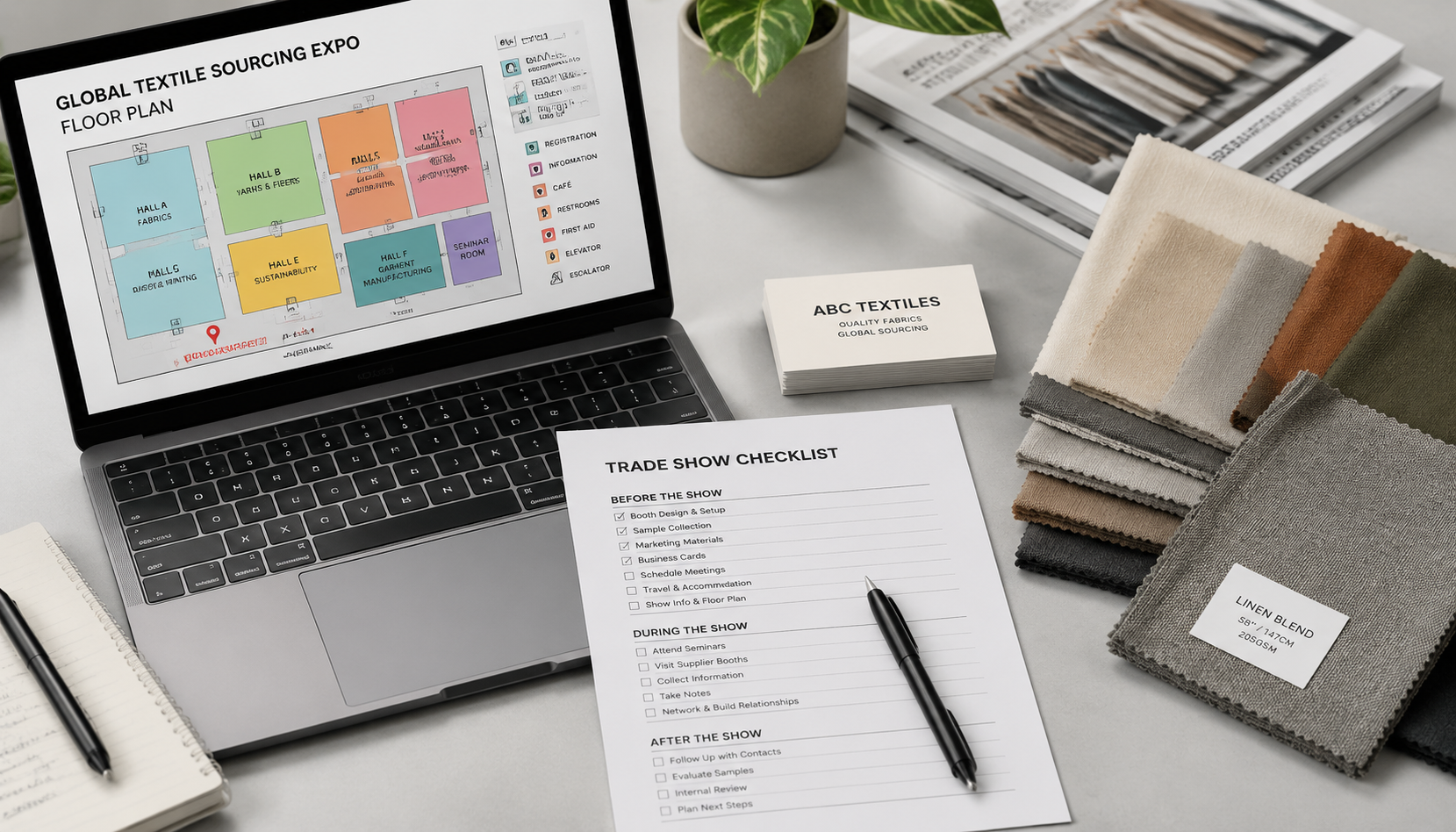
Last year, a US apparel sourcing manager budgeted $14,000 for a trip to a major Shanghai textile expo. She flew back with zero viable suppliers. The exhibitor list hadn’t been pre-vetted, and the minimum order quantities (MOQs) she was quoted were 5 to 10 times her budget. That budget? Gone. That quarter’s sourcing plan? Delayed. This guide exists so you don’t repeat that story in 2026.
Choosing your 2026 show calendar isn’t about which city sounds most appealing for a week away. It’s a cold, hard financial calculation. The cheapest registration fee can end up costing you the most in wasted travel days, mismatched suppliers, and missed production windows. You need to match the show’s core exhibitor profile to your specific fabric category and order volume tier.
Get this alignment wrong, and you don’t just waste the trip cost. You delay your entire procurement cycle by months. Finding a new supplier after a failed show doesn’t happen in days—it resets your sampling, approval, and production timeline from scratch.
Final takeaway: The cheapest show to attend is rarely the best value. The one that matches your volume and fabric needs, even with higher travel costs, delivers a real return.
Think of this not as a list, but as your global sourcing calendar for textile trade shows in 2026. The dates below are based on announced schedules, but always verify on official sites before booking flights. Early-bird registration deadlines often hit 60-90 days before the event.
| Event Name | City & Dates (2026) | Core Fabric Focus | Best For (Buyer Profile) |
|---|---|---|---|
| Texworld New York City | New York, ~Feb & Jul 2026 | Wovens, knits, sustainable textiles | US East Coast mid-volume buyers; great for a textile trade shows 2026 guide nyc starting point |
| Sourcing at MAGIC | Las Vegas, ~Feb & Aug 2026 | Apparel supply chain, performance fabrics | US West Coast / brand sourcing managers |
| Intertextile Shanghai Apparel Fabrics | Shanghai, ~Mar & Sep 2026 | Full-spectrum — knits, wovens, functional, home | High-volume global buyers, private-label brands |
| Première Vision | Paris, ~Feb & Sep 2026 | Premium fashion, innovation, sustainability | Design-led European & international brands |
| ITMA | Hannover, Jun 2026 | Textile machinery & technology | R&D teams, production engineers |
| Heimtextil | Frankfurt, ~Jan 2026 | Home & contract textiles | Home goods importers & hospitality buyers |
| ISPO Munich | Munich, ~Jan 2026 | Performance, sportswear, outdoor functional | Functional / activewear sourcing teams |
Don’t overlook the niche players. If you’re in activewear, the Functional Fabric Fair in Portland or Munich is a laser-focused discovery tool. Denim heads should mark Kingpins (Amsterdam, New York). For the Americas market, Colombiatex in Medellin is a strategic hub. These smaller events often have more senior technical staff at booths, less crowded aisles, and stronger regional supplier clusters. They can be a secret weapon in your best textile trade shows 2026 guide.
Show schedules shift. The only reliable textile exhibition in 2026 schedule lives on official show websites. Bookmark your top 3 and check monthly from September 2025 onward. Note that visa processing for China or Europe can take 8-12 weeks, so lock in your shows by Q4 2025 at the latest.
A few years back, the sourcing manager for a mid-size US activewear brand needed sustainable performance knit suppliers. She planned a single-show strategy at Texworld NYC. The logic was sound: budget-friendly at $3,500 total for two attendees versus $16,000+ for a Shanghai trip. The reality? Texworld NYC had far fewer performance-knit exhibitors. Two of three target booths turned out to be trading companies, not mills. MOQ quotes landed at 3,000-5,000 m (3,280-5,468 yd) per color, triple her 1,000 m (1,094 yd) comfort zone. Swatches mailed later didn’t match the on-floor samples.
Her compromise was elegant and cost-effective. For 2026, she’s splitting the strategy: Texworld NYC for domestic discovery ($3,500 budget) AND pre-scheduled video calls with three pre-vetted Shunde-based integrated mills four weeks before Shanghai. She’ll fly into Shanghai for only two firm meetings, cutting the trip from five days to two and the total cost to $8,500. Less waste, more leverage.
Most buyers waste over 40% of their show hours on unplanned wandering. You need a walk plan, not a wonder plan. The goal is structured serendipity: protect time for pre-booked meetings, then systematically sweep for new discoveries. This is where the real value of attending an advanced textiles expo in 2026 or a major fair materializes.
| Time Block | Activity | Goal |
|---|---|---|
| Day 1, Morning | Priority booth meetings (pre-scheduled) | Deep-dive conversations, touch fabrics, collect samples with labeled specs. |
| Day 1, Afternoon | Aisle sweep & new discovery scan | Walk every row; photograph promising booths; collect cards, circle back Day 2. |
| Day 2, Morning | Technical seminars & trend halls | Gain macro insights; spot emerging suppliers not in main aisles. |
| Day 2, Afternoon | Follow-up meetings & final sample collection | Revisit Day 1 discoveries; nail down next steps (video calls, sample requests). |
Documentation is critical. Label every fabric sample immediately with the exhibitor’s name, booth number, and date. Take a photo of the booth frontage and their business card. Email all notes to yourself the same evening—details blur fast after 10 hours on the floor.
Even the best-planned show uncovers budget surprises only visible on the ground. Here’s the cost breakdown most listicles miss.
| Cost Category | Domestic Show (e.g., NYC) | International Show (e.g., Shanghai) |
|---|---|---|
| Registration Fee | $0 – $500 (often free for buyers) | $0 – $300 |
| Flights (per person, round trip) | $300 – $800 | $1,200 – $2,500 |
| Hotel (per night × nights) | $200 – $350 × 2-3 nights | $150 – $300 × 3-5 nights |
| Local Transport & Meals | $150 – $250 | $100 – $200 |
| Sample Shipping / Courier | $50 – $100 | $150 – $400 |
| Translator Service | N/A | $300 – $600 per day |
| Estimated Total Per Person | $3,000 – $5,000 | $8,000 – $18,000 |
That MOQ a marketer gives you at a booth is a starting conversation, not a final contract. Treat it as a signal. For integrated mills with their own dye houses—like those operating since 2005 with full production chain documentation—custom-dye MOQs often start at 3,000 m (3,280 yd) per color. They might offer 500 m (547 yd) from stock greige goods. Trading companies, however, often quote lower MOQs, say 1,000 m (1,094 yd), but at a 15-30% higher unit cost because they’re aggregating from multiple smaller sources. Know which you need.
There’s also a timeline gap buyers forget. After the show, confirm a sample (often 1-2 meters, 1.1-2.2 yards), then negotiate final pricing and sign a Sales Order. This pre-production phase eats 2-6 weeks. Add that to the mill’s standard 10-20 business day lead time for production, and your first true delivery window is likely 90-120 days post-show for a stock item, longer for custom.
Convinced a show is your only option? It’s not. Each sourcing channel offers different advantages; the choice depends on your volume, risk tolerance, and resources.
| Criteria | Trade Show | Direct Factory Visit | Digital / Video Sourcing |
|---|---|---|---|
| Discovery Breadth | High (hundreds of suppliers) | Low (1-2 per trip) | Medium (unlimited virtual visits) |
| Cost per Contact | Medium (amortized travel) | Very High (dedicated travel) | Low (time + video call fees) |
| Hands-on Fabric Eval | Excellent (touch, drape, feel) | Excellent (full production samples) | Poor (reliant on mailed swatches) |
| MOQ Negotiation Ease | Good (face-to-face rapport) | Excellent (deep relationship) | Medium (email/formal channels) |
| Supplier Verification | Medium (ask on-site questions) | High (see the production line) | Low (hard to verify claims) |
| Follow-up Speed | Fast (established contact) | Slower (requires scheduling) | Very Fast (digital trail) |
My take? For most B2B buyers looking at MOQs between 500 m and 5,000 m (547 to 5,468 yd), the optimal path is hybrid. Use one domestic trade show as your broad discovery funnel. Then, leverage digital sourcing to have targeted technical deep-dives with pre-vetted international mills. Finally, reserve an expensive, time-consuming factory visit only for the final 1-2 shortlisted suppliers you’re ready to commit to. This balances cost, verification, and fabric quality assurance.
If you can’t attend a show in 2026, you can still bridge the gap. Reputable manufacturers with large, ready-stock warehouses can provide comprehensive swatch kits and technical datasheets upon request. This hands-on evaluation is a critical step that digital alone can’t replace, and it’s a service available directly via their engineering teams.
Start domestic to reduce risk and cost. In the US, Texworld New York City (Feb/Jul) or Sourcing at MAGIC in Las Vegas (Feb/Aug) are strong, accessible starting points. They let you practice the show-floor process, learn vendor qualification, and test your sourcing brief without the complexity of international travel, language barriers, and customs logistics.
Aim for early-bird registration windows, which typically open 90-120 days before the event and close 60-90 days out. For international shows, add 8-12 weeks of visa processing time. You should be finalizing your 2026 show calendar by September 2025.
Always carry: 1) A one-page tech pack or spec sheet (composition, weight, width, finishes). 2) Physical fabric swatches or Pantone TCX cards for color reference. 3) A target price range document. 4) Business cards. Digital copies on a tablet or phone are a backup, but physical samples allow instant touch-feel comparisons at the booth.
Yes, but manage expectations. You can request samples, which will likely be cut from their booth stock or main production line. Delivery typically takes 2-4 weeks, shipped from their factory or regional office. Critical: Before leaving the booth, get written confirmation of the fabric’s exact specifications—composition, weight, width—as what’s on the display might not perfectly match the sample you receive.
Honestly, it’s a challenge. Most large integrated mills have MOQs starting at 500 m (547 yd) or higher for custom orders. Your better options are: A) Target stock-fabric mills or trading companies at shows who may offer lower MOQs. B) Focus on building digital relationships for post-show sampling. C) Consider using a local agent who consolidates orders from multiple small buyers to meet a mill’s production minimum.
Scale and cost. A US show like NYC costs $3,000-$5,000 per person, offering direct access to US-based distributors and mills with shorter supply chains. Shanghai (Intertextile) costs $8,000-$18,000+ per person but grants unparalleled access to the world’s largest concentration of full-spectrum manufacturers—from fiber to finished fabric—all under one roof. The trade-off is budget versus supplier depth and range.
Ask these questions on the spot: 1) “What is your factory’s exact address?” Vague answers about a “production park” are a red flag. 2) “Can you provide your OEKO-TEX Standard 100 certificate number?” Real mills have this ready. 3) “Can I see photos of your specific production lines (weaving, dyeing, finishing)?” Generic marketing photos don’t count. Cross-check this information on industry platforms and the manufacturer’s official website afterward.
A 2026 textile trade show is a powerful sourcing tool, but only if you treat it like a surgical strike, not a vacation. The ROI isn’t in collecting the most brochures; it’s in leaving with two or three verified supplier relationships that can support your business for the next 3-5 years. Plan meticulously, budget for the real costs, and walk the floor with a clear objective. The connections you make with a good technical contact at a booth—someone who understands your weight in Fabric GSM Calculator/yd² and your finish requirements—are worth more than a thousand generic email inquiries. Do your homework, and the show will deliver.