Address
Nanlang Industrial Zone, Xingtan Town, Shunde District, Foshan, Guangdong, China
Work Hours
Mon–Fri, 9:00 AM – 6:00 PM (CST/UTC+8). We aim to respond to all inquiries within 48 hours.

Address
Nanlang Industrial Zone, Xingtan Town, Shunde District, Foshan, Guangdong, China
Work Hours
Mon–Fri, 9:00 AM – 6:00 PM (CST/UTC+8). We aim to respond to all inquiries within 48 hours.
Raschel vs Tricot Warp Knitting: Which Fabric Structure Fits Your Product. This guide covers key properties, real-world applications, and a practical sourcing checklist for B2B buyers.
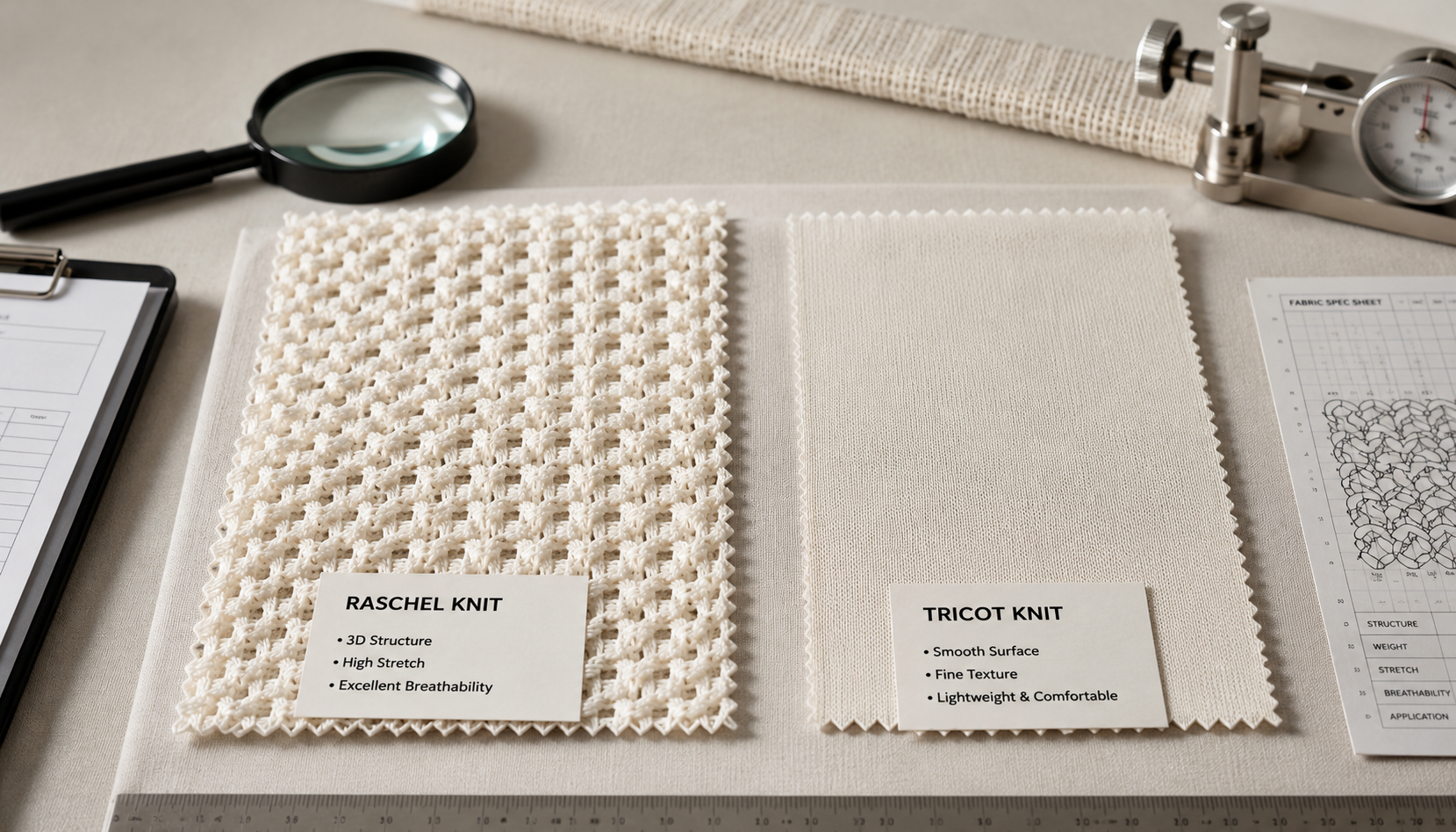
Last quarter, a European outdoor brand’s procurement team signed off on a tricot knit mesh for their new 45-liter hiking backpack’s ventilation panel. The spec sheet called for 150+ CFM airflow. The tricot sample hit 85 CFM. They went back, loosened the gauge, got to 130 CFM — then watched the loops distort after five wash cycles. The result? A six-week delay, a 12% price premium to rush a Raschel order, and a color range cut in half. The hidden cost of choosing the wrong warp knit structure often dwarfs the per-meter price difference.
This guide breaks down the mechanical, performance, and commercial differences between Raschel and tricot warp knitting. We’ll move from how the machines actually build fabric, through a side-by-side technical matrix, to a practical procurement decision framework you can use on your next sourcing project.
The fundamental difference starts at the needle. A Raschel knitting machine uses a latch needle — a simple, robust hook with a hinged latch that closes over the yarn to form a loop. This mechanism tolerates a much wider range of Yarn counts, from fine 20-denier filaments to bulky 600-denier+ textured yarns. The latch needle’s forgiving action is what allows Raschel machines to handle fancy, uneven, or even elastic yarns that would jam a more precise system.
A tricot warp knitting machine, by contrast, employs a compound needle. This two-part needle — a hook and a sliding closing element — operates with extreme precision at very high speeds. According to technical overviews on platforms like ScienceDirect’s tricot machine topic page, modern tricot machines can exceed 2,000 revolutions per minute (rpm), while typical Raschel machines run between 800 and 1,200 rpm. That speed difference is the core of tricot’s economic advantage for high-volume, uniform fabrics.
Both machine types use guide bars — the components that carry the yarn across the needles. The number of guide bars directly limits pattern complexity. A basic tricot machine might have 2 to 4 bars. A Raschel machine can have 6, 12, or even up to 78 bars, enabling intricate lace, 3D structures, and multi-yarn decorative patterns. It’s not just about more bars; it’s about what those bars allow you to design.
| Machine Type | Needle Type | Typical Gauge | Max Speed (rpm) | Yarn Range (denier) |
|---|---|---|---|---|
| Raschel | Latch Needle | E12 – E28 | 800 – 1,200 | 20D – 600D+ |
| Tricot | Compound Needle | E28 – E40 | 2,000+ | 15D – 100D |
The latch needle’s simplicity is its superpower. It can form loops with yarns that are textured, bulky, or even contain metal wires for technical textiles. Gauge, expressed in needles per inch (E), determines fabric density. A Raschel machine at E18, for instance, has 18 needles per inch, creating a relatively open structure ideal for mesh. At E28, the same machine produces a finer, more closed fabric. When you’re sourcing, asking for the machine’s gauge is non-negotiable — it directly dictates the fabric’s hand feel, weight, and porosity. Many detailed Raschel warp knitting machine PDF datasheets from machinery manufacturers will list compatible gauge ranges and maximum bar counts for each model.
The compound needle’s precision comes at a cost: it requires finer, more uniform yarns. Textured or irregular yarns can cause needle jams and fabric defects at high speeds. This is why tricot machines excel with smooth, continuous filament nylon or polyester in the 15D to 100D range. The typical E32 gauge produces a very fine, dense fabric with a smooth surface — perfect for apparel linings or printed substrates. The high speed translates directly to lower unit costs for large orders, but it also means the machine is less forgiving of yarn quality variations. Your yarn supplier’s consistency becomes critical.
When you’re comparing Raschel warp knit fabric to tricot, don’t get lost in textbook definitions. Focus on the parameters that actually affect your product’s performance and your bottom line. Here’s a matrix built around the five dimensions procurement teams most frequently confuse.
| Parameter | Raschel | Tricot | Buyer Impact |
|---|---|---|---|
| Loop Structure | Open, variable, often mesh-like | Closed, parallel, uniform | Determines breathability, stretch, and visual texture |
| Typical Weight Range | 80 – 350 gsm (2.4 – 10.3 oz/yd²) | 30 – 150 gsm (0.9 – 4.4 oz/yd²) | Impacts product feel, drape, and shipping cost |
| Surface Texture | Rough, textured, or 3D | Smooth, flat, consistent | Affects printability, skin comfort, and lamination |
| Pattern Complexity | High (6+ guide bars) | Low (2-4 guide bars) | Drives design freedom vs. production simplicity |
| Dimensional Stability | Moderate; can stretch more | High; minimal shrinkage | Critical for pattern cutting and garment sizing |
Raschel fabric’s open loop structure creates inherent porosity. Think of a 70-denier nylon 6.6 Raschel mesh at 135 Fabric GSM Calculator (4.0 oz/yd²) — it feels airy, slightly coarse, and has a visible grid pattern. This isn’t a defect; it’s the structure’s purpose. It drapes loosely and allows maximum airflow.
Tricot fabric’s parallel, closed loops create a smooth, almost silky surface. A 40-denier nylon tricot at 55 gsm (1.6 oz/yd²) feels crisp and cool to the touch. It’s the fabric you’d want against skin in a sports bra or as a base for sublimation printing. The difference is tactile and immediate — you can feel it with your eyes closed.
Raschel structures can be built heavy, up to 350 gsm (10.3 oz/yd²), using coarse yarns and dense stitch patterns. This makes them suitable for automotive seat covers or industrial filters. However, this openness can mean more stretch and potential shrinkage if not properly finished. Tricot’s tight, uniform structure inherently resists distortion. A well-finished tricot fabric can achieve shrinkage rates of 3% or less in the warp direction, a critical spec for apparel where pattern accuracy is paramount. Always verify the specific shrinkage data against standards like AATCC Test Method 135 for dimensional stability.
The right structure depends entirely on the product’s primary performance requirement. It’s not about which is “better,” but which is fit for purpose.
Raschel knitting’s ability to use coarse yarns and create large, stable openings makes it irreplaceable in technical textiles. A 200-denier polyester Raschel net can be an effective bird netting for vineyards. A multi-bar Raschel machine can produce intricate lace that mimics handcraft for the home textile market. The structure is engineered for function first — breathability, filtration, reinforcement — with aesthetics as a secondary, but powerful, benefit.
Tricot’s economic dominance is in high-volume, fine-gauge apparel. The smooth surface is ideal for printing vibrant graphics on sportswear. Its lightweight nature, often below 80 gsm (2.4 oz/yd²), makes it perfect for lingerie where comfort and invisibility under clothing are key. The high production speed means that for an order of 10,000 meters of a single style, tricot will almost always be the more cost-effective choice. It’s the workhorse of the intimate apparel and activewear industries.
Let’s talk numbers. A Raschel machine’s setup time is longer. Changing a pattern might require adjusting multiple guide bars, whereas a tricot changeover is simpler. Yarn waste on a Raschel machine can run 3-5%, compared to 1-2% on a tricot line. These factors contribute to a higher base cost per meter for Raschel fabrics.
However, for a 10,000-meter order of a complex, open-mesh Raschel fabric, the unit price might be $2.80 – $3.50 per meter. The same length of a simple, plain tricot fabric could be $1.50 – $2.20 per meter. The gap narrows with complexity, but for standard constructions, tricot wins on pure cost at scale. The trade-off is that you cannot achieve the same performance characteristics — you’re comparing a sports car to a pickup truck.
| Cost Factor | Raschel | Tricot | Notes |
|---|---|---|---|
| Machine Setup Time | Longer (multi-bar adjustment) | Shorter (simpler configuration) | Impacts small-batch economics |
| Yarn Waste % | 3-5% | 1-2% | Factor into material cost calculation |
| Unit Cost @ 10,000m | Higher (e.g., $2.80-$3.50/m) | Lower (e.g., $1.50-$2.20/m) | Varies wildly with yarn type and finish |
| Minimum Order Quantity (MOQ) | Typically higher (1,500-3,000m) | Can be lower (500-1,000m) | Tricot offers more flexibility for test runs |
A European outdoor gear brand needed a breathable mesh for a new backpack line. Their spec required 70D nylon 6.6, ≥800 g/m² bursting strength, and ≥150 CFM airflow. Raschel mesh met all specs, but the MOQ was 3,000 meters per color. They were launching a 4-SKU test run and couldn’t commit to 12,000 meters upfront. They first tried 500 meters of a tricot mesh (E28 gauge, 70D nylon 6.6) to save cost. The fabric passed tensile tests but only hit 85 CFM — a failure. A second attempt with a looser tricot gauge (E18) improved airflow to 130 CFM but introduced unacceptable loop distortion after 5 wash cycles. The compromise was negotiating a 1,500-meter Raschel MOQ with the supplier by accepting a 12% price premium and a 4-week lead time extension. The factory absorbed partial setup cost. The final fabric met all specs, but the buyer accepted a narrower color range (3 colors instead of 6) to hit budget. This trial-and-error process cost them six weeks and highlighted a key lesson: performance specs should dictate structure choice, not the other way around.
Use this framework to cut through the noise. Ask these four questions in order:
Once you’ve answered these, you can move to the next step: exploring specific product lines. For instance, if your answers pointed toward a high-airflow, medium-strength Raschel solution, a product like a 70D Nylon 6.6 Raschel mesh with 135 gsm (4.0 oz/yd²), 150 cm (59″) width, and ≥150 CFM airflow would be a logical starting point. You can review such options in a supplier’s warp knit fabrics category.
Choose Raschel when: 1) Your design requires yarns heavier than 150 denier. 2) You need an open mesh or 3D structure for breathability, filtration, or visual effect. 3) The pattern complexity exceeds the capability of 4 guide bars. Raschel knitting is the tool for technical innovation and decorative complexity.
Choose tricot when: 1) Your order volume exceeds 5,000 meters for a single fabric. 2) You need an exceptionally smooth, flat surface for printing or lamination. 3) Your budget is tight and your timeline is aggressive. Tricot is the engine of efficient, high-volume production.
Don’t rely on a spec sheet alone. Use this checklist during your supplier audit and sample approval process.
| Check Item | Standard / Method | Raschel Spec Guideline | Tricot Spec Guideline |
|---|---|---|---|
| Machine Brand & Model | Supplier Declaration | Confirm latch needle type | Confirm compound needle type |
| Machine Gauge (E) | Supplier Declaration | Match to design (e.g., E18 for mesh) | Match to design (e.g., E32 for fine fabric) |
| Fabric Weight (gsm) | ASTM D3776 | Tolerance ±5% | Tolerance ±5% |
| Dimensional Stability | AATCC 135 | Verify specific shrinkage % | Typically ≤ 3% warp direction |
| Colour Fastness to Light | ISO 105-B02 | ≥ Grade 4 | ≥ Grade 4 |
| Pilling Resistance | ISO 12945-2 | ≥ Grade 3-4 | ≥ Grade 3-4 |
| Supplier Certifications | Audit | OEKO-TEX, GRS, ISO 9001 | OEKO-TEX, GRS, ISO 9001 |
Supplier certifications are a critical part of this verification. A factory holding OEKO-TEX Standard 100, GRS 4.0, and ISO 9001 provides documented proof of chemical safety, recycled content traceability, and quality management systems. Always request certificate numbers and check their validity.
After reviewing documentation, the final step is always to get a physical sample. The hand feel, drape, and actual performance can only be judged in person. Most reputable suppliers offer a straightforward sample request process. For example, you can submit a sample request by selecting your desired specifications, filling out a simple form, and confirming logistics — typically receiving 1-3 meter swatches within a week.
Tricot uses compound needles for high-speed production of fine, smooth fabrics. Raschel uses latch needles to handle coarser yarns and create complex, open structures. For a buyer, tricot means cost efficiency on simple orders; Raschel means design freedom and technical performance.
Yes. Raschel is one of the two primary types of warp knitting, the other being tricot. Both use yarns fed from warp beams, but they differ in needle type, machine speed, and fabric outcomes.
Yes. Tricot is a high-speed warp knitting process that produces fine-gauge, smooth fabrics using compound needles. It’s the dominant method for lingerie linings, apparel fabrics, and technical substrates.
Raschel knit lace features intricate patterns created by multiple guide bars (often 6+). It has an open, net-like base, combines fine and coarse yarns for dimensional effect, and produces a textured, often three-dimensional surface. It’s widely used in curtains, bridalwear, and decorative home textiles.
The choice between Raschel and tricot isn’t about which technology is superior. It’s about aligning the fabric’s inherent capabilities with your product’s non-negotiable requirements. Start with the performance spec — the airflow, the hand feel, the weight — and let that dictate the structure. Then, use the cost and MOQ data to negotiate a viable production plan. If your next project involves a high-airflow, medium-strength application, exploring a proven Raschel warp knit fabric solution is a logical first step. For technical discussions on custom specifications or to initiate a sample evaluation, you can connect with the engineering team to review your requirements in detail.