Address
Nanlang Industrial Zone, Xingtan Town, Shunde District, Foshan, Guangdong, China
Work Hours
Mon–Fri, 9:00 AM – 6:00 PM (CST/UTC+8). We aim to respond to all inquiries within 48 hours.

Address
Nanlang Industrial Zone, Xingtan Town, Shunde District, Foshan, Guangdong, China
Work Hours
Mon–Fri, 9:00 AM – 6:00 PM (CST/UTC+8). We aim to respond to all inquiries within 48 hours.
Bonded Fleece Fabric: Lamination, Warmth & Outdoor Uses. This guide covers key properties, real-world applications, and a practical sourcing checklist for B2B buyers.
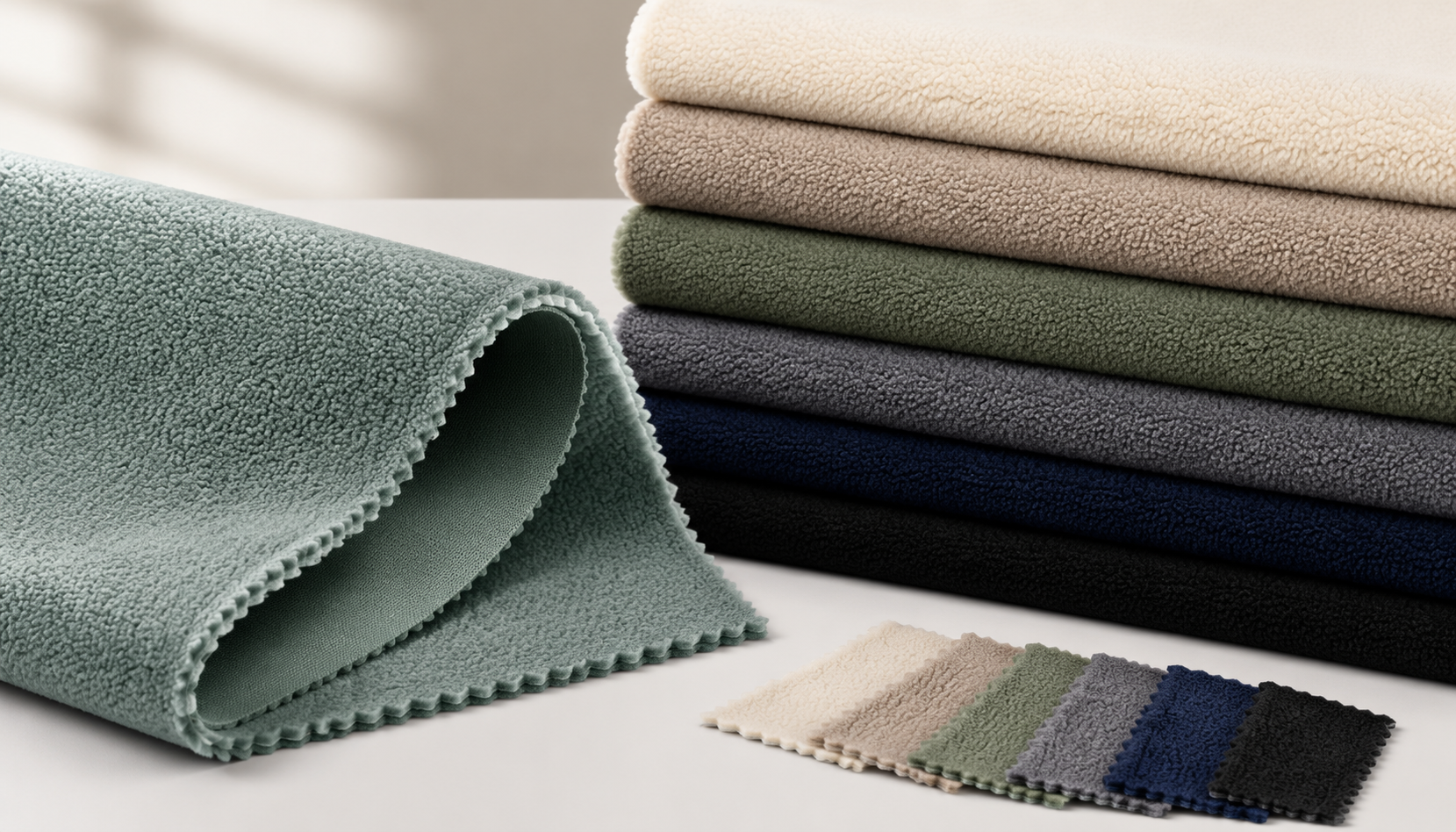
A European outdoor brand once scrapped an entire production run of mid-layer jackets. The culprit? A procurement manager who specified “bonded fleece” without understanding the difference between TPU and PE film layers. At -10°C (14°F), the PE membrane became brittle and cracked across every seam. Six months of development, gone in a single cold-weather test. This kind of costly mistake happens more often than the industry admits — and it’s almost always preventable.
The term “bonded” gets thrown around loosely in textile sourcing. Some buyers assume it means two layers stitched together. It doesn’t. Bonded fleece fabric outdoor applications demand a specific construction: two or more textile layers fused under heat and pressure using a thermoplastic membrane or adhesive. The bond isn’t a seam — it’s a molecular-level union that determines wind resistance, water protection, and long-term durability.
| Parameter | Single-Layer Fleece | Bonded Fleece |
|---|---|---|
| Structure | Fleece face only | Fleece face + membrane + optional backer |
| Wind Resistance (CFM) | 15–40 (high air permeability) | ≤ 2.0 (near windproof) |
| Typical Weight Range | 150–280 gsm (4.4–8.3 oz/yd²) | 200–400 gsm (5.9–11.8 oz/yd²) |
| Thickness | 2–5 mm (0.08–0.20 in) | 4–8 mm (0.16–0.31 in) |
| Cost Index | 1.0x (baseline) | 1.3–1.8x |
That cost premium is where many procurement teams balk. But here’s the thing — a well-bonded fleece eliminates the need for a separate windproof liner in most outdoor garments. You’re consolidating two layers into one, which actually reduces cut-and-sew complexity downstream.
The membrane types matter enormously. TPU (thermoplastic polyurethane) offers superior elasticity and cold-weather performance. PE (polyethylene) is cheaper but stiffer and more prone to cracking. PA (polyamide) sits somewhere in between, favored in niche European workwear applications. Choosing the wrong one doesn’t show up in a hand-feel sample — it shows up six months later in the field.
Understanding the lamination process helps buyers ask smarter questions. A factory that controls its bonding parameters tightly is a factory that delivers consistent quality. A factory that treats lamination as a black box is a factory that will eventually ship you a batch that delaminates after 10 washes.
| Film Type | Temp Range | Elastic Recovery | Wash Durability |
|---|---|---|---|
| TPU | -30°C to 80°C (-22°F to 176°F) | ≥ 90% | 50+ washes |
| PE | -10°C to 60°C (14°F to 140°F) | 60–70% | 20–30 washes |
| PA | -20°C to 70°C (-4°F to 158°F) | 80–85% | 35–45 washes |
I’ll be honest — I’ve seen PE membrane work fine for cost-driven promotional outerwear that gets worn one season. But for any bonded fleece fabric outdoor application where the garment needs to survive two or more winters, TPU is the only serious option. The price difference (typically 20–35% at the membrane level) pays for itself in reduced warranty claims.
Three variables control everything. Temperature: typically 150–180°C (302–356°F). Pressure: 0.3–0.5 MPa (43–72 psi). Dwell time: 15–30 seconds depending on fabric thickness.
Push temperature above 185°C (365°F) and the TPU membrane starts to degrade — it becomes brittle, loses elasticity, and will crack under flex stress. Drop pressure below 0.25 MPa (36 psi) and you get incomplete bonding — the classic “bubble” defect where layers separate in localized spots. I’ve seen entire shipments rejected because the factory’s pressure rollers were worn and couldn’t maintain consistent force across the full fabric width.
The critical quality checkpoint is peel strength testing. According to ASTM D751 (the standard for coated fabrics) and the international equivalent ISO 2411, bonded fleece should achieve a minimum peel strength of ≥ 8 N/25mm. Anything below 6 N/25mm is a red flag — the bond will fail under real-world stress. Always request test data, not just a verbal assurance.
When a product spec sheet says “waterproof,” it can mean almost anything. In B2B procurement, vague language is the enemy. You need three hard numbers: hydrostatic head (water resistance), MVTR (breathability), and CFM (wind permeability). Without these, you’re buying on faith.
The AATCC 127 test method defines how hydrostatic head is measured — it’s the pressure at which water penetrates the fabric, expressed in mm H₂O (or inches H₂O for US buyers). For waterproof bonded fleece fabric outdoor applications, here’s how the tiers break down:
| Performance Tier | Hydrostatic Head | MVTR | CFM |
|---|---|---|---|
| Entry-Level | 5,000–8,000 mm H₂O | 3,000–4,000 g/m²/24h | 3.0–5.0 |
| Mid-Range | 10,000–15,000 mm H₂O | 5,000–7,000 g/m²/24h | 1.5–2.5 |
| High-End | ≥ 20,000 mm H₂O | ≥ 8,000 g/m²/24h | ≤ 1.0 |
Those numbers aren’t marketing targets — they’re the thresholds that separate garments that perform from garments that disappoint. A mid-range waterproof bonded fleece at 10,000 mm H₂O will handle moderate rain for 2–3 hours. Push into sustained downpour and you need 15,000+ mm.
Here’s a procurement SOP I’ve refined over years of working with technical outerwear brands:
Standard bonded fleece in the 200–280 Fabric GSM Calculator (5.9–8.3 oz/yd²) range handles most temperate-climate outdoor use. But push it into genuinely harsh environments and three failure modes emerge:
The heavy-duty upgrade path involves three changes. First, increase base weight to 320–400 gsm (9.4–11.8 oz/yd²). Second, step up membrane thickness from 0.015 mm to 0.025–0.030 mm — this alone dramatically improves cold-crack resistance. Third, specify double-sided brushed fleece for the base fabric. The factory’s brushed and suede-finish fabric capabilities support this kind of custom base construction, which is critical for achieving the loft and insulation that heavy-duty applications demand.
Bonded fleece isn’t just for outdoor jackets. The construction shows up across five major industry verticals, each with distinct performance requirements and certification demands.
| Industry | Preferred Membrane | Key Standard |
|---|---|---|
| Outdoor Apparel | TPU | AATCC 127, ISO 811 |
| Workwear / Uniforms | TPU or PA | EN 342, EN 343 |
| Home Textiles | PE | OEKO-TEX 100 |
| Automotive Interiors | TPU or PA | FMVSS 302, ISO 3795 |
| Medical Warming | TPU | ISO 10993 biocompatibility |
Outdoor brands drive the majority of bonded fleece demand, and their procurement decisions follow a predictable chain. The design team specifies “windproof + warm + lightweight” — the classic triangle. The sourcing team then faces the TPU-vs-PE dilemma: TPU hits every performance metric but costs 30–40% more at the fabric level, which cascades into a retail price that may exceed the brand’s market positioning.
A Nordic outdoor brand I worked with illustrates this tension perfectly. Their winter mid-layer program demanded bonded fleece at ≤ 300 gsm (8.8 oz/yd²) with hydrostatic head ≥ 15,000 mm H₂O. The TPU membrane solution passed every test. The PE alternative came in at 8,000–10,000 mm H₂O — technically “waterproof” by relaxed standards, but nowhere near the brand’s specification.
The first round of PE samples passed lab testing but failed after 30 simulated washes. Peel strength dropped from 12 N/25mm to 5 N/25mm — well below the brand’s 7 N/25mm internal threshold. They tried lowering bonding temperature to 140°C (284°F) to reduce membrane stress. The result? Incomplete adhesion and widespread bubbling.
The compromise came from an unexpected angle. They stayed with TPU but reduced membrane thickness from 0.025 mm to 0.020 mm. This sacrificed roughly 15% of hydrostatic head (down to 13,000 mm H₂O) but cut material cost by 12% and kept the finished fabric at 290 gsm (8.6 oz/yd²). The brand accepted a specification that was “slightly below design target but far above market average.” That’s the kind of pragmatic trade-off that actually ships product.
After watching dozens of procurement cycles play out, I’ve distilled the process into six steps that consistently prevent costly mistakes.
Step five is where most buyers cut corners. They touch the sample, decide it “feels right,” and move to production. But hand-feel tells you nothing about membrane integrity, bonding consistency, or wash durability. Those are data points, not tactile impressions.
When you’re ready to begin the verification process, the factory’s technical team can provide sample kits and detailed specification sheets within 5–7 working days, including peel-strength test specimens cut to lab-ready dimensions.
| Risk Type | Trigger Condition | Consequence | Mitigation |
|---|---|---|---|
| Wrong membrane type | Supplier substitutes PE for specified TPU | Field failure in cold conditions | Require membrane supplier certificate |
| Weight deviation | Bulk fabric ±7% from sample | Garment fit and thermal rating issues | Specify ±3% tolerance in contract |
| Peel strength decay | Post-wash strength < 6 N/25mm | Delamination, warranty claims | Require 30-wash peel test data |
| Color fastness failure | Rating < 3.5 on grey scale | Customer returns, brand damage | Test per ISO 105-B02 before bulk |
| Hydrostatic shortfall | Bulk tests 20%+ below sample | Product fails waterproof claims | Include penalty clause for variance |
Three red flags that should make you walk away from a supplier:
For context on the factory’s capabilities and certifications — including OEKO-TEX Standard 100, GRS 4.0, and ISO 9001 — the about page provides a full overview of production infrastructure and quality management systems that support these procurement standards.
Bonded fleece isn’t always the right answer. Knowing when to choose a different construction is just as important as knowing how to specify bonded fleece correctly.
| Property | Bonded Fleece | Plain Fleece | Softshell |
|---|---|---|---|
| Wind Resistance | Excellent (CFM ≤ 2.0) | Poor (CFM 15–40) | Good (CFM 1–5) |
| Warmth (clo/100gsm) | 0.5–0.7 | 0.6–0.8 | 0.3–0.5 |
| Breathability (MVTR) | 3,000–8,000 g/m²/24h | 10,000+ g/m²/24h | 5,000–15,000 g/m²/24h |
| Cost Index | 1.5–1.8x | 1.0x (baseline) | 1.8–2.5x |
The breathability trade-off is the most overlooked factor. For high-output activities — trail running, ski touring, fast-packing — the membrane in bonded fleece creates a vapor barrier that causes moisture buildup inside the garment. In those scenarios, a softshell with mechanical stretch and higher MVTR outperforms bonded construction, despite the higher cost.
It depends on the membrane. TPU-bonded fleece typically achieves CFM ≤ 1.0, which is functionally windproof — air passage is negligible. PE-bonded versions land around CFM 2–5, which blocks most wind but isn’t sealed. The word “windproof” on a spec sheet means nothing without a CFM number attached. Always demand the data.
Three honest drawbacks. First, the membrane reduces breathability — MVTR on bonded fleece is always lower than equivalent-weight single-layer fleece. Second, the lamination process adds 30–50% to fabric cost. Third, membrane aging reduces peel strength over time; bonded fleece typically has a shorter functional lifespan than un-bonded alternatives, especially under heavy wash cycles.
A 300 gsm (8.8 oz/yd²) bonded fleece registers roughly 1.5–2.0 clo (thermal resistance units). A 600-fill goose down jacket sits at 2.5–3.0 clo. Down wins on warmth-per-weight in dry conditions. But here’s where fleece fights back: when wet, fleece loses less than 15% of its insulating value, while down can lose over 50%. For bonded fleece fabric outdoor use in damp maritime climates — think Scotland, Norway, Pacific Northwest — that wet-performance advantage is decisive.
Bonded fleece occupies a specific and valuable niche in the outdoor textile landscape. It’s not the warmest option, not the lightest, not the cheapest. But for applications demanding reliable wind protection, moderate waterproofing, and consistent thermal performance in a single integrated layer, it remains hard to beat. The key is specifying it correctly — membrane type, bonding parameters, performance benchmarks — and verifying every claim with data. Get those details right, and bonded fleece delivers exactly what it promises. Get them wrong, and you’ll be the next cautionary tale at a textile trade show.